
Translated material
Why is Russia lagging behind?
This year, the new book prize "Politzerosvet" will be awarded for the first time.
“After February 24, the conversation about enlightenment is impossible outside the ethical and political context. Therefore, this year a special Polit-Svetvet award was established-for a book dedicated to the current socio-political process and helps to understand its nature, ”says Boris Zimin, the head of Zimin Foundation, with the support of which is presented with Politicosvet.
Not only books, but also the cycles of articles, multimedia projects, podcasts and YouTube shows were sent to the competition, but the qualifying committee decided to stop this year only on a book format: these publications turned out to be so significant. The long list of Politsevvet includes 10 books of Russian publishers - of which in October the jury will choose 5 finalists, and in December - a laureate.
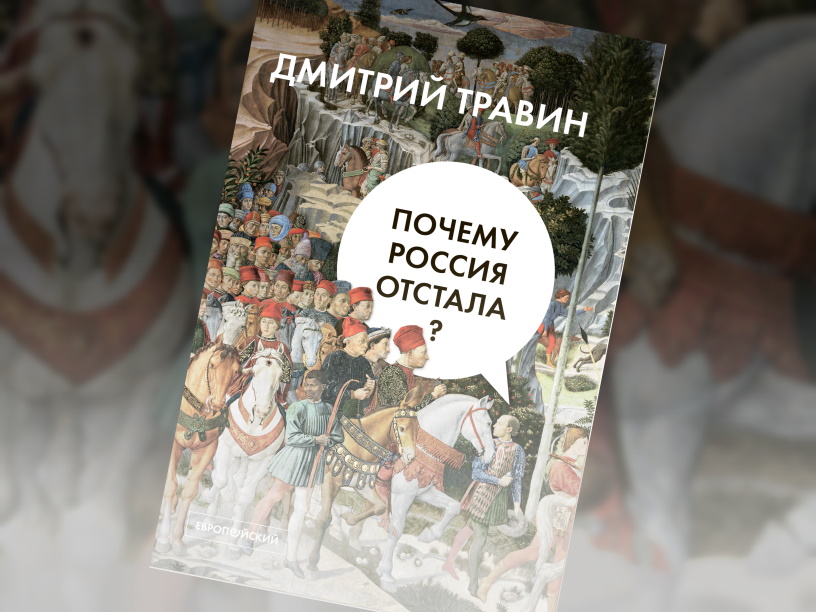
Publishing House of the European University in St. Petersburg is presented on the long list of Dmitry Travin's book “Why is Russia behind?” .
Answering the question of the success or backwardness of different countries, economists describe economic reforms, political scientists explore authoritarian and democratic regimes, and culturalists compare mentality of peoples. This book is written differently. It is a work in the field of science that is still unusual for our country - historical sociology. The book of Dmitry Travina, the scientific director of the Center for Research on modernization of the European University in St. Petersburg, will interest those who like to recognize and analyze numerous facts from the past different countries, including Russia. The author immerses the reader in history and reveals both bright and gloomy moments of the formation of European society. And most importantly - shows what place our country occupied in it from the earliest times.
We offer to read a fragment of the book.
The land of God and sovereign, and Rospash and rye are our
Stephen Pinker, who studied the evolution of violence in the world, showed that the power of the state, reducing the number of people who died from murders and wars, simultaneously increases the number of victims suffering from tyrants, priests and kleptocrates [Pinker 2021: 94]. A similar story happened with property. As the medieval state strengthened, the problem of robberies became less urgent. However, she was replaced by another - confiscation, which could easily be subjected to property. The concept of “confiscation” probably cannot even be invested in modern meaning, since the Middle Ages considered the seizure of property carried out by a person who is higher in the hierarchy under certain circumstances. The state defended the business with one hand, and the second robbed. More precisely, it, as a reasonable stationary bandit, sought to monopolize the right to robbery, while limiting its scale, so as not to cut the chicken that carries gold eggs. But it was far from always possible to limit, since the “demand for confiscation” was often determined not by rational considerations, but by the current need for money.
For many medieval cases of confiscation, the monarchs of those times watched with completely different eyes than we today. They believed that they have the right to take someone else's, since this is not a stranger in their understanding. As Aron Gurevich rightly wrote in the innovative book for Soviet times the book “Problems of the genesis of feudalism in Western Europe”, the medieval state possessed the features of a large lord, where economic relations are interwoven with power 1 .
In the Middle Ages, “an idea arose according to which the king is the owner of the whole land of his state. The sovereigns of the early Middle Ages were not alien to their kingdom as hereditary possession, they shared him between their sons, saw a patrimony in it. <...> However, the “property” of the king on his kingdom, of course, had nothing to do with the right of private property, it really deciphered as a “sovereignty”, that is, again, it was a lordic power over a vassal, a free peasant, a townspeople, clergy and other subjects ”[Gurevich 1970: 59–60].
Richard Pipes and his followers believe that only Russia was the patrimonial state [For more details, see Travin 2018a: 81–87], but in reality other states were built in a similar way. Many authors are talking about this. For example, Immanuel Wallerstein quotes Frederick Lane: “The feudal state was in a certain respect of the private property of the sovereign in the same sense that Feod was the private property of the vassal” [Wallerstain 2015: 59]. Well, the Roman dad looked at the matter even wider. In particular, Boniface VIII argued that the pontiff “rules the bodies and property of all Christians” [Voskoboinikov 2020: 78]. The Church of the “body and property” at the local level was examined in approximately the same. For example, the whole Milan was the household of St. Ambrose, where “sovereign power belongs to the archbishop, the successor of the saint,” and the Milan “serve as a sovereign in exchange for his protection” [Dubie 2015: 36].
However, the ideas that the state, diocese or seignor is a patrimony, went from above. At the same time, there were other ideas. Vassals, parishioners and peasants were sure that they had certain rights. Accordingly, the “estate” could not become the owner in the modern sense of the word, which Gurevich rightly said, but could realize his rights to the extent that he had real force and could overcome the resistance of various groups of interests - vassals who want to have more lands, peasants, striving to pay less taxes, churches competing with the monarch, who are competing in minimization, who are interested in minimizing minimization fiscal burden and maximization of urban freedoms, creditors hoping to return their loans to the crown.
In particular, Senor could take away and redistribute the earth. As the French memoirist of the XV century noted. Philip de Commander, powerful people regarding their vassals “act directly. They will say: “You will not obey and violate the Ommage that brought me”, and then, if they can - but this thing will not become behind them, they will take his property by force and let them go around the world ”[Comino 1986: 209]. Why could it be done? Not only because a strong man easily went to violate other people's rights, but also because the rights to property themselves looked completely different from now. Harold Berman noted that in the Middle Ages, “in fact, the land was not a nobody property, it was“ held ”in the hierarchy of“ holding ”, leading up to the king or to another higher lord” [Berman 1998: 296]. Egor Gaidar wrote: “Private ownership of land in the Roman or modern sense of the word in the Middle Ages cannot be. The land is considered to be their own, the redlasting rights of the king, and the count, the knight, the community, and the peasants have crossing it ”[Gaidar 2009: 196]. And Jacques Le Goff explained which of this the consequences arose: “Property as material or psychological reality was almost unknown in the Middle Ages. From a peasant to a lord, each individual, each family had only more or less broad rights of conditional, temporary property, usufruct. Each person not only had a gentleman or someone, who has a more powerful right, who could forcibly deprive him of the land, but the right itself recognized the legal opportunity for a lord to take away his land property from the equivalent, sometimes very remote from the seized ”[Le Goff 1992: 126–127].
A significant part of the lands in the Middle Ages did not have a connection with a specific person at all. These were communal lands. They were not divided between peasants, but used by them together. First of all, this concerned meadows, on which all members of the community and forests grazed cattle, from where they took firewood and building materials [Gurevich 1985a: 111]. In the German village of pasture from spring to autumn, individual peasants were at the disposal, the rest of the time - at the community [Kotelnikov 1986V: 479]. Another important function of the community was to regulate production, in which the rights of individual farms were limited. Say, in France, the community set unified dates for grape collection [Immortal 1986a: 111]. The non -fraud of the land “were actually if you use modern terminology, in collective or corporate, property of the local population” [Reynolds 1997: 111]. The rural community “energetically defended the right of collective property to these lands, resolutely stopping attempts by individual communitymen“ use communal lands for themselves ”[Udaltsova, Osipova 1985: 399]. Moreover, in some cases, for example, in Spain, community property could also be extended to mills. “Each neighbor was seen as a co -owner, and if the mill was sold, he received compensation for his share in this property” [Korsunsky 1976: 61].
The communal lands looked like draws, which gave rise to the temptation for strong people to drive peasants from them (to carry out enclosure). But the state sometimes protected the communitymen, contributing to the preservation of this type of property. So, for example, the British authorities came under Tudors [Semenov 1949: 98–151]. The French state also tried to impede the fencing, although it began to do this much later than English - from 1560 it was curious that in France the royal courts protected the peasants and competed with seanoral ships, favorable, respectively, to the lords. Apparently, the point was that the French king suffered from the power of his aristocratic subjects and was not averse to weakening them at least somehow. And besides, the peasantry whose rights were protected became a more stable tax payer. As a result, by the XVI century. “The heredity of the holds fixed by judicial practice was too firmly included in the custom so that it could be disputed” [Block 1957: 183–184, 248].
The arable land, unlike communal ones, was not used together. But even in this case there were exceptions. During the colonization of the new territories, part of the lands “was sometimes given to the temporary use of communitymen and opened them individually, and a year or two later entered the communal pasture for a period of 8-10 years” [Avdeeva, Barg 1986: 47]. These lands were not private property. Moreover, most of the arable land resembled private property, but only at first glance. In fact, it was not one, and this usually stem did not come from the economy, but from politics. More precisely, from the situation characteristic of the Middle Ages, when the peasant had no protection from strong and well -armed people. If you came to rob you, it was impossible to call the police due to the lack of both the police and the mechanisms of fast communication with the authorities. Yes, most likely, and because of the indifference of the authorities to such problems. If the community could not protect itself with collective efforts (as, say, in the film Akira Kurosawa “Seven Samurai”, where the peasants hire their guards), had to voluntarily go under the protection of the “security forces”, choosing a “rational” stationary bandit instead of a “unreasonable” nomadic one. This kind of practice was formed in the Roman era, called the patronage [Korsunsky 1985a: 78] 2 . And since after the death of the Roman Empire, the life of a peasant did not become safer, the desire to find a cartridge has not gone away. For the sake of patronage, “a small allodist gave his land ... in order to get it back, but already as a“ holding ”or“ lease ”” [Block 2003: 239].
“For a significant part of the“ relict ”free farmers there was such an atmosphere when to recognize himself as Villan of some lord to preserve his father’s put up, which meant to put him under the“ legal protection ”of the Lord at the cost of refusing personal freedom, ownership rights and, therefore, consent to bear the immeasurably heavier duties in his favor. "Judicial scrolls" contain many evidence of this kind of confession "[Barg 1962: 259]. “Already in the 9th century, if not earlier, (in England. - D. T.) it was considered the norm that each person has his patron - Glaford” [Gurevich 1985b: 289]. Similarly, the case was in Spain, where the peasants gave the land to the seniors, but stipulated the conditions on which they could further use their former plots [Korsunsky 1976: 113]. In the history of France and Germany, the practice of departure with its land was also observed under the protection of some strong master [Immortal 1985: 230; Milskaya 1985: 267, 270]. The whole situation was well stated with one figurative phrase Daron Ajemoglu and James Robinson: “To be free means to be a chicken among hawks, prey for predators” [Adjemoglu, Robinson 2021: 45].
In England, there were cases when, to recognize themselves, the Villans were not individuals, but entire groups of land holders and even entire communities. They went to this voluntarily and accurately. Often, the Yavka was preceded by lawsuits when the Lords started a lawsuit against obviously free holders, demanding that they recognize them with their villagers [Barg 1962: 260]. Villan, who went under the defense of the "security forces", probably believed that his ownership of the land should remain inviolable. The master has only the right to regular payments. However, the manor courts over time began to make decisions in favor of the lords. “In the XIV and XV centuries, they increasingly and less willingly recognized the heredity of Villanic hold” [Blok 1957: 183].
The Marxist idea that is familiar to our country is that, they say, the class of exploiters (feudal lords) as a whole imposed its will to the class of exploited (peasants), greatly simplifies the situation. A somewhat idyllic representation follows from it that in a society where the life and property of a common person is not protected by anything, a peaceful, well -maintained life of a free community would be possible, and only evil lords ruined everything. Seniors, perhaps, were really angry, but they played an important role, without which society could not function. The idea of the theoretical possibility of life without “exploitation” is akin to the idea of the golden age of mankind, which once existed in the distant past. In fact, the problem was not so much in the operation of one class to another as in the banditry of armed people and in the “raids” on free, but not protected workers, which is why they themselves were forced to go under patronage. Another thing is that the state ultimately encouraged the practice of patronage that has developed naturally and charged with the obligation to the peasants to subordinate to the masters [Korsunsky 1985B: 454].
As a result, a situation arose when the owner in the modern sense was neither the Lord nor the workers. Each side had its own rights, which differed depending on the balance of power and on the tradition that had developed in a country. Let us briefly consider the situation in different countries, including Rus'.
In medieval France, “peasant qualifications were legally considered the supreme property of the seignor and, on this basis, the peasants paid him the qualifications, banabers and court duties (where they were). The church or secular lord charged them from them. At the same time, the same quotities were the actual property of the peasants, who disposed of them at their discretion until sale, provided that the senor was paid special corrupt duties ”[Lublinskaya 1978: 118]. The court allowed the peasant, if necessary, to defend these rights [Immortal 1986B: 314]. Mark Blok explained the emergence of uniform peasant hereditary holdings (regardless of what legal category they belonged to) the action of custom, which for the Middle Ages meant much more than for our time. “This one who adhered to the traditions of the era lived in a thought, according to which only what was practiced for a long time had the right to exist” [Blok 1957: 120]. According to Blok, French lawyers hesitated for a long time, not being able to determine who the true owner is. But by the XVI century. They agreed that its holder is the owner of the earth. And by the XVIII century, this idea of property has already become a common place [Ibid: 184].
Things were in a similar way in Germany. In one of the main legal documents of the XIII century. -“Saxon Mirtsal”-it was noted that any land allotment, which is in someone's hands for one year and one day, is considered to be a peasant hold, if during this time no one introduced a legally justified objection. This provision meant that the feudal lord no longer had the right to deprive the holder of this land by his arbitrariness. True, according to the "Swabian mirror" a gentleman from the end of the XIII century. He could take the land from the peasant without trial, but only with the appearance of debt [Mayer 1979: 130–131].
The Spanish peasants (Solariagos) had significant rights to their land hereditary allotment. The state prevented the landowner from driving the tenant if the owner wanted to use it more efficiently. Spanish Fueros in the XI - XIII centuries. They fixed the size of peasant duties, and from some they liberated farmers. That is, the owner of the land did not have the right to receive from it that income that would be determined by objective market conditions. For example, according to Fuero Leon, the one who lives on a foreign land pays the owner (if it does not have a horse or a donkey) annually 10 wheat bread, shepherd of wine and one ham [Korsunsky 1976: 107]. If the peasant left the village, he could sell the land, but here the prevailing norms limited him. The buyer was to become either a lord or neighbors, that is, people of the same lord, which limited the seller in rights and, possibly, negatively influenced the price [Korsunsky 1976: 110; Varyash 1986a: 162].
But in England, things were different. According to the famous medieval lawyer Henry Brakonton, Villan had no rights to his property. All his farm and he himself belonged to the Lord. However, in real life, the relations of the Lord and Villan were often regulated by a manor custom. The farm was inherited by one of the sons of Villan, if he paid in a timely manner for the transfer of his rights to the master. If the transfer of land inherited in a certain situation is unprofitable for the lord, it was necessary to seriously press the peasant in order to take away the site from him and transfer to someone else [Barg 1986: 127–129].
In Rus', as in England, the master dominated. But he did not have absolute land rights. For example, if the peasant left, and then returned, he "had a legal basis (recorded by a normative act) in order to sit" in place ". In other words, the feudal lord in normal could not arbitrarily dispose of such, even a temporarily abandoned area. <...> The strength of the peasants to the earth was facilitated by the activity of the communities. The corresponding facts about the black volost-communal are well known: she vigorously defended her lands from the feudal lords (although often unsuccessfully), and sometimes tried to include allocation of lordic landowners who have passed in their composition ”[Cherepinnin, Nazarov 1986: 279–280]. Mikhail Pokrovsky noted that “when the Moscow peasant of the XV - XVI centuries was asked on whose land he lives, the answer was usually the answer:“ The land of the sovereign of the Grand Duke, and my possession ”or“ the land of God and the sovereign, and Rzpash and our rye ”” [Pokrovsky 2005: 26–27].
The Italian libel is a tenant of land. However, this was not at all the rent that is characteristic of a modern market society, where it is clearly known who is the owner and who is only a user of property. The lessee's drive from the ground was prohibited by the contract and, judging by the testimony of a number of sources, was difficult to do in practice. Therefore, if a person was a hereditary holder, he acquired quite strong rights to his site without even being the owner. Apparently, the libels often considered the rented lands their own, and it was necessary to specifically stipulate in the documents that this was not so. Lybellaria did not become the owners. In the urban statuses of Siena and Voltaurra, special paragraphs considered cases when Libellary had the land in holding for more than 30 years, but nevertheless was not recognized as the owner, although by Roman law a person became the owner of all property that he owned for so long. In different cases and in different regions, the specific ratio of the rights of the owner and the holder depended on their social status [Kotelnikova 1967: 238–246; Kotelnikova 1986a: 148].
Medieval lawyers were at an impasse and did not know how to explain the situation of the solid hereditary land ownership of the peasants from the point of view of Roman law and his doctrine of property [fairy -tale 1968: 128]. The modern English author spoke directly: “In England, there is no concept of“ absolute property ”(Ownership), only the lands included in the domain of the crown can be so defined, but any private person acts as a holder from the crown directly indirectly” [Cit. Kasatov 2019: 29]. Mark Blok generally preferred the question of property in this connection. He noted that “almost for centuries, all the trials associated with dominance above the ground or with the income brought by it considered the issue of not property, but Saisine (that is, possessions protected and legalized by tradition)” [Blok 1957: 184]. Gurevich also spoke about this: “The concepts of“ power ”,“ appropriation ”,“ ownership ”approach this relationship (feudal lord with a peasant. - D. T.) much more than the concepts of“ full ”or“ private property ”,“ supreme property ”,“ monopoly on land ”” [Gurevich 1970: 52] 3 . This opinion was shared by the English sociologist Michael Mann [Mann 2018: 566].
The Russian historian Andrei Kasatov, who devoted a whole monograph as a whole monograph, explains the question more specifically: “Property as something absolute can only be represented in the context of a judicial dispute, when there is only one person who can be awarded with the whole set of rights to it. Of course, in the conditions of feudal Europe, this was unlikely to be possible, but if you mean actual power over property and the extraction of rent, and not feudal services and payments, the system worked just that. <...> On the contrary, considering property as a certain set of specific powers, it must be admitted that absolute property in the form in the form was tried to present it by the novelists and civilists of past years, the same fiction as the theory of two actors in the textbooks of Roman law ”[Kasatov 2019: 240].
Thus, private property in the Middle Ages is the same fiction as “legal civilization”. European countries had to go a long and difficult path in order to ultimately form the property that makes an effective market economy. Moreover, it is not only about the earth here. There was any property conditional in the Middle Ages. The sovereign seized any property from a private trader, regardless of who owned them, if he considered it appropriate and had sufficient strength for this.
1. Gurevich’s scientific views did not go to the works of the classics of Marxism, revered in the USSR, but to the opinion of the classic of French mediastism Mark Blok, who wrote in the book the characteristic features of French agrarian history: “It would be completely wrong to see only the economic side in relations of the seignor and his subjects, no matter how important it is. Senor is a master, and not just the head of the enterprise. He has in relation to his holders political power, gains his armed forces from them if necessary, and extends his protection to them as compensation ”[Blok 1957: 121]. During his monograph, Gurevich was stiffly criticized in Soviet times [Gurevich 2004: 146–173, 176].
2. Another option for the emergence of conditional property in Rome is Prekarii. A small farmer (Prekerist) worked on a site received from a rich owner. He, as a rule, at any moment could regain the land back. But already in the 4th - 5th centuries. n. e. PROKEN Holding became long, in some cases - lifelong. There were decisions of church cathedrals that the duration of use does not provide property rights. From this we can conclude that the Prekerists had an idea that the Earth belongs to him [Korsunsky 1985a: 77]. But in fact, she did not fully belong to either the owner or the employee.
3. Some authors believe that such a state of affairs was characteristic only for Russia, where the so-called power-ownership existed [For more details about these theories, see Travin 2018a: 143–144]. But in fact, the history of this concept speaks completely different. He was introduced into the circulation by orientalist Leonid Vasiliev in 1982. If he carefully read his article, it will be found that he had in mind not at all what the authors say about the fundamental difference between the East and the West. Vasiliev noted that in almost all ancient societies, the Supreme Leader “assigns and realizes the right to grant the lands” [Vasiliev 1982: 83]. This is the phenomenon of power-performance. And private property is formed only on this base. Everywhere (except ancient Greece and, perhaps, dates), it arises as a result of such awards [Ibid: 88]. Thus, it is impossible to say that power-ownership is the phenomenon of only eastern societies. But both in the east and in the West, the redistribution of the Earth can subsequently occur. And here, according to Vasiliev, the cardinal difference of two types of societies arises. “Relations of redistribution in Europe were structurally secondary” [Ibid: 91].
What does it mean “secondary”, he really did not explain. Apparently, it was meant that in the West the owner more often retained his rights, which lost them as a result of the arbitrariness of the ruler. It is unlikely that we have a sufficient number of sources to conduct accurate quantitative assessments of “redistribution” in all ancient and medieval societies.
However, if we are not interested in the historical picture of the past, but the possibilities of modernizing different countries, then such an assessment will not be needed. Indeed, in order to prevent economic development, it is not necessary to take the property from the vast majority of people. It is enough to create an idea in society that the property of a person is not protected by law and can be taken away for some kinds, or even simply by the arbitrariness of the leader. In such a situation, there is a massive fear of loss of property, which means that the desire to “hide”, “do not lean out”, “take off the assets”, “go into the shadow”. In modern Russia, which supporters of the theory of power-performance belong to the eastern type of societies, redistribution from a formal point of view is secondary. Most of the owners do not lose property as a result of rude “raids” or passes it to the other owner voluntarily (for ransom). But such insecurity negatively affects the economy. Similarly, the situation was in almost all countries of Europe in the Middle Ages. The “secondary of the redistribution” turned into the nevertheless large -scale seizures of property, which significantly inhibited the development.
Earlier, in the “Slow Reading” section, the following books were presented, included in the long list of the Polit.
Lev Gudkov. Refusal totalitarianism . In 2 volumes-M.: New Literary Review, 2022.
Ilya Zhegulev. The course of the king. The secret struggle for power and influence in modern Russia. From Yeltsin to Putin. - M.: Howard Rork, 2022.
Karin Cleman. Patriotism from below. “How is it possible for people to live so poorly in a rich country?” - M.: New Literary Review, 2021.
Ivan Kurill. Battle for the past. How politics changes history. - M .: Alpina Plisher, 2022.
Evgenia Lesin. XX century: study of the past. Practices of transitional justice and memory policy in former dictatorships. Germany, Russia, countries of Central and Eastern Europe. - M.: New Literary Review, 2021.
Mikhail Fishman. Successor. The story of Boris Nemtsov and the country, in which he did not become president. - M.: Corpus, 2022.