
Translated material
The last bet
The Bank of Russia reduced the key rate by 0.5%. But perhaps there will be no more decrease
A rare coincidence of expectations
The Bank of Russia bears the reputation of the most unpredictable Central Bank in the world. A year ago, an article by Russia's CBR: Predictactably Unpredictics, in which the Russian Central Bank was called "predictably unpredictable," was published in JP Morgan Economic Research Note. This is not just a vivid image - in 2021, analysts on average were mistaken in the forecast of the decision of the Central Bank of the Russian Federation at a key rate of 15.46 basic point.
And in 2018, the IMF, in his report, Challenges to Steady Growth noted that during the period 2010-2018 “unexpected for markets” were 27% of the key rate adopted by the Bank of Russia.
In fact, the unpredictability of the behavior of the financial regulator indicates the problems in the economy: either the market does not understand the signals of the Central Bank, or the regulator deliberately misleads the market.
Or the economy storms so that entrepreneurs, analysts, exchange speculators, bankers and ministers have no consent in the issues of “who is to blame” and “what to do” - and then the Central Bank has no time to look for a consensus with the market: he makes decisions based on his vision of the situation and on the phrase “surprise acts stunning”.
But in this case, what happened to happen: the market analysts were waiting for a decrease in the key rate by 0.5% - and the regulator met their expectations. This is a positive signal to the market as a whole - it means that economic entities and a financial regulator are “looking in one direction”.
However, not everything is so simple.
Hard consequences of soft policy
It is often said that “mitigation of the monetary policy of the Central Bank”-and it is expressed through a sequential decrease in the key rate-can contribute to economic growth. The lower the key rate, the softer the conditions for loans. Yes, a person who is borrowing to a salary will not help a person who is leaving to a salary, the rate of the state oligarch is also indifferent - he will receive a loan on his conditions. But for the market as a whole, a reduction in the rate is an important signal: the Central Bank shows that it does not see large risks of prices and offers to propose and take loans more actively.
The rate below - loans are more affordable - more money in the economy is more - take and develop at least production, at least consumption. Below the rate - there will be GDP growth, above the rate - there will be no growth.
Not quite so, the economist will say. It only seems to you that a decrease in the rate is equivalent to economic growth. Everything is a little more complicated.
Monetary policy (DCP) is generally neutral regarding the dynamics of potential GDP, that is, it cannot be steadily affected by it. Now, if the economy is growing below its potential - yes, the softening of credit conditions can spur business, and if the market overheats, in this case, a tough DCP, with an increase in loan rates, helps to avoid market bubbles. By increasing the rate, the regulator, as it were, tells the market participants: do not rush, be careful in turning. But the decrease in the rate in itself will not force the economy to "grow."
You can give anabolic steroids to a person lying on the couch, but this will still not make him athletes.
But the soft DCP, if it does not contribute to the growth of the economy, it probably contributes to the increase in prices - and in many studies it is shown that with high inflation, the potential growth of the economy slows down.
High prices instead of cheap loans
September ballot "What the trends are talking about. Macroeconomics and markets ”, prepared by the Department of Research and Forecasting of the Central Bank of the Russian Federation, was almost entirely devoted to explaining why the soft monetary policy (it is evidenced by a decrease in the key rate)-or the medicine that the Russian economy needs.
Firstly, the analysts of the Central Bank of the Russian Federation explained, inflationary pressure did not go anywhere. Yes, in July 2022, annual inflation dropped to 15.1%. Yes, Rosstat reports that prices are not rising and even decreasing, but this is not “deflation”, but just adjustment: after the manufacturers and retailers sharply raised prices in March-April, they encountered a decline in sales, and as a result of the price tags, they had to rewrite. Plus, a seasonal decrease in vegetable prices played a large role - food costs occupy such a significant part of the budget of Russians that the cheaper potatoes and cabbage pulled down the consumer price index.
In addition, cheap loans contradict the idea of import substitution, explains the Department of Research and Forecasting of the Central Bank of the Russian Federation:
“Functioning in their niches that do not intersect with imports, Russian manufacturers can expand them. But this will give the result only on condition that buyers and consumers are ready to change their preferences and go to a new niche for themselves. ”
How will you buy Russian if you have money for imported? This is the essence of the “structural transformation” of the economy, which involves the development of production in industry niches, previously engaged in foreign business.
Now these niches are released, the regulator explains, and
“The lack of competition makes projects for the production of such goods obviously payback: if there are no analogues, the manufacturer can easily cover their costs through the price. Therefore, the cost of servicing loan funds to finance investments is not a critical factor for making a decision on production. ”
Let the buyer pay for everything.
The problem of the Russian economy is not in the accessibility of the loan, but in something else.
What exactly?
Prices are reduced, but no
So far, prices can continue to decrease: according to the updated forecast of the Central Bank of the Russian Federation, annual inflation will be 11–13% in 2022, and taking into account the monetary policy, will decrease to 5–7% in 2023 and will return to 4% in 2024.
But the reason for this will not be no longer a key rate, but people's tendency to savings “in conditions of general economic uncertainty, the duration of addictive to the new structure of the offer in the consumer markets, as well as expectations of further reduction in prices from the beginning of the year of strengthening the ruble.” An additional factor in price reduction can be a good crop of agricultural products in 2022, explained the central in its release dedicated to the key rate.
However, in the future, the regulator warned of a new threat of inflation:
“Significant dialogue risks can create further strengthening of external trade and financial restrictions. They are able to lead to more than expected in the basic script, reducing the potential of the Russian economy. Restrictions on the side of the proposals may, in particular, increase due to problems with the supply of equipment, slow replenishment of finished products, raw materials and components in case of enhancing negative trends in the dynamics of imports. In turn, the implementation of the growing risks of the global recession can additionally weaken the external demand for Russian export goods and, as a result, lead to a weakening of the ruble. ”
What "basic scenario" are we talking about?
The “Basic Scenario of the Development of Economics” was set out in the Bank of Russia project “The main directions of the Unified State Monetary Policy for 2023 and the period 2024 and 2025, published in August 2022.
According to the “Basic Scenario”, in 2022 and for most of 2023, the economy of the Russian Federation will decrease, adjusting to the changed external conditions. In 2025, the economy will return to a potential growth rate of 1.5–2.5%.
But if the economy goes along another trajectory, GDP in 2023 will decrease stronger than in 2022. In 2024, the fall will continue, and only in 2025, according to the Central Bank of the Russian Federation, is a low growth - about 1%.
That is, the regulator sees serious risks for restoring the economy and hints that they will be associated with the consequences of sanctions restrictions.
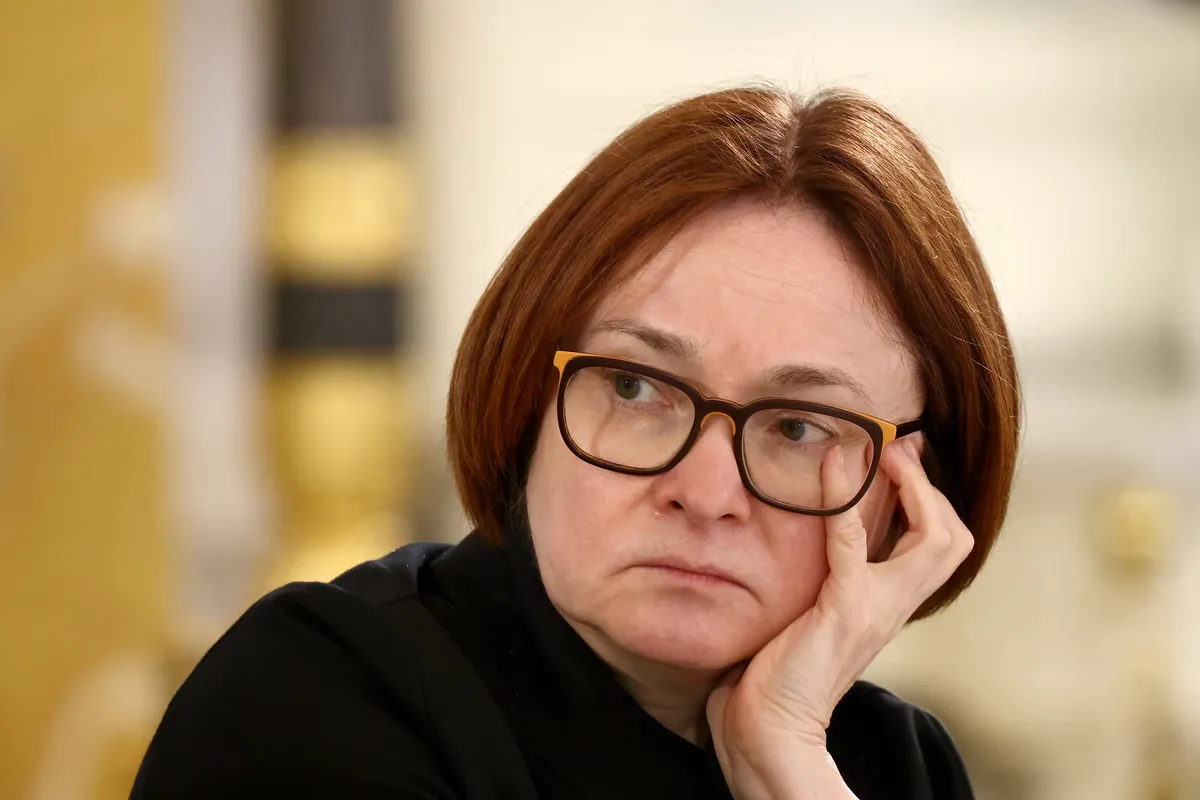
Anxiety Elvira Nabiullina
But external restrictions are not all. In addition, Elvira Nabiullina recalled at her press conference,
“We believe that the structural restructuring of the economy will be accompanied by acceleration of prices, despite certain periods of their correction. This is an important circumstance on the basis of which we predict inflation above the target next year and which we take into account when pursuing monetary policy. ”
And why will the structural restructuring of the economy be accompanied by rising prices? We recall the phrase from the Bulletin of the Central Bank of the Russian Federation “What the Trends are talking about”:
“Lack of competition makes projects for the production of such goods obviously payback: if there are no analogues, the manufacturer can easily cover their costs through the price.”
Want to “buy Russian” - be prepared to pay more, reminds the regulator. What did you think?
People, by the way, understand this perfectly. As the head of the Bank of Russia said:
“We are worried that the inflationary expectations of the population remain at elevated levels and even increased slightly, despite several months of decreasing the general price level. This was not observed in the previous periods of slowing down inflation, for example, in 2019. ”
People do not believe in reducing prices - and this is an important recognition of the leadership of the financial regulator.
The dynamics of the economy and inflation largely depends on the decisions taken in the field of budget policy, the release of the Central Bank of the Russian Federation says. That is, the budget becomes the main driver of the Russian economy in the current conditions, or rather, its expenses. “In recent months, budget expenditures are growing an accelerated pace. It can also create dual flation effects, ” the chairman of the Bank of Russia recalled.
And the most important thing in the current release of the Central Bank of the Russian Federation is the lack of a signal about the regulator plans to reduce the rate. Together with the words of Elvira Nabiullina that the rate of reducing the rate is most likely close to completion, this allows us to conclude that in the near future we are waiting for the increase in prices and the lack of growth in GDP.
The Central Bank is always right? More likely
Question: Is it possible to trust the forecasts of the Bank of Russia about risk growth for the economy, while the government looks at the situation much more optimistic?
It seems that the Russian financial regulator really "knows about the market something that everyone else does not know." This is not an inside and not secret knowledge, but what is called an information advantage.
In August 2022, specialists of the Department of Monetary Policy and the Department of Financial Stability of the Central Bank of the Russian Federation published a study “The role of communication and information factors in the occurrence of surprises of the DCP of the Bank of Russia”, which analyzed who better predicts inflation-market analysts or the central bank. As a result, the authors of the study concluded that the Central Bank of the Russian Federation really owns additional information about the situation in the economy, which, according to the market, allows it to predict inflation more precisely.
Therefore, let us surprise us and do not upset the forecasts of the regulator - they know what we may not know better.