
Translated material
For the first time in 40 years, China opened a new mineral of lunar origin. But it's not exactly
Outside the country, no one knows about this mineral
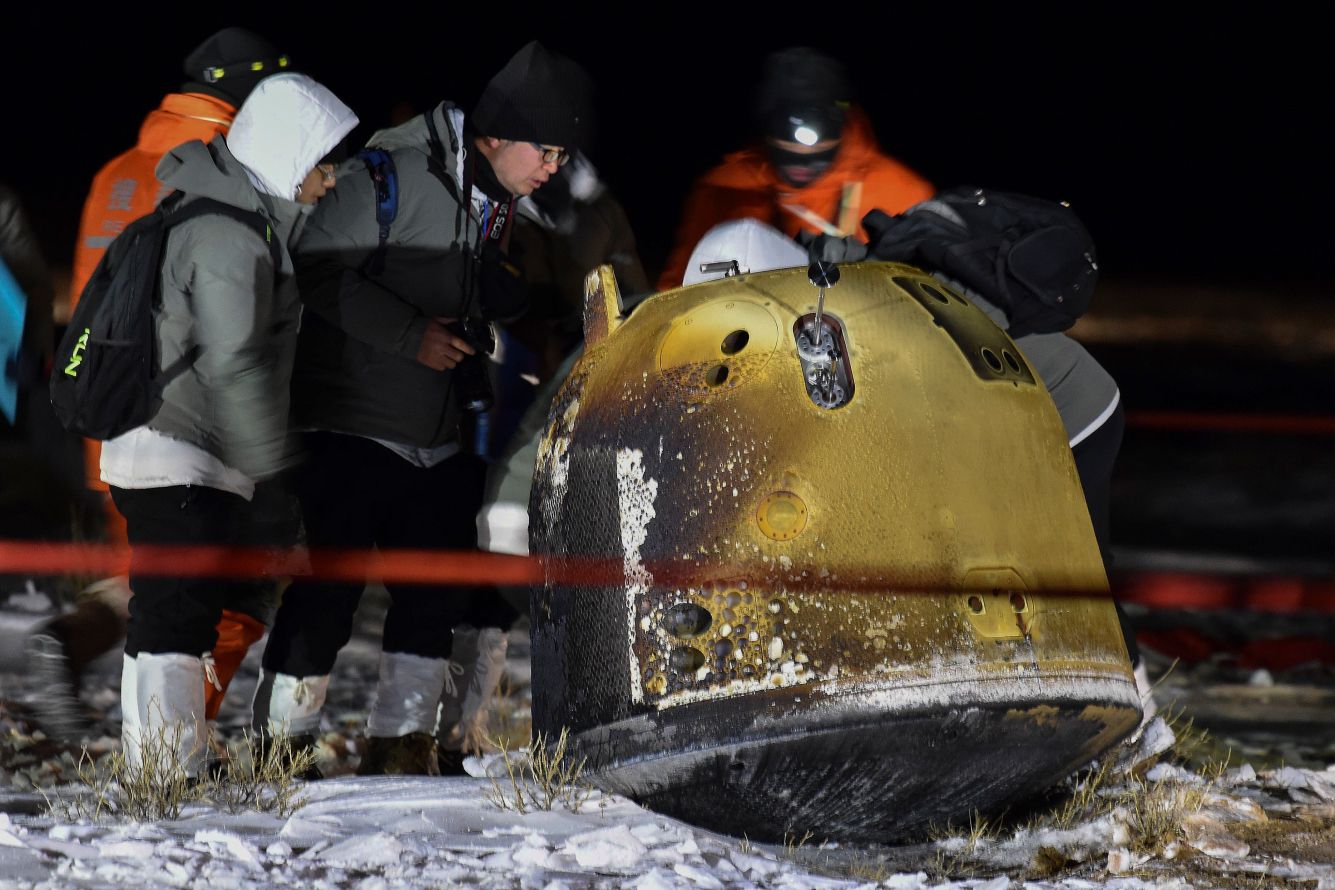
The Chinese State Information Agency "Sinhua" announced the discovery of scientists from the Beijing Research Institute of Geology of Uranus (BRIUG) of the new lunar mineral. It was called Chaneizite (y)-by the name of the spacecraft that delivered the mineral to the ground. The apparatus-“Chan-5”-in turn, is named after the Chinese deity of the moon .
Scientists managed to find a new mineral in a sample of lunar soil, which Chane-5 delivered to the ground from the ocean of storms at the end of 2020. From this material - 1.7 kilograms of the regolith - Briug for research went to a very small part, only a few tens of milligrams. For two months, the members of the research group manually crossed and studied 140 thousand microscopic particles, which were in a 50-million lunar sample.
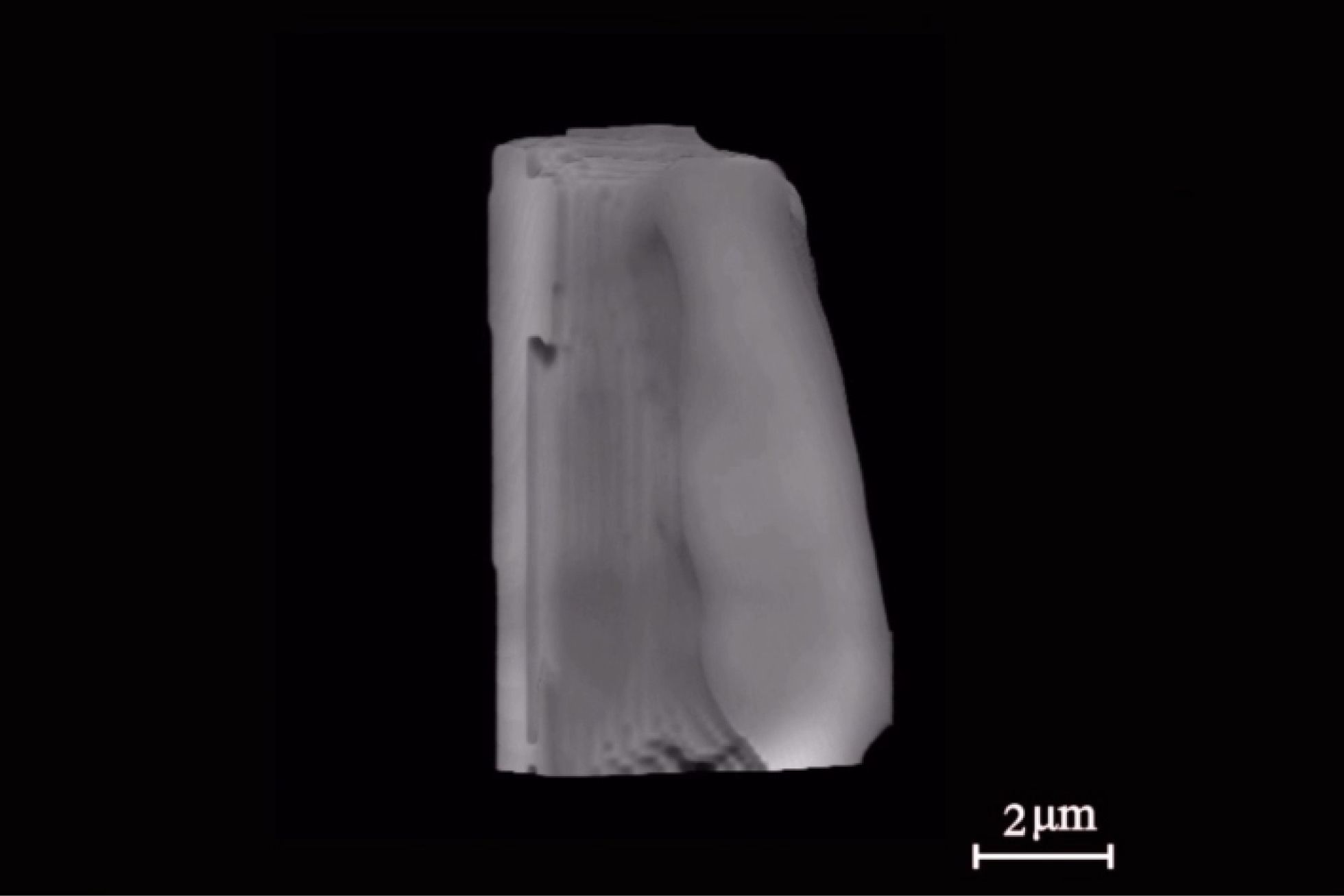
A mineral discovered by researchers is a crystal size of 10 by 7 by 4 micrometers (that is, its length is a hundredth fraction of a millimeter). But, despite the tiny size, scientists managed to determine the atomic structure of the crystal and prove that it can be a representative of a new type of minerals. "Xinhua" accompanies its message by an image of a crystal made on a scanning electronic microscope.
The opening of a new mineral has yet to be confirmed
After many years of studies of lunar soil, which was delivered to the ground by the mid-1970s by American "Apollo" and Soviet "Moon", scientists identified approximately 90 minerals that are part of the lunar substance. However, the vast majority of them at the time of identification have already been found in earthly samples, so they cannot be called "purely lunar."
There were only three exceptions at first: pyroxeritis and tranquivititis silicates (named after the sea of calm ), as well as Armolcolite (an oxide named after the first letters of the names of the Astronauts Nile Arm Strong, Bazza Ol Drin and Michael Kol Linza). Over time, however, even these “purely lunar” minerals were found in earthly samples - the last of them in 2012 was Transvility.
According to the Sinhua report, the Chaneazit mineral has already been registered by the International Mineralogical Association and was included in the Nomenclature and Classification Commission in the list of new minerals. Nevertheless, in the latest renewal of the classification released on September 14 - after the announcement of the opening, there are no data on the new mineral. Meduza also failed to find the mention of Chanezit either in the bases of scientific publications and preprints, or in the largest mineralogical base mindat.org . Accordingly, there are no additional details about the chemical and isotopic composition of the mineral, about its crystal lattice and other mineralogical parameters.
The study of lunar soil is only part of the ambitious Chinese mission to master the moon
The Automatic Chan-5 Automatic station, thanks to which Chaneizit got to the ground, went to the moon on the Changzhen-5 rocket launcher from the Wennan cosmodrome on Hainan Island in November 2020. The launch was the first after a 40-year break in the mission for the collection and study of lunar soil.
However, Changzhen-5 is not just a lunar soil collector, but a part of a large and ambitious lunar program developed by China in the early 2000s. It is aimed at developing lunar resources , including minerals (which, in the current message, Sinhua is additionally emphasized by the mention of the candidate for thermonuclear fuel of Helia-3).
The first, as part of the Chinese program, the orbital apparatus of Chan-1 (2007) and Chan-2 (2010), which performed the global photography of the moon for its mapping, sent to the Chinese program. The second stage of the program completed the landing in 2013 in the lunar bay of the rainbow of the Chan-3 apparatus with the Lunost of Yuita. At the same time, the understudy, Chan-4, also made a soft landing on the back of the moon on January 3, 2019, in the crater von Karman. The main goal of that mission was the development of an automatic soft landing - a step to the third stage.
This step was the flight of Chan-5. The lining scheme of the apparatus largely repeated American lunar missions, but with two important differences. The main one was that the flight took place in fully automatic mode. This made it possible to make a mission significantly more “compact” and cost a lighter launch vehicle. The second (not technical, but substantial) difference between the mission is also important and is related to the choice of landing site.
“Chan-5” got its samples in the region, geologically unlike the areas of landing “Apollo” and “Lun”. The Chinese apparatus landed and made a fence of the soil near Mount Ryumker, which is located in the north-eastern part of the ocean of storms. There are approximately 20 volcanoes surrounded by the fields of young lava - its age is 1.2–1.5 billion years. These are the latest volcanic rocks, which, in principle, can be found on the moon. After all, mass volcanic activity on the satellite ended much earlier - about three billion years ago.
It is reasonable to assume that a rather unusual landing place is the most important element of success when looking for something really new in mineralogically on the moon. However, this is just an assumption. At least at least confidently talking about the properties and features of Chanezit will be possible only after the publication of a full-fledged scientific article with its description. In the meantime, outside the Chinese state media, no “traces” of the new mineral can be found.