
Translated material
What will happen after the defeat near Kharkov
The Russian authorities and the wire community for the whole week comprehended the failure of the Armed Forces of the Russian Federation near Kharkov and the intensified shelling of the border Russian territories and closely monitored the movements of the Armed Forces of Ukraine, trying to guess the direction of the new Ukrainian strike. Disputes about the possibility of partial mobilization in Russia were aggravated in the public plane, but the Kremlin is so far ready only for hidden and dosed mobilization by the forces of Ramzan Kadyrov and Evgeny Prigozhin.
What's happening
On the final newsletter last Friday, we wrote that the Ukrainian offensive in the Kharkov region could be the first truly large operational success of the Armed Forces from spring-and the very next day it became clear that this success took place: the Russian troops left almost the entire Kharkov region. The media following the President of Ukraine Vladimir Zelensky write about 8000 square meters. km of the liberated territory, which is approximately equal to the entire promotion of Russian troops since the beginning of summer.
From a military point of view, it is more important that the Russian Armed Forces lost the main line of supplying the northern flank of the front (Volchansk - Burluk -Khunsk), went to the borders of Russia in almost the entire Kharkov region, and also left raisins, thereby having lost a favorable position for the offensive in the Donbass - to Slavyansk and Kramatorsk.
This week, an operational pause continued at the front with the relative stabilization of the situation: both sides equipped positions. The Russian troops managed to stop the advance of the Armed Forces, holding the city of Liman in the Seversky Donets and not allowing a flank offensive along the eastern coast of Oskol, as well as on Kremennaya and further to Severodonetsk and Lisichansk. But these directions remain promising for the onset of the Armed Forces of Ukraine, as well as a probable direct blow from the west to Kupyansk, which the parties were divided in half along the Oskol River flowing through the city center.
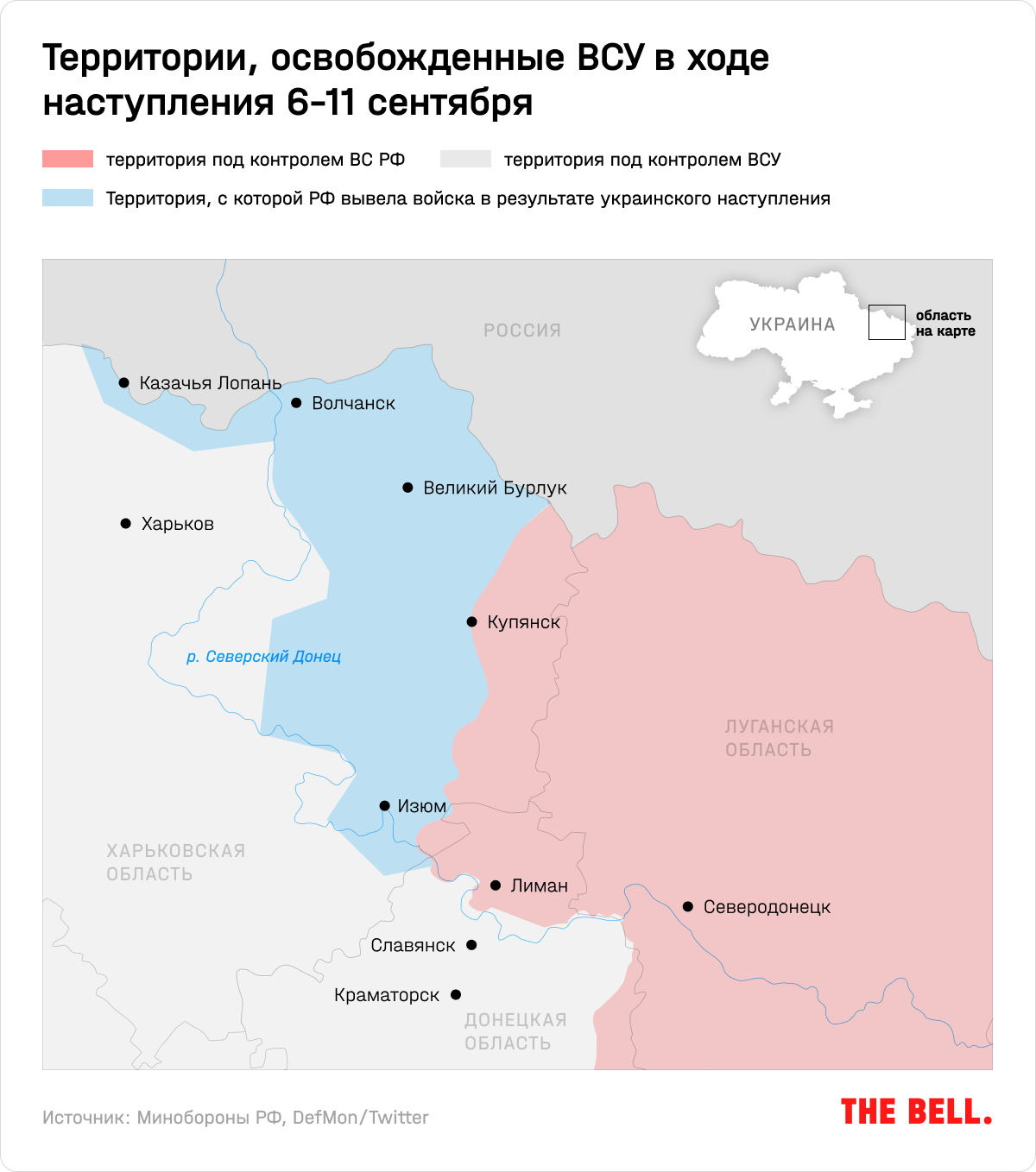
On Friday evening, first there were reports that part of Kupyansk on the east coast of Oskol, which was controlled by the Russian Armed Forces, was left, after - that the attack was repelled. There is no official evidence of either one or the other.
Another important news was the strengthening of mutual attacks on civil infrastructure. In the past Sunday of the Armed Forces of Russia, the blows of winged missiles were partially disabled TPP-5 in Kharkov, as well as the TPP in neighboring cities. From the blows on the energy infrastructure of large cities, the Russian military still abstained (but even after Sunday such blows were not repeated). In the week , the Damchunsky reservoir on the Ingult river in Krivoy Rog was also shelling. This supposedly allowed to demolish several crossings of the Armed Forces and cut off part of the forces in the Kherson direction. Ukraine responded with the strengthening of shelling of border settlements in the Belgorod region ( 1 , 2 , 3 , 4 , 5 ), the culmination of which on Friday was a powerful blow to the city of Valuyki with damage to the substation, as a result of which it was left without electricity. Also, the Armed Forces of the Armed Forces inflicted a missile blow to the administration of the occupied Kherson; On the same day, as a result of the explosion in the building of the Prosecutor General of the LPR in Lugansk, the prosecutor of the unrecognized republic was killed.
On Friday, Vladimir Putin commented on the Ukrainian counter -offset (“flag in your hands”), and Russian strikes at the Ukrainian CHP (“recently, the Russian aircraft inflicted a couple of sensitive strikes. We will assume that these are warning blows”), and the possibility of negotiations with Ukraine (“Mr. Zelensky publicly announced that he was not ready and did not want to talk with Russia. Well, not ready”.
Consequences
Some Western military experts, not excluding and restrained in assessments, are called the success of the Armed Forces of Ukraine under the Kharkov potential turning point of the war, indicating the interception of Ukraine, if not strategic, then operational initiative. The Wall Street Journal directly compared it from the consequences of the withdrawal of troops from under Kiev at the end of March, after which Russia had to abandon the capture of all eastern Ukraine and confine himself to the offensive in the Donbass.
The loss of initiative is almost the worst option for the warring side, especially if it fights on the long front, not having numerical superiority, like Russia in Ukraine. The side that owns the initiative can choose the direction of the next blow that has lost it - only react, spraying the reserves, and hope to turn the situation into their favor.
The political significance of what happened to Russia and the world is very great. “The losses force partners, allies and buyers of Russian weapons to overestimate relations with Russia, and many are in private are amazed at the losses of Moscow,” writes the same WSJ. “The reputation of Russia has been struck by a serious blow. The fact that she stalled in Ukraine makes us think what this country actually represents, where it goes and how important the power will remain on the global stage, ”the edition of Thomas Graham, the director of the Russian SNB of the United States at Bush Jr., quotes.
But there are more cautious comments. The success of Ukraine is not in doubt, but it is too early to talk about the fracture, and Russia is not defeated at all, the former commander in chief of NATO in Europe James Stavridis wrote in Bloomberg. Moreover, it is now that you can wait for the escalation of the conflict, says a retired admiral: Russia can now go to the destruction of civil infrastructure and the carpet bombing of cities.
NATO Secretary General Jens Stoltenberg in an interview with BBC on Friday said that under Kharkov, Ukraine not only conquered significant territories, but also struck the operational depth, and this “extremely inspires”. “But you need to understand that this is not the beginning of the end of the war: you should prepare for a long struggle,” he stated. A similar opinion is held in Washington, writes The Washington Post. It reminds that Russia has largely retained military potential, and predict the “nonlinear” development of the situation with fierce battles for intercepting the initiative in the fall and the onset of winter lull without prospects for negotiations of the parties.
What are the problems of Russia
If you leave the issue of motivation beyond the brackets, then the main problem of Russia, which continues to wage war as a “special operation”, is the lack of prepared personnel, experts say. “Turbopatriots”, which become increasingly noticeable power in the media space, require at least partial mobilization. This week, for example, the statements of the ex-minister of defense of the DPR Igor Strelkov had to comment on Dmitry Peskov for the first time. And the most discussed theme of the week was a video in which a person who looks like Evgenia Prigozhin recruits prisoners in the Wagner PMC to participate in the war (this is far from the first such message, but the video appeared for the first time).
The topic of mobilization last week for the first time began to actively comment on people close to power. Gennady Zyuganov said that the “special operation” has already grown into a full -scale war with the West, so it was necessary to conduct a “maximum” mobilization (as then specified in his party, it was about the mobilization of resources, not the population). Several governors (in particular, the heads of the border Kursk and Voronezh, as well as the Magadan and Kemerovo regions) supported the calls of Ramzan Kadyrov about “self -mobility” in the regions.
On Friday, the British Ministry of Defense paid attention not only to the next (this time with a video) a recruiting message, but also for the early release of cadets of Russian military schools. The latter means that the deficit is not only ordinary, but also the junior officer.
The Russian authorities of mobilization (which Ukraine has already conducted) clearly fears. Dmitry Peskov, in response to the statements of deputies and governors, said that the opportunity to declare full mobilization is not considered, and urged critics “to be neat” and observe the “very, very subtle facet of pluralism”. But, even if she got on the agenda, mobilization will not solve the issue of preparing troops quickly.
Other problems of the Russian Armed Forces - insufficient saturation with anti -tank weapons, drones, means of communication and high -precision means of damage - are important, but fade against the backdrop of deep defects in strategic planning and interaction at the tactical level. “The Ukrainians demonstrated two most important qualities during the offensive,” writes James Stavridis. - The first is the ability to simultaneously offensive operations on a wide front - which the Russians could not. The second is a wonderful organization of interaction between the military of the troops: infantry, artillery, tanks and tactical aviation. And again, the failures of the Russian army are obvious here. ”