
Translated material
"It is not a fact that there will be mobilization, but they have already introduced the law." What is written in the amendments to the Criminal Code adopted today by the State Duma
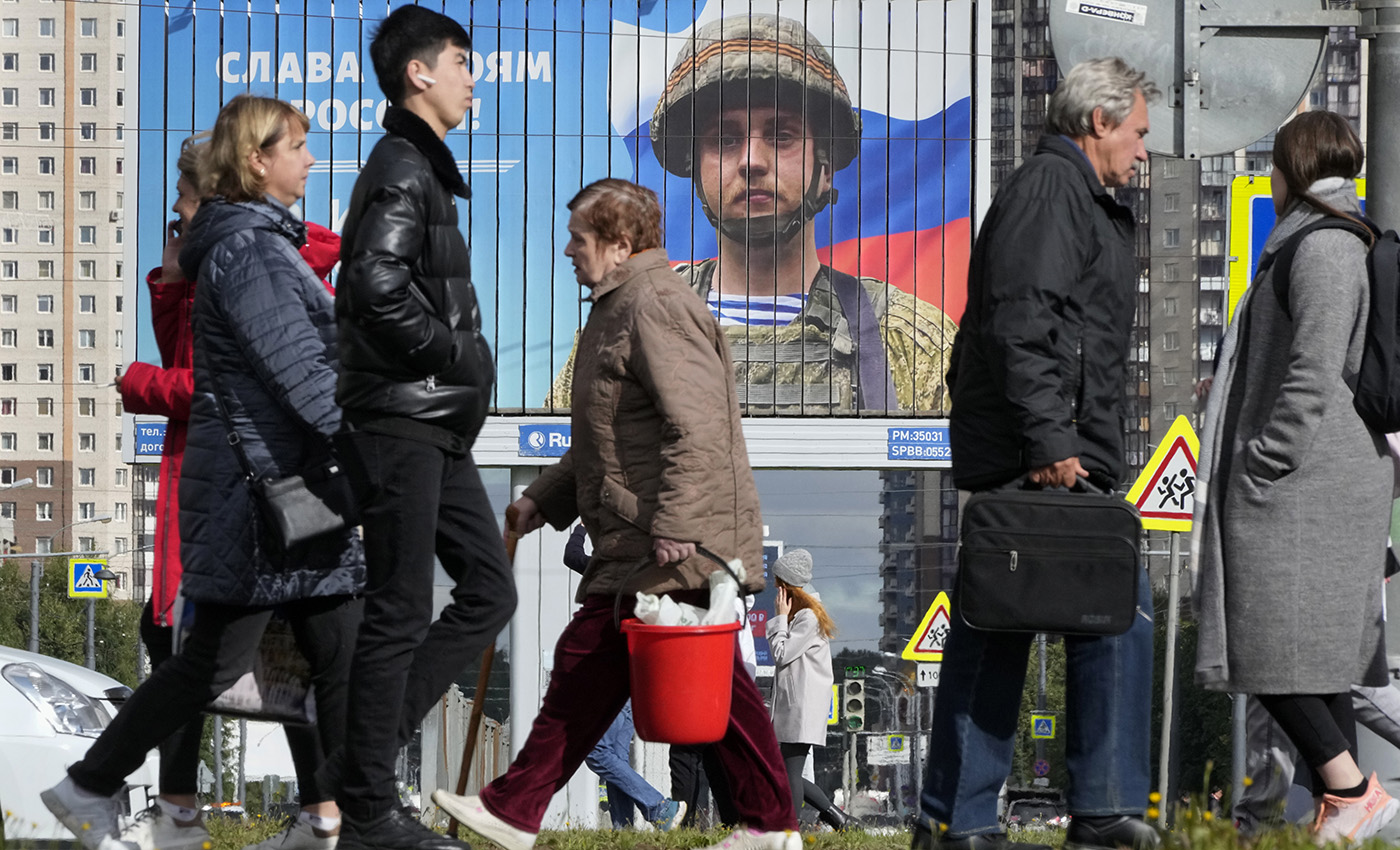
Photo: Dmitri Lovetsky / Ap
State Duma deputies adopted today in the second and third reading a bill introducing such concepts as “mobilization”, “martial time” and “wartime” in the Criminal Code. The Mediazona carefully read and legalized this document.
Mobilization and martial law as an aggravating circumstance
In the current version of the Criminal Code, an aggravating circumstance is considered to be “committing a crime in an armed conflict or military operations” (paragraph “L” of part 1 of Article 63 of the Criminal Code).
The authors of the amendments replace this formulation of another, wider - "during the period of mobilization either martial law, in wartime, or in the conditions of armed conflict or conducting hostilities."
Articles of the Criminal Code on military crimes were supplemented and tightened
This new wording - “during the period of mobilization or martial law” - deputies included in many articles of chapter 33 of the Criminal Code, which refers to crimes against military service.
Article 331 of the Criminal Code states that crimes against military service are crimes "committed by military personnel undergoing military service on conscription or contract, as well as citizens who are in reserve during their military training camps." Thus, chapter 33 of the Criminal Code does not apply to conscripts and people who are in stock - until they are called up for service or fees.
Article 331 of the Criminal Code. The concept of crimes against military service
The authors of the amendments propose to recognize as if to recognize Part 3, according to which the responsibility for crimes against military service, committed in wartime or in a combat situation, is determined by the "wartime legislation."
“There are separate ones, but they decided to go the other way: to the usual Criminal Code to make changes now that the fighting, that is,“ special operation ”, are also considered. They simply prescribed now in every article that they changed: “In conditions of hostilities,” says Maxim Grebenyuk, the lawyer and creator of the Military Ombudsman project. - It is not necessary to wait for the war. It is not a fact that there will be mobilization, it is not a fact that there will be martial law, they have not yet decided. But they have already introduced the law - in short, they immediately killed all the hares. ”
Article 332 of the Criminal Code. Failure to fulfill the order
The article was complemented by two new parts.
Part 2.1 - on non -fulfillment of the order “during martial law, in wartime or in the conditions of armed conflict or conducting hostilities”, as well as the refusal “from participating in military or military operations”. Punishment - from two to three years in prison.
Part 2.2 - for failure to fulfill the order to wartime, which caused significant harm to the interests of the service or committed by a group of persons, can be sent to the colony for a period of three to 10 years (now the maximum punishment under Article 332 of the Criminal Code is five years).
Article 333 of the Criminal Code. Resistance to the boss or coercion to violation of military service duties
The article was complemented by part 3 - for crimes "committed during the period of mobilization or martial law." Punishment - from five to 15 years in prison (so far the maximum punishment under this article is eight years).
Article 334 of the Criminal Code. Violent actions against the head
In this article, a similar part 3 will appear - about crimes during the period of “mobilization or martial law”. According to it, the military can receive from five to 15 years in prison (now according to the second, more severe, part of this article give up to eight years).
Article 337 of the Criminal Code. Unauthorized abandonment of part or place of service
The punishment is tightened: from two to 10 days of absence - up to five years in prison (now until up to a year); from 10 days to a month - to seven years in prison (now up to three years); More than a month - from five to 10 years in the colony (now the maximum punishment is five years).
In the note to the article there was a clarification: now it applies to men who are in stock and called up for military training.
Article 338 of the Criminal Code. Desertion
Part 3 is also added - for desertion in the "Mobilization or Martial Law period" can be obtained from five to 15 years in the colony. So far, the maximum punishment under this article is 10 years.
Article 339 of the Criminal Code.
We are talking about a military crime - this is an article for those who are already called up for service or fees. (Article 328 of the Criminal Code) does not apply to military crimes; The authors of the "mobilization" bill ignored his attention. Thus, the punishment for evasion (failure to appear at the military registration and enlistment office, the refusal to accept the agenda and so on) is still the same - this is a maximum of two years of imprisonment.
The same part 3 is added about the evasion in the “Mobilization or Martial Law period”. Punishment: from five to 10 years (now - up to seven years).
In addition, similar parts regarding the “mobilization period or martial law” appear in articles O,, as well as about.
The terms for all these articles are increasing to ten years of the colony (now only one of them provides for such a maximum punishment - about violations on combat duty).
They will give up to seven years in prison (now five years).
During the "martial law" up to five years, to seven (now the maximum of both articles - two years).
New articles against the military: on surrender and looting
In chapter 33 of the Criminal Code, new articles appear on crimes against military service.
Article 352.1. Voluntary surrender
Punishment - from three to 10 years in prison.
Article 356.1. Marauding
For part 1 - for looting “during martial law, in wartime or in an armed conflict or conducting hostilities”, which is not connected “with a forced necessity” - will be punished by deprivation of liberty up to six years.
Part 2 - looting with the use of violence that is not dangerous to the life of violence or threats - is provided for up to ten years.
According to part 3 - a group of people, on a large amount or with a life -threatening violence - from three to 12 years.
In part 4 - in a particularly large amount, with a threat of murder or causing serious harm - from eight to 15 years.
New articles of the Criminal Code about state defense systems that duplicate each other and the Code of Administrative Offenses
The bill supplements the Criminal Code with four new articles on state defense orders. All of them duplicate the existing articles of the Code of Administrative Offenses - now criminal liability is introduced for re -committing the same act, which for the first time is considered as an administrative offense.
Article 201.2 of the Criminal Code.
A criminal case under this article may be initiated against those who have already been brought to administrative responsibility under an article on violation of the conditions of the defense state contract.
Punishment is a fine of up to 3 million rubles or imprisonment of up to eight years in the first part and up to 10 years by the second (if the damage to the state exceeds 5% of the contract price, but not less than 5 million rubles, or if the order is not executed).
Article 201.3 of the Criminal Code.
Criminal liability occurs after punishment under a similar administrative article. Punishment is a fine of up to 3 million rubles or imprisonment up to eight years.
Article 285.5 of the Criminal Code.
Threats those who have already been involved under Article 14.55 of the Code of Administrative Offenses, the punishment is the same as under article 201.2 of the Criminal Code.
Article 285.6 of the Criminal Code.
The case can be instituted after punishment under Article 7.29.2 of the Code of Administrative Offenses, the article is similar to 201.3 of the Criminal Code.
Ekaterina Smirnova, lawyer, partner of the law firm D&A Partners, calls the bill the second stage of coercion of private companies to conclude contracts, when it is “necessary for military operations outside” of Russia. The deputies discussed such measures back in July, Smirnova recalls:
“The introduction of articles is, on the one hand, logical from the point of view of the Russian legislator; On the other hand, inadequate legal regulation.
Russian legislation is already allowing the opportunity to force an economic entity to conclude an agreement within the framework of the state defense order (GOZ). So, in accordance with the Law on GOZ, the conclusion of the contract is mandatory for. The Code of Administrative Offenses establishes administrative liability for refusing to conclude an agreement in article 7.29.2.
For non-fulfillment or improper performance of obligations, a contractual (civil liability) was established. Additionally provided for administrative liability - Article 14.55 of the Code of Administrative Offenses. Therefore, the introduction of criminal liability is the following logical step: to hold accountable (up to imprisonment of up to eight years!) For refusing to work for the state or for improper work for the state.
The innovation is inadequate legal regulation, because the state contract remains by its nature an agreement to which the general provisions and principles of the Civil Code are applicable, such as the equality of participants in the contract, the inviolability of property, freedom of contract, the inadmissibility of arbitrary interference in private affairs, and ensuring the restoration of violated rights, their judicial protection.
The legislator de facto tries to regulate civil law relations-the procedure for concluding and executing contracts-criminal law instruments that were not originally created for such regulation. After all, we are not talking about criminal liability for fraudulent actions in the execution of a state contract or a waste of budget funds. This is precisely about civil law violations: a private subject does not want to conclude an agreement with the state within the GOZ, could not deliver goods on time or put a goods of inadequate quality. To regulate such issues through fear of criminal liability is clearly inadequate from the point of view of law.
Such amendments to the Criminal Code are destructive not only for the legal system, but also for the country's economy. Firstly, forced cooperation with the state under fear of criminal liability is an element of the state plan, not a market economy. Secondly, there is a sad trend in the distribution of approaches to the regulation of the state defense order to other areas: most often, state and municipal purchases and purchases of state-owned companies. We have already seen an example of this in July 2022: Federal Law No. 272 extended the same approach to state (municipal) contracts and purchases of state -owned companies that used to be applied only to state defense orders. In particular, he found that in the case of the government introducing special measures in the economy, legal entities, regardless of their legal form and form of ownership, are not entitled to refuse to conclude contracts in accordance with the law on the purchase of state-owned companies (223-ФЗ) and the Law on the contract system (44-ФЗ). Such agreements become mandatory if we are talking about the supply of goods, the performance of work, the provision of services in order to ensure the conduct of the Russian Armed Forces, other troops, military units and the bodies of counter -terrorism and other operations outside the country.
Accordingly, there is a risk that criminal liability will subsequently be extended not only to the defense order, but also for all cases when the contract is concluded on the basis of an adjustable procurement.
It looks like preparations for military position (no matter how euphemisms you try to replace this phrase): you can no longer refuse cooperation with the state under pain of imprisonment up to eight years. ”
Editor: Dmitry Tkachev
Supplemented on September 23 at 12:49. Added important clarification. Many confuse Articles 339 of the Criminal Code (evasion of military service) and 328 Criminal Code (evasion of draft). The first applies to the military, that is, those who are already undergoing service; Her deputies tightened. The second is about those who have not yet been called up. For them, the punishment for evasion remains the same: a maximum of two years in prison.