
Translated material
How girls in Iran are trying to regain their rights
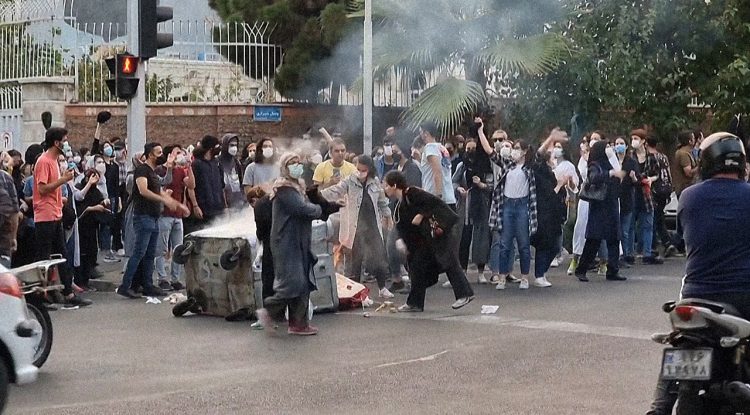
They protest after the death of 22-year-old Mahsa Amini, detained by the "Police of Monashes"
In Iran, protests have not stopped for a week: they began after the death of the 22-year-old Kurdish girl Mahsa Amini shortly after the “moral police” detained her for improper wear of the hijab. "Cold" tells how Iranian women have lost their rights, but are fighting for their return.
In order not to miss the main materials of the "cold", subscribe to our Instagram and telegram .
Woman, life, freedom
On September 13, the “Police of Monashes” detained 22-year-old Mahs Amini in Tehran, where she came with her family. The reason was that she allegedly put a hijab incorrectly. The police, according to the brother of Amini, said that they would take her into the department and let her go after the hourly “re -education lesson”. After that, she ended up in the hospital. Doctors told Mahsa's relatives that she suffered a heart attack and a stroke and fell into a coma. According to official figures, Amini died on September 16, never regaining consciousness.
In the already remote post on the Instagram of the hospital, where Mahsa Amini hit after the detention, it was said that she was hospitalized "without signs of life." The post was deleted after the medical institution employees were accused of “anti -government agents” on social networks.
The police deny the beating and claims that Amini had a problem with the heart, so it was hospitalized. The FARS news site commented on the state of the girl: without calling the source, they reported that Mahsa Amini suffered from epilepsy and was ill with diabetes, and also underwent surgery to remove the brain tumor at the age of five. Her relatives said that everything was fine with her health, Mahs did not feel problems with her heart; They did not comment on other diagnoses called Fars.
After the death of Mahsa Amini in Iran, mass protests began. On the day of the funeral of Amini, in her hometown of Sopeze, a crowd of people went to the governor’s office demanding to punish those responsible for her death. On Amini's tombstone appeared the inscription “You have not died. Your name will become our motto. ”
The Kurdistan Free Life Party and Democratic and Free Eastern Kurdistan Community funds have published a joint statement after the murder of Amini: “We urge youth and women, as well as the whole intelligentsia, political prisoners, organization, free press, workers and workers ... The universal strike under the slogan “Jin, Jiyan, azadaper” (“Woman, Life, Freedom”). ”
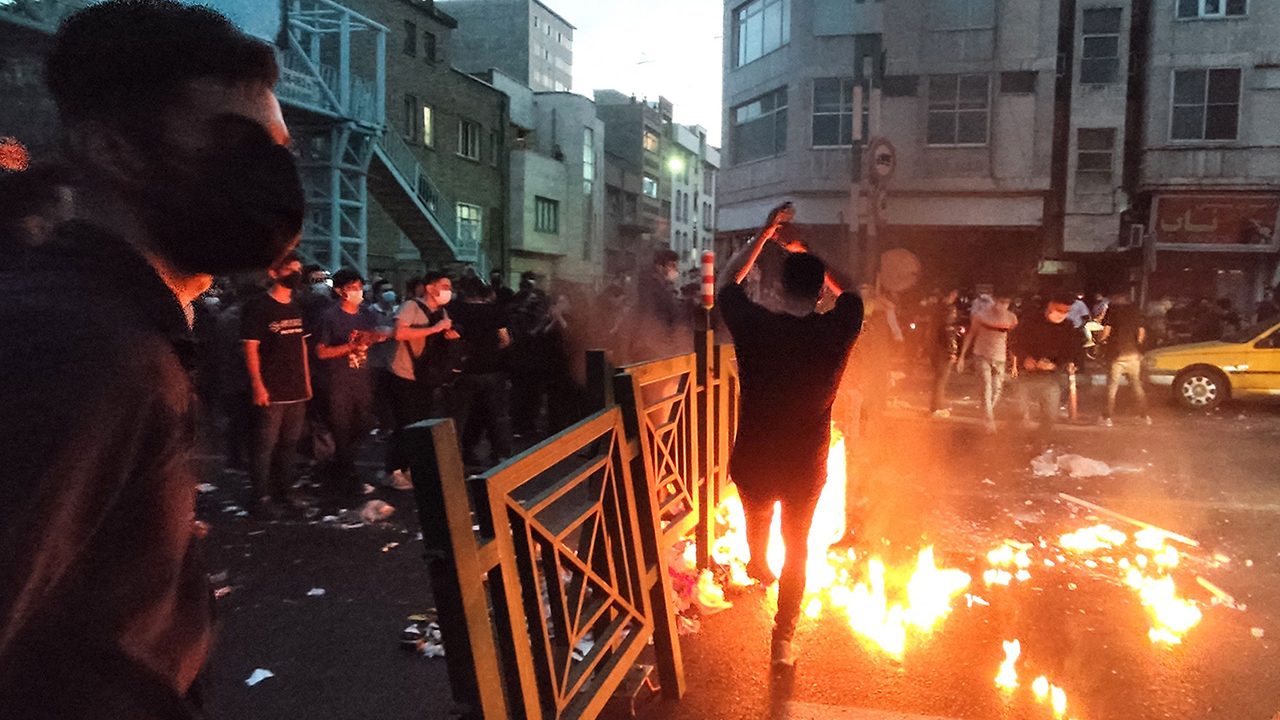
Women began to take off the scarves in protest against the obligatory wearing of the hijabs, cut their hair andburn the hijabs. In different cities of Iran, protesters tore up state flags and posters with the image of Hameni - the Iranian permanent religious leader since 1989 - with the screams of Death to the Dictator.
According to Amnesty International, the Iranian police used tear gas, and a video appeared on social networks in which demonstrators are beaten with batons. According to the Iran Human Rights human rights organization, at least 54 protesters were killed during the shares as of September 24. Hengaw Kurdish human rights group reported that a 10-year-old girl was seriously wounded during protests-a bullet hit her head. On Iranian state television, at least 35 dead are indicated .
Strict punishments
Before the Islamic Revolution of 1979, the situation of women in Iran was not so deplorable. In 1918-1919, the country's government founded ten state elementary schools for girls in Tehran, in which several hundred students studied, and in 1935 the girls were first accepted at Tehran University. Successes were achieved in other areas: in the 1920s, an organization for the protection of women's rights arose for the first time in Iran, and in 1936, Shah Reza Pekhlevi issued a decree that forbade women to cover their heads with Cadra or Hijab. Iran’s authorities ordered the police to take off the war from any woman who appeared covered in society. Many considered it humiliating and did not want to shoot hijab, which even led to suicide among women. In 1963, Pekhlevi launched a reform program, which included the introduction of suffrage for women.
In 1968, the first woman was in the office of Iranian ministers: she became the Minister of Education Farrukhr Pars. Gradually, the minimum age of women for marriage was increased from 15 to 18 years old, women also had a legal opportunity to fight for custody of children in the event of a divorce, which was also possible to ask for reforms.
After the revolution, the age for marriage for girls was reduced to nine years (thanks to the struggle of activists, it was still increased to 13 years, although marriage for girls under 13 years of age remains possible with the permission of the guardian or approval of the court, taking into account the interests of the child), women began to be removed from government posts, and Parse Farrukhra was executed. The observance of the Iranian dress code has become mandatory.
Since 1979, women and even girls could not appear in public places with an uncovered head - this is considered a crime. The compliance with the dress code is monitored by the “morals”: her employees can stop the woman if she does not cover her hair, wears tight-fitting clothes or applies a lot of makeup. For this, she can be finished, fined and sentenced to prison from 10 days to two months. In practice, there are more deadlines: in 2019, the Iranian activist Kord Afshari received 15 years in prison for public appearance without a scarf. According to the court, in this way she "contributed to corruption and prostitution." This year, according to the Front Line Defenders international human rights organization, Afshari was justified on this charges, but still remains in conclusion on others.
In 2014, the Iranian activist Masikh Alinadzhad, who, for personal security, lives in the United States, founded the online movement of My Stealthy Freedom: photos of Iranian women without shawls in the protest against their compulsory wearing are posted on Facebook initiatives.
“Five women from the White Wednesdays campaign are in prison, and, unfortunately, some Western media are silent about them. Or instead of asking for their liberation, they say [me]: “Do you not feel guilty that these women are in prison?” <...> Those who execute people in Iran should feel guilty, ” says Alindzhad.
In early July 2022, Iran President Ibrahim Raisi ordered a strict punishment for women for non-compliance with their dress code. Now those who publish photos without hijab are fined and dismissed from government posts.
On July 12, 2022, the national "Hijab and chastity Day" was held in Iran. Women began to upload photographs without scarves on social networks, after which they began to arrest them for non -compliance with the order of President Raisi. Among the arrested was the writer and artist Sepida Raro, who appeared on the street without a hijab. According to the news agency, Iranian human rights activists Hrana, after arrest she was taken to the hospital with internal bleeding. On July 30, Rrino apologized for violating the rules of appearance on one of the state television channels. “There were obvious traces of beatings on her face,” said Skylar Thompson from Hrana. “It is clear that besides the fact that she was forced to recognize psychological torture, she was beaten.”
In September, a member of the Iranian government, Mohammad Salekh Hashemi Golpaeugani, said that the country's authorities plan to use the technology of recognition of persons to monitor the appearance of girls and women in public places.
Iran will be liberated by women
Now Iranian women cannot travel abroad without the permission of a husband or male Opekun, they can not sing and dance in the presence of men, if these are not husbands or relatives. Women continue to talk about the sexualized violence, which are faced with both prisons and in ordinary life. According to the Kurdish edition of Anf News, September 3, 2022, Schilet Resuli, living in East Kurdistan, tried to rape a neighbor. The girl jumped from the second floor to escape from the rapist - a few days later she died of injuries. The death of Schieler also led to mass protests in East Kurdistan. Women demanded to punish the rapist and gathered at the courts of courts with an appeal to stop silence against girls.
Now in Iran the death sentences continue to be carried out: on July 29, 2022, the authorities executed three women - in all three cases they were accused of killing their husbands. According to the report on women and deaths in Iran, at least 164 women were executed from 2010 to October 2021.
Representatives of the Iranian authorities blame women in an increase in the number of divorces in the country: “During our fathers and mothers, women did not receive education, and some did not go to school, [and,] as soon as the marriage was concluded, there was no divorce. Unfortunately, the more the education of women increases, the more often they cannot strengthen family life. ”
Due to the fear of organized resistance, the country's authorities pursue and torture Iranian activists and human rights activists. So, in February 2020, Nilufar Bayani, engaged in activism in the field of ecology, said that investigators Ksir subjected her to cruel mental and psychological torture, and also threatened sexualized violence. Mary Mohammadi, who participated in the rally in support of the relatives of the Ukrainian aircraft shot down by the Iranian military, also announced harassment by employees of KSIR. Before the interrogation, she was brought to the courtyard of police branches, where they forced to sit on the asphalt in front of the toilets in the cold. And in December last year, Ahmad Vakhidi, the Minister of Internal Affairs of Iran and the commander of the Islamic Revolution Corps, said : "If the Islamic Revolution is damaged, this will be done by women." The death of Mahsa Amini provoked new protests by Iran women. Chimen Shine, coordinator of the Society of Women of East Kurdistan (KJAR), commented on the female movement in Iran and East Kurdistan: “All women should protect and accept the achievements of organized struggle. When we are really united as women, we are strong. It should not be forgotten that the feminine policy of the colonial [Iranian] regime provides for us only life as objects. Very subtle measures are used to try to put us in the position of obedience to the ruling person. As women whose desire for freedom is unshakable, we can never accept this. <...> We say that Iran and Eastern Kurdistan will be freed by women. ”