
Translated material
About 100 percent

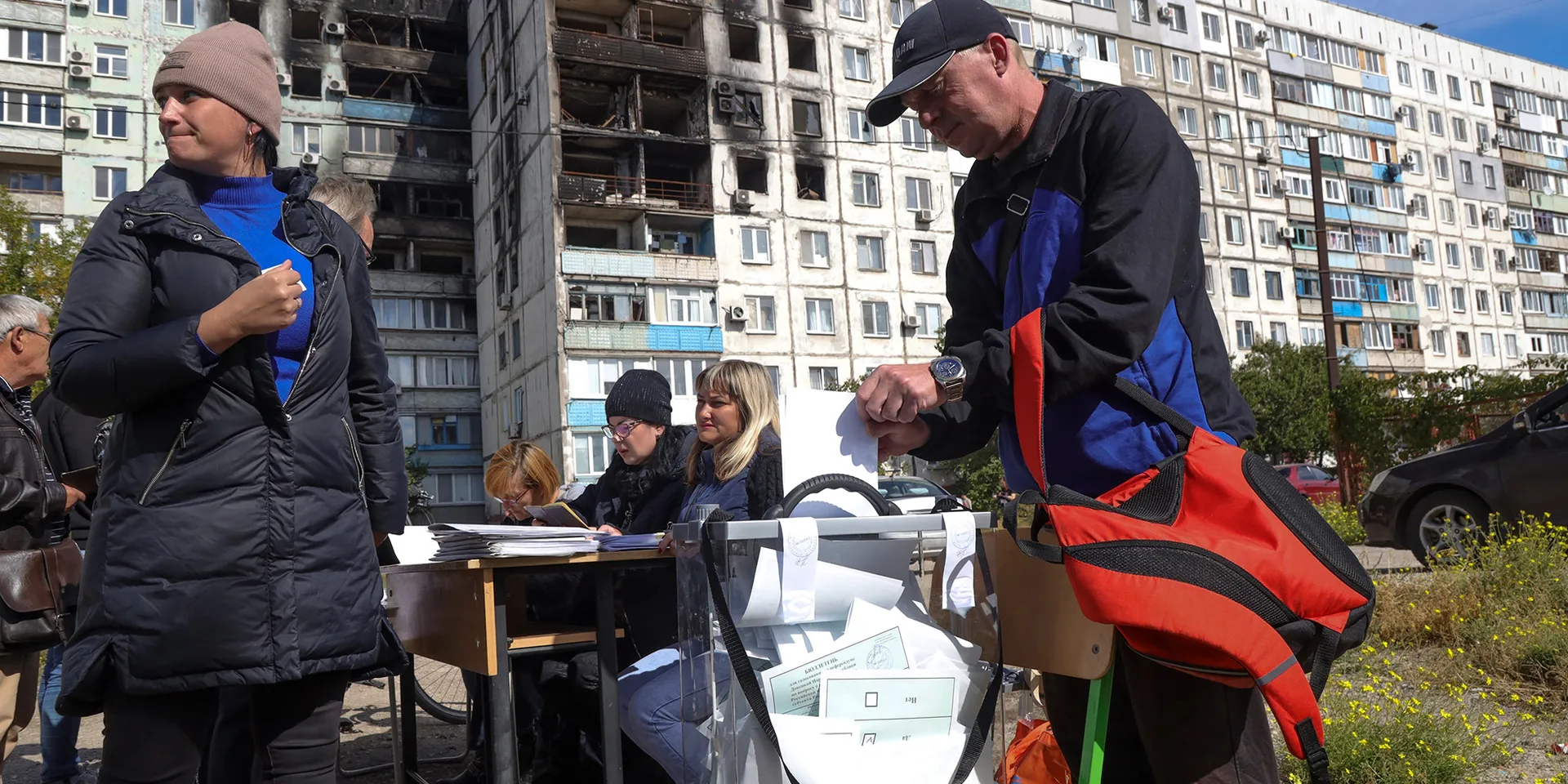 Photo: AP / Scanpix / LETA
About 100 percent
The results of “referendums” were announced in the occupied territories of Ukraine. What's next?
On Tuesday, the last day of “referendums” on joining Russia took place in the self-proclaimed DPR, LPR, as well as in the Russian-occupied territories of the Kherson and Zaporozhye regions.
How did the voting take place?
The “referendums” began on September 23. For the first four days, people voted “in their local areas” and at home. Special “brigades” consisting of members of election commissions and security forces with machine guns went from house to house. Polling stations opened only on September 27 and were open until 16:00. The military personnel participating in the fighting voted on the disposition of their units. In Russia, residents who fled the occupied territories could also vote. Sites were opened in temporary accommodation centers and some government agencies.
Already on the first day of the “referendums” there were many reports that residents were being forced to vote and were being monitored to ensure that they answered “yes” to the question of joining Russia. It was reported that those who voted against were taken away by armed men.
Russian state and pro-government media throughout the five days of the “referendums” wrote about the great enthusiasm of the population and published numerous interviews with residents.
In addition, there were many statements from “international observers” who spoke about the good organization of the elections and the absence of violations. Among these observers were Europeans - citizens of Italy, France and Germany. The Insider found out that all of them are somehow connected with the Russian authorities or state media.
Results
The leadership of local Central Election Commissions announced that the “referendums” had taken place at the moment when, according to their data, more than 50% of voters voted. In the DPR, LPR and Zaporozhye region this happened on September 25, in the Kherson region - the next day.
The Central Election Commission published the first results a few minutes after the polls closed, based on the results of processing 13-18% of the votes. The overwhelming majority voted in favor:
• Zaporozhye region - 98.2%,
• DPR - 97.9%,
• LPR - 97.8%,
• Kherson region - 97%.
What happens next
Already on the first day of the “referendums,” Presidential Press Secretary Dmitry Peskov said that the territories in which they were held would become part of Russia “quickly enough”: “Everything will be completed on time in accordance with current legislation.”
On September 24, Vedomosti, citing sources in the presidential administration, the State Duma and the Federation Council, wrote that Vladimir Putin was planning to address the Federal Assembly on September 30. It will be dedicated to the results of the “referendums” and the annexation of the occupied territories to Russia.
At the same time, members of the Federation Council say that they do not plan to hold an unscheduled meeting. Chairman of the Federation Council Valentina Matvienko and Senator Andrei Klishas said that the entry of new territories into Russia could be discussed at a scheduled meeting on October 4.
On Tuesday, Vedomosti wrote that the annexed territories could be included in the new Crimean Federal District - along with Crimea. Journalists named Dmitry Rogozin as the main candidate for the post of head of the new district. Peskov, commenting on this news, said that such decisions and appointments are not announced.
One of the main questions is how “referendums” and the annexation of new territories can affect the actions of the Russian army. Deputy Chairman of the Security Council Dmitry Medvedev on Tuesday once again wrote about the possibility of Russia using nuclear weapons. According to him, this can happen “if aggression using conventional weapons poses a threat to the very existence of our state.”
What else do they say in Russia
Sergei Aksenov , head of Crimea: “Soon a certain point of no return will be passed. Gaining a new status for the liberated territories will put an end to uncertainty. They will become full-fledged subjects of the Russian Federation. And in fact, we will no longer be conducting a military defense operation, but a counter-terrorism operation on our territories.”
Dmitry Peskov , Putin's press secretary: “[After the vote] the situation will naturally change radically from a legal point of view, from the point of view of international law. With all the subsequent consequences for the purposes of protection and security in these territories.”
Vladimir Putin : “It is the salvation of people in all the territories where this referendum is being held - all this is at the forefront and is the center of attention of our entire society, the entire country.”
How the world reacts
Ukrainian President Vladimir Zelensky said that after the “referendums” negotiations with Russia will be impossible and Putin knows about it. World leaders immediately announced their support for Ukraine, saying that they would not recognize the results of the “referendums.”
On the fourth day of the “referendums”, the UK expanded sanctions against Russia. Goznak, which, according to the British side, prints Russian passports for residents of the occupied territories, and the IMA-Consulting PR agency, which was involved in campaigning, were added to the sanctions list.
Also subject to British sanctions were Russian billionaires Iskander Makhmudov, God Nisanov and Igor Makarov.