
Translated material
Defenders from the Fatherland
How to work for Russian lawyers in the context of the actual dictatorship of the war? Explains Ivan Pavlov
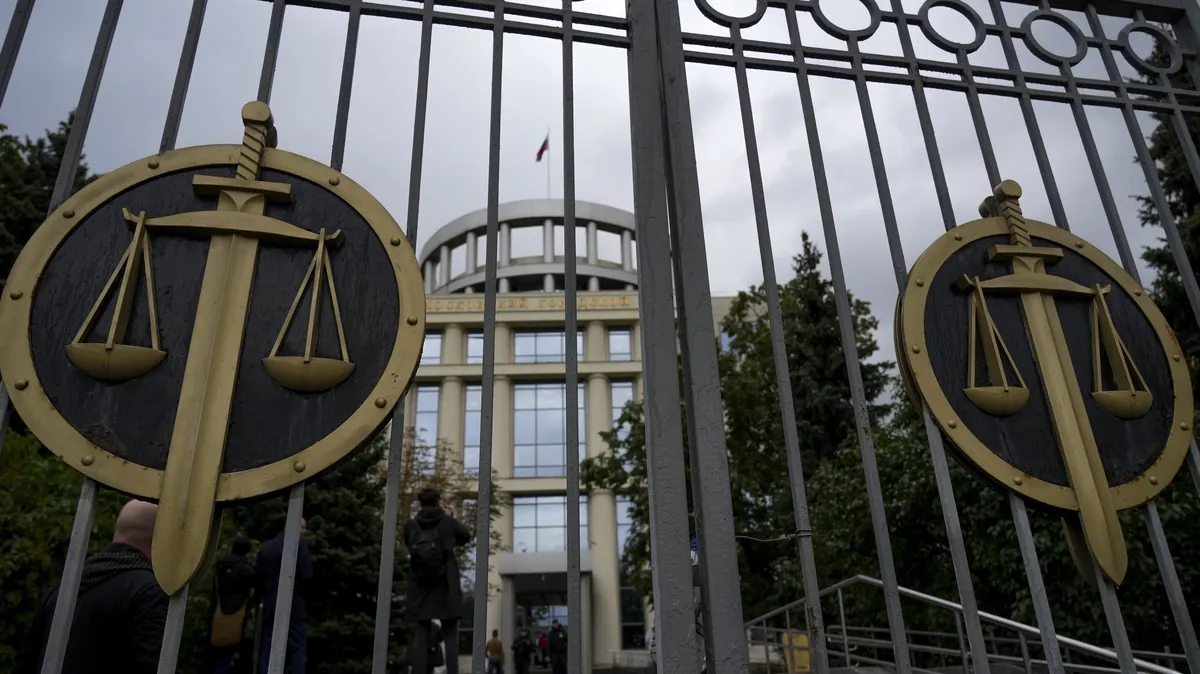
Moscow military commissar Viktor Shchepilov warned lawyers: they will help reservists avoid “partial mobilization” - they themselves will sit down for aiding in evading. The law enforcement officer of the capital received a letter on September 23, and a day later on her website, she called on colleagues who are ready to “provide legal assistance to citizens on issues related to mobilization”.
“People panic, rushing around, the corporation cannot remain aloof from this emergency, trying to facilitate the search for professionals ready to protect the rights of fellow citizens from violations,” commented this vice-president of Henry Reznik. How to work today both the defense and the judicial system, as a whole, explains the lawyer Ivan Pavlov, who left Russia a year ago amid a criminal case instituted against him.
- Lawyers are already massively threatened with criminal prosecution, but there are legal grounds for not a person not to fall into war? Does the lawyer have no right to tell them?
Ivan Pavlov
advocate
-Here we must still understand the essence of the lawyer profession. Legal assistance is to give legal advice, but at the same time, of course, the lawyer does not have the right to give advice that entail the commission of a crime or offense. It is impossible, for example, to give advice on how best to make theft? This is not in doubt.
- When it comes to a crime, it does not cause. But I do not understand what the crime is - to avoid mobilization in a legal way.
- You have formulated the question so that it itself contains a description of the corpus delicti: evasion of military service. If you asked a question differently, I would probably give another answer. And it’s not the point of you, many are now discussing this issue. It is important to correctly place accents and formulate the essence of the legal assistance provided by the lawyer so that nothing illegal is contained in the issue.
- For example?
- For example, lawyers have the full right to advise their principals on issues regarding the call for military service, mobilization, and so on. So it would sound more neutral and would not compromise the legal assistance provided by the lawyer. Otherwise, really a lawyer can turn to some extent into an accomplice. He hinted at this to the military commissar in his letter, this is what he meant. But I do not know lawyers who would directly give consultations aimed at evasion of mobilization or calling for military service.
-I might ask a question differently. But approximately the way I asked, they formulate questions and those who are going to lawyers now. These are ordinary people who are not familiar with legal intricacies, they simply ask: what to do to legally avoid war. Does such a wording push a lawyer to complicity?
- Then the lawyer must slightly adjust the task that the principal sets before him. And only then give an answer. Although it is clear that everything can be simplified. Many citizens are interested in, for example, how to minimize taxes.
- That's it: in different countries there are lawyers to help optimize taxes to ordinary citizens, there is nothing illegal about this.
- In some countries, and these are countries with a developed legal system, there are lawyers who were attracted as accomplices of crime related to tax evasion.
- George Grisham immediately comes to the memory of the “company”: the FBI hunted for the company, which helped to get away from taxes.
- You see! Even detective novels write about this, so everything is not so simple. The Russian Lawyer Chamber gave a rather balanced answer to this: they will encourage this activity, but - depending on which. They are ready to provide assistance on appeal and mobilization. All specifics here are precisely in correctly placed accents.
- Could it happen in our conditions that the lawyer will give advice in the most correct formulations, but he will be attracted and still deprived of status?
- Maybe. Unfortunately, lawyers are not protected in Russia. They have not been protected before, and now-even more so. The situation of lawyers in Russia is unenviable, and the honor and praise of those colleagues who, despite this, continue to remain in this country, continue to conscientiously fulfill their duties.
- In private conversations, they say almost in one vote: the work of a lawyer in Russia, in principle, lost its meaning, that is, the profession itself has lost its meaning.
- You know, I have been working as a lawyer since 1995. And I saw how the judicial system developed in Russia, I then saw a positive dynamics.
- It was another country.
- Already we can say - another planet. And I remember the attitude towards lawyers at that time.
- At the beginning of the zero, real competitive processes took place, all this worked.
- And we, lawyers, noted that everything is developing in the right direction. Of course, there were claims, but positive dynamics was noticeable. And from the middle of the zero we felt how everything went in a completely different direction. And now the lawyer can only provide some kind of palliative help.
- At what moment did you feel that everything went the other way?
- The fracture was around 2005, when Putin began to clean the judicial corps. Then just packs of judges were kicked out of the profession.
I then defended two chairmen of district courts in St. Petersburg, and it lasted from 2005 to 2010. Judges with 40 years of experience, not a single canceled decision, and then they simply took and fired.
- Then what was it fired for?
- They canceled both by one decision. That is, the decisions in both cases were legally made, survived in appeal, and only the Supreme Court already abolished them. These were cases when citizens complained about arresting account banking. The judge suspended the order of the Central Bank, and then, in fact, for this she was deprived of status. The same thing happened in the second case. We then went through several meetings in the Supreme Court, reached the constitutional, who made a decision in our favor. The Supreme Court refused to review the decision on the early termination of the powers of judges, the constitutional made another decision on this topic. In short, in 2010 we forced this system to retreat, and we restored the judges as a position. Of course, after that they themselves went into honorary resignation, but they paid some tremendous compensations for all this time.
And then, and it was, I repeat, 2005, I began to be interested in what happened in this system. I had two such things, and the judges were then fired in packs. They simply cleaned the system: some were removed - they put others. I remember that cleaning very well.
- Even earlier, “cleaning” began in business - it was the “Khodorkovsky case”, and the press began to screw the nuts - the editor -in -chief Raf Shakirov was fired from Izvestia in 2004. Nevertheless, you told a story that ended well, albeit five years later.
- Then the Constitutional Court was still different. Serving the same thing now, I would evaluate the prospects differently.
- That is, in 2010, it turns out that the judicial system still worked?
- Yes, in 2010 we even achieved the adoption of laws on freedom access to information about the activities of state bodies. Remember those?
- The courts also began to publish decisions on their sites.
- And we still use this. This was my merit, I then collaborated with the Ministry of Economic Development, they attracted me as an expert on freedom of information. And I was the author of these laws. Now the law on freedom of information in the courts is probably working fifty percent, and the law on access to information on the activities of state bodies is twenty percent.
Detachance to the whole beginning in 2012. Before that, it became worse and worse, but not so fast, and then a real escalation began. The period of the presidency of Dmitry Medvedev can be evaluated as such a “buffer”, then there were some hopes.
And in 2012, all the negative changes went in completely different pace, these ugly laws appeared - foreign agents, the state of “new” and so on. So the milestone can be called 2012, then the courts became different.
- Recently, I spoke with one of your colleague, asked what could be in the head of a judge who understands that an illegitimate decision breaks the life of an obviously innocent person. And he said about the following phrase: the judges cease to be people during his work. Is that so?
- Yes, they become not people, but with functions, to a certain extent this is so. I also knew the judges who showed themselves as decent people, even shared many of our fears, agreed largely with lawyers. But they could not do anything.
- I do not understand this “could not do anything” in relation to the judge.
- They are functions. There can be no question of any independence of the judicial system, talking about it even with the judges themselves only cause a smile. Everyone is focused not on the law, but on a certain “signal”.
- “Signal” is how?
- Remember, there used to be an expression "telephone law"? And now everything is going on Vifau. That is, no one calls anyone, the judges should feel without it what the decision to make. And if the judge does not feel this, then he is somehow unfinished, he probably does not correspond to his judicial situation.
- It does not correspond - if the judge makes a decision simply by law?
“If he suddenly does not know what decision to make.” Once the judge called the decision to inform, now the judges must understand themselves, and then somehow the decision to draw up the right decision. Honestly, lawyers can arrange anything, justify the guilty sentence for the innocent, acquittal - for the perpetrator, all this is possible, the task would be set. Well, it will be crookedly, not very convincing, but you can arrange something. It will probably be noticeable that the position of the court has unimportant, unconvincing, but we see such decisions now.
- And you do not have to go far for an example: the case of Ivan Safronov.
“But this is not because the judges are some fools.” They simply fulfill the task as much as possible. Moreover, I repeat, they themselves must feel how to do it. Some questions can still ask the chairman of his court, he himself may not know the decision, but he knows exactly where to go and whom to ask. In its pure form, “telephone law” is gone, it was replaced by propaganda, which sends clear signals. And the judge should be configured to the “correct” wave along which the signal comes.
- Here the judge sends a person to prison for 22 years. She thinks about what is doing? What are the judges say “in the kitchen”?
“They try not to talk about it.” And everything is clear.
-Such a judge comes home, eats, she has children there, they ask something ...
- That is how this happens. Writing such sentences is her work. She is conscientious about her work. Say, not she-so someone else will do the same.
- Not only the judge now, but the experienced defender already at the beginning of the process understands what the sentence will be. And how can he work?
- Don't know. For a year now I have been outside Russia, I see that in Russia everything is changing just avalanche. Regarding the lawyers remaining in the country, I can only say that "we are singing a song to the madness of the brave." In such conditions, do not quit everything, not to leave, and to stay and work is heroism.
- But what are the mechanisms in the work of lawyers now? What legal technologies can a lawyer community come up with to protect customers in the current situation?
- The main "technology" - we must wait for political changes. Under the current regime, neither with a lawyer, nor with a system of justice in general, nor with other institutions there will be nothing good.
As soon as the mode begins to change, a window of possibilities will appear, including for the advocacy, for the justice system. Radical changes will be needed. Yes - lustration will be needed. These issues are already discussed in narrow circles, and I try to participate in this, even organize something. But in wartime there are more urgent tasks.
-People sit down for a long time and in vain right now, they cannot wait for “political changes”, they need protection now. What is the work of a lawyer now, what can he really do for a principal in such conditions?
- For many cases, it is really impossible to achieve a fair sentence now. I'm already talking not about justification, but about elementary justice. Especially in political matters. And then the work of a lawyer is some psychological support. Because he is the only one who can visit a person more or less without restrictions. Although there are more and more restrictions. But in general, now the work of a lawyer is to hold a person by the hand, to pat on the shoulder, to cheer up. More and more in this direction the work of a lawyer is leaving now.
- The work of a lawyer has always been considered highly paid enough, although I know that many work Pro Bono. Do you think this is fair for the principal to pay only because he will be patted on the shoulder? Or does this work cease to be highly paid?
-You somewhat overestimate the income of most lawyers, but it can be different. After all, the lawyer, which enters into which he passes through himself. And at the same time, he irrevocably loses some “cells”-faith in himself, in his profession. Agree, this is worth a lot: to take a deliberately hopeless business, let it pass through yourself and, in the end, burn professionally. And what to do to such a lawyer next? But nothing, he is unemployed.
- We almost every day learn about the new restrictions that Alexei Navalny and his lawyers face. Do you know the precedents when some seasoned criminal was subjected to the same prohibitions?
- I have not heard of such precedents. Although in certain cases, a lawyer secret may be limited by the law, for example - when the lawyer himself commits a crime along with the client. And, unfortunately, lawyers working with Navalny are indeed under the threat of the fact that a criminal case will also be instituted against them. Because the power was biting a bit, it has cleared its mechanism for restricting the right to a lawyer secret. That is, the power said "a". And when she says “A”, “B” in such a situation is already a bargain against a lawyer. If they already limit the right to a lawyer’s secret, then they have conceived something against a lawyer.
- What tactics can be in such cases of the client? Can he, for example, “stock up” with lawyers and quickly change them when the next is limited to something?
- Yes, the more lawyers - the better. We used such tactics in due time, this allows you to protect the rights of the principal in all non -prohibited methods and more efficiently. This is a cautious wording, but I can only answer.
- In recent years, lawyers often said: in political matters, everything is clear with the court, but in ordinary criminal people they are judged fairly. But I am watching the most ordinary criminal cases, up to the trial of a migrant worker, who unsuccessfully coped the need for garages - and received 15 years “Strogach” as a pedophile, because on the other side of the garages there was a school. This difference remains now or has it already erased?
-Now, firstly, the border between the affairs of political and general-unit has become very blurry. Secondly, there was a lot of political affairs, their share in the general stream is larger. But if we talk about the theft of potatoes from the store, then here you can count on some at least the predictability of the solution and some justice. Although this is very conditional.
The share of acquittals in Russia is very low, it is 0.2%. While in Georgia, where I am now, acquittals are 9%, and this is already similar to a fair system.
And in Russia, almost 100% are accusatory sentences. What is this talking about? That the lawyers here are idiots?
- Probably, in Russia a very highly professional preliminary investigation.
- Well, yes, these 99.8% of convictions will protect him from any criticism. The investigation receives a carte blanche from the court: do what you want, everything will get away with you.
- Theoretically, one can understand the judge who knows what “should be” the verdict in the political case. But what is the motivation in criminal cases, why not judge them by law?
- Therefore, our court associates itself with the state, in Russia it is one law enforcement mechanism. Having become the president, Putin almost immediately came to court and at the “closed meetings” asked: do not interfere with our law enforcement agencies now, give them time to restore order, and only then we will think about human rights and so on. If the investigator says that such and such is to blame, then he is to blame. Maybe the investigator did not work out a little, well, so help him, finalize yourself. And the courts perceived this as a guide to action. And now this is just a continuation of such a state repressive system. If the court suddenly passes an acquittal, then this is almost a slap in the face of all those who participated in the investigation. Это что же, куча государственных денег, куча времени истрачены, а тут суд берет — и всё это перечеркивает? И вот мы, полиция, человека прессовали, а вы, суд, сейчас возьмете и его отпустите? И еще государство ему денег заплатит? Получается, что оправдательное решение сильно бьет по репутации всего государства.
— Вот так они и опустили качество работы следствия ниже плинтуса: зачем что-то доказывать, если суд «доработает сам».
- So! Вы говорите, что есть дела без политики. Но и в них всё равно есть политика: это уголовная политика. Потому что в уголовном деле государство выступает против гражданина, и если оно ошиблось, это бросит тень на всю его уголовную политику.
Вы знаете, по каким делам у нас обычно выносят оправдательные приговоры? По делам частного обвинения, когда, например, сосед ударил соседа. Тогда можно сказать обвинению: вы тут не доказали вину, а у нас презумпция невиновности. То есть не государственный обвинитель, а частный не справился со своей обязанностью доказать. Другая категория дел, по которым нередко выносят оправдательные приговоры, это должностные преступления. Тут, вероятно, у судьи срабатывает какой-то психологический механизм, он как бы пропускает историю через себя.
— Представляет себя на месте подсудимого?
— Конечно, перед ним же чиновник сидит. А вдруг, думает судья, и я попаду в такой переплет. По такой категории преступлений оправдательных приговоров в разы больше.
— Так это и составляет те самые 0,2% оправдательных приговоров?
— Это — и еще суды присяжных, но их всё меньше и меньше.
— У нас научились очень ловко отменять оправдательные вердикты присяжных и «пересуживать», последний пример — дело калининградских врачей, которых приговорили со второго раза.
— Да, но все-таки суды выносят оправдательные приговоры, когда вердикты о невиновности выносят присяжные. Потом это действительно пересматривается. И всё равно в статистике оправдательных приговоров это учитывается.
— Вы сказали, что участвуете в обсуждении будущих реформ. А что вообще надо сделать с этой судебной системой? Какие условия надо создать судьям, чтобы они были независимы?
— Тут есть разные подходы, в том числе — радикальный: всех судей увольняем и набираем новых. Найдется, поверьте, достаточно образованных и талантливых людей, которые смогут этих судей заменить. Надо вообще ставку делать на молодежь. Есть другой подход: не всех увольнять, а избирательно.
— По каким критериям?
— Всё будет зависеть от того, кто станет принимать решения в будущем. Ясно, что режим поменяется. Тогда надо будет просто решить, какой применять подход. В 1993 году ошибка была в том, что люстрации не было вообще никакой, во второй раз так нельзя ошибиться.
— Как бы вы сформулировали статус судьи, чтобы он действительно был независим? Какими должны быть условия его работы?
— Это уже детали. В первую очередь, в обществе должен быть запрос на независимый суд.
— Разве эти «детали» — не самое главное?
— В 1993 году в России был продекларирован независимый суд, законы вроде бы неплохие были приняты. Но политического спроса на независимый суд так и не возникло. Просто лидеры были такими. При всём уважении к Борису Николаевичу Ельцину, он все-таки был продуктом советской эпохи
— Но на протяжении лет десяти суды были реально независимыми.
— Да, хотя понятно, что любая власть, если она такая сильная, как президентская в России, подавляет все остальные ветви, включая и судебную. У нас же президент даже формально — не глава исполнительной власти, он — глава государства, то есть он — как царь, он — над всеми ветвями власти.
— Я исхожу из того, что если суды в стране начнут работать нормально, то постепенно и всё остальное подтянется. Какой должна быть процедура назначения судей, чтобы они были независимы?
— Это проблема не только права и процедуры, но еще и культуры. Сделать всё правильно по процедуре недостаточно, есть еще и традиции, препятствующие тому, чтобы пытаться обойти закон. Надо, чтобы места заняли и оставались на местах в течение нескольких поколений люди совестливые — не воры, не коррупционеры…
— Извините, но это романтика, а я спрашиваю о процедуре.
— Ну почему же романтика? Надо дать возможность системе «устаканиться», тогда возникнут традиции. Процедуры, конечно, тоже важны, но еще важнее, кто их реализует. Говорю вам как юрист: любую процедуру можно извратить как угодно. Поэтому я и настаиваю, что делать это должны люди порядочные и совестливые.
— Эти понятия могут быть очень субъективными.
— Согласен, я только хочу сказать, что не всё зависит от законов, важно еще, кто их применяет. Я думаю, что судья должен назначаться пожизненно, это обеспечит его независимость. Ни председатель суда, ни президент не должны иметь возможность просто так лишить судью статуса.
— А как тогда обеспечить то, чтобы пожизненный судья не оборзел?
— Независимость и несменяемость не означают, что судья может совершать всё что угодно. В любом институте есть исключения. И для лишения судьи статуса тоже должна быть прописана четкая процедура. Должно быть четко сформулировано, чего ему делать нельзя, в каком смысле нельзя, как вы сказали, «борзеть». И такие процедуры ведь есть и сейчас. Просто сейчас все ветви власти находятся в плену у одной, у горстки престарелых чекистов, которые создали хунту и захватили в заложники практически всю страну. Законы ведь есть и сейчас, но важно, как они работают. А работают они сейчас только в одни ворота.