
Translated material
Since the beginning of the war, 50 arson of military commissariats and administrative buildings have committed in Russia
"Mediazona" told who and how they are persecuted for these attacks
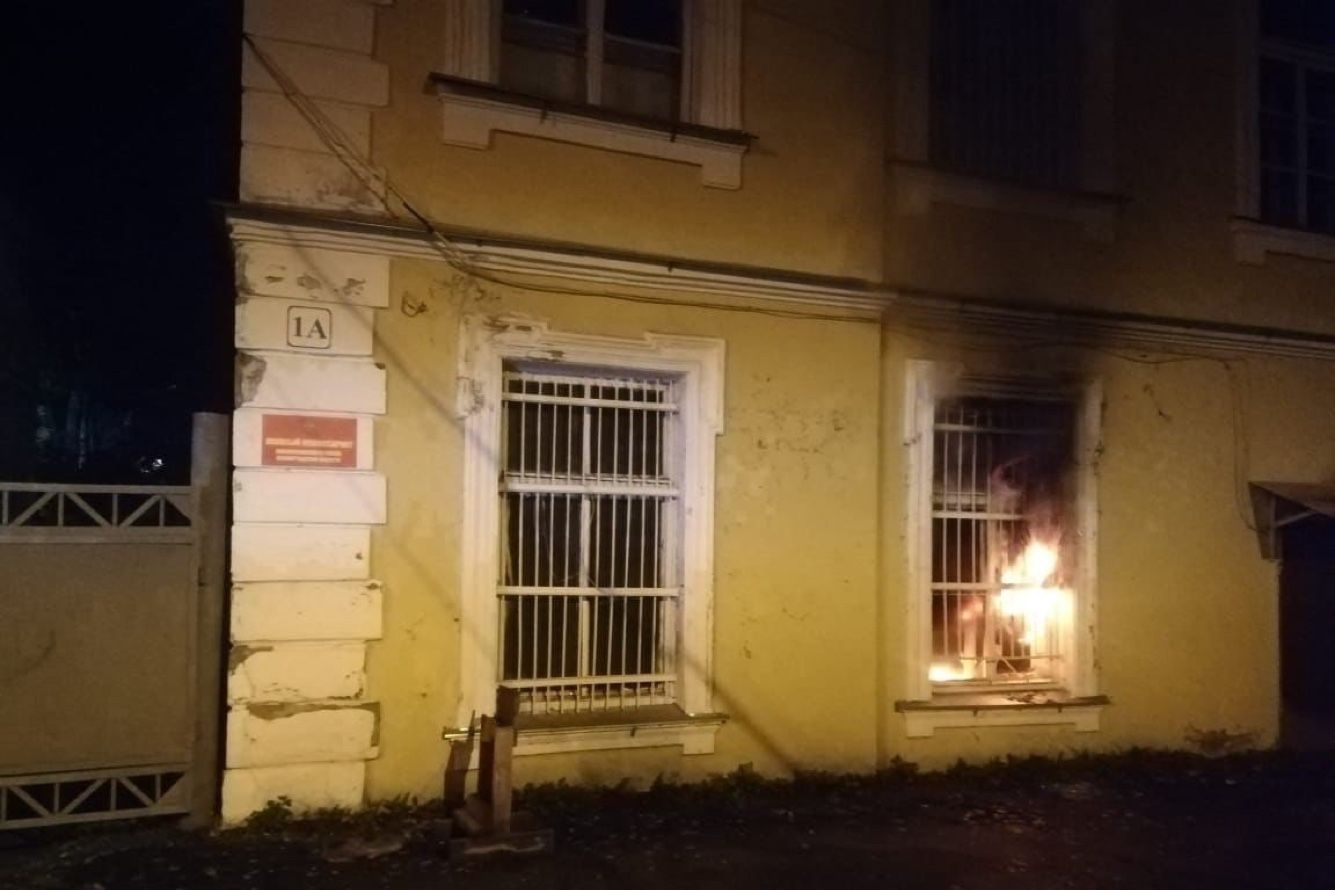
Russian military registration and enlistment offices began to set fire immediately after the outbreak of war in Ukraine. For seven months, more than fifty attacks were made on military commissariats and administrative buildings. By the summer, the number of such attacks began to decline - in August it became known only one case, while in May there were 14. However, after the mobilization announcement, the number of arson increased significantly. Mediazona told everything that is known about these incidents.
The first known case of arson of the military registration and enlistment office occurred a few days after the start of the “special operation”. 21-year-old Kirill Butilin threw the military enlistment office in the Lukhovitsy near Moscow cocktails. On March 8, the telegram channel "Vatahanters" published a video recording of the incident and accompanied the post with a manifesto of Butylin, in which he announced that he had set fire to the military enlistment office in order to destroy the archive with the personal affairs of the draftees and prevent mobilization. “I hope that I will not see my classmates in captivity or in the lists of the dead,” the report said.
Butylina was detained on the day of publication of this post. Some Russian media reported that before that he managed to get to the border of Lithuania and Belarus, from where he was sent to Russia and taken to the police department in the Lukhovitsy. According to the Ministry of Internal Affairs , on March 13, Butylin “left the police department arbitrarily”, but by the evening of the same day he was again detained.
Mediazona writes that initially the case was started on the article on Vandalism, but soon the article was replaced with a “arson”, and later they added “an attack of a terrorist attack” to the case. In June, Butylin was included in the register of terrorists and extremists. He faces up to 20 years in prison.
According to Mediazons, since the beginning of the war in almost 40 regions of Russia, more than 50 attacks on military enlistment offices and buildings of other state institutions have been committed. Most shares did not result in significant damage. The attacks were rather symbolic-“somewhere only windows, the door or cladding of the building were burned, somewhere the property was not injured at all,” writes Mediazon.
But in some cases, the damage was significant. Former rural teacher Ilya Farber, with a difference of two days, set fire to the game of the military registration and enlistment office in the Udmurt village. According to the Mediazons, in the first case, the premises were burned, where the service documents and card index of veterans of the Great Patriotic War were stored, and in the second - a room with personal things of employees.
Two large fires occurred in the Shchelkovo near Moscow (two cabinets and archive were injured in the local military commissariat), and in the village of Zubov Polyana in Mordovia, where the fire spread to two floors, including the cabinets in which the data of the calls were stored.
In addition to the military enlistment offices, the goals of the attacks were the buildings of local administrations, the police, the FSB and the Russian Guard. Attacks on the FSB buildings occurred in Krasnodar and Nizhny Novgorod, and the police departments in Moscow, Dagestan and Vladivostok. In Komsomolsk-on-Amur, a 50-year-old man tried to set fire to the branch of the Russian Guard.
In mid -May, the artist Bogdan Ziz spilled two large buckets with yellow and blue paint on the facade of the Evpatoria administration, and then, according to the investigation, tried to throw a bottle of incendiary mixture into the room, which did not explode. The artist was detained, he is in jail. A criminal case on preparation for the attack was brought to him.
Mediazon notes that at first, the cases of arson were considered within the framework of relatively easy articles - “hooliganism” or “intentional destruction of property”. However, closer to summer, law enforcement agencies began to qualify them as more serious. For example, Dmitry Lyamin, arrested in the spring for trying to aim the military commissariat in the Ivanovo region, was accused of an attack in early July.
The 21-year-old Andrei Alekseev from Vladivostok was accused of terrorism, who in early June threw a burning rag to the military enlistment office building, and 46-year-old Igor Paskar, who set fire to the Krasnodar Office of the FSB in mid-June. A 21-year-old resident of Uglich was accused of an attempt on the attack-he was detained near the military registration and enlistment office with Molotov cocktails.
The Mediazone suggests that after the start of mobilization of such cases, there will be even more. Due to the 18ths that occurred after September 21 (when mobilization was announced in Russia), four people were detained: in Nizhny Novgorod-19-year-old Artem Lebedev, in Kamyshin-37-year-old Pavel Magalyas, in Chernyakhovsk-30-year-old Sergei Chursin, in Uryupinsk-35-year-old Mikhail Filatov. It is still unknown what articles they will be charged with. None of the criminal cases about the arson of military registration and enlistment offices for six months of the war had reached the trial.