
Translated material
Rape by referendum. Why did Putin carry out a pseudo -democratic procedure if few people believe in it anyway?
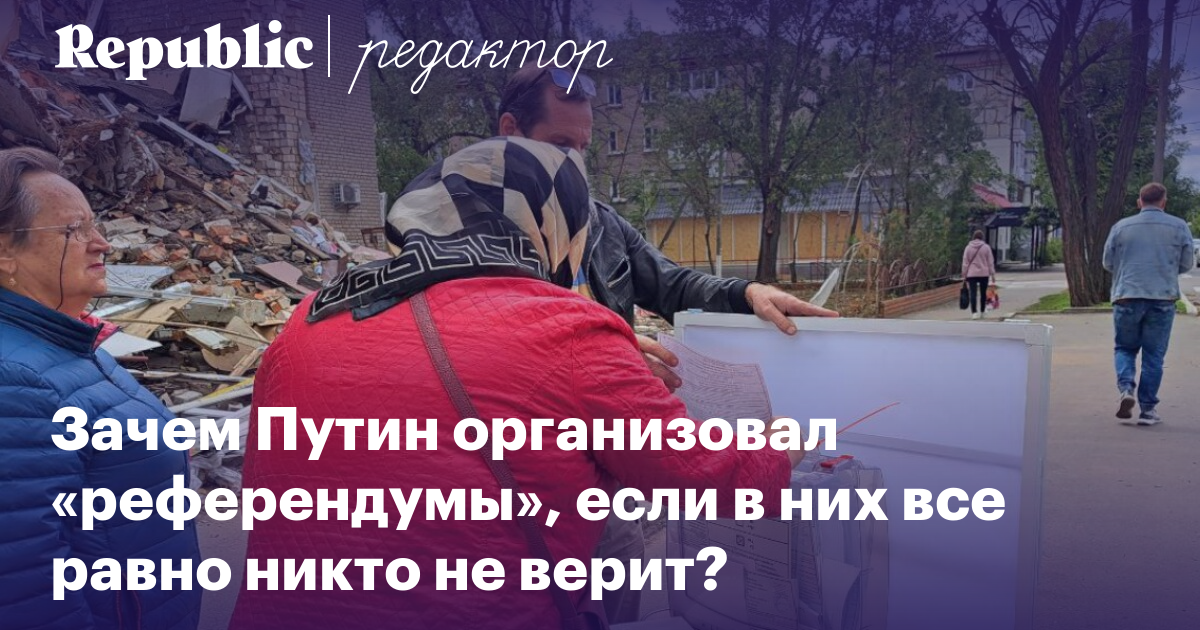
People surviving under the blows of the armies - and, it seems, the very fate itself - on the captured lands of the Lugansk, Donetsk, Zaporizhzhya and Kherson regions of Ukraine, experienced another experience of violence and humiliation. This time - in the form of forced participation in referenda on the accession to Russia, held on September 24–27, 2022. In conditions of military occupation by a foreign state, daily risk to die, in the absence of free media and other platforms, discussing the key existential and political question of people forced to answer the question: do they want their communities to join Russia?
In my opinion, a referendum, one of the most important democratic institutions, in wartime conditions has neither legitimacy nor legality. And in the context of the Russian-Ukrainian war, this special operation of the occupation administrations was another act of violence against citizens of Ukraine living under Russian occupation.
The regulatory framework of the referendum
By its institutional nature, a referendum is an act of making political decisions directly by citizens, without involving representatives of citizens in parliaments or local councils. As a rule, decisions brought to referenda are extremely extreme, as in the case of polls by the Soviet population about the new union agreement or on the withdrawal of the republics from the USSR in 1991. Due to this extreme of the issue, neither representative bodies nor political leadership had sufficient powers to decide the fate of their peoples without the participation of citizens. Only an extraordinary mandate arising after a direct decision of citizens allows the rulers to implement a decision.
However, the history of late and post-Soviet referenda shows that decisions were implemented only if the will of the people and rulers coincided, as well as legality and legitimacy. In the case of a new union agreement, an attempt of the GKChP coup and the coming to the power of the republican leaders - Yeltsin, Kravchuk, Shushkevich and others - tore off the process of performing the will of citizens manifested at the March 1991 referendum. However, the coincidence of the will of peoples and elites in the same year led to the implementation of many referendum decisions on leaving the USSR. And again in 1990-1993, many regional referendums (for example, Crimean or Transnistrian), due to their illegality and the contested legitimacy, led either to non -recognition of the result or to the military conflict.
So, a referendum can have a real -political quality, often leading to different forms of injustice, including civil conflicts and international wars, or democratic quality that contributes to the emergence or strengthening of a democratic republic.
Subscribe to read the whole
Make a subscription Redefine.media to read Republic
Subscribe [you can pay for a Russian or foreign card. The subscription is extended automatically. You can unsubscribe at any time.]
Where are the money subscribers going