
Translated material
Putinoslavia
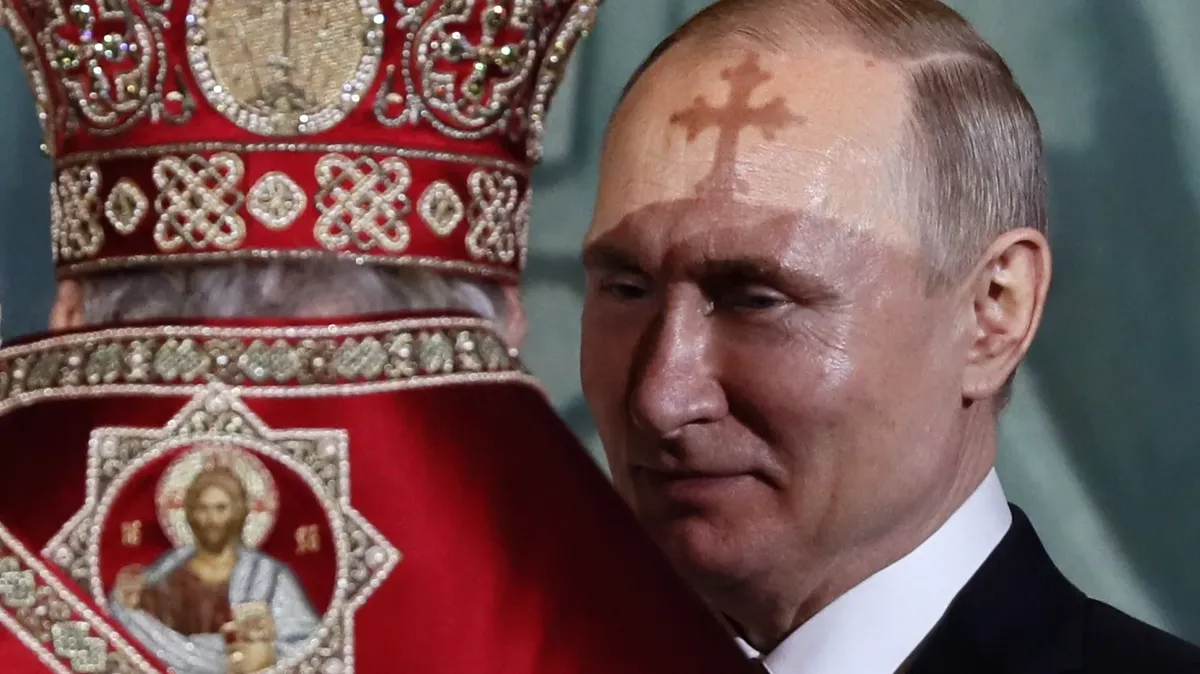
Patriarch Kirill (Gundyaev) ordered the clergy to celebrate the 70th anniversary of Putin at the highest church level. Is this not a canonization yet?
Non-fake
For obvious reasons, in the current circumstances of any popular celebration and special glee on the occasion of the official 70th anniversary of the permanent President of the Russian Federation V.V. Putin is not expected. There will be no thousands of demonstrations with portraits of the beloved leader, rallies and meetings at enterprises and institutions, classes will not be canceled in schools and universities, transport will not stop. Propaganda will attribute all this to the unusual modesty of the current national leader, who, as he himself admitted, feels himself a slave on galleys and even decided to spend the day of his glorious anniversary for the good of Russia.
A completely different atmosphere reigns in the Russian Orthodox Church Patriarch Kirill (Gundyaev). Determining to participate in the ceremonies of the “accepting into the Russian Federation” all six regions that Ukraine considers an integral part of its territories (in 2014 and 2022), Cyril decided to give the anniversary of the President’s beloved the nature of the church celebration. On the eve of this sacred day, on October 6, according to the dioceses and parishes of the Russian Orthodox Church, the blessing of the Primate was sent to the circular, signed by the Patriarchate of the Patriarchate of Metropolitan Dionysius (Wait). The official website of the Patriarchate published it only in the evening, and the first “leaks”, held in the morning, caused a part of the clergy and the church people serious doubts: wasn’t a fake? This text seemed so fantasmagoric even against the background of the usual patriarchy servilism.
Vladimir Mikhailovich Gundyaev ordered his thousands of many thousands and a multimillion -dollar flock to honor Vladimir Vladimirovich Putin in two ways - private and public (cathedral). Privately, on the very day of the holiday on October 7, ordered "to summarize the diligent home prayer for the health of the head of state of the Russian one." But on October 8, when a widely revered day of the replacement of St. Sergius of Radonezh is noted, Putin’s glorification should be carried out in a liturgical, liturgical format. The performance, which is usually loudly led by the deacon, should add a petition “On the head of the state of Russian Vladimir Vladimirovich, and on your hedgehogs, the rich mercy and generosity of your, give him health and long -ledness, and from all the resistances of the visible and invisible enemies of deliverance, in the wisdom of the spiritual confirmation”. It is stipulated by the Liturgy on the day of the Monk Sergius in more than 20 thousand churches in the territory of the Russian Federation (in the circular, it is stipulated that other countries of the “canonical territory” of the Russian Orthodox Church should not apply to the following many years: “Blessed and peaceful life, health and salvation, and in all good haste, giving, Lord, now the honorable head of state Russian Vladimir Vladimirovich, the sovereign, and the military. and the people of the God -preserving of our Fatherland. ”
At the same time, the Patriarch tried to tie Putin's image to the face of St. Sergius,
who blessed the “Prince of Moscow - the Holy Borous Demetrius of Donskoy - and the Russian army to fight the enemy, who wanted the dismemberment of the Russian land and encouraged the feud in its people.” That is, in this role -playing game, Cyril acts as if St. Sergius, and Putin is Dimitri Donskoy, who is extremely in need of the blessing of such a holy old man for a “special operation”, which without such a blessing turns into a series of endless “gestures of goodwill”. True, Demetrius of Donskoy himself humbly arrived at the ascetic in his deserts, and Patriarch Kirill does not count on this, mobilizing all his spiritual army to sung the “posture” of the head of state. But this is an insignificant nuance-after all, the 21st century is in the yard.
The first impression of the fake that leaves the document is deeply no coincidence. From the very moment of its founding in Stalinist times, the Moscow Patriarchate considered the service of power and the justification of all its decisions as its most important priority. But by namely, the heads of state were remembered in the Orthodox tradition only under the monarchy - when these chapters were, from a church point of view, the anointed of God. Throughout the Soviet (and post -Soviet) power of the Russian Orthodox Church, the Russian Orthodox Church prayed only abstractly “about the Vlasta and the army” of those countries where its structures were located. The liturgical commemoration of “Vladimir Vladimirovich” does not fit into the prevailing tradition and directly appeals to the time of the Russian Empire, hinting that Putin’s sacred status significantly exceeds the “constitutionally chosen president” of the secular state. Therefore, such commemoration makes a shocking impression - despite the position of individual marginals, the church people, even in a hyperloal Russian Orthodox Church, are not ready to equate Putin with the anointed of God. Patriarch Kirill thus appears as the leader of the radical-marginal wing of his organization, which significantly underestimates the status that he has and which he could claim.
Another factor in the underestimation of this status is the reaction of the leaders of the Christian and the world and, in particular, the heads of official local Orthodox churches to what the Russian Federation is supposed to be called a “special military operation”, and to make Cyril justify all this. The reaction here is absolutely unambiguous - it organically follows from the words of Christ "the peacekeepers are blessed" and "everyone who takes his sword will die." For more than seven months, the head of the Russian Orthodox Church has ceased to be his own for the rest of the Christian world, and is there in the same isolation as the Russian Federation in global policy.
More Stalin?
Willy-nilly, the parallel of the current modest anniversary with the really magnificent celebration of Stalin on December 21, 1949, Stalin celebrated this date at the peak of his glory, as the “creator of the Great Victory” and the leader of the post-war revival of the USSR. For the current leader, whose caliber clearly does not coincide with Stalin, things are not so well. The Russian Orthodox Church, owed Stalin by its restoration in 1943, of course, was then dealing with a powerful stream of flattery and praise in the style of the “personality cult”.
In the “Journal of the Moscow Patriarchate” (No. 12 for 1949, SS. 5–11), a welcome address to Stalin was published by the signatures of all bishops of the Russian Orthodox Church, where the hero of the day was called the “leader, teacher and friend of the workers”, “great state -owned”, “the fatherly caring trustee of all sides of our human existence”, and feelings for him were recognized as “a particularly precious part our spiritual property. " In the activities of Stalin, the Bishop of the Russian Orthodox Church saw "the triumph of moral principles in contrast to malice, cruelty and oppression dominating the obsolete system of social relations." In fact, the properties of Stalin in this address were equated with the divine ones - well, except that he was not proclaimed the creator of the universe.
Patriarch Alexy I, who, actually, came from the noble family of the Simansky and was Hirotonisan to the bishops by the will of Nicholas II back in 1913, said in the Elokhov Cathedral of Moscow a sermon, where he called Stalin as “not only the peoples of the Soviet state recognized by the whole world, but all the working people ... The first among the advocates of the world among the peoples, among the people among the peoples. peace all over the world. " Three and a few years later, already beeing Stalin, Alexy I will repeat the wording from the word of St. Filaret of Moscow on the funeral service of Emperor Nicholas I: "The power of the great, moral, social power was abolished: the force in which our people felt his own power, which he was led in his creative works and enterprises, to which he was comforted for many years." But even in those days, it did not occur to the leadership of the Russian Orthodox Church to include “dear Joseph Vissarionovich” in the liturgical text. The patriarchy somehow tried to distinguish external service to the cult of personality with the internal sacramental life of the Church. Obviously, Patriarch Cyril does not feel this face.
The origins of such a humiliating position of the Russian Orthodox Church, which leads to the greatest in the history of our country, are in the so -called "Sergianism" - are in the so -called "Sergianism" -
The “new course” of Metropolitan Sergius (Stragorodsky), who usurped with the help of the OGPU power in one of the parts of the Russian Church, which Stalin later chose as the basis for the recreating of the Moscow Patriarchate. In 1927, Sergius issued a “Declaration”, in which he declared the consent to completely obey the Soviet regime and consider its joy and sorrows - the joys and sorrows of the Church. As the church historian Prot noted. Leo Lebedev, “Sergianism” consists in the consent of the church authorities “to serve not to Christ, but to the powerful of this world (whoever they are), is guided not by the Holy Spirit, but by the spirit of this world, friendship and fraternity with anti -Christ forces always prefer to the brotherhood in Christ.” He died in 1971 in the Kirov prison, where he was thrown over his faith, Christian publicist Boris Talents saw in “Sergianism” “a mechanical combination of Christian dogmas and rites with socio-political views-the official ideology of the CPSU. In fact, all religious activities were reduced to external rituals ... You can’t worship Christ and at the same time in public and family life to speak a lie, create a lie, commit violence and dream of earthly paradise. ”
The preaching of the “theology of the war” shocking sincere Christians from the lips of Patriarch Kirill and some other representatives of the Russian Orthodox Church is the logical fruit of the centuries -old “Sergian” school. She prepared entire generations of hierarchs and church administrators to the fact that when the moment of the last and decisive choice between light and darkness comes, between Christ and the Antichrist, “not to be mistaken” in this choice. And Patriarch Cyril, as he believes, was not mistaken.