
Translated material
We are humiliated because we are special
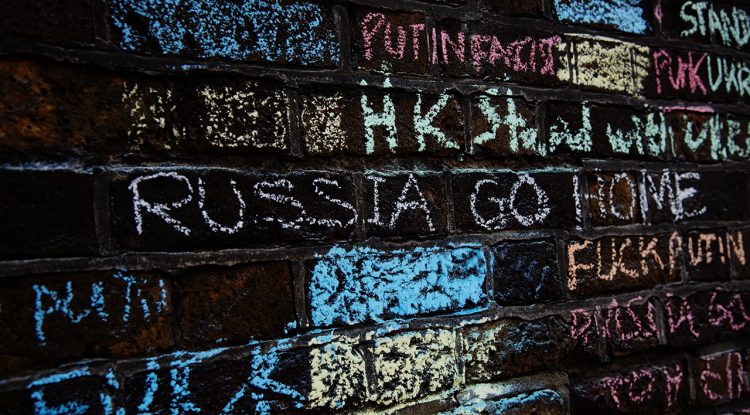
The Russophobia of the West was invented recently, but the Russians willingly believe in it. This is how it happened
Anti -Russian sentiments in Europe have existed for a thousand years, the authors of the documentary “Russophobia” say, which has been shown three times on the first channel since the beginning of the year. However, in fact, to talk about the intolerance of the West has become in Russia not so long ago. The “cold” is understanding when the “Russophobia” of the West became one of the important topics of the Russian state media and why many Russians believe that it exists.
In order not to miss the main materials of the "cold", subscribe to our Instagram and telegram .
The 40-year-old Muscovite Maria Svetova ( surname changed ) wanted to leave Russia after Russian troops invaded Ukraine in February 2022. According to her, she was driven by the desire to protect her nine -year -old daughter from growing up in an “aggressive environment”. Svetova was looking for tickets to Turkey, read about ways to obtain a residence permit there, but the departure did not work out. Now, six months later, she believes that “there would be no war on the war without the participation of the Americans”, she is no longer going to leave, because “the Russians do not like it anywhere,” and dreams that “so that everyone is behind and cease to envy it.”
“Russophobia” is one of the main arguments that the Kremlin and state media use, explaining the sanctions imposed by the Russians imposed by Western countries after the outbreak of war. This is a relatively new propaganda term.
The main foreign policy body of the country, the Ministry of Foreign Affairs began to actively use the word “Russophobia” in its statements since 2014 (until 2014, the Foreign Ministry used this word in isolated cases), as can be seen from the archive on the website of the department. Then Russia annexed Crimea and supported the formation of self -proclaimed Donetsk and Lugansk People's Republics in the east of Ukraine. The data of the American Laboratory of Digital Forensic Research (DFRLAB) with Atlantic Council confirm this: from 2001 to 2013, the Ministry of Foreign Affairs practically did not use the word “Russophobia” in its statements. In 2014, DFRLAB has already recorded 11 such statements, and in 2017 - more than 50. Similar dynamics was traced in the materials of the state media - Sputnik and RT.
The theme of "Russophobia" in Russia, as can be seen from the statistics of "Yandex", reached the peak of requests after the start of the war with Ukraine. If in March 2021 the number of shows by the word “Russophobia” in the Russian search engine was about 11.5 thousand, then in March 2022 it reached an absolute maximum of 204.5 thousand. In April, Russophobia worried users almost 90 thousand times, in July this number still decreased, to 44.8 thousand.
The theme of the Western dislike for all Russian has become dominant on Russian television in the past eight years, the host of the Zomboychik program is confirmed by Ilya Shepelin on the Popular Politics YouTube channel. Most of the political talk shows known today, where it is raised, arose after the annexation of Crimea: this “time will tell” on Channel One, “60 minutes” with Olga Skabeeva on “Russia-1” and “meeting place” with Andrei Norkin on NTV. With the outbreak of war in Ukraine, their airtime increased: if earlier the 60 minutes program came out two hours a day, now its duration has increased to five hours. This happened due to the reduction of entertainment content on the State Academy of Sciences, Shepelin explains.
The tonality of television discussions has also changed. “They stopped being shy. If earlier the presenters did not allow themselves expressions such as “the final solution of the Ukrainian question” and “Ukrainians are not a people at all”, now this is daily vocabulary on the air, ”says Shepelin. At the same time, they talk about Ukraine as a nation that does not have its own subjectivity. “Ukrainians have always been part of the Russian people, they cannot be separate, Ukraine is not independent, it is controlled by Americans from behind the ocean. And finally, Ukraine is such an endless “wedding in Malinovka”, a funny state, ”the theses of TV presenters Shepelin lists.
Criticism of Kyiv and dissatisfaction with the unfair attitude of the West towards Russia, according to him, sound inextricably in the domestic television. “About the Ukraine itself to the Russian viewer, it may not be interesting to listen. But if they explain to him that it is a NATO project and that rockets to Tomsk and Voronezh will then fly from the territory of Ukraine, then it does not care, ”he explains.
Invented news and the victim complex
As examples of intolerance to everything Russian on television, fictitious news can be used. For example, the host of Vesti of the Week Dmitry Kiselev in one of the July issues announced that "the scientific council of the University of Oxford in Britain decided to annul all the diplomas issued to children of Russian officials and their close relatives since 2014." He called the decision to “cancel his own diplomas” by an absurdity and emphasized that “they don’t even return money for training.” At the end of the plot, Kiselev added that the news, as it turned out, turned out to be a “joke, network trolling”, a common satirical edition of Panorama. “But it sounds believable. After all, in life so, ”he added.
The reception used by Kiselev is very effective, says a psychologist, professor at Columbia University in New York Svetlana Komissarruk. “This is an old and proven belief technique: some unreliable information is thrown, but they say that it is a lie at the end when a person has already learned it. It works because our cognitive capabilities are not unlimited, ”she explains. -When the opinion of something has already been formed, then all the facts that we hear are strung as beads on a thread. Listeners of Kiselev and Solovyov are already convinced that Russophobia exists and that everything is bad and unfair. You can sow any misinformation on this fertile ground. ” According to her, refutations of fakes do not work, "since we selectively hear confirmation of what we consider the truth."
Of course, negative sentiments to Russia exist and even intensify as bloodshed in Ukraine continues, Komissarru says. But they are associated with the actions of the Russian authorities that cause fear and fears. “If they said“ Russian -state -owned and this, ”it would be more accurate,” she said.
So, in May 2018, the Committee on International Affairs of the Lower House of Parliament of Great Britain published a report on “dirty money from Russia”. In it, the deputies called on the G7 countries to close loopholes that allow the “kleptocrates” from Putin’s entourage to withdraw stolen money from Russia. The report went after he became known that Russians store 34 billion pounds in British offshores ($ 47 billion at the rate at the time of publication - April 2018). The press secretary of the President of the Russian Federation Vladimir Putin Dmitry Peskov then called the call of British politicians a manifestation of the "unprecedented Russophobic mania."
In fact, such a phenomenon as Russophobia, in principle, does not exist, the historian and publicist, Professor Karlov University in Prague Sergey Medvedev, is sure. “There are completely different layers of Russia's perception. And it depends not only on the country, but also on the period of time. But if you take the world in general, then Russia is not the subject of its intense interest and thoughts, ”he says.
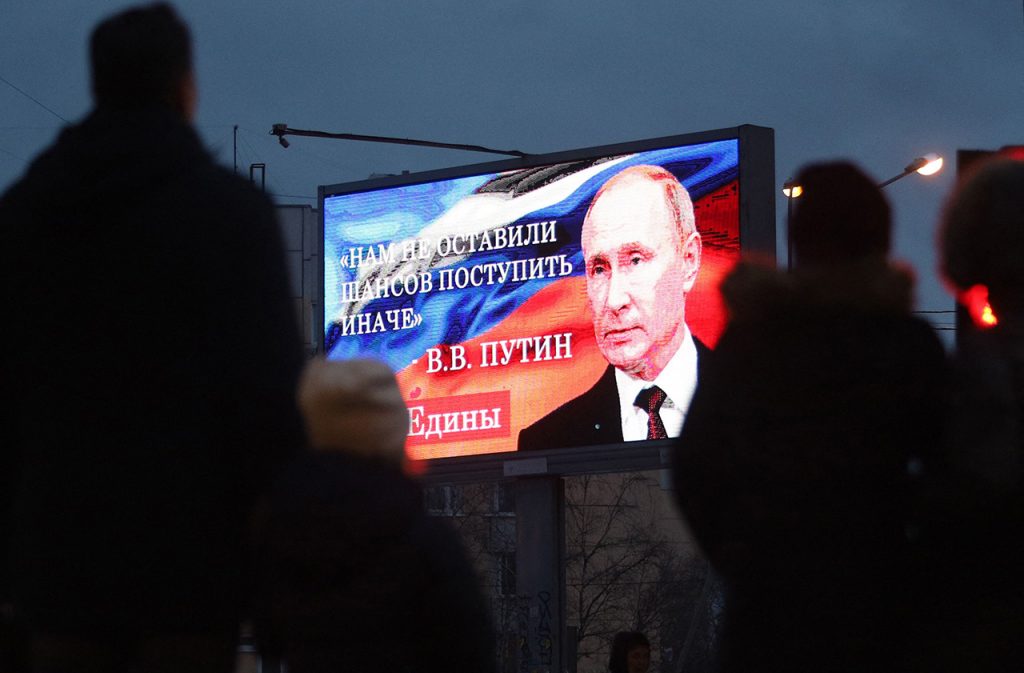
Talking about Russophobia give the authorities a convenient opportunity to explain to the population why it is so difficult in Russia. This helps society find its identity, in which it needed more than 20 years, says Medvedev. Komissarru explains how this works from the point of view of social psychology: in a society that is experiencing dysfunctional times, the perception of his group as an unfairly offended is a unifying denominator, which entails the idea of rallying around a strong leader. “Say, it’s not us bad, they consider us so. They distort our politics, our views, specially everyone was fucked up about us. Let's get together around the one who knows how not to give us offense. This simple mechanism always works, and propagandists skillfully use this, ”she says.
Frightened by the propaganda of Russophobia, the layman is also more loyal. “If I speak Russian, I look like a Russian, then I can’t do anything about it. And I am very scared that prejudice exists against me. I need to hold on to my own so as not to disappear. This is how this fear is skillfully used to rally around the regime, ”adds Kommisruk.
Talk about the Russophobia of the West allow us to exploit the idea of a special path of development of the Russian nation, adds a historian, professor at the University of Seth-Hall in New Jersey Maxim Matusevich: “The idea of his own exclusivity is quite widespread in Russian society, which, in my opinion, is associated with the cult of suffering. Fascist concepts are often based on such myths. ”
The model of an innocent victim in modern Russia arose after “getting up from the knees”, reminds Matusevich. For the first time, this metaphor was used by Boris Yeltsin in his inaugural speech when taking office as the President of the RSFSR in 1991. Eight years later, Putin adopted it, in September 1999, saying that "Russia can rise from the knees and how to heat it properly." So he reacted to the attack of Chechen militants on Dagestan and explosions of residential buildings in Buinaksk, Moscow and Volgodonsk in 1999.
“The belief that we have been humiliated was planted in Russian society for more than 20 years:“ We are humiliated because we are special ”,“ We are afraid because they do not want our success. ” This is one of the central topics of the Russian propaganda, it is saturated with conspiracy and very effective, ”says Matusevich. “But at the same time it remains unclear: who put you on your knees and who did not allow you to rise from them?”
Discrimination of Russian students
On February 27, the Commissioner for Human Rights in Russia, Tatyana Moskalkova, wrote on Instagram that she discussed with the Minister of Science and Higher Education Valery Falkov Protection of the rights of Russian students abroad: “The Ministry is taking unprecedented measures to protect the rights of Russian students, who are expelled from universities in France, the Czech Republic, Belgium and other European states in connection with the situation in Ukraine.” The allegations of the Ombudsman about the discrimination of students were refuted , but the restrictions on students' receipts often began to bring in state media as an example of Russophobia.
20-year-old Anastasia Nemcheva ( the surname changed ) from Novosibirsk, which was going to study in the Czech Republic, ran into "Russophobia" upon admission. “In the summer, I passed exams at the Agricultural Technical University in Prague and scored 89 points out of 100, a passing score - 70. But neither I nor other applicants from Russia and Belarus did not get to the list of enrolled. They did not explain this to us. The guys from Ukraine and Kazakhstan who scored with us who scored the same points passed, ”she says.
It turned out that, refusing the Russians and Belarusians to enter, Czech universities are guided by the recommendations of the National Financial and Analytic Management (FAO), which oversees the observance of international sanctions in the country. Last year, the department compiled a list of technical specialties, the training on which residents from countries affected by sanctions called unsafe. It included such disciplines as physics, nuclear disciplines, information technologies, energy, engineering, aviation, nano and biotechnology.
The ban on learning technical specialties for citizens from countries undergoing sanctions does not apply to scientific research and fundamental works, the results of which will subsequently be published. There are also no restrictions on the receipt of students from Russia for other specialties. Familiar Nemcheva, who entered the economic and humanitarian faculties in the Czech Republic this year, did not meet any restrictions.
Propaganda inside and out
The 36-year-old Alexander Fedotov ( the surname was changed ) from the Siberian city, according to him, faced "terrible chauvinism" when he tried with his family to move to Lithuania. The process of restoring his wife’s citizenship through the Lithuanian authorities deported to Siberia by the Soviet authorities is “inhibited artificially,” he claims. “We were subjected to real discrimination on a passport sign, since an employee of the migration department has been deliberating for two years for two years. At the same time, four independent lawyers confirmed that existing documents are sufficient to restore citizenship, ”Fedotov is indignant. He is convinced that such an attitude towards him is dictated exclusively by his origin, and considers it unfair to extend to all Russians responsibility for what is happening in Ukraine. "Why should I be responsible for other people's crimes?" - He is perplexed, adding that he "was always configured against the Putin regime and did everything he could in his place."
Political scientist Bernaras Ivanovas, Associate Professor of the University of Vitovt the Great in Kaunas, is convinced that there is no go -ahead from the Lithuanian authorities to slow down the migration processes: “There can be such a decision. It's just that there is a typical bureaucratic plug when one hand does not know what the other is doing. ”
The attitude to political refugees from Russia in the Baltic countries was generally favorable, but questions began to arise after the transit flows of tourists from Russia who wanted to relax in Europe appeared, despite the fact that their country wages the war and sanctions are imposed on it, Ivanovas confirms. “Against the background of the bloodshed in Ukraine, this caused bewilderment. Among them [Russians entering Europe] there were many and just economic refugees who were important to emigrate, and their attitude to the war was neutral or even positive, ”he recalls.
Russian propaganda affects not only Russians, but also Europeans, the interlocutors of the “cold” say. “It gives people a simplified picture of what mood people experience in Russia. Unfortunately, many are enough, ”says Ivanovas. In his opinion, nervousness in relation to Russia arises in neighboring countries because "people simply do not understand what is happening inside [Russia] and from where there is so much aggression."
“When Western spectators see stories about how Solovyov threatens the Baltic and Finland countries with nuclear blows, and Kiselev promises to drown the UK“ Poseidon ”with torpedoes, this, perhaps, explains the best way to help Ukraine,” Ilya Shepelin, the leader of the Zombieman, confirms. The videos from Russian television laid out by journalists Francis Skarr and Julia Davis on Twitter with English subtitles regularly gain millions of views.
Meanwhile, international sanctions imposed against Russia after invasion of Ukraine help the townsfolk within the country to strengthen in the thought that the West is subject to Russophobia, said the associate professor of the Faculty of Finance and Banking of the RANEPA Sergey Khestanov. “The effectiveness of official propaganda increases dramatically when you can clearly see what it screams about. Blocking bank cards, the termination of air traffic by a majority of the population is perceived as Russophobia, ”he says. Kheestanov believes that Western measures such as visa restrictions and the inability to bring foreign exchange savings abroad, work to “rally people around the flag”, and not to stop the war in Ukraine.
“The victim’s complex now very often pops up even in conversations with young people who can hate Putin at the same time,” says Maxim Matusevich from the university in New Jersey. He explains this by the fact that the Russians have lost many opportunities inherent in welfare. “But even if people are able to link this with the actions of the regime, this does not prevent them from experiencing a pity for themselves as victims from all sides. And the further, the more often I see such moods in Russia, ”he says.
“When we discuss that supposedly children of Russians are not allowed to enter [universities] abroad, it seems to me that this is a problem of“ small pearls ”. Because in Ukraine their peers are fighting, or even killed. And this, you see, is more significant, ”says Svetlana Komissarru, answering the question of how to relate to anti -Russian sanctions to people who do not support the Russian authorities, but for which these sanctions are still beaten. She believes that the Russians have already learned to bypass difficulties associated with non -working maps, flights, visas and training abroad. “These are solved problems, people adapt,” she believes.
“Russia is bombing Ukrainian cities, killing civilians,” says Sergey Medvedev - I wonder how to respond to this to societies and governments of other countries? At the same time, Russian people, as in the old days, cross the boundaries along tourist visas and roll out throughout Europe. I do not call for the abolition of visas, but I want you to understand the optics through which the inhabitants of European countries look at it. It doesn’t happen: there is war, but here is not a war. ”