
Translated material
Running to the Upper Lars
Diary of a Petersburger moving towards the Georgian border after mobilization
I will not go into stupid preface about the reasons for fleeing from Russia - everyone already understands everything.
Physically, I ran alone, but without the mobile connection and help of friends sitting before the computers, the escape would be much more difficult.
First, I decided to fly from my native Peter at the “reserve airfield” to Serbia. He took inexpensive tickets on October 8 (now they are gone). But the news became more and more alarming, and I spat on money, took tickets for a plane in Chelyabinsk on September 29 and a bus from there to Troitsk, on the border with Kazakhstan.
On Monday morning, September 26, I decided that this plan is too risky too. I learned that the acquaintance reached Georgia through Sochi, immediately found and bought a suspiciously cheap ticket. He gathered in 20 minutes, and already on the way to the airport it turned out that getting from Sochi to the Georgian border is still a quest. I handed over a ticket and took a new one, to Vladikavkaz.
The night in Vnukovo (the capsule hotel decides, take a note) - and at 15 o’clock on Tuesday, September 27, I am in North Ossetia.
In the morning, I decided that I would not eat anything before getting into Georgia, so that at the most inopportune moment I would not want to go to the toilet, only drank water and lemonade.
At the exit from the airport, bombing is offered to be taken to Tbilisi. I know that these are scammers - they will only take it to the traffic jam, but they will take the full price.
From the airport he took Yandex-Taxi to the bicycle store on the street. Kursk, 1 is the very center of Vladikavkaz.
A taxi driver - a representative Ossetian - said that he himself would have gone to the war to “defend the homeland”, if not for the age. I did not criticize my decision to escape from the country - but I did not look satisfied.
I did not take a tip.
A friend on the Internet ordered a bicycle to me in advance - therefore, the car was a high -quality and not for an outrageous price, like speculators on the road (there, according to the stories, they demanded 40, or even 100 thousand for mere ruins).
He jumped into the grocery, took the battery of chocolate bars and lemonade, as much as he could take away, 800 rubles. The elderly saleswoman had no change with 5 thousand, I suggested that she leave the change to myself - it was the feeling that every minute was in the account. But she did not agree (“How is it?! I can’t” ”), and while I stuffed the west into the backpack, called her husband, took the money from him and meticulously calculated. The husband - the smiling elderly Ossetian - very intelligibly explained the way to the Upper Lars.
At 17.00, I finally rushed along the Georgian Military Road (the old imperial name for the highway from Vladikavkaz to the Upper Lars and Tbilisi.-Approx. Ed.). Only 35 kilometers, nonsense for an experienced cyclist, even with a heavy backpack. But the road was by no means easy.
“ Where are you running, brother! "
After a couple of kilometers, cars with young guys behind the steering wheel began to stop next to me. Some looked quite friendly, others inspired the worst suspicions with their appearance. I didn’t forget for a second that I had a couple of thousand euros (all savings) plus the remaining rubles in my waist bag. Where will I run if I stay alive: to complain about robbers to the police or further to the checkpoint?
After seven kilometers, the first outburst appeared: bicycles stand by the road leaning against the cars, on them are “inexpensive” signs.
Soon after the start of the Okopa row, I heard for the first time: “Where are you running, brother? You are a coward, brother! Zassal, brother! " In total, on the road, I ran into this ten times.
The feeling of anxiety increasingly intensified. Cars slowed down nearby or slowed down right in front of me. They offered something or expressed dissatisfaction. I did not listen and did not stop, only repeated the most friendly voice, with a smile: "Thank you, do not!"
Very quickly, I formed the main rule of the shoot: when you run, you can’t stop for a minute. You can not start conversations, share your experiences, attract attention. You are here - and in a minute you are no longer there, as if it were not. Speed = safety.
From time to time, absolutely desert sections of the highway came across. On one of these, the oncoming White car was slowed down, from there they shouted something mockingly and abstract (I did not disassemble the words) and a shot rang out. Maybe they shot into the air. I continued to pedal - only forward, while I can.
Sometimes I was overtaken by cars with great ones, which were pushed on them.
The road is very good, even and relatively safe, there are not so many lifting, and the descents are long and allow you to rest.
Shortly after one of the lifting of a middle -aged, the bearded Ossetian shouted: "A thousand before traffic jams." I was ready to pay, I liked his face and tone, they caused confidence. But a minibus without windows ... you never know what. "Thank you, don't!"
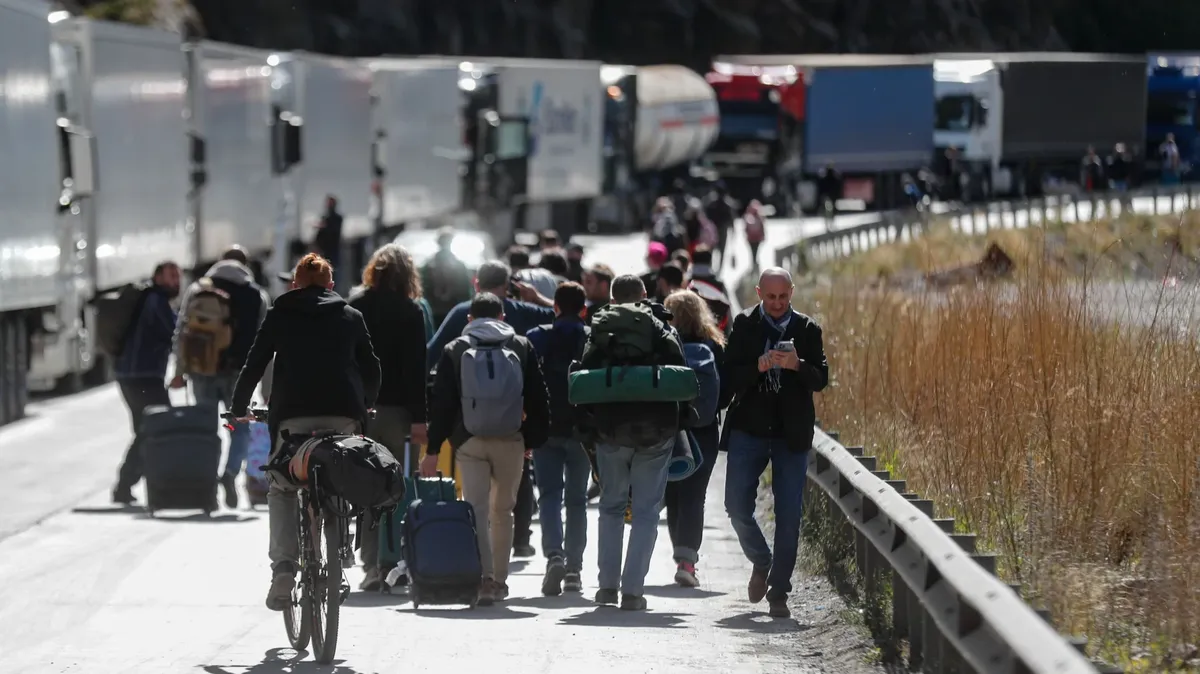
Much faster than I was ready, the turn of the trucks began. They stand on the sidelines, do not bother to go. Drivers roam next to the lost view. Some sit at folding tables, play cards or dinner.
One of them shouted with a smile to me: "Are you running, running?" - And he showed the elbows "chicken." Just in case, I smiled back.
Soon the gorge and Terek became visible. The view is insanely beautiful against the background of twilight. Lermontov, Griboedov ... And now I am.
Then I realized that I had forgotten to buy a headlight to the bicycle: a pitch mountain night would come. And she immediately came - in the mountains the twilight are short.
It was then that I drove into the first cork. Lighting is only the light of the headlights. Cars are very tight and very stupid, some are generally across the road. It is not easy to find a passage in this maze. Often you have to raise a bicycle and carry in your arms.
From each car it is heard: "Uh, do not scratch the car, brother!" And I really would not want to be those who are scratched with any of these cars.
Then I first met other fugitives. These were on scooters, from Voronezh. They spread a few words - they lost their own, remained to wait.
- How much to the checkpoint? - I ask.
- A kilometer ago was 16 kilometers.
15 kilometers for such a traffic jam? Yes, even with a bicycle? Maybe quit him? I decide that I will drag him as much as I can. Forward, forward, while there is strength.
- Good luck!
- Good luck!
I ran on.
Motorcycles are roaring, squeezing through the skins between the trucks and cars, which are crowded in three or four rows on a two -lane road. Many harsh bearded men stand here and there, talking about something, they say by phone.
I pull the bicycle past them, there is still enough strength to not be mistaken and not to touch anyone.
And suddenly - the cork ends, as if trimmed with a knife. Further the path is free. I sp pedaling easily more than ever in my life.
I realized the post -fact that rumors about the mafia working on the road are not rumors at all.
Improvable taxi drivers take a lot of money for the entrance “to how much it is possible”, often tens of thousands of rubles. But the cork does not last at all many kilometers, a maximum of three hundred meters. And after it, the new taxi driver takes a new dachshund - to the second traffic jam. And then the third - already to the checkpoint (yes, there are only two traffic jams). In the line of neutral strip and among those who have already reached Tbilisi, there are rumors about people who eventually paid 40 thousand each.
Cemetery of abandoned cars
Soon after the first traffic jam, the military began to come across, in uniform and with machine guns. And traffic police machines, stripped with multi -colored lights.
DPS officers slow down cars, but do not pay attention to cyclists. The military does not pay attention to anyone. And no one else pays attention to me: does not offer to give a lift or sell something. I'm no longer a target.
I am passing some village-apparently, Lower Lars. There is a store here, but I do not need anything. Forward while there is strength.
It’s completely dark for a long time - and I understand how dark when the absolutely empty section of the track comes across: neither cars, nor people ... But no, people are - I understand this when I almost crash into a pedestrian. This is a whole group. There is no strength to say. I’m going around them, I’m going on.
The second cork is not so terrible, but longer. Its basis is the trucks standing in the right lane, and sometimes in two rows. But here on the right, behind the wagons, there is almost always a travel along the sidelines. There is almost no gangster look around the bearded man.
Drivers are sitting at a folding table, one of them shines with a mobile -like lantern so that I can go around them along the edge of the ditch. Thank him.
For the first time I touch the car - hit the rear with the steering wheel. It did not break, but bent. I say: "Sorry!" - But there is no reaction. The car is empty. Maybe she is thrown. Second - I'm already far away.
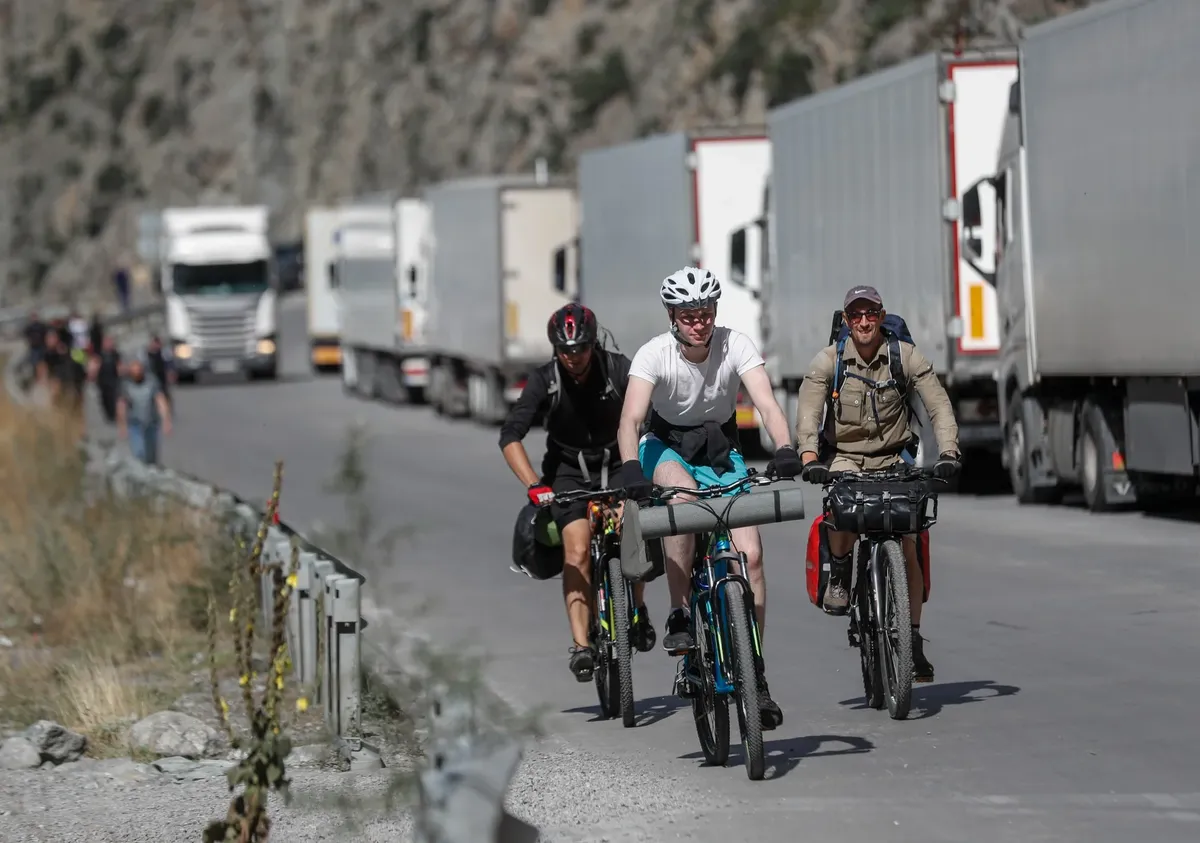
I pour into the caravan of bicycles - the fourth. We find the road in the labyrinth of the truck, looping to it and to it. And suddenly - chop! - A backpack falls from me. I raise it - a plastic carbine burst on one of the straps.
- Crap! - Swear.
- What's happened? - asks the cyclist who was following me.
- The backpack broke.
-Help something?
How can you help here?
- No, I can handle it. Thank you.
The guys are leaving. Four motorcycles carry me past me, all with passengers. In one of them I recognize a man in a jacket, who flew from Moscow to Vladikavkaz a few hours ago.
I examine the backpack. It's not so bad. I tighten my teeth with a double knot on a small stump of fabric. I hung it on my shoulders - normally, does not break. The first time in the entire road - since I stopped so and so, - I allow myself to make a couple of sips from the bottle of Cola attached to the frame.
I’m going further - the strength seemed to have even increased.
In a narrow place, I touch the wing of a white car with a wheel. Behind the female voice in a tongue in a language that I do not know. I decide not to turn around and not say anything. I disappear in the night.
The traffic jam ends and the auto is starting: on the right side of the road - trucks, on the right strip forward - an endless series of cars. In the left lane - back to Russia - from time to time, lonely cars go from the Georgian side. To drive along the oncoming lane or on the left side of the road is not a problem. On the left far in the dark, Terek is noisy.
A large number of traffic police patrols and the military. A lot of motorcycles and ATVs carry passengers and bicycles towards the checkpoint. On the quadriki you can go around any cork on the side of the off -road.
Then I find out that many of the cars are abandoned. People lived in them for several days, while the line almost did not move. Those who were driving in large groups were often divided:
Women who seemed to threaten nothing to drive later, men walked on foot to have time to escape. And someone gave up and returned back. Later they told me that in one of these cars a three -year -old child with a temperature of 40 was sick for three days. The endman did not know how it ended.
At some point, I am daring. I stop to take a breath, I get the energy, swallow and lead a bicycle - you can’t stop.
There are many cyclists and pedestrians around. They drag bags on wheels - these are my brothers and sisters in misfortune.
Ahead I see buildings behind mesh fences and barbed wire. The checkpoint is close!
And suddenly I understand that on the right, on the oncoming lane, there were too many pedestrians. This is a pedestrian queue. I think that I need it, but in this place there is a high fence of concrete blocks along the dividing strip. I’m going with strength to throw a bicycle through it, but then someone from the darkness tells me that for the Great is a separate line on the right, behind the line of trucks. Perhaps this person helped me save for many hours.
I immediately find the end of the line and take a place. Here are all “their own” - fugitives. But the conversations are not glued - it is too early to flutter, the place is very alarming. Sometimes we communicate with each other, but quietly and constrained. Time - 19.30. I left Vladikavkaz only two and a half hours ago, and in the sensations - as if I had passed all day.
"You are a traitor, the bicycle regretted selling"
It's dark, it’s hot, but a strong wind blows. The line moves slowly, jerking.
In turn, rumors are worn about the “Ride” at customs: all border guards will go for an hour for a break.
A familiar Georgian calls me, who drove along this highway many times and confirms: the skull from 21 to 22.
Well, what to do? We will stand as much as necessary.
People in balaclavs go past the queue, shine in their faces with flashlights and offer: “Selling a bike, brother!” Unsable production: sell a bicycle for 20–40 thousand, then buy it on a checkpoint for 1–2.
“Sell bicycles, still quit - Georgians with bicycles do not let, brother!”
Then, in line on a neutral strip - neutral - I heard this from many pedestrians: “If you want a bicycle to Georgia, I had to stand in a car line. And you got into a pedestrian. They will not let the bicycle go. ”
It turned out to be a lie - they allowed. The bicycle-pester-made line after entering the Georgian gearbox is divided into pedestrian (passing into the building) and a bicycle (you go through the car gates). And just business.
It becomes cooler. I put on a jacket. The wind blows continuously and very strongly - on the plains this is only “impulses”. It’s good that it is warm. And there is no rain.
Suddenly I hear a guy with a girl quarreling. The girl begins to cry. But it turns out that this is not an Abuez: "What will I do without you?" She says through tears. "Don't know! About twenty days a summons will come, and that’s it ... "
It turned out that he was wrapped on the border - he was on the list. I tried to argue, but there was no sense. The couple descends towards Vladikavkaz.
It approaches 21 hours - and suddenly the queue begins to move faster. I am trying to count how many trucks are left before turn, but each time there are five - there are more of them than it was seen from afar.
The queue reaches the bridge over the Terek. And suddenly, ten minutes before the terrible 21 hours, he begins to "fly" at an unimaginable speed!
A big jerk is a pause. Again a big jerk - a pause.
Ahead, at the checkpoint itself, a scandal is started. A man in a sports jacket demands to sell him a bicycle: “You are traitors, panties, run, and we will protect your homeland! And you regretted my bike! " What they answer the extortionist, I do not hear. Another jerk of the queue -
And I see a border guard who is trying to shout out the deceiver, the “patriot”: “passports in the open form! Do not take pictures! Who will take out the phone - I will send at the end of the line! "
I show my passport and go forward. The huge space of the checkpoint, there are cyclists and pedestrians with bags on wheels. I understand that you can go here and sit on a bicycle - my legs have already begun to get sick with standing.
Soon I get to the line of the gates of passport control. Cyclists are directed to three extreme windows, the line goes quickly.
Suddenly the border guard comes up: "Three are behind me!" - And leads the three most smart into a separate free window. When he comes up the next time, I find myself smart. The border guard leads us three to a free window. The border guard takes my passport, peers into my face. He encourages the question: "Patronymic?" I call it. "Year of birth?" I call it. Puts a stamp. I'm going through. But I don’t feel that you can rejoice.
Later they told me that many of the guys were taken to the pont: they said that they would not be missed, they were discharged a summons. I don’t know how many were drove - I spoke only with those who were on the other side. They answered: “I don’t know, I didn’t get anything,” after which they put a stamp and passed. Although there were those to whom the agenda really was discharged, and they wrapped them without the opportunity to get out (like the one that, together with the crying girl, passed me in bicycle).
"And that all this is running somewhere ..."
I continue to move around the space of the checkpoint, in front-wide away gates, and behind them, in front of the Duty-Fri shed, stands a large dark group of full people with beards.
Suddenly someone nales me to the left of the darkness: "Passport!" A person in a civilian jacket stands in the opening of a building.
I peer into it, but I do not see epaulettes or other distinctive signs. The least I want to give my passport to someone.
- Are you an employee? - I ask carefully.
- And who? - He grins.
Then a second appears from the darkness - on it is burgundy tunic and trousers. And I understand that the first under a civilian jacket has the same form. FSB-Shniki?
I give a passport.
- Where are you going?
“Yes,” I am not quite lying, “I’m going on a trip.” I want to get a bicycle to Istanbul, and if I get a Bulgarian visa, then to Belgrade.
I really considered this possibility: if there are strength after the border, continue the path by bicycle. With the Bulgarian visa, in the spring he promised to help in which way the St. Petersburg activist Krasmyr Vranks. As far as I knew, he settled in his homeland, in the city of Croesy Zagora - and this is just on the way from Istanbul to Belgrade, it would be great to see ...
Meanwhile:
“And that all this is running somewhere ...” the FSB-Shnik asks with a pronounced thoughtfulness.
“I don't know,” I say, “I am a bicycle tourist.” I was going on vacation for a long time.
- OK. Happy Way, - he gives me a passport.
I remove the book of life in a reliable waist bag and finally go beyond the gates of the checkpoint. Time - half of the tenth. So, I went through the border just during the road? It seems that the number of border guards just by this time increased on the contrary ...
But the alarm does not leave: I hear from the group of bearded men: "Sell bike!"
I do not answer anything, I sit in the saddle and disappear in the night. The fears were in vain: from that moment, suspicious personalities were no longer met.
I know that the neutral is three or four kilometers with a length. Osil. I'm going to absolute darkness. But darkness does not last long. After five hundred meters, the line begins on the Georgian border.
Hundreds of cars and trucks lined up in one line. According to the oncoming lane, cars are traveling from time to time, lonely or in small groups. The light of the headlights helps a lot - there is no other light source here.
Вдруг дорога входит в старинный тоннель. Про тоннели я не знал — оказалось, что их тут два.
В первом дорога превращается в пыль и битые камни. Ехать невозможно, и даже тащить велосипед по узкому промежутку между машинами и стеной сложно. Двигатели машин работают, благодаря этому светят их фары. Выхлопные газы сдуваются сильным ветром. Но первый тоннель скоро заканчивается, дорога выходит на очередной мост через Терек. Тут ветер такой силы, что ехать невозможно.
Ночь на нейтральной полосе
Перед вторым тоннелем — большая группа пешеходов с багажом.
— Что сидим? - I ask. — Случилось что?
— Отдыхаем просто. Впереди тоннель, кто его знает, что там?
Киваю, еду вперед. Поначалу второй тоннель идет хорошо. Тут отличный асфальт, по встречке — можно ехать. Вдруг меня окликают справа:
- Wait! Здесь очередь.
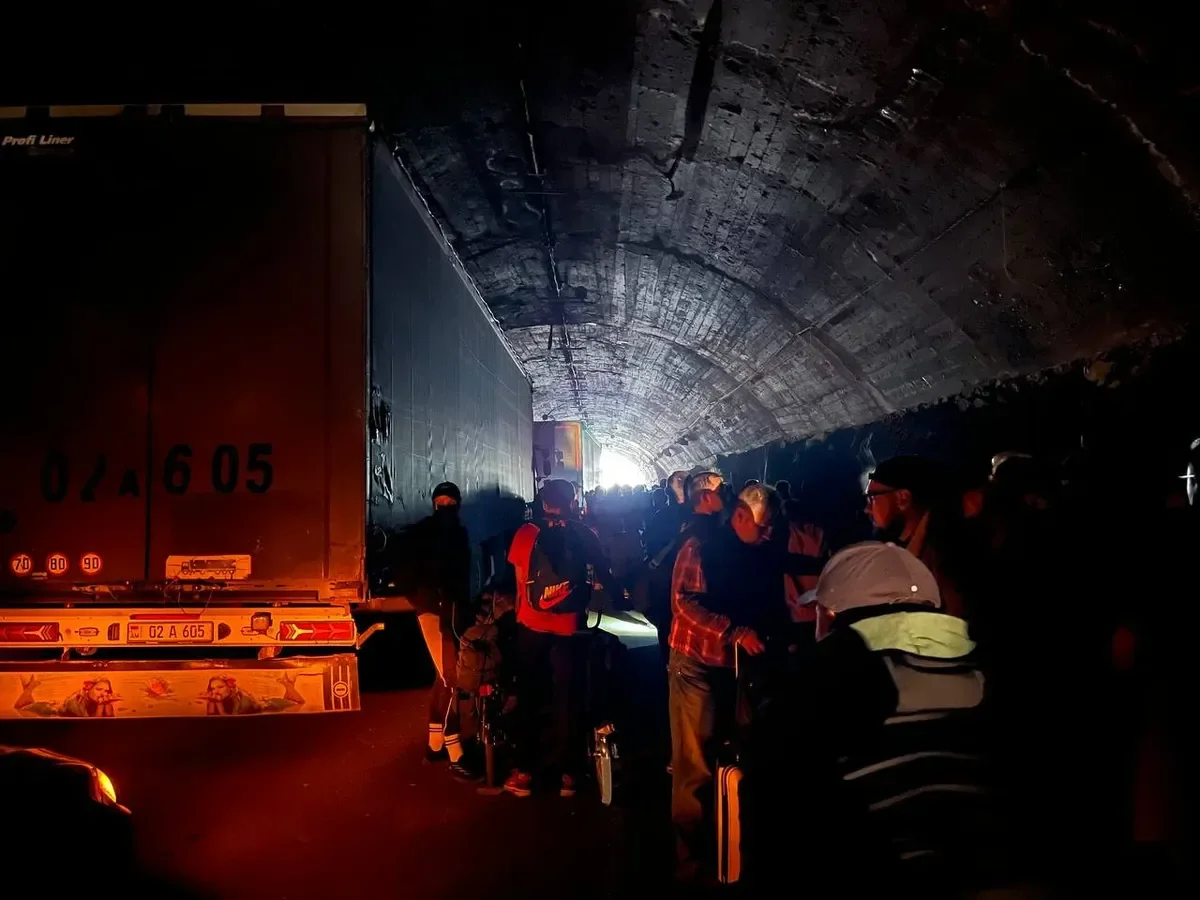
И правда — в два-три ряда, прижимаясь к стене, стоят вперемешку пешеходы, велосипедисты, самокатчики.
— Если уйдешь вперед, там не впустят, придется всё равно возвращаться.
— Логично, — отвечаю и встаю в очередь под сводами древнего туннеля. Как далеко выход — не видно. Машины в своей очереди рядом стоят с работающими двигателями и светят фарами. Выхлопных газов почти не ощущается — из-за сильного ветра. Но их воздействие может накапливаться… наверное?
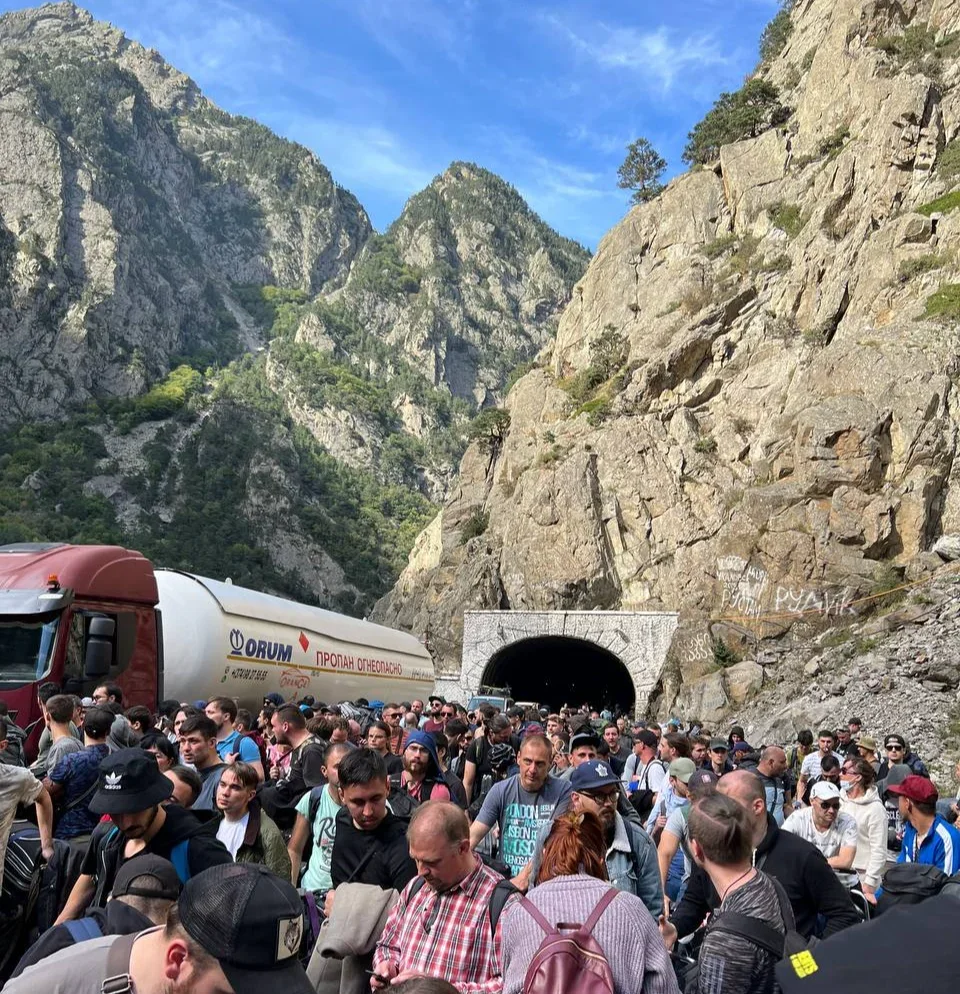
Завязываются первые разговоры. Кто откуда, кто сколько дней просидел в машине (из того, что я слышал, — максимум три), кто сколько времени стоял в очереди (пешеходам, похоже, приходится хуже велосипедистов — они стоят дольше, по 6–10 часов; их больше, очередь менее выстроенная — из-за этого возникают конфликты).
В этой очереди стоять физически тяжело — но страха уже нет.
Все, с кем я перекинулся хоть парой слов, бегут не от мобилизации. И не из трусости. Мы бежим от фашизма, безнадеги, подлости, лжи. К новой жизни. Потому что позади жизни уже нет.
Хотя там всё еще остается много людей, из которых некрофильский режим высасывает душу.
У всех нас отличное настроение, ведь самое опасное — российскую границу — мы уже прошли. Дальше может быть тяжело — но это же временные трудности.
Проходит минут сорок. Очередь почти не двигается. Многих начинает всерьез волновать опасность выхлопных газов. Но рваться вперед — значит вызвать конфликт. Ведь те, кто стоит впереди, прождали здесь дольше нас, их можно понять. Хотя кто-то всё же обгоняет, не слушая предупреждений, многие из них потом возвращаются. Но все ли? It is unlikely.
Вдруг приходит спасение — волонтеры. Они работают в контакте с грузинскими погранцами. Помогают организовывать очередь, разносят воду. Среди них точно был один грузин, но большинство — россияне, которые прошли границу и решили задержаться, чтобы помочь другим, — тем, кто идет следом. Если это не подвиг — то я не представляю, что такое подвиг. Потому что доподлинно знаю это чувство — как хочется, перейдя границу, наконец свалить отсюда куда подальше.
В этот раз волонтеры совершают чудо: они заставляют очередь впереди нас ужаться и встать более широким фронтом. А тех, кто еще не вошел в тоннель, останавливают, чтобы ждали, пока выйдем мы — застрявшие внутри, — а потом пропускают небольшими группами.
Позже, уже днем, я узнаю, что система работала долго: мимо меня прошла команда парламентеров из-за тоннеля — разбираться с тем, что их пропускают группами всего по 10 человек, хотя могли бы больше. Среди переговорщиков затуннелья — парень в косухе, которого я запомнил с самолета и потом видел на заднем сиденье мотоцикла. На дороге к КПП он меня обогнал, но пешая очередь съела всё это преимущество.
Всего в туннеле я простоял часа полтора.
Свежий воздух был маленьким счастьем. Но ветер становился всё сильнее, он нес с собой пыль, которая била в глаза, очки спасали мало. Люди закрывали лица шарфами, козырьками бейсболок. Снова послышался шум Терека. Мы находились в глубоком ущелье, но справа от дороги ничего не было видно.
За выходом начался склад брошенных на обочине велосипедов. Всего их было несколько десятков, может быть, пара сотен. Как я понял, бросали велики в основном те, кто договаривался с водителями подсесть к ним в машину.
Какие-то люди копались в велосипедах, светя мобильниками и налобными фонарями, забирали целиком или по частям. Наверное, этим занимаются и мафиози, промышляющие на дороге, но позже в очереди я встретил «нашего» человека, который подобрал два одинаковых велика:
— У меня дети — двое парней, они обрадуются.
— Ты живешь где-то рядом? - I did not understand.
— Нет, они в автоочереди сзади. У нас микроавтобус. Дождусь их, положу в него велики. И поедем дальше, куда глаза глядят. Может быть, в Турцию?
Вскоре после выхода из тоннеля я взглянул на часы — 00:20. Началась среда, 28 сентября. Еще пара часов, и я в Грузии! If…
Мы стояли и стояли. Стояли и стояли. Потом вдруг рывок — и очередь продвигается на пять метров. На три метра. На два метра. В час по чайной ложке…
Наверное, вы ждете фоток? Их нет у меня. До российской границы я просто не останавливался, на КПП снимать запрещено, а в очереди на нейтралке я не мог ничего делать от боли: сил хватало только на то, чтобы продолжать стоять.
У меня плоскостопие, пусть не очень выраженное. Ноги начинают болеть уже через минуту неподвижного стояния на месте. Ортопедические стельки помогают, но не спасают.
К двум ночи от боли в ногах я уже не мог думать. Но оказалось, что можно терпеть, даже когда невозможно терпеть.
Одному легче было пробиться к российскому КПП. Но стоять в очереди в одиночку — этого не посоветуешь никому.
Те, кто стоят в группе, могут отходить в сторону, чтобы посидеть на камнях или даже поспать. Я отойти больше чем на минуту не могу: слишком темно, чтобы запомнить лица соседей. Потеряешь очередь.
Впереди справа — небольшой костерок и фонарики. Люди сидят, видимо, на берегу Терека. Эти — явно не из очереди.
Примерно в три часа ночи мы приближаемся к ним.
— Эй, мужики! — кричу им. — Вы здесь чего сидите? Вас в Грузию не пустили? — я читал об этих невезучих у волонтеров, которые просили по возможности захватить им еду (воду они приспособились набирать из Терека). Вроде бы некоторых россиян грузины сразу не пускают — их ждет трехдневная проверка.
— А вы с какой целью интересуетесь? — с некоторой опаской отвечает один из них, и тут же добавляет, — знаете, в тюрьме так спрашивают?
Я понимаю, что это шутка.
— Есть хотите?
- What? — он не слышит меня из-за ветра.
— Еда, говорю! Есть хотите?
- Yes! — с надеждой в голосе.
— Тогда сюда идите.
Подходят только двое. Отдаю им десяток шоколадок и пару бутылок лимонада — всё, что сумел дотащить. Одну бутылку, энергетик и пару шоколадок заныкал себе.
— Вы волонтер? - Ask.
- No. Но от них услышал о вас.
- Thanks a lot! Очень выручили.
Парни вернулись к костру и стали делиться с другими.
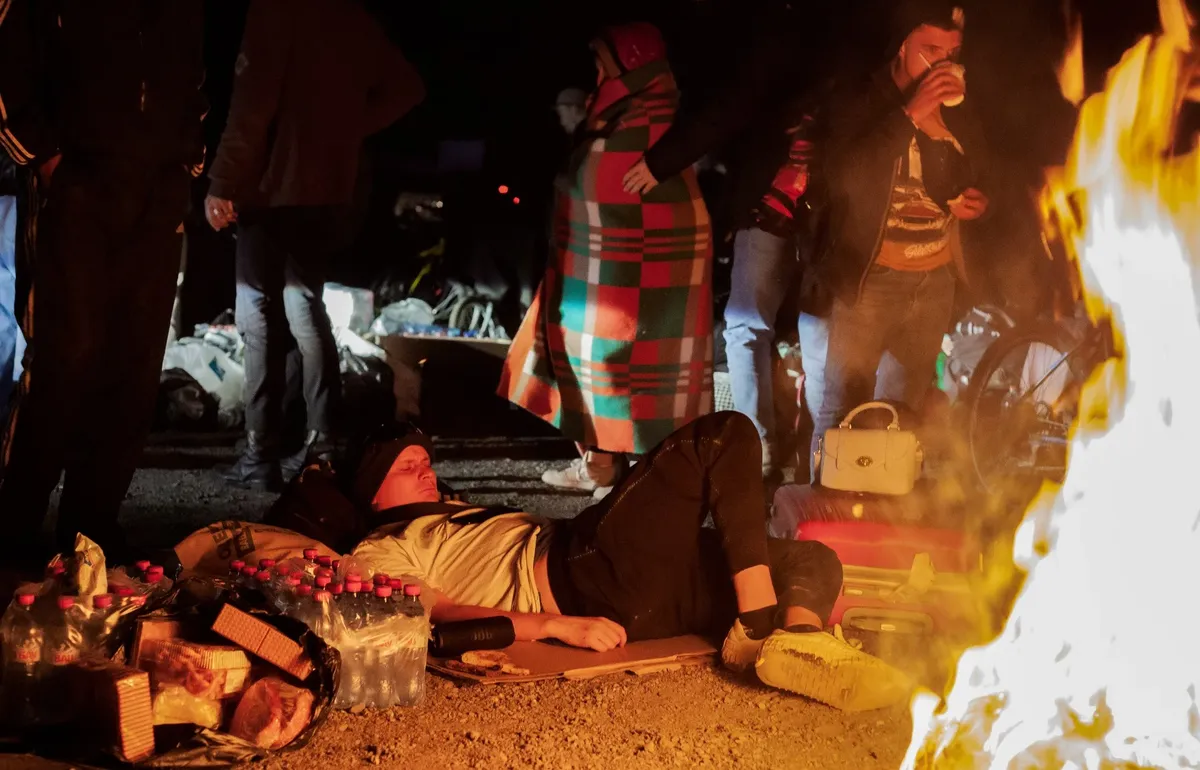
Еще час… или два? Вдруг вижу одного из волонтеров, которые спасли нас из тоннеля. Имени не знаю, поэтому кричу фамильярно:
— Эй, волонтер!
- Yes!
— Сколько до КПП?
— Не знаю, парни, честно.
— Да не времени! - I scream. — Километров сколько?
— Да метров двести, — и это лучшая новость за эту ночь. Пару часов ведь всего понадобится, да?.. Эх, если бы!
Начинается самая жуткая часть ночи.
Вокруг меня черные тени под черными капюшонами. Ветер такой, что говорить сложно, даже если захочется. И говорят мало. Хотя кто-то всё же смеется, шутит — в своих группах. И это тревожно — потому что у тебя-то группы нет.
Я прошу парня слева от меня подержать велосипед, чтобы отойти в туалет. He nods. Отхожу за каменную руину в пяти метрах от нас, в темноте скольжу по склону и ударяюсь коленом о какую-то трубу, торчащую из земли. Но не сильно — это меньшая из моих бед.
Быстро возвращаюсь — очередь не продвинулась ни на шаг.
Нас постоянно просят сместиться вправо, чтобы освободить проезд, особенно когда идет фура или автобус. Я стою на острых камнях. Боль в ногах кажется невыносимой… Но я ее вынес, значит всё было не так страшно. Один раз я сажусь на пенку, но места между людьми так мало, что вытянуть ноги, а тем более лечь — невозможно. Из-за неудобной позы всё начинает ныть и затекать. Я с невероятным трудом встаю. Лучше продолжать перебирать ногами на месте, опираясь на руль велосипеда.
Вскоре я узнаю порядок: грузинские пограничники запускают десять человек из нашей вело-пешеходной очереди, потом десять машин в ту сторону, потом десять машин обратно, потом снова из нашей. Цикл занимает минут десять-двадцать. А передо мной… тысяча человек? Две тысячи? More? Это кажется безнадежным.
Тем более что без очереди, по дороге между машин, регулярно проходили люди с маленькими детьми или с колясками, в сопровождении своих мужчин. Против этого никто не протестовал: понятно, что детям такую очередь не выдержать. Но каждый из них — это место в очередной десятке.
Один поворот дороги, которая идет вплотную к отвесной скале, выпил очень много крови. Там сложно повернуть фурам, особенно если кто-то стоит на встречке, и еще более особенно — если их поджимает к скале наша очередь на обочине.
Волонтеры и водители орут на очередь, пытаясь сдвинуть ее вправо, орут друг на друга. Вдруг какой-то микроавтобус вырывается вперед и преграждает возможность повернуть очередной фуре. Волонтеры набрасываются на него, кричат:
— Сдавай назад!
Водитель огрызается в ответ, пытается ехать, волонтеры встают перед машиной, один чуть не попадает под колеса. Тогда водитель — пожилой кавказец — выскакивает из микроавтобуса с огромным охотничьим ножом и бросается на волонтеров. Наносит резкие удары, те отпрыгивают и разбегаются. Это нейтралка, закона нет.
Водитель садится в машину и проезжает вне очереди через проклятый поворот. Потом вдруг останавливается, и в его микроавтобус садится с десяток пассажиров — похоже, они шли пешком впереди него, но тут он их нагнал. Ведь автоочередь ночью движется быстрее.
Вскоре после этого по дороге проезжает женщина в электрической инвалидной коляске с прицепленными ходунками, прикрывая лицо капюшоном от ветра. Как она здесь оказалась? Проехать всю эту дорогу на такой коляске она бы не смогла. Значит, была в каком-то транспорте и пустилась своим ходом? Сопровождения при ней я не увидел. А если сломается?..
На грузинском КПП
Наконец мы прошли чертов поворот, и впереди я увидел его — грузинский флаг, освещенный на фоне черного неба. Белое поле и большой красный крест. Маленьких крестов мне было не различить.
Это была надежда — потому что флаг был близко. Двести метров? Может, триста? Там должен быть погранпункт.
Стояние длилось и длилось, я пытался петь, чтобы отвлечься от боли в ногах. Голода я не чувствовал, но иногда прикладывался к бутылке с колой.
А потом стих ветер. И это было поистине прекрасно — потому что стало можно нормально говорить. Шутки, просто треп. Кто откуда едет, кто куда направляется. География подобралась — на любой вкус и цвет. Кто как проходил КПП, кто сколько стоял в очереди, кто сколько платил за велик или подвоз. И, конечно, как погано стало в рашке и какая сволочь наша фарфоровая крыса.
Разговоры помогли наладить контакты. Люди делились друг с другом водой и едой. Обстановка разрядилась. Хотя очередь всё равно почти не двигалась.
А потом внезапно настало утро — очень быстро посветлело, развиднелось, вокруг нас оказалось ущелье, а вот Терек скрылся за грядой невысоких камней. На этих камнях сидели и лежали люди, отошедшие из очереди.
Ожидание продолжалось. Флаг манил, но не хотел приближаться. Одну-единственную машину — кем-то брошенный на дороге «лендровер» — обходили больше часа.
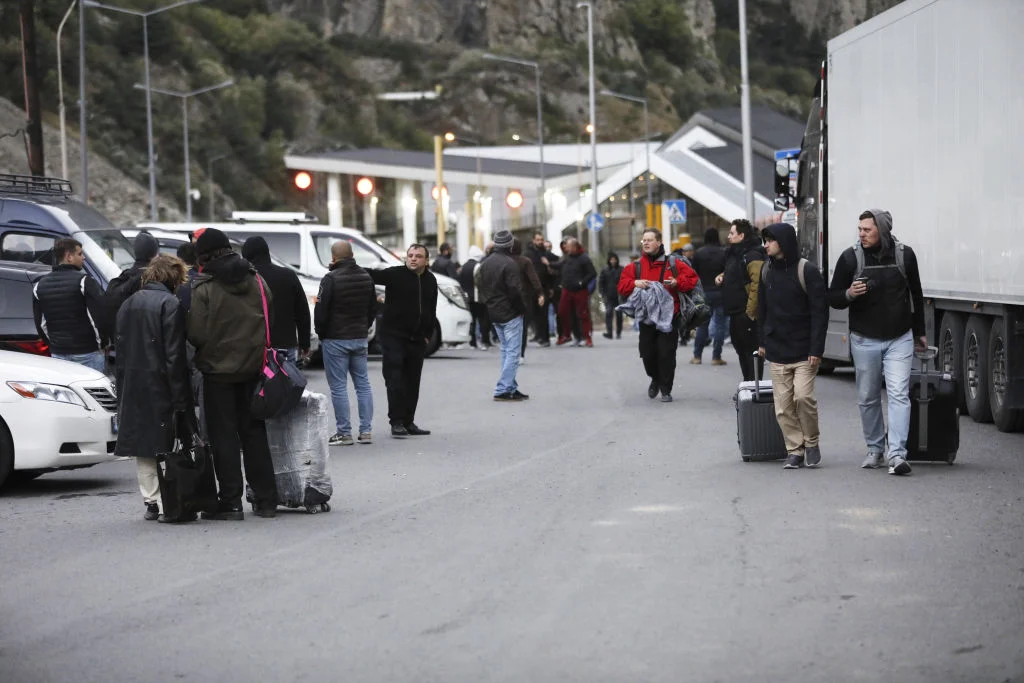
Потом наступило семь утра — и началась новая жизнь. Свежие волонтеры начали разносить воду. Штат пограничников увеличили, и нас начали пускать большими группами. Правда, от постоянного «сдвигания вправо» очередь превратилась в гигантскую толпу. И запихать эту толпу в узкие ворота было непросто: чтобы сузить очередь, кому-то нужно уйти назад, то есть отдать с такой болью отвоеванные у нейтралки метры. Даже если осознаешь, что от этого дело пойдет быстрее, — пройти хоть шаг назад физически невозможно. Тем более что справа, по долине, очередь начали обходить те, кто «вас здесь не стояло». Лично мне сложно их обвинить: российское КПП этой ночью работало гораздо быстрее грузинского. Очередь в нейтралке росла и почти не двигалась. Это рождает отчаяние — а отчаявшийся человек пытается сделать хоть что-то…
Часам к шести утра к флагу добавился новый ориентир — белый сарай. Это оказался «Дьюти фри», некоторые ходили туда за едой. А часов в восемь перед моим взором предстали заветные желтые столбы — ворота КПП. Они были близко! И страшно, болезненно далеко.
Ног у меня уже не было. Была только боль и матерные выдохи вполголоса.
Подошла молодая парочка — мужчина и женщина.
— Пожалуйста, впустите нас в очередь, — сказал он. — Мы волонтеры, и нам обещали, что за это нас пропустят со следующим заходом. Но люди в начале очереди нас впускать отказались. В конец мы не пойдем — это нечестно, а свое прежнее место мы потеряли. Пускаете?
Раздалось несколько положительных ответов — и мой в том числе. Парень казался честным, а просьба — справедливой.
Примерно через полчаса случилось очередное чудо! Очередь понеслась вперед широкими волнами, причем каждая из них была в два приема. Метров десять вперед, потом еще метров восемь.
Подошел явно выспавшийся волонтер и бодро крикнул:
— Кто хочет поволонтерить?
Никто не отозвался: все устали до чертиков.
— Кто возьмется, будет организовывать следующую волну, а с волной после этого может войти вне очереди.
Пока остальные соображали, один мужик быстро согласился. Потом он пару раз проходил мимо нас в светоотражающей жилетке. Вроде бы перед ним слово сдержали — хотя уверенности нет.
Волны пошли большие и частые. Рывок метров на двадцать, а потом сразу — еще метров на двадцать! Такой кайф испытывают люди, выигравшие в лотерею: когда никакой надежды нет, и вдруг — вот она! Грузинских пограничников явно прибавилось и переход заработал в полную силу.
Я уже видел сетчатый забор. Слышал, как ругается грузинский пограничник, требуя «выстроиться в шеренги по пять». Один предприимчивый знакомый из очереди предложил мне кооптироваться в его пятерку. I agreed. Но наша пятерка так и осталась единственной, ведь если выстраиваться по пять человек — кому-то придется идти назад. В итоге, под нажимом погранца, мы всё-таки сделали шаг назад. И с правого фланга сразу полезли внеочередники!
Тогда это казалось важным. Казалось, что шанс вот-вот выскользнет из рук, ведь нас всю ночь приучали к тому, что «очередь — это вещь, которая не двигается».
Но это не было важным. Потому что буквально в следующую волну впустили человек сто, а в следующую за ней — еще человек восемьдесят минимум. Я не знаю, было ли больше, потому что в восьмом десятке оказался я.
И я перешел за желтые столбы, и вдруг оказалось, что у меня есть ноги, и они могут ходить. А потом я сел на велосипед и поехал — метров двести-триста, к вело-очереди к окошку погранконтроля.
Четыре человека стояли передо мной, потом подошли трое грузин — граждан страны без очереди пускают, — потом три, два, один… и вот я протягиваю свой паспорт, говорю: «Здравствуйте!»
Мрачный погранец что-то смотрит, печатает на компе и без слов ставит штамп с визой. И это — всё! Я в свободной Грузии? Неужели это правда? Прощай, немытая Россия, и всё такое? Быть может, за стеной Кавказа?
***
На площади перед КПП я продал велосипед за 6 тысяч рублей — пришлось поторговаться. Жаль было оставлять идею с велотуром по Азии и Европе — но сил на этот подвиг я в себе больше не чувствовал.
С четырьмя парнями скооперировались и взяли микроавтобус до Тбилиси. Я из них видел в очереди лишь одного — но мы все уже были как однополчане. Пуд соли вместе съели, железные сапоги износили. И понеслись мы — сто двадцать километров по красивейшей на свете Военно-Грузинской дороге, с очень душевным, крайне клиенто-ориентированным, пусть и значительно консервативным водителем Георгием.
А как меня в первую же минуту на улице грузинской столицы задержали за то, что у меня был при себе нож, полицейские, и чем всё это кончилось, — это уже совсем другая история.