
Translated material
Billions of years ago on Mars could exist microorganisms producing methane
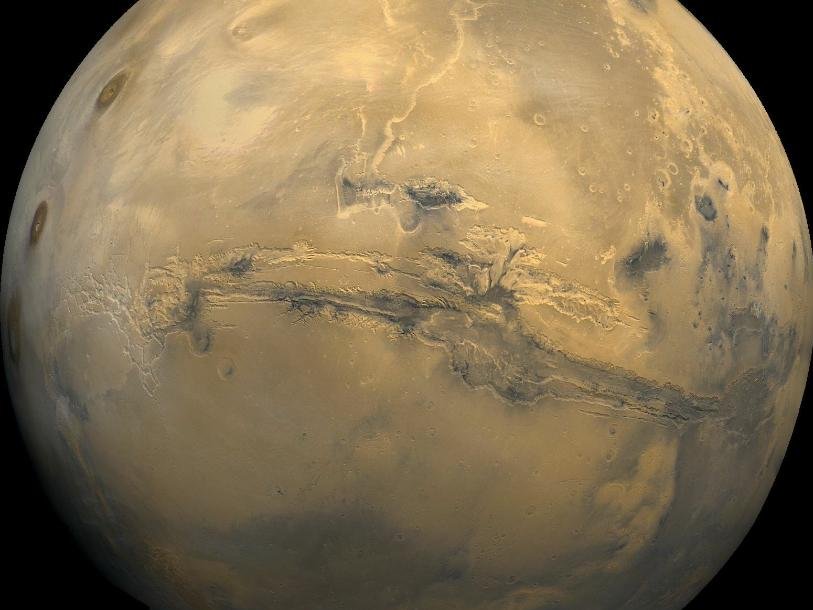
According to a new study, the bowels of Mars in the Noan period (4,18–3.7 billion years ago) were probably suitable for the habitat of microorganisms that fed hydrogen and produced methane.
The available data indicate that on Mars there were at least a part of its history - potentially favorable conditions for the development of life. “In the Noan period, the Cora of Mars could provide a favorable environment for a microbial life,” says Boris Soterey from the Department of Ecology and Evolutionary Biology of the University of Arizona and the Institute of Higher School in Paris. - The porous, saturated with brine, the regolite would create a physical space protected from ultraviolet and cosmic radiation, and provided the solvent, while the underground temperature and diffusion of a dense restored atmosphere could support simple microbial organisms that consumed hydrogen and carbon dioxide as sources of energy and carbon and produced methane as waste. ”
Boris Sotere and his colleagues simulated the interaction between the early Martian environment and the ecosystem of methanogenic hydrogenotrophs - microorganisms surviving by the consumption of hydrogen and methane production - which are considered one of the earliest forms of life on Earth. Their modeling showed that the Martian bark was a place suitable for the existence of such an ecosystem (provided that the surface was not completely covered with ice), and could produce a biomass similar to the Earth's early ocean biomass.
They predict that this ecosystem would affect the climate of Mars, globally cooling it 40 degrees on Kelvin and creating less suitable conditions for life near the surface. This would make microorganisms move deeper into the bark of the planet. Looking ahead, the researchers identified three areas - the plain of Hellas, the plain of Isis and Crater Ezero - as the best places to search for signs of this early methanogenic life at the surface of Mars.
The study is published in the journal Nature Astronomy.