
Translated material
Man of the day: Boris Rossokhin
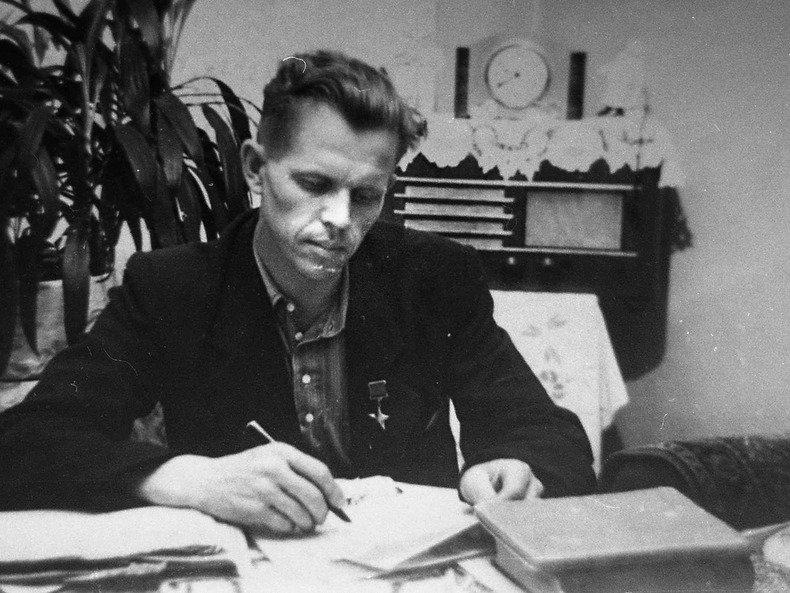
On October 11, 1922, Boris Rossokhin was born, a pilot-player
Personal business
Boris Gavrilovich Rossokhin (1922-2005) was born in the Kirov region in a peasant family. From childhood he lived in Sverdlovsk, then moved with his parents to Tavda, where he studied at school No. 1. After graduating from high school, he worked in a geodetic party.
In 1940, at 18, he was drafted into the Red Army. Still studying at school, Boris dreamed of becoming an artilleryman, learned the army charter brought by one of the children who had already served. But at the military registration and enlistment office he was offered an aviation school. As a result, Boris became a cadet of the Chelyabinsk military aviation school of mechanics, which he graduated in 1941. He was left at the school as the main mechanic, the foreman of the unit. Here the war found him. Rossokhin persistently asked for the front, but the command decided that he would bring more benefits in the rear, preparing the young generation of pilots. However, Boris did not give up and literally bombarded the command with requests for transfer to the army and sending to the front. Only in 1943 was his request satisfied - in October after graduating from the Molotov Military Aviation School of pilots in Perm, he was sent to the army.
He served in the 59th Guards Assault Aviation Regiment of the 2nd Guards Assault Aviation Division of the 16th Air Army of the 1st Belorussian Front. In November 1943, Rossokhin received the IL-2 attack aircraft, the famous “Flying Tank”, as ours and Germans called this aircraft. Often flew into air intelligence, usually alone.
On February 15, 1944, flying out for reconnaissance in a battle at Petrovichi Polesie region, Rossokhin discovered 15 vehicles and 70 equesties on the Rechitsa highway - Gluska. He made seven visits to the target, during which he destroyed at least two cars, 6 wagons with cargo and about a dozen German soldiers and officers.
On July 5, 1944, Rossokhin was instructed to explore the location of the enemy’s troops in the Baranovichi area and the movement of our mobile groups in the rear of the enemy. During intelligence at the Ozeritsa station, he found three railway trains west of Baranavichy. Entering the target from the side of the Sun, Rossokhin threw off bombs and set fire to a train with fuel, from which the other two trains were destroyed.
On September 11, 1944, completing the intelligence task in the Prague area in order to find and photograph the location of the enemy tanks, when approaching the target was met with strong anti -aircraft fire. Despite the massive barrage fire, Rossokhin nevertheless completed the task, performing 8–9 visits on the shaving flight. He discovered about 30 German tanks and attacked them. At this time, his plane was knocked out of anti -aircraft guns. Oil tank was pierced at the car, hot butter poured into the cabin, poured Rossokhin's glasses and burned his eyes. But he still brought his plane back to the airfield and delivered valuable intelligence.
Just a year later, Lieutenant Boris Rossokhin, Lieutenant’s military operations, was already a link commander. By November 1944, on his combat account there were one hundred and thirty -eight sorties in the conditions of intense air battles, many destroyed tanks, defeated echelons, burned warehouses with ammunition, disabled military equipment and enemy manpower. He himself was also beaten more than once, he was burning in his IL-2, he was repeatedly wounded.
In July 1944, Rossokhin was shot down in the sky over Belarus. His car fell behind the front line. “An uncontrollable car rushed to the river. It was too late to jump with a parachute and it was useless - the enemy is below. If before this day to Rossokhin they said that there were miracles on Earth, he would, of course, doubted. But on this day I had to believe in a miracle: the attack aircraft landed on a gentle sandy slope, rolled down the river along it, cutting its wings with rare young trees. A few minutes later, Boris, all broken, overdating the unbearable pain, left the cabin miraculously an exploding “Ilyushin”. In a dry voice called out an arrow. With difficulty, they got out of the plane and, before the darkness, sat in a thick oak tree, ”this case describes this case by Benjamin Kolykhalov in the documentary story“ Fiery avalanche ”.
An experienced taiga and ranger, Boris Rossokhin brought the shooter to his own on the third day. In the fall of the aircraft, he was injured by the spine, his limbs began to refuse him, and the doctors gave him disability. But as soon as his arms and legs began to move, Rossokhin escaped from the hospital and returned to the regiment.
On February 23, 1945, Lieutenant Boris Rossokhin was awarded the title of the Hero of the Soviet Union with the award of the Order of Lenin and the Golden Star Hero and the Golden Star’s medal and the Golden Star Helder and heroism.
However, wounds nevertheless made themselves felt and Rossokhin was transferred to transport aircraft. In 1945, after he lost consciousness during one of the flights, Rossokhin was fired in the reserve with the rank of senior lieutenant. Later he was awarded the title of Colonel of the reserve.
Being commissions from the army, Boris Rossokhin arrived in Sverdlovsk in 1946 (now Yekaterinburg), where he first began working as a senior engineer, and then the head of the plant department No. 28 (Pneumostroymashin), he was appointed director of the FZO No. 41 school at the plant. But the young front -line soldier wanted to study. He enters the evening department of the Physics and Technical Faculty of the Ural Polytechnic Institute (UPI), and in 1955 he graduates with honors.
After graduating from the institute, Rossokhin was sent to work in Bulgaria, then to Germany, where he helped restore industry destroyed by the war. Already in peacetime, he was touched by an explosive wave on the uranium mine of the Vismuth Joint -Stock Company in Thuringia (GDR). As a result, he was again in the hospital.
In 1960, he returned to his homeland and joined the Institute of High -Tempery Electrochemistry of the Ural Branch of the Academy of Sciences of the USSR. In the laboratory of molten salts and electrolytes, he performed a large cycle of scientific research on the receipt and refinement of titanium, the alloy formation of beryllium, nickel, zirconium and other rare -earth elements. The resulting experimental data formed the basis of the candidate dissertation, which Rossokhin defended in 1966. In the same year, he became a scientific secretary, and in 1969 - the deputy director of the institute.
In 1973, Rossokhin organized the Galvanics Laboratory and headed it for ten years. The technologies developed in the laboratory of producing renieval foil and special products from molybdenum, as well as coatings from rhenium and titanium, are introduced into production in the Ural plants.
In 1983, Rossokhin asked the institute’s leadership to dismiss him from his position for health reasons. The request was satisfied. He was transferred to the post of chief of staff of civil defense and the head of the 3rd department. In this capacity, he worked at the institute until 1988.
Even while retired, the former combat pilot was actively engaged in social activities.
Boris Rossokhin died on July 18, 2005. He was buried in the Shirokorechensky cemetery of Yekaterinburg.
What is famous
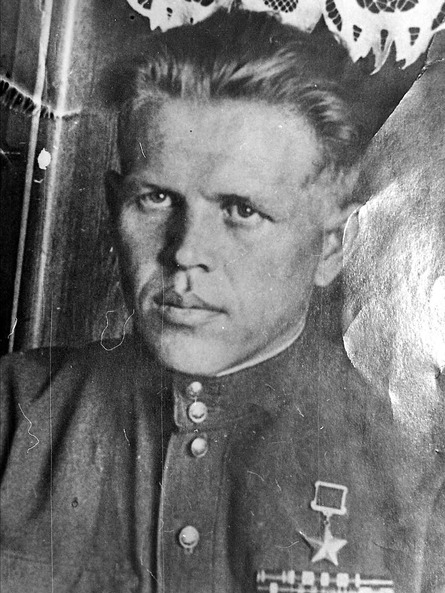 Boris Rossokhin
An outstanding military pilot-player, Hero of the Soviet Union, who made many combat sorties during the war and destroyed a huge amount of military equipment and manpower of the enemy. On the personal account of Boris Rossokhin, about 1,200 enemy soldiers and officers, 4 railway trains, 140 wagons, 260 cars, 36 tanks and armored personnel carriers, 6 artillery batteries, 2 staff buses, several ammunition warehouses and 2 crossings.
In addition to the hero of the hero, Rossokhin was awarded the orders of the Red Star and the Patriotic War of the 1st degree, two orders of the Red Banner and medals.
What you need to know about
As the homeland of Boris Rossokhin, many sources call the village of Nizhny Bota of the Yuryansky district of the Kirov region. However, such a village does not exist. On the page "Our Heroes" of the official website of Tavda, where the future pilot spent his childhood, the village of Nizhny Bakhta Kirov Region is indicated as his place of birth. The same place of birth is called in a report dedicated to the hero created by students of the Tavdin school No. 1.
Boris Rossokhin himself considered himself a Urals: “The regiment commander called Zykov and Rossokhin to himself - he often sent friends to tasks together.
- Get ready for intelligence. Carefully check the photo equipment. You, Rossokhin, Siberian?
- Ural I, comrade major. From Tavda.
- Hunter?
- I had to hunt, fish.
- In winter, are you tracking well in the snow of the beast?
- Everything is in the palm of your hand: where the lynx passed, where the Squirrel protein with its membranes hit the snow, where the hare jumped.
- So fly for intelligence. Look where the fascist beast ran, left traces in the first snow. ”
April 28, 2005 - Three months before his death - Boris Rossokhin was awarded the title "Honorary Citizen of the Tavdinsky District".
Direct speech
About the exploration of Rossokhin (from the book “ 16th Air ”) : “... On July 10, the pilots of the 59th Guards Shap Guard Lieutenants N.V. Ivanov and B. G. Rossokhin, when performing a combat mission in the area of the village of Lakenitsa, were fired by the enemy anti-aircraft fire. The plane of Lieutenant Rossokhin - an experienced pilot and an experienced intelligence officer - was shot down. I had to sit on the territory of the enemy. The Nazis rushed to a decreased plane. Then Lieutenant Ivanov, descending to a shaving flight, began to shoot the German soldiers who tried to approach the plane, until the wounded Rossokhin disappeared from the Nazis. On February 23, 1945, the guards pilots were awarded the title of Hero of the Soviet Union for the excellent implementation of combat missions. ”
6 facts about Boris Rossokhin
- Boris Rossokhin knew Pavlik Morozov well, and he studied with his brother Alexei at the Tavdinsky school in the same class.
- In order for the spine to hurt less after the injury, fighting friends tied to the back of Rossokhin Panner - so he could fly.
- As part of the 226th transport aviation regiment, Rossokhin served the historical Potsdam conference (July 17 - August 2, 1945), saw the leaders of the countries of the anti -Hitler coalition - Stalin, Churchill, Truman.
- In 1991, the war once again reminded of itself - already elderly Boris RSSOKHIN was amputated, as the surgeon said, "to the maximum permissible physical limit." The operation was carried out on the birthday of the pilot.
- In Yekaterinburg, on the alley leading to the main corps of the UGTU -UPI, an obelisk is installed in honor of the heroes of the Soviet Union, who studied and worked here. One of the eleven heroes is Lieutenant Colonel Boris Rossokhin. His name is also named after one of the lecture audiences of the institute-“FT-422”.
- The Department of Air Defense of the Institute of Military Technical Education and Security of UrFU is named after Boris Rossokhin. In the corner of military glory dedicated to the hero, his combat awards and personal belongings are represented.
Materials about Boris Rossokhin
Rossokhin, Boris Gavrilovich on the site "Heroes of the country"
Report on Boris Rossokhin on the website of school No. 1 of Tavdy.
Article about Boris Rossokhin on Wikipedia