
Translated material
Armageddon, which has already happened
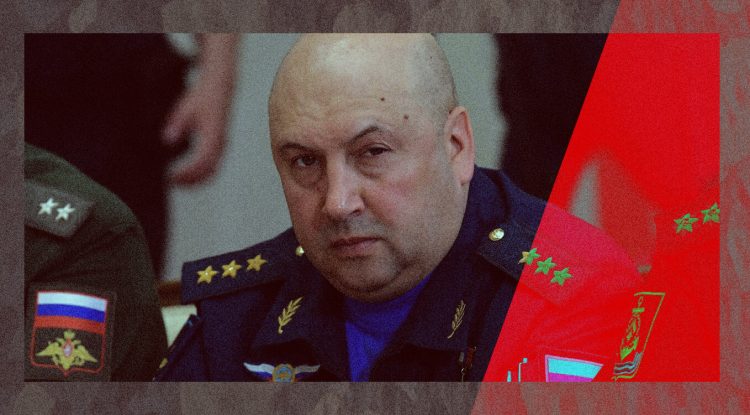
Historian Ilya Venyavkin - about what to expect from General Sergei Surovikin, who now leads the Russian troops in Ukraine
On October 8, General Sergei Surovikin was appointed new Russian troops commander in Ukraine. The wire-packed journalists and publicists reacted to this appointment with enthusiasm, and the official media immediately began to turn the commander into a public figure: on October 11, the first channel congratulated him on his 56th anniversary. At the request of the “cold”, historian Ilya Venyavkin, who had recorded Podkast about Surovikin in the spring, tells how the general thinks and fights, whose career began with the murder of protesters against the State Emergency Committee in August 1991 and continued by military crimes in Chechnya and Syria.
In order not to miss the main materials of the "cold", subscribe to our Instagram and telegram .
In early October, after the Russian army left the previously captured Liman, two important votes of the so -called party of the war - Chechnya President Ramzan Kadyrov and the founder of Wagner PMC Evgeny Prigozhin - made a sharp criticism of the Russian military command. “All these earlings are with BOSHIC assault rifles to the front,” Prigozhin said , supporting Kadyrov’s expressive statement . The Russian army became permissible to criticize publicly, and telegram channels, deputies and propagandists spoke about the shortcomings of the generals. The reason for all the military failures of Russia in the war with Ukraine, they declared Russian military leaders - corrupt, limp and prone to nonsense.
The next step, of course, was the search for a real Russian commander. Within the framework of the cultural myth familiar to everyone from the school, in order to correct the mistakes of the mediocre command, at a turning point at the front there should be a decisive and stingy people in the words of the People’s General-such as they were (at least in pop-mythology) of Kutuz and beetles. In the framework of this mythology, such a commander should have another important quality: in no case he should criticize the ruler, whose mediocre decisions have led to disaster, and thus not undermine the authority of power, but, on the contrary, strengthen it. The ruler will temporarily retreat into the shadow to let the commander turn the course of the war, and then go on stage to accept the triumph.
On October 8, the searches ended: the Ministry of Defense of the Russian Federation announced the creation of a new position “Commander of the United Group of Forces in the Switch”. Appointed General Sergei Surovikin to this position; On October 11, he turned 56 years old. Both Kadyrov and Prigozhin warmly welcomed this appointment. “This is a real general and a warrior: an experienced, strong -willed and far -sighted commander, for whom such concepts as patriotism, honor and dignity are always above all,” said the President of Chechnya. “He was born to correctly serve his homeland,” Prigozhin added . “These are not beautiful uniforms and tsatski.”
Another influential “hawk”, the military observer of Komsomolskaya Pravda, Viktor Baranets, wrote that it was under Surovikin that the troops suffer the smallest losses and always achieve their goals. Other media picked up a quote from a ram written back in July: “Since Syria, colleagues call him“ General Armageddon ”.
What do we know about Surovikin and how can its purpose change the nature of the war in Ukraine?
Hero of Russia
On December 8, 2017, Sergei Surovikin received the title of Hero of Russia with the official wording "For the courage and heroism manifested during the fulfillment of military duty in the Syrian Arab Republic." Having accepted the award from the hands of Vladimir Putin, he said : "We are ready to fulfill any task you set." It seems that this is the most important thing you need to know about the general. Throughout his career, he separately emphasized that there was no such order to the execution of which he would not agree, and there are no funds that he would not dare to use.
For the first time, the name Surovikin became known to the public in 1991 - then he was still a captain. On the night of August 21, when the center of Moscow was covered by protests against the GKChP, a column of 20 BMPs led by Surovikin entered Moscow to put commandant posts on the garden ring on the orders of the patchists. When the column ended up in the tunnel near Kalininsky Prospekt, it was tried to stop the protesters who think that the military were going to storm the White House (there was President of Russia Boris Yeltsin and his supporters at that moment). Surovikin ordered the crews to close the hatches and continue to fulfill the task. As a result of panic and chaotic shooting in the tunnel, three people died - Dmitry Komar, Ilya Krichevsky and Vladimir Usov.
As part of the investigation of the August events, Surovikin and other commanders gave a written explanation, in which they said that an angry drunken crowd was attacked, and unknown were handed out civilian boxes with vodka. They did not notice victims from the civilian population. As a result of the audit, Surovikin was not convicted. And today, 20 years later, Evgeny Prigozhin even presents this act as a feat: “Surovikin in August 1991 did not manage to load full ammunition into his tank. And if I had time, then we would live in a completely different country, ten times more powerful. ”
On August 24, Komar, Krichevsky and Usov posthumously became the heroes of the USSR, and a year later the first in the history of the new country received medals to the “defender of free Russia”. Thus, Sergey Surovikin is a hero of Russia, who is directly related to the murder of three heroes of the USSR.
Comdress from Khankala
The Russian army is similar to a black box, from which information about military leaders almost does not seep. However, there is not so much information about Surovikin - and not only official. Songs are even written about him: the police colonel and the author of the Russian chanson, Vladimir Slepak, devoted to the general the ballad “Comprehensive” (apparently, it was written once in the 2000s). In it, Surovikin is opposed to thieves' officials who do not fight in Chechnya, but are sitting in Barvikha.
Surovikin’s public speeches during the Second Chechen campaign fully supported this image. In February 2005, he, as the commander of the 42nd Guards Motor Rifle Division, told the press about the search for militants who killed nine fighters of the division reconnaissance group. “For each deceased soldier, we will destroy three militants - this is our special account,” Surovikin said , not explaining how the militants will be distinguished from ordinary Chechens. Soon, an investigation of Novaya Gazeta was published, from which it followed that there were no militants with a high probability, and the Russian military were drunk and died because one of them shot the premises from a grenade launcher.
A few weeks later, Surovikin gave an interview to the Red Star newspaper and spoke in detail about what exactly prevented him from fighting in Chechnya. The main obstacle was not militants, but legal norms and human rights activists. “For example, the special forces commander received information that the field commander should follow on such and such a road today,” the commander explained . - An ambush is set. The car rides. Military personnel see that in her, in addition to the bandit, there is still a woman with a child. Of course, no one will open fire on such a car. But war is war. And sometimes it is difficult to distinguish special forces whether there is someone else in the cabin, except for the bandit. It happens that they open the fire, and then they put on the officer handcuffs, initiate a criminal case. ”
A month later, Surovikin's subordinates demonstrated how to act without looking back at any legal norms. According to the reports of human rights activists , on June 4, 2005, military personnel of the Vostok battalion of the 42nd motorized rifle division conducted a punitive operation in the village of Borozdinovskaya: “Armed people in gray police and camouflage forms burst into the houses and forced all men to get into cars. They were taken to a local school, ordered to lie down on the ground down, wrapped their clothes on their heads. All, including elderly people, adolescents and disabled people, were beaten with their feet and butt of machine guns. ”
In the village of Borozdinovskaya, the majority of the population were Avars. The leaders of the Vostok battalion suspected them with “separatists” and decided to punish them. During the punitive operation, the battalion’s employees burned four houses in the village, killed the 77-year-old Magomaz Magomazov, 87 people were tortured and humiliated, and another 11 men were taken away in an unknown direction. Soon after, most of the villagers decided to escape to Dagestan.
The official investigation did not lead to anything, and Surovikin himself denied what had happened: "Talking about the abduction by the" East "by the inhabitants of Borozdinovskaya have no soil and are aimed at rocking the political situation." In 2021, the ECHR admitted that in Borozdinovskaya the Russian authorities violated a number of articles of the Human Rights Convention.
General Armageddon
The fact that Surovikin is ready to fulfill orders, regardless of victims among the civilian population, manifested itself with even greater distinctness, after in October 2017 he was appointed the Commander-in-Chief of the Aerospace Forces (VKS) of the Russian Federation. At that moment, Surovikin headed the grouping of Russian troops in Syria. It is significant that, being a combined arms general, he did not have a specialized experience related to the VKS, but he distinguished himself in the fact that he was not embarrassed in the use of missile attacks on civil infrastructure.
Throughout the operation in Syria, Human Rights Watch recorded missile strikes on medical facilities, schools, markets, and camp camps, stadiums and offices. “In no studied episode in areas exposed to blows, no military goals were found. All these areas were far from active hostilities. Apparently, the blows were deliberately delivered to sow panic among the inhabitants and force them to leave and thereby facilitate the government to return this territory to their control, ” the 2020 report said. It is important that the nature of Russian indiscriminate blows to the civilian population did not change significantly, regardless of the name of a particular group commander. Neither Surovikin (he led the Russian troops in Syria, first in 2017, and then in 2019), nor other Russian generals suffered for these actions, because Russia's veto in the UN Security Council did not allow the human rights activists to the international criminal court.
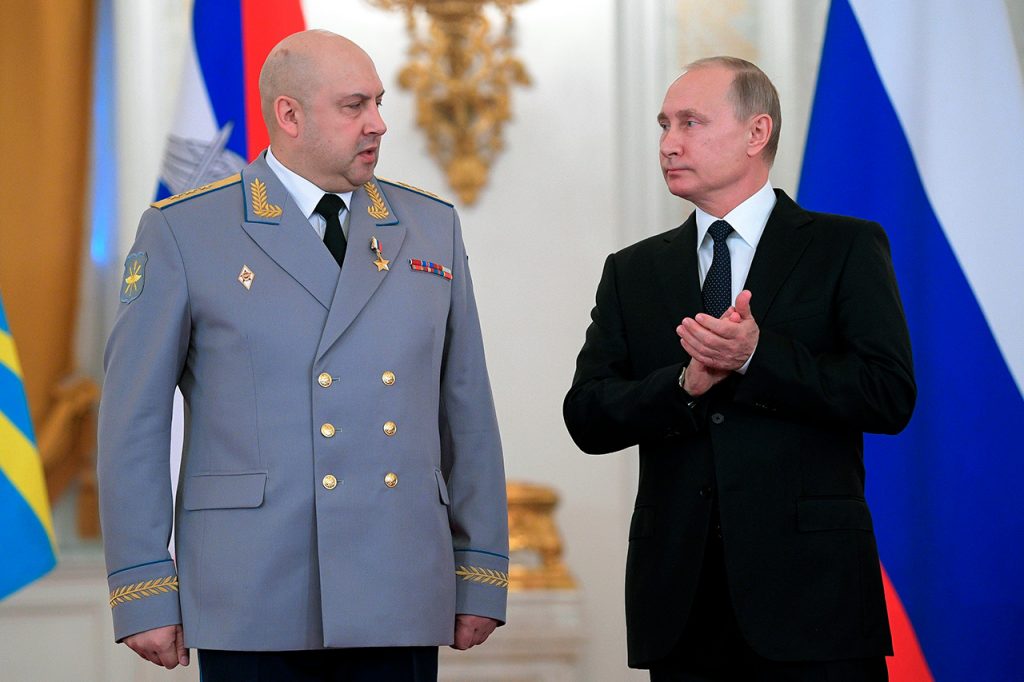
Surovikin himself in his public speeches did not notice any victims among the civilians and used the usual dividing rhetoric today: “More than 32 thousand militants, 394 tanks and more than 12 thousand units of weapons and equipment were destroyed.” It can be assumed that he will adhere to the same tactics in the war in Ukraine.
Moreover, despite the fact that now the wire telegram channels represent the appointment of Surovikin to the post of commander of the united group in Ukraine as something radically new, Surovikin has long been making decisions in this war. Back in March, the Ukrainian prosecutor's office opened a criminal case against the Russian military leadership in general-and Surovikin in particular due to the fact that he gave orders for missile and bomb strikes on civilian facilities. It is not known whether Surovikin personally managed to launch rockets to the shopping center in Kremenchug, the station in Kramatorsk, the TPP and the TPP in Donetsk and Kharkov regions. But for the blows that Russia inflicted on October 10 to the so -called high -precision weapon in Kiev, Dnieper, Zaporozhye, Odessa, Lviv, sums, crooked horn, he is precisely responsible.
Now it’s hard to predict how much the decisions of Surovikin will be able to influence the course of the war, but the real disaster has already happened many years ago. The leadership of the Russian Armed Forces are people who do not consider any sacrifice among the civilians and do not question any orders, no matter how criminal they are.
The author’s opinion may not coincide with the opinion of the editorial office.