
Translated material
TOP-20 films about dictators
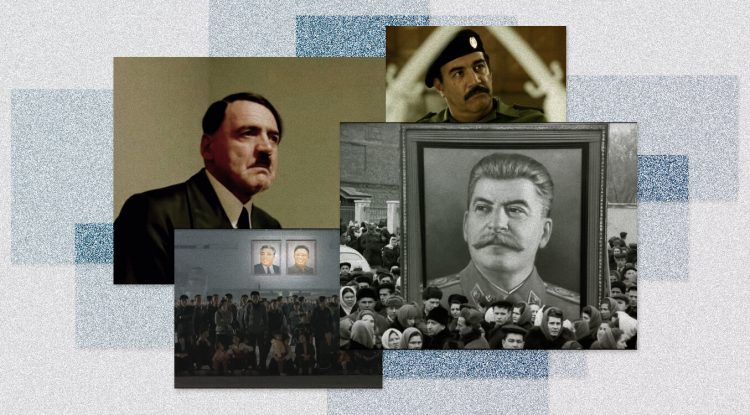
From Adolf Hitler to Idi Amin: Cinema about how tyranny arises and destroyed
The twentieth century is the time of the worst dictatorial regimes in the history of mankind. And this is also a century in which the cinema has become the most popular of the arts and one of the main channels for obtaining information. “Cold” took two films about 10 dictators from different countries, watching which you can find out how tyranny works - and how it ends.
In order not to miss the main materials of the "cold", subscribe to our Instagram and telegram .
Adolf Hitler
Führer of the German people, 1934-1945
Is it true:
"Bunker", director Oliver Hirschbigel, 2004
The merciless chronicle of the last days of Adolf Hitler, a factologically flawless (as far as possible in the feature cinema) reconstruction of what was happening in the Führerbunker at the end of April 1945, shot according to the memoirs of Hitler's secretary Troudl Yunga.
Soviet soldiers are already in Berlin, Germany is about to surrender, the Fuhrer in agony gives crazy orders and plans suicide. This, of course, is a fragment of the biography, Hirschbigel does not pretend to be more, but it is not known what can tell us more about the dictator - how he lived, or how he died.
After the film released, many in Germany, including, for example, the author of the sky over Berlin, Vim Venders, accused the director of human being wilted, but for the artist such claims are perhaps a compliment.
Even if you did not watch the film itself, you are definitely familiar with this hysterical scene of Hitler, played by the Great Bruno Ganz, who was released into dozens of rewinded memes. From the latest examples - here .
Fiction:
"Moloch", director Alexander Sokurov, 1999
Five years before Hirschbigel, Alexander Sokurov already displayed on a wide screen of a painful, miserable Hitler, also placing him in a closed space.
"Moloch" at the same time, of course, is an antibiography. This is a surrealistic fresco in the scenery of an impregnable fortress somewhere in the middle of the Alps. Hitler and Eve Brown talk to each other with metarealistic phrases-panka Yuri Arabov, somewhere nearby are the caricature Goebbels and Bormann.
Having abandoned the historical truth, Sokurov and Arabs wave to the truth, if you like, the highest. And they succeed.
Joseph Stalin
General Secretary of the Central Committee of the All -Union Communist Party of Bolsheviks - CPSU, chairman of the Council of Ministers of the USSR, 1922-1953
Is it true:
"Farewell to Stalin", director Sergei Loznitsa, 2019
The editing documentary of the Ukrainian director Sergei Loznitsa discourages the simplicity of his decision: the director simply gathered the chronicle of Stalin’s funeral and farewell to him, did not finish anything, did not finish, but eventually created horror horror. Who saw the tearful eyes of Soviet citizens at the coffin with the leader - Pennyiza is not afraid.
“Farewell to Stalin” is another example of how death is more accurate than life. Well, let's say the obvious: this movie is not about the dictator, of course (although about him too), but about the country. And both about this and about this.
Artifice:
"Khrustalev, car!", Director Alexei German, 1998
In continuation of the topic of horror, there is a terrible film in the history of Russian and Soviet cinema. And the most difficult thing for perception - it was not without reason that he was boasting (and then publicly apologized and said that they simply “didn’t immediately understand”) even those who saw all film critics at the premiere in Cannes.
Actually, Stalin in "Khrustalev, car!" practically no, and still he is here everywhere. And in Brueghelev scenes from the Moscow communal apartment, and in the denunciation of the boy on his father, and in the scene of the rape of the general with convicts.
"Khrustalev, car!" - The most fierce attempt to “bury” Stalin in Russian culture - and at the same time a recognition of the impossibility of doing this.
The phrase, put into the name, is apocryphytically the first thing that was said in post -Talinsky Russia, it was allegedly thrown by Beria by the gabeshnik, who was on duty at the leader of the leader. Well, that is, about this movie - Stalin died, the word is Beria.
Go amin
Uganda President, 1971-1979
Is it true:
"General Idi Amin Dada: Self -portrait", director Barbet Shreder, 1974
The canon of the genre “Documentary about the dictator” and the most voluminous portrait of a man who had managed to build one of the most bloody regimes in the history of Africa over the eight years of the reign of Uganda and destroy his citizens under half a million.
Barbet Schreder (known primarily as a biographer and interviewer of the writer Charles Bukovsky, not odious politicians) called his film a self -portrait and, perhaps, did not lie. Many episodes of the film were staged by his main character: Schroeder does not intervene in this narrative, but only observes how Amin raises the paratroopers, plays a jazz band, swims in the Wildlife Park, jokingly scolds the Minister of Foreign Affairs for bad PR Uganda in the Western world (after two weeks the body of this minister will be found in the Nil River). The director calmly talks with Amin about his plans to attack Israel, sympathies to Hitler and listens carefully, listens, listens.
As a result, Schroeder mounted two versions of the film (this was the condition of Amina): one was combed, for showing in Uganda, the second - for everyone else. Amin, predictably, was satisfied with the first, and according to the second he demanded that the director of abbreviations. He refused. Then the dictator gathered more than 150 French citizens living in Uganda, locked them in the hotel, saying that now their fate is in the hands of the Schrief. The director gave up. Cut scenes returned to the film after the fall of the Amin regime.
Artifice:
"Last King of Scotland", director Kevin McDonald, 2006
The mass viewer knows about Idi Amine not from documentary cinema, not from history textbooks, and not even from evening news. For him, “His Excellency is a lifetime president”, “Lord of all animals on earth and fish at sea”, “Conqueror of the British Empire in Africa” is a person with the face of Forest Whitakers (a dozen awards for this role, including Oscar, Golden Globe and BAFTA) from the dashing thriller Kevin MacDonald.
Not too careful about historical facts, McDonald writes the history of the African tyrant with wide (usually crimson) strokes, from takeoff to fall, and the viewer, along with another hero of the film, a young doctor from Scotland, is first imbued with sympathy for a bold and active leader, and then terrified. This is not a movie about the dictator again. The Last King of Scotland is about the risks of charming tyranny.
Benito Mussolini
Duche fascism and founder of the Empire, 1922-1945
Is it true:
Mussolini and Me, director Alberto Negrin, 1985
Political and family drama based on the memoirs of daughter Benito Mussolini Edda and the diaries of her husband-diplomat-Galeazzo Chiano.
The powerful acting trio (Chiano-Anthony Hopkins, Mussolini-Bob Hoskins, Edda-Susan Sarandon) tells the story of the fall of the Duche regime, starting shortly before the Second World War and stopping in the spring of 1945. This is the optics of close relatives, but at the same time Italian citizens who do not approve of the alliance with Hitler and disappointed in expressive charismatics-prime minister. From the point of view of political technologies, the purpose of any tyrant is to become the “father of the nation” and thus connect the people by a non -rational political choice, but by true love. In this sense, Alberto Negrina is a legitimate metaphor that is convincingly working both from an artistic and historical point of view.
Artifice:
"Tea with Mussolini", director Franco Dzeffirelli, 1999
And this look at Mussolini is the same as the portrait of Brezhnev, composed of folk jokes. Florentine English women drive Five O'Clock Tea
And they discuss the double. One says that he somehow even met with this “hot Italian”, and he met all expectations. “We live in the days of the great dictators,” the British consul, who is entering the company, agrees. In the yard-the mid-1920s, no one suspects what will happen next. The tonality of conversations, of course, will soon become completely different. The film will end in 1944, and in four walls of different Italian apartments-the whole history of European acceptance and rejection of evil. And for Dzeffirelli, who was 12 years old in 1935, this movie is his own Amarkord, a conversation with himself about childhood, Italy and Europe.
Juan Domingo Peron
Argentina President in 1946-1955 and 1973-1974
Is it true:
Puerta de Heirro, Expulsion of Peron, directors: Victor Laplace and Diegillo Fernandez, 2012
In 1952, Juan Domingo Poron was elected to the President of Argentina for the second time, and already in 1955, he was overthrown. He fled from the country and after a few Latin American countries reached the secluded suburbs of Madrid-Puerta de Heirro. Here he lived until he returned to his homeland in 1973, here the action of the film Viktor Laplace and Diegillo Fernandez unfolds here. Peron recalls the time of his rule and makes plans for the future. Unhurried, not too fascinating, but historically reliable narrative.
In general, it is surprising that the main politician in the history of Argentina, the person for whom it is still about the “our” Stalin, the spears in his homeland are breaking - he or the great statesman - in culture most often appears simply as the husband of Evita Peron. This picture is a rare example of another focus, and this is, in fact, the main thing, if not the only one, its dignity.
Artifice:
Evita, director Alan Parker, 1996
Well, here, perhaps, the most famous film about this very Evite. In the title role - Madonna. In the role of Peron - Jonathan Price. The narrator is Antonio Banderas.
Films about the novel by Evita and Juan-more than 10 so accurately, and all of them delicately omit political issues, focusing on the love story of the young provincial, who came to conquer Buenos Aires, and charismatic in military uniform, successfully conquered the capital. Parker is trying to talk about vanity, and about the political populism of the first lady, and her husband touches her tangent, but still removes the melodrama, in which they also sing.
The spectacle, maybe for an amateur, but the existence of such lovers is difficult to deny - they are among American journalists (three Golden Globe awards), and among the film Academics (one Oscar).
Antoniu Di Salazar
Portugal Prime Minister, 1932-1968
Is it true:
"Life: images of dictatorship", director Suzan de Souza Diash, 2005
The Portuguese dictatorship is one of the longest not only in the twentieth century, but also, as meteorologists say, in the history of observations. It lasted 42 years, 36 of which Antoniu Di Salazar (it seems, the only dictator is a university professor) were solely rules.
Suzan de Souza Diash for years has gathered photo and video archives of this period: propaganda documentaries, photographs of political prisoners, classified documents to mount them in a cold, categorically non-journalistic movie that tyranny is death. She slows down and accelerates the chronicle, turns static personnel inside out, voices them with an avant -garde soundtrack and this inconsistent method achieves a literally alchemical effect - history begins to come to life.
Artifice:
"Siege", director Antoniu da Kunya Telesh, 1970
The year of release of the film on the screens is the year of the death of Salazar. The “siege” begins with the scene of the separation of the main character with his hazardous husband-the historical metaphor is understandable. A woman as a nation, husband as a state dictator, marriage - as life day after day: not without love, but with suffering.
All comparisons were not stretched, filming the film began when Salazara was already struck by the stroke, which gave Talelis the right and the opportunity to talk about the imminent “divorce”. “Siege” is a story about fear and choice, about responsibility, including political, for its present and future. Before the “Carnation of Gvozdik” and the establishment of a military Provisional Government, four years remained.
Saddam Hussein
Iraq president, 1979–2003
Is it true:
"Saddam House", director Alex Holmes and Jim O'Henlon, 2008
It is quite a frontal that in the case of the audience priority of the political over the artistic only plus, the mini-series of the joint production of two giants of television publicism, BBC and HBO, with ambition to tell generally everything about Saddam Hussein.
The film begins to unfold in the 1970s, when Hussein, being deputy chairman of the Iraq Revolutionary Command Council, that is, the second person in the state, began to clear his way to absolute power, and ends with December 2003, that is, the arrest of the dictator in the basement of the village shelter house.
Saddam, of course, came out films and more detailed and more accurate (both criteria, for example, corresponds to the series “Long Days”), but they all focused in some small period of his life: either formation or collapse. The "House of Saddam" has embraced all 30 years of the political life of the Iraqi dictator. Nothing more universal on either small or large screens about Hussein.
Artifice:
"Devil's double", director Lee Tamahori, 2011
The best feature films about dictators are those where the dictators themselves do not leave the background. The Devil's Double is just that. Saddam appears here, mainly in order to complain about the fact that he regretted and did not castrate his son - Khussayin. And the main character is not even a son, but the legendary Latif of Yahia, who poses himself as the ex-two of his son.
Why would he, in principle, have a double question: it spends most of the time in nightclubs and bars-and no more or less expected state affairs from him. The stories of Yahia (like memoirs that formed the basis of the script), most likely, the pure lies, but, firstly, the lies of talented, secondly, since we are about the film, very talentedly and with humor, and thirdly, in a paradoxical way of dying about dictatorial regimes are sometimes no less clear, which is true.
Nikolai Chausko
Chairman of the State Council and President of the Socialist Republic of Romania, 1967-1989
Is it true:
"In capital letters", director Radu Zhuda, 2020
The Romanian new wave is perhaps the best and most important that has happened to the world cinema over the past 30 years (among competitors is the Korean wave). The holder of the Golden Bear for the film “Mad Cinema for Adults” of Rada Zhuda - the most eccentric representative of this generation in Russia.
“Initial letters” is a postmodern picture in form, but quite historical in content. This is the story of the famous schoolboy Mugur Kalinescu, who in 1981 arranged graffiti-testing in Botoshani-painted walls, bus stops, and so on anti-government slogans.
The secret police quickly calculated the author, and then the case began, which went down in history under the name “School against Chausko” and, as is commonly believed, accelerated the fall of the last regime. According to the plot of the film, the theater director decides to shoot a performance according to declassified archives. The cinema is born at the point of contact of the theater, cinema and documents.
Artifice:
"4 months, 3 weeks, 2 days", director Christian Munzhiu, 2007
But - the unconditional masterpiece of the "Romanian new wave." And - like most films in this section - it is not about the dictator and not even about the dictatorship, but about people, in the dictatorship of the survivors.
1987. From 2022, we know that this is a sunset of the Chausko regime, but then no one seemed like that. The student Gabitsa learns that she is pregnant and is going to make illegal abortion: legal ones are prohibited.
Human drama in political circumstances. One of the key films of the zero is the “Golden Palm Branch” of the Cannes festival and “European Oscar” from the film academics of the Old World.
Augusto Pinochet
President of the Republic of Chile, 1974-1990
Is it true :
"Pinochec case", director Patricio Guzman, 2001
The program documentary of the favorite of European festivals and the main movie specialist in the military coup in Chile - Patricio Guzman.
The name of the film is generally a sufficient description of it. In 1998, waking up after the operation in the London private clinic, the dictator was arrested by Scotland Yard. The next eight years is the same “case”: endless accusations, deprivation of immunity, and immediately - justification or exemption from criminal liability (for example, due to senile dementia). As a result, after 503 days, the accused of whole and unscathed returned to Chile. Guzman, whose film crew, Pinochet, still arrested the chairman of the government junta immediately after coming to power, hoped that this would become the first example when the Latin American tyrant really answered his crimes, but did not happen. Why this happened, and he understands his film.
Artifice:
"No", director Pablo Larrain, 2012
Formally and highly artistic evaluative film about the Pinochet with Gael Garcia Bernal in the title role. The action of “no” develops around the plebiscite about trust in the dictator, on which more than half of the voters in the end said the same “no”. But we know this today: in the moment it seemed that the voting results could be any. The hero of Bernal is a young advertiser responsible in 15 minutes of alternative opinion on television broadcast. A quarter of an hour - to change the future of the country.
It is interesting that after no, the wonderful Chilean director Larrain seemed to cease to interest the male politicians and he focused on their wives, having first removed Jackie about Jacqueline Kennedy, and then Spencer about Princess Diana.
Kima
The ruling dynasty of the DPRK, 1948–?
Is it true:
"In the rays of the Sun", director Vitaliy Mansky, 2015
Alas, there are no good and truthful films about North Korean dictators. That is, there are good ones, some of them are even removed with the direct participation of the main synofile in the history of the republic - Kim Jong Ira - but from the point of view of facts there is a predictable guard. Есть, конечно, правдивые, но все они — телевизионные типовые документалки в духе BBC. Так что, похоже, самый важный фильм о Северной Корее все-таки снял российский режиссер Виталий Манский.
Главная героиня, восьмилетняя школьница, готовится к празднику в честь дня рождения Ким Ир Сена и вступает в местную пионерию «Дети Солнца». То есть основатель династии присутствует в фильме лишь в календаре. Его сын, Ким Чен Ир, появляется разве что в форме памятников. А нынешний лидер Ким Чен Ын — просто висит над действием грозовой тучей. То есть Манский, как и многие другие упомянутые выше режиссеры, снимает не про диктаторов, а про их жертв. «В лучах Солнца» — честный (при том, что производственно построен на обмане корейской приглашающей стороны) и безжалостный взгляд большого художника. Безжалостный настолько, что Манский до сих пор отвечает на этические претензии в свой адрес: якобы партизанский способ съемки мог поставить под удар героев ленты. Но, кажется, с ними все в порядке, а восьмилетняя Джин Ми, та самая главная героиня, за которую больше всего переживали зрители, теперь и вовсе — самый известный ребенок в КНДР. Пропаганда решила обернуть кадры Манского в свою сторону. Школьнице, по слухам, даже поручили вручать цветы Ким Чен Ыну на закрытии съезда партии.
Artifice:
«Объединенная зона безопасности», режиссер Пак Чхан Ук, 2000 год
Один из любимых фильмов Квентина Тарантино, одна из первых ласточек (ястребов?) той самой корейской волны, упомянутой выше. Самый кассовый на тот момент корейский фильм в истории, подбросивший Пак Чхан Ука («Олдбой», «Служанка») в высшую лигу не только национального, но и мирового кино.
«Объединенная зона безопасности» — эстетский, мелодраматический, военный детектив, действие которого разворачивается на границе Северной и Южной Кореи. Классический сюжет герметичного детектива — убийство, несколько подозреваемых, приглашенный следователь — у Пака вырастает в эпическую политическую драму, в финале которой не так уж важно, кто виноват, потому что глобально виноваты все.
PS Фильмы о всех диктаторах сразу
Is it true:
«Как стать тираном», производство Netflix, 2021 год
Досуговая публицистика от главной стриминговой поп-платформы планеты под комментарии Питера Динклейджа (Тирион Ланнистер из «Игры престолов»). Шесть серий, и каждая, что кулинарное шоу, представляет рецепт одной из главных тираний ХХ века. Герои предсказуемы, мы их тоже здесь почти всех рассмотрели: Адольф Гитлер, Саддам Хусейн, Иди Амин, Иосиф Сталин, Муамар Каддафи и северокорейские Кимы.
Дорогая инфографика, оригинальная анимация и разной уникальности хроника — все достоинства и недостатки нетфликсовских проектов известны давно, «Как стать тираном» в этом смысле — показательный пример. Содержательно — тоже не слишком глубоко, но как введение в историю проблемы — вполне подойдет.
Artifice:
«Детство лидера», режиссер Брэйди Корбет, 2015 год
Безупречный дебют одного из самых умных молодых режиссеров Америки Брэйди Корбета — история превращения затюканного, нежного мальчика в универсального тирана — граждане Германии, России или Италии наверняка по-своему могут уточнить, в какого именно.
При первом просмотре кажется, что ответственность за это превращение лежит на семье, при втором — что на буржуазии, а если посмотреть фильм в 2022 году, сомнений не возникает: лично на каждом смотрящем она и лежит.