
Translated material
This country is not to mobilize
What thoughts in Russia of 2022 is the book “Mobilized Nation. Germany 1939–1945 "
The book of historian Nicholas Stargardt was published in Russian in 2020, but the mass reader became interested in it only in the fall of 2022. Why do lovers of light historical rhymes and personally Sergey Vladilenovich Kiriyenko will not find in the book what they are looking for, says Ivan Napapenko.Starting from February 24, 2022, we were all in the face of the advancing barbarism, violence and lies. In this situation, it is extremely important to preserve at least the remnants of culture and support the values of humanism - including for the sake of the future of Russia. Therefore, the editorial office of Gorky will continue to talk about books, reminding our readers that the world remains in the world and fiction.
Nicholas Stargardt. Mobilized nation: Germany 1939–1945. M.: Hummingbird, ABC-Atticus, 2020. Translation from English by A. Z. Colin. Content . Fragment
 A friend told the story. Recently, he crossed the border of Russia with an unfriendly country, taking with him the book “Mobilized Nation”. He realized the provocativeness of the name only at the border post and left the book in the car so as not to cause unnecessary questions on the inspection. A friend forgot that the cars are also inspected. Standing in line for passport control, he watched as outside the window the FSB border service employee looked at the back seat, turned the book lying down the cover, pulled his chin and, emerging the car, began to leaf through. Now he will come, a friend thought. The employee leafed through for a long time, but still did not come.
If you believe the statistics, many people are now leafing through the work of the historian Nicholas Stargardt - since the beginning of the mobilization of the publication has grown four times. The name does not deceive: this is a really acutely -actual book that contains a variety of material, in particular, capable of delighting lovers of the thesis about the fact that history is repeated. But she does not seem important to me.
Stargardt is building a story around a series of questions: how did the Germans realize that they were involved in the war and genocide? What did this understanding affect? Why, up to the very end, the Germans resisted so fiercely - even those who did not support the Nazis? Why, finally, the traditional opposition of “victims or criminals” in this case does not work well? In other words, how it turned out that the Germans mobilized as a social community - which is not at all identical to the decree on mobilization, whether it is total or partial mobilization?
To all these questions, Stargardt is looking for an answer in meetings of letters that beloved, close relatives, parents and children, married couples wrote to each other. The appeal to such documents is not news, but Stargardt uses the approach, invented in the 1990s by researchers of the First World War: he is not interested in individual letters, but a long correspondence within the temporary fork 1939–1945. Perennial epistolary conversations allow us to understand how the Germans saw what was happening, how their attitude towards events and motives to take up the feather changed.
I will build this text as follows. First, I will talk about how - in the eyes of Stargardt - the Germans' views on the war and mass killings changed and how they managed to maintain the ability to resist until the very end. Then I will touch on what this ability to resist and social mobilization was based. And in conclusion, I will touch on how 80 years later the experience of one mobilized nation is comparable to the experience of another partially mobilized nation.
From "we won" to "we cannot lose"
“When an order on mobilization was issued on August 26, 1939, the Germans had no idea what awaited them. However, many did not hide a gloomy attitude to the prospect of war. ” And at the same time, Stargardt emphasizes, few doubted that the war with Poland was needed: it was preceded by powerful information training, according to which the Poles did violence against the German majority in the areas of his residence. The blow to the Poles disturbed the Germans, but seemed justified. It was applied after an insignificant occasion - a failed provocation, where the SS men portrayed an attack on a German radio station; Her transmitter was so weak that the performance of the Polish executioners in Berlin was not even heard. The occupation of Western Poland passed quickly and successfully.
What turned out to be new in it? The experience of the “racial war”, to which Hitler was called by the command: combing from machine guns and showing refugee columns, merciless bombing cities, pogroms with tens of thousands of victims, mass executions of prisoners of war and civilians without regard to the rules. Judging by the letters, individual soldiers understood what was happening (“the Polish intelligentsia was destroyed as a class”). However, the majority found what was happening, if not acceptable, then understandable - among them young Henry Bell. “Having seen the cruelty of our soldiers with my own eyes, I believed in the bestial behavior of the Poles,” wrote the veteran of the First World War to his son. The eastern campaign will soon go through the patterns of the animals tested in Poles and Polish Jews.
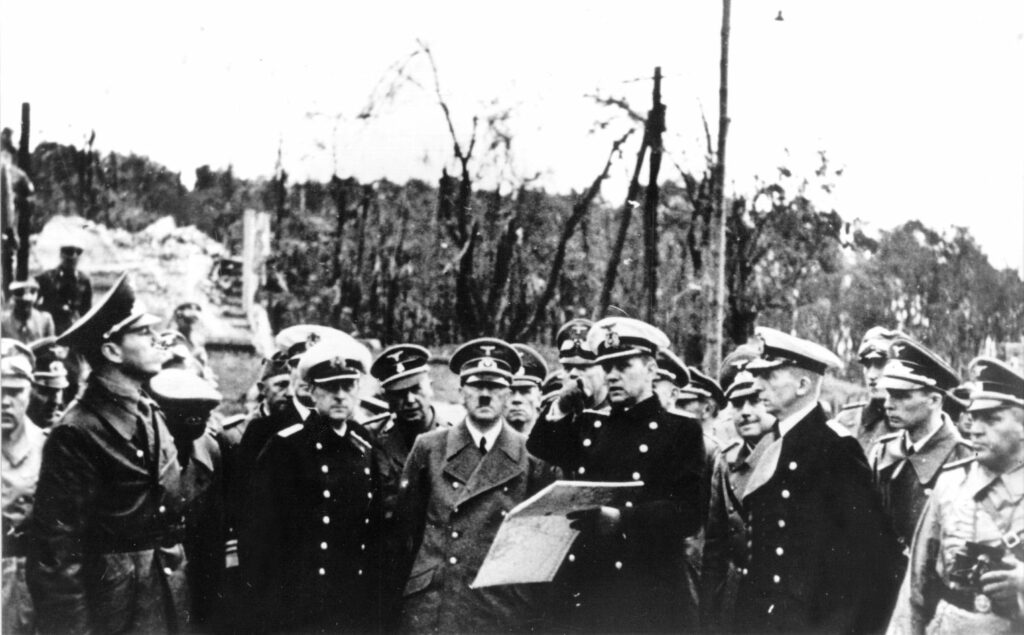 Adolf Hitler on destroyed Westerplatt near Gdansk, September 1939 © Deutsches Historisches Museum, Berlin
Then a combination of fear, an understanding of the validity of the actions of the leadership ( “the war imposed frauds of the Western powers” ), crowned with enthusiasm, was repeated. The Wehrmacht immediately broke up with the French troops in response to the invasion of the English and French troops in Holland and Belgium allegedly taking place in order to "invade the Ruhra." SD reports confirmed that people, despite surprise, "are internally convinced of the need for such a difficult step and the sacrificing victims that he would require." The French campaign was closed by a historical gestalt: Hitler signed a truce with the “hereditary enemy of Germany”, accurately repeating the procedure of November 1918, in the same railway carriage in the forest under the compound.
The motive of retribution is a through explanatory model for any rivalry, and the German war is no exception. The way the population perceived British bombing and Britain’s retreat bombing describes a characteristic conversation in Berlin between an American journalist and a cleaner from a working family: “Why are they doing this? ... - Because you bomb London. - Yes, but we will bomb military objects, meanwhile, the British bomb our homes. - Or maybe ... you will bomb them at home too. “In our newspapers, they say that no ... Why did not the British accept the proposals of the Fuhrer?” The effect of what was happening was that the Germans gradually got used to the war: "By the end of 1940, the damage from enemy bombs in Berlin became a kind of tourist attraction." This was not only bombing, but also the ubiquitous foreign workers-by the end of the spring of 1940 in Germany there were already 850,000 people. The war with world plutocracy promised to be long, but in the current phase it did not particularly disturb the population and seemed, according to the reports of the SD, "almost invisible."
The Germans also reacted to the “preventive” war with the USSR, which Hitler began to defend the “individual countries”, but in order to “ensure the safety of Europe and thereby saving all”, by the shock to the same acceptance. Acceptance in the rear is radically different than at the front: the rapid advancement of the Germans’s shock forces went in parallel with the large -scale executions of Jews and the Communists in the rear. Soldiers and officers became witnesses and participants in the “devouring man and the life of an orgy” - and everyone developed his own scheme for adaptation to monstrous experience. Judging by the correspondence, the majority preferred not to share information with relatives in the rear or only concerned with this. However, in addition to the shocked, there were “tourists in the places of executions”, who took photos and sent them to the manifestation home: this is how the knowledge about what is happening at the front was dissolved in society. A noticeable share of witnesses justified what was happening through the same retribution for Jewish and Bolshevik violence. One German wrote to his wife, for some reason punishing not to tell his son: “150 Jews were shot ... men, women, children, and all naked. Jews are completely out of the way. Please do not worry about it, it should be so. And do not talk about it R., leave for later! "
As the offensive linked, elite units, and not special forces, were drawn into unlimited reprisals. So in 1941-1942, what Stargardt called "an irreversible transformation of German soldiers on the Eastern Front": the invaders believed that everything they create was justified. Tightening on the gallows, exposing people into the steppe, burning the villages and villages, they believed that they react naturally to a huge threat, which could not be opposed otherwise. One of the officers wrote home that the soldiers laughed in his face when he asked where the prisoners had just taken. The executions became "granted by themselves." After failure near Moscow in correspondence and propaganda, the word Hart was increasingly sounding-the need for stiffness/cruelty became a kind of common sense.
Behind the Wehrmacht in the West, ordinary violence acquired a new scope: having declared the US war at the end of 1941, Hitler launched a full -scale “eradication” of Jews (the order to wear yellow stars was released on September 1, 1941 in response to the fact that the Germans in the United States are forced to wear a swastika on clothes). If in the east of deportation it was possible to hide under the pretext of fighting the partisans, then in Europe everything looked unambiguous. The model of coverage of events chosen by Goebbels is important here: the place of frank anti -Semitic pamphlets took vague hints. They did not demand from the reader the adoption or approval of the “final decision” as a political or racial necessity, but created a feeling of a strange, known secret to everyone. The notorious “spiral of silence” was promoted in society-it is curious that this term invented this term many years after the end of the war Elizabeth Noel-Hoyman, who in the 1940s scribbled an article for Goebbels about the power of Jewish media.
The situation of “knowledge without knowledge” removed, on the one hand, the issues of responsibility did not require approval or support of the leadership, but gave rise to a public split. Without space for public discussion, this knowledge split the family. Around it was concentrated black humor and elderly rumors like a well -known duck that RJF on soap means Rein Judisches Fett (“Pure Jewish Fat”), not Reichstelle Fur Industrielle Fette (“State Administration for Production of Industrial Fat”).
Stalingrad outlined an important coup: over the four years of the war, propaganda rhetoric-by observation not someone, but Goebbels-switched from “we will win” to “we will win”, then from “we must win” to “we cannot lose”. When the “bomb terror” of the Allies began, the authorities with unpleasant surprise found that the actions of the British and Americans find a joint explanation: the Germans explained what was happening as an retribution for “we did with the Jews”. The trouble for the Nazi elite was that the final decision was thought of as burning bridges, which should unite the nation in the understanding that now there is absolutely nothing - the prospects are reduced to the opposition "Victory or Death". But the statement of reckoning did not contribute to heroic mobilization, but a feeling of doom and helplessness.
However, closer to the end of the war, this doom will really melt into a certain patriotic incentive. Society did not split, despite the lack of prospects, bombing, evacuation and strengthening of persecution by the Gestapo and SD. Yes, internal conflicts (for example, between the evacuated and those who accept them) aggravated, but the Germans jointly attracted the state to solve private problems, maintaining confidence to it - not so much to the regime itself as to the bureaucratic apparatus. The party state remained the main source of rights, the receipt of benefits and privileges - what, it must be admitted, tried his best to correspond. The war itself as a defining factor in reality seemed to remain out of criticism.
She remained exactly the same “eternal war” for educated soldiers and officers who could no longer bear the propaganda frenzy, but could not doubt the need to sacrifice themselves. Stargardt shows how the reading of Yunger and Gölderlin turned into conviction to fight for “free spiritual Germany”, parallel to the Third Reich, professing about the same people who, together with his colleagues, raped and burned the villages. The literary canon hid the monstrous truth behind the veil of lyrical abstraction, making it optional of any moral choice and ennoble the total of war.
With the opening of the second front and the successes of the Soviet Army, the total war finally reformatted the life of German society. At the same time, the allied commanders were unpleasantly surprised at the resistance of the enemy, who, it would seem, was about to escape. As one of the most important motivations for stamina, Stargardt calls the fear of "being conquered by Russians." In 1944, the Germans seemed to realize that the Apocalypse was inevitable and it was necessary to take the initiative into their own hands. Suddenly, at the black hour, the number of those joining the NSDAP jumped up for the Reich: the conclusion that Hitler’s support was based not so much on radical anti -Semitism or faith in the war as the spiritual need of the nation. Rather, she rested on the promises of the world and light victories. But as the victory ended with an endless strip of defeats, and the world has become impossible, a significant part of German society indoctrinated itself into the apocalyptic Nazi worldview. As the author formulates, "not the success, but rather the failure of the regime imprinted the animal code of its main values in the consciousness and souls of those who did not belong to the Nazis at all."
The patriotic struggle, which strikes the allies, continued until the spring of 1945-let the talk of the struggle for the Nazi values did not go away. Although Hitler and his minions were disappointed in the German nation, November 1918 did not repeat - despite the crisis of resources, the moral collapse of Germany in the format of the First World War did not occur. If you like, the Germans justified the hopes of their Fuhrer: the internal front lasted to the end.
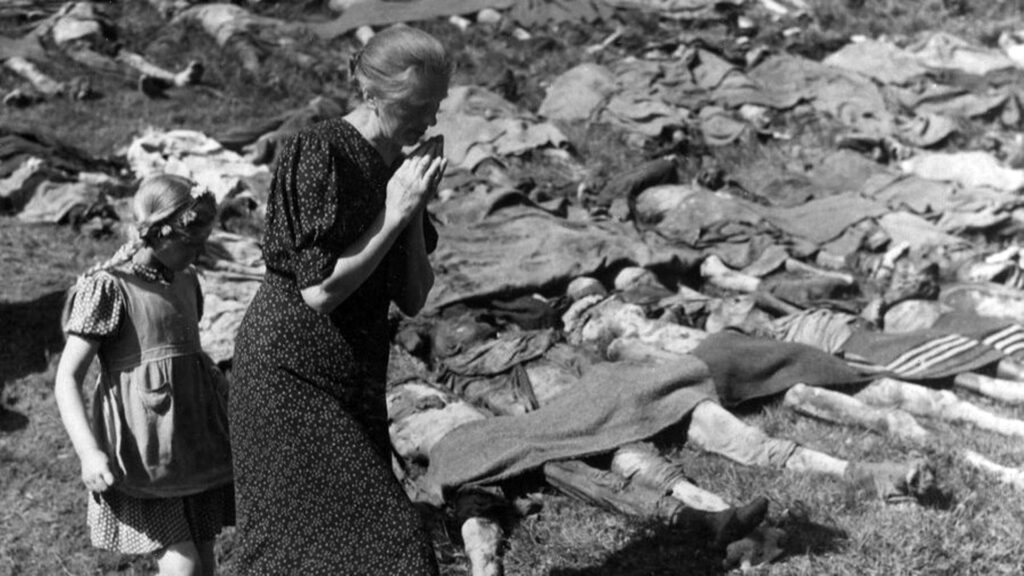 The consequences of mass executions of concentration camps in the last days of the war, 1945 © National Archives and Records Administration, College Park
Supports of "folk community"
The question that inevitably arises: how did it happen that German society turned out to be mobilized and supported the alliance with the state until Germany surrendered? In other words, how did what Sergei Kirienko dreamed about, who recently announced in an interview with Komsomolskaya Pravda that “Russia will win in the war with NATO if it becomes popular”? Partly the answer in the experience of Germany is obvious: the war becomes especially folk when it goes on its territory in conditions of erased differences between the front and the rear. Does this that Sergei Vladilenovich wishes is a question for him and his like -minded people.
However, this nation has its own conditions of possibilities that go beyond the borders of the military period itself. We are talking about structures that have made social (and not military) mobilization possible. It is well known that, having come to power, the Nazis began to smash labor movements and repress the socialists and communists. However, it was not about the complete destruction of existing public organizations, but about their integration into the party system. The principle was observed not to disperse, but to head. As a result, by the beginning of the war in party organizations that worked as real mutual assistance networks, and not decorative buildings, two -thirds of the population consisted of. Actually, in the party, on the eve of the war, 5.5 million people were listed-more than 6 times more than in 1932. 2.3 million participated in the National Socialist Women's Organization, and another 8.7 in the Hitler Youth and the Union of German Girls. In the National Socialist Popular Charity and the German Labor Front, the heirs of the working committees of mutual assistance, are 36 (!) Millions.
What is especially impressive - most of the staff of these organizations worked for free. It was these and similar structures that did not completely break up with the end of the war that served as an interface between the population and the state, which until the end sought to pay all benefits, benefits and salaries, observing their own laws. It was these organizations, where women played a colossal role, that contributed to successful evacuation, air defense and other procedures for maintaining life in the rear. Finally, the churches played a huge role: the Protestant theologians (not all, but many) accepted the idea of the national revolution with enthusiasm, since they were rejection of the “godless” Weimar Republic, advocated for the feat for the “salvation of the people” and repentance for November 1918. Among the Catholics, the idea of the "people's community" also found an almost complete understanding.
In addition to social institutions, a huge role in the justification of the war, which seemed justified even when doubts arose in the regime, played a completely special generational contract. The new German war was thought of as a continuation of the First World War: the sons felt necessary to go to the Eastern Front in order to finish what the fathers began - in order to save their grandchildren from the need to die again in the barbaric steppes. We are talking about debt - not to the regime, but to their own children and parents, who became the “strongest foundation”, according to Stargardt, for German patriotism.
Mobilization and mobilization
Если сравнивать российский и германский контексты, то, несмотря на шокирующее количество исторических рифм, различие двух «наций» и контекстов кажется радикальным. В немецкой версии гарантией народной войны и собственно социальной мобилизации оказались доверие государству, которое выполняет свои обязательства перед расово привилегированным большинством, работающие и способные брать на себя инициативу общественные организации огромного масштаба, своеобразно понимаемый контракт поколений, ресентимент, эффективная пропаганда и способность приучить общество к насилию.
Что из указанного списка есть в распоряжении у российского руководства, читатель может решить сам.