
Translated material
Let's get married. The growth of the number of weddings shows that by mid -October at least 492 thousand people were mobilized in Russia

Illustration: Mari Msukanidze / Mediazone
After the start of mobilization on September 21, those who received agendas can marry on the day of contacting the registry office, and not wait a month, as usual. Mobilized en masse this opportunity. The Mediazon decided to use the wedding boom to assess the total number of mobilized ones: by comparing information from registry offices with the data of the Federal State Statistics Service and the census, we estimated that by mid -October at least 492 thousand people had already mobilized in Russia.
By announcing “partial mobilization” in Russia, the authorities assured that 300 thousand people would be sent to the war, or “1% of the mobilization resource”. It is impossible to check this number: the paragraph of the Decree of Vladimir Putin, which indicates the number of mobilized ones, is hidden from the public. Sources of independent media reported that it refers to a million people or even a greater number . The regions also do not disclose “mobilization tasks”: usually the governors simply talk about the very fact of its implementation, and then the “second wave” or “small donor”begins in the region.
Vladimir Putin promises that the “partial mobilization” will end in Russia by the end of October - most likely, the president will announce that the declared 300 thousand fighters have been scored. As in the case of the loss of the Russian army, the real number of mobilized can be much higher.
Mediazone decided to evaluate the real number of already mobilized Russians, taking the data on the weddings they play.
After the start of mobilization, the number of weddings increased sharply
After from September 21, military registration and enlistment office began to send to men the agendas for war, excitement began in the registry offices across the country. Before sending to the front, the mobilized decided to officially formalize their relations - dozens of regional media outlets issued reports on the wedding boom.
According to the law , obtaining the agenda is a “special circumstance” that allows marriage on the day of treatment, without a mandatory monthly expectation in the usual case. “We have been together for five years, there is a joint child. They planned to sign next summer, but I had to accelerate. Passports and subpoenas are needed with you, about 20-30 minutes, everything went on everything, ”the reader E1.ru talked about such a wedding. “I realized that if he leaves, then officially we are no one for each other,” another resident of Yekaterinburg explained her motivation.
“It didn’t work out, then pregnant, then again somehow here. They took the apartment, there was money ... Somehow I don’t know, I wanted everyone to be magnificent and could not find time for it. And then it happened that I had to, ” said Natalya Kaluzhanka. She lived with her partner for 20 years and gave birth to three children - they got married only after receiving the agenda.
In some cases, mobilized allowed to marry after sending to the unit. They were allowed to go home from the school part for a wedding, sometimes the brides rode for men to another region to marry there.
In the event of a wound or death of the mobilized, his wife will be able to apply for monetary compensation, and many regions have already announced additional measures to support families in which men were sent to fight. In addition, the status of a close relative allows you to visit the wounded soldier in the hospital.
The increase in the number of marriages after the declaration of mobilization is well noticeable on the example of Buryatia. This is the only Russian region in which the registry office publishes statistics every day over the past day. From September 21 to September 21, Buryat registry offices recorded 83 weddings per week, and after the 21st-662.
"Mediazona" received daily data on wedding registration in September - mobilization growth is noticeable everywhere.
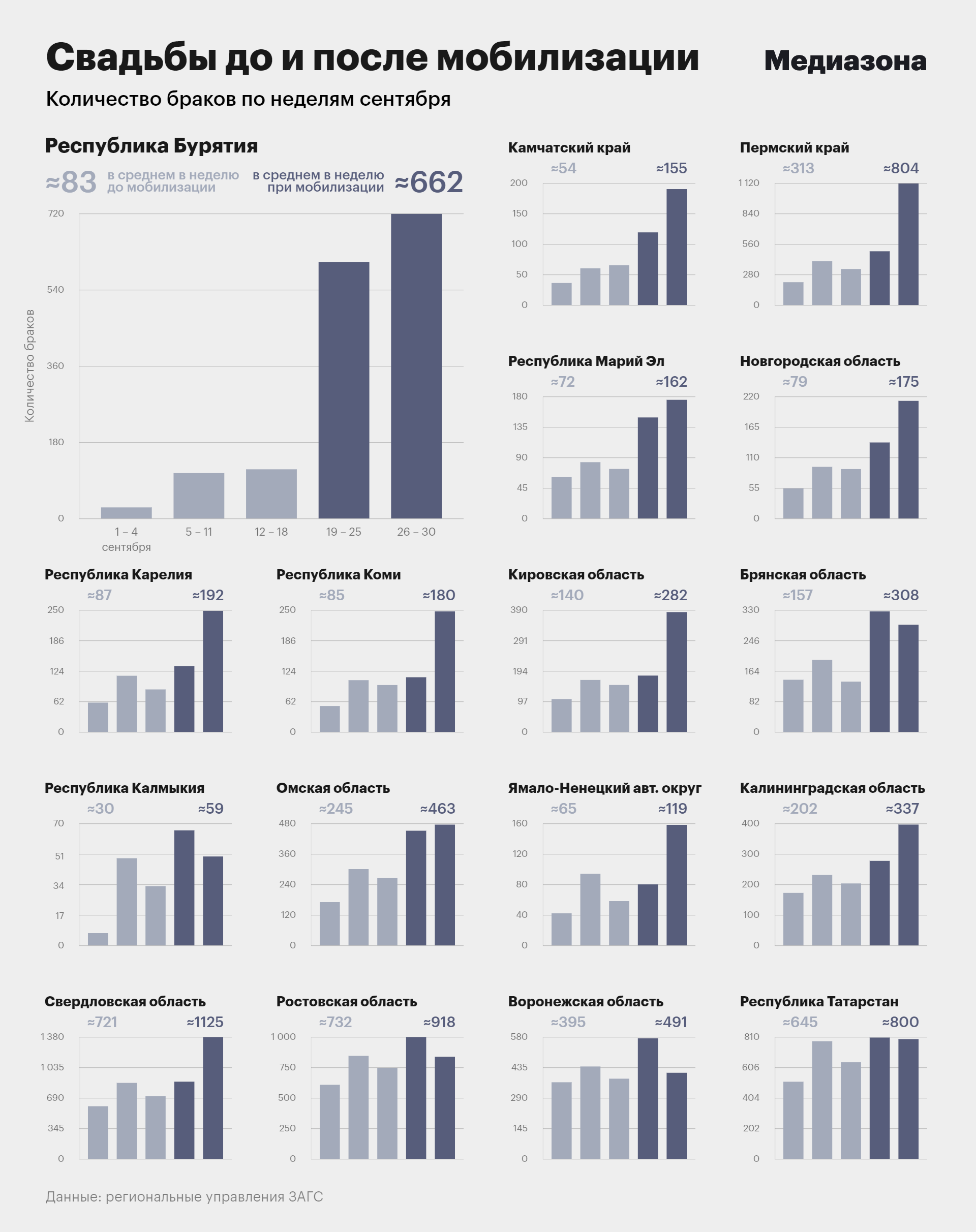
We can argue that almost everything in September and the first half of October is mobilized weddings. People who decided to marry “just in case” or signed before leaving abroad after the mobilization, until they got into statistics: without a summons, registry offices make marriages in a general manner, and after filing an application, you need to wait at least a month.
In total, Mediazone about weddings in 75 regions of Russia - according to our estimates, in the registry offices of these regions, the relations of approximately mobilized. In other words, we know for sure that in these regions the agenda received at least 31 thousand men who were in a relationship, but were not married.
How living out of marriage help to evaluate the share of mobilized
In state statistics, relations without marriage are called "unregistered marital union." Knowing the total number of men who live in a relationship, but without a stamp in the passport, and knowing how many of them they received the summons and went to the registry office after September 21, you can estimate the percentage of mobilization.
Gorges cannot calculate the number of unregistered marriages themselves. The only source of such data is the census. The last All -Russian census was held in 2021, but the demographs call it a “disaster” and consider the data unreliable. Only 46% of Russian citizens took part in it - most of the scribes simply did not reach. In 2002 and 2010, this figure was above 70%.
According to the 2021 census, in the “Unregistered Marital Union” throughout Russia, almost men aged 18 to 49 years consist of. Only officersare subject to older mobilization, the number of which is extremely small (therefore, we did not take into account people over 49 years old).
On the advice of the demographer Alexei Rakshi, we adjusted the data from the census, as this number looks low and fell strongly compared to previous censuses. After the correction, approximately a person throughout Russia came out, of which in 75 regions on which we have data about weddings.
If 31 thousand out of 2 million people who lived in an “unregistered union” of men, by mid -October, accurately received a summons, this corresponds.
How we adjusted the data of the 2021 census
To minimize the influence of poor -quality data collection during the last census, we used its results only in relative values.
The number of those who did not indicate their marriage status at all - the number of such answers has grown greatly compared to previous censuses - we proportionally distributed between the rest of the answers. Then, in each region, for every five -year age group, we calculated the share of men living in an unregistered marriage.
We multiplied the resulting share of the cohabitants by the number of men in each region according to the Bulletin of Rosstat as of January 1, 2022 - these data are formed regardless of the census.
Almost 500 thousand people have already mobilized throughout the country by mid -October
The percentage of mobilization in different regions can be applied not only to those who were in unregistered marriages, but in general to all men aged 18 to 49 years - after all, the military enlistment office does not matter if the man is married, idle, divorced or in relations.
From the point of view of demography, only the number of children under the age of 16 years can become the reason for the delay. According to the authorities, as well as the mobilized themselves, first of all, they call men with the military accounting specialty necessary at the front - it also does not depend on the status of relations.
It is logical to assume that young people get more than the age of age - they are less sick and recently served. However, the distribution of age among men in unregistered relationships and approximately the same with a peak in the group of 25-34 years.
For each of the 75 regions with well -known weddings, we calculated our percentage of mobilization - and correlated it with data on the number of men from 18 to 49 years old. From our calculations it follows that by mid -October at least 431,000 people were mobilized in these regions.
To estimate the number of mobilized in the regions without data, we took the average percentage of mobilization of 1.56%. In this case, it turns out that throughout Russia, by mid -October, 492,000 people were mobilized.
The percentage of the mobilized varies greatly from the region to the region. Judging by the data of excess weddings, the east of Russia came most for the call: Amur Region, Transbaikalia, Jewish Autonomous Region, Khabarovsk Territory and Buryatia.
In the Amur Region, there is a 38th separate motorized rifle brigade, which from the first days is involved in the invasion of Ukraine and suffered serious losses. It is replenished at the expense of mobilized villagers.
In Transbaikalia, the military commissariats massively mobilized even those who did not pass by age, and, for example, men with alcohol dependence - later the authorities claimed to be returned home.
The military commissar of the Jewish Autonomous Region fell into the news of the federal media, when he stated that in the region they would mobilize those who did not serve at all, as well as men of all ages, regardless - because "everyone is equal." Soon, EAO was one of the first to report on the implementation of the mobilization plan.
In the Khabarovsk Territory, due to “mistakes during mobilization”, the military commissar of the region was fired , however, they returned it to the post of three days.
In Buryatia, according to human rights activists, after the mobilization announcement, the “Judgment Night” began in villages and villages: men were massively handed out for men, practically without looking at age.
In absolute values, according to excess weddings, the most mobilized were among residents of the Moscow region, the Krasnodar Territory and Bashkiria. These are one of the most densely populated regions in Russia; If you look at the share of mobilization, then there is nothing unusual in the local call.
According to our calculations, about 8.9 thousand people were mobilized in Moscow. Similar numbers are given by the mayor Sergei Sobyanin in the report for helping the family families. Despite the fact that the call here can hardly be called soft - men were caught in cameras and guarded by the subway - this is the lowest percentage of mobilization throughout Russia: in the city, according to Rosstat, 12.6 million people live. The real population, taking into account agglomeration, is much higher.
As we thought excess weddings and where did we get the data
Data sources
Wedding data in September 2022 in each Russian region will post Rosstat - this will happen no earlier than in early November.
Now the data on their sites are published by regional registry offices. The “Mediazona” sent requests to the regions that did not publish the September data. In each request, we asked us to send us data on the days, but not all registry offices agreed to this: the majority provided the total number in the month, clarifying that they do not conduct daily statistics.
The regions for the first schedule with an increase in the number of weddings after September 21 have not been chosen by us - these are just the data that we managed to get.
In 39 regions of Russia, the authorities, registry offices or local media around mid -October published an exact number of “accelerated” weddings on the agenda - we used this data.
In 36 regions that provided weddings for all September, there was no such information, so we calculated the number ourselves.
For those 39 regions that have reported on the number of weddings on summons, our assessment is relevant on the day of publication of a press release (as a rule, this is the first half of October). For 36 regions in which we calculated excess weddings, the assessment is relevant at the end of September.
This slightly underestimates the overall assessment and makes the spread between the regions stronger. However, we do not consider it critical: the main wave of mobilization took place in September.
After the publication of Rosstat's data on the situation throughout the country, we will update our assessment.
Evaluation of excess weddings
In recent years, the number of marriage registration has decreased, so it is not entirely correct to compare September 2022 since September 2021, when the coronavirus epidemic continued. To assess the number of excess weddings more accurately, for each region we built a linear trend; We used the data of five well-being (2015-2019), since due to the elbows in 2020 there were much less weddings than usual. We took the average between this number and the actual number of weddings in September 2021, after which we deducted this average of the number of weddings in September 2022 - and so we got an excess, that is, the number of excess marriages.
Thus, we recorded excess weddings in 35 out of 36 regions that did not report on the number of “accelerated” weddings on the agenda. The only exception was Ingushetia, there in September there were fewer basic weddings.
Another 10 Russian regions did not report the number of “accelerated” weddings, did not publish statistics for September and did not provide it on request. These regions account for only 8% of the male population of the country.
Did all unmarried ones get into the registry office and part
Perhaps not all people who received the agenda (and therefore the opportunity to urgently make a marriage) have already ended up in the educational part or at the front - but reports of officials and the media show that the number of those who managed to challenge the decision on the call is extremely small. It is probably small and the number of those who received the agenda, urgently played the wedding, went to the military registration and enlistment office and suddenly received a delay.
It is worth emphasizing that our calculations are based on the assumption that all men who are in long -term unregistered relationships and received the agenda went to the registry office. According to indirect signs - the number of reports on accelerated weddings and reports in the media - we can assume that there are really the majority, but, of course, not all went to register the marriage. Without taking into account these people, our assessment comes out lower than it could be if such data in principle existed.
Text and data: Date Department "Mediazons"
Visualization: Data-Department "Mediazons"
Editors: Maxim Litavrin, Yegor Skovoroda
Using the data used in the study, you can find GitHub.