
Translated material
In China, the Congress of the Communist Party, which re -elected Xi Jinping, was held for another five years (in theory he can edit at least his whole life)
What will happen to the country now? Explains Kitist Temur Umarov
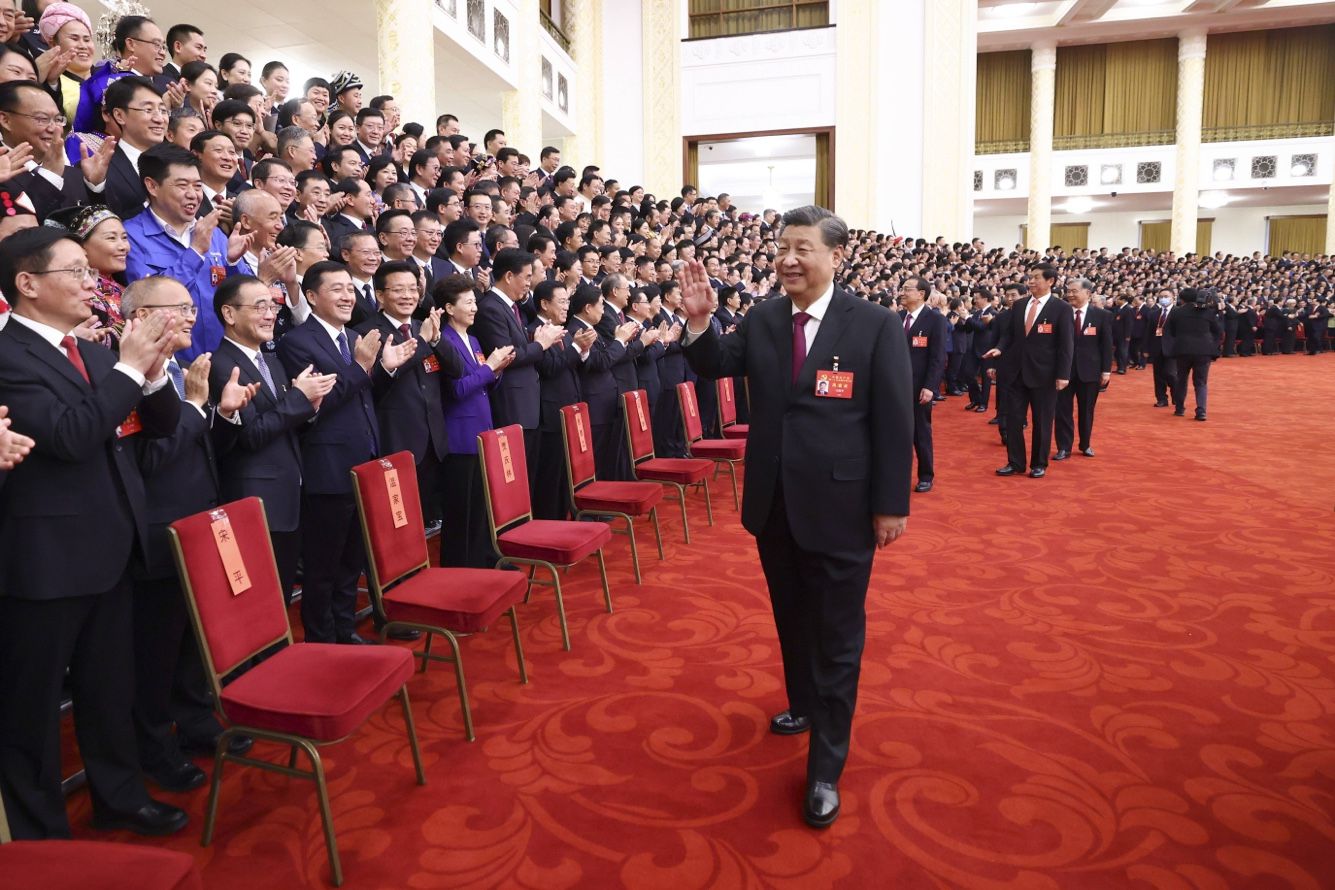
On October 23, the Congress of the Communist Party closed in China, at which almost the entire composition of the Politburo's Standing Committee, the main political body of the country, was replaced. Xi Jinping, again selected by the Secretary General and Chairman of the Republic, was the first in the last 50 years to take these posts for the third term in a row . During the decisive meeting, the former Secretary General of Hu Jintao was taken out of the hall under his arms - later the Chinese authorities explained that he simply became ill. The “Medusa” learned about what the results of the congress have learned from the regional department and the author of the telegram channel about China Temur Umarov.
- Xi Jinping decided to go for a third term as the chairman of the PRC and the Secretary General of the Communist Party of China. He became the first of the Secretary Generals to violate the rule of two terms. How did he go around this ban?
-Indeed, since the late 1970s there was no one who would remain for the third time in a row. But it is important to distinguish between the party position of the Secretary General and the government of the chairman of the republic. In order to remain for the third term by the chairman of the PRC, in 2018 SI rewrote the constitution, which allowed him to stay in the post.
However, the Chairman of the PRC is a more symbolic position, he is a representative of China at the international level. Another thing is the positions of the Secretary General and the head of the Central Military Council. These are key positions that give many tools to influence party and state affairs. They do not forbid to go for a third term - rather, in China there is an unspoken tradition: it was previously accepted that the Secretary General was changing every two terms to a relatively young member in the list of the Standing Committee of the Communist Party Bureau (PKPB). Now this rule is not following.
- Why did this happen?
- This turned out due to the fact that in five years in power, Xi Jinping successfully carried out large -scale cleaning in the Communist Party with his hands of his protege [van Tsishan], which headed the Central Commission for checking the discipline . Just under the pretext of the fight against corruption, hundreds of party members were removed from the Communist Party, and hundreds of people fell under the anti -corruption campaign. What happened now is not that a big surprise, but the next proof that in China there were no influential political elites that would confront SI and its environment.
- Cleaning were carried out not only in the Communist Party itself, but also in its Politburo - they removed four of the seven members of this body from the posts. Why was this done and how did it affect the rating of SI?
- If we take a look at the composition of the new Politburo Permanent Committee, we will see that all six people who entered this collegial organ are primarily known to the loyalty of Xi Jinping. It is very significant to the appointment of Ciang to the post of head of the Chinese State Council - an analogue of the government. Before this appointment, he had no experience in the government, but he is personally close to Xi Jinping. This suggests that for SI it does not matter how qualified people are, whether they have knowledge about the effective government of the state - loyalty is important, they turn a blind eye to everything else.
- Last week, the former Secretary General and Chairman of the PRC Hu Jintao was taken out of the meeting hall right during the first plenum of the XX Congress of the Communist Party. Did it become clearer during this time, what happened?
- There are several theories. The first, voiced by the leadership of the PRC, is that Hujintao just became bad. The second theory is partially connected with his health, partly with the fact that he could tell Xi Jinping that he did not like the new composition of the Politburo, in which there is no protege. And, perhaps, Hujinto somehow hinted that he would vote against. At the meetings, everyone votes with raising their hands, like at school, so it would be strange to see that Hu Jintao votes against Xi Jinping. And so that such a picture does not arise, it was taken away.
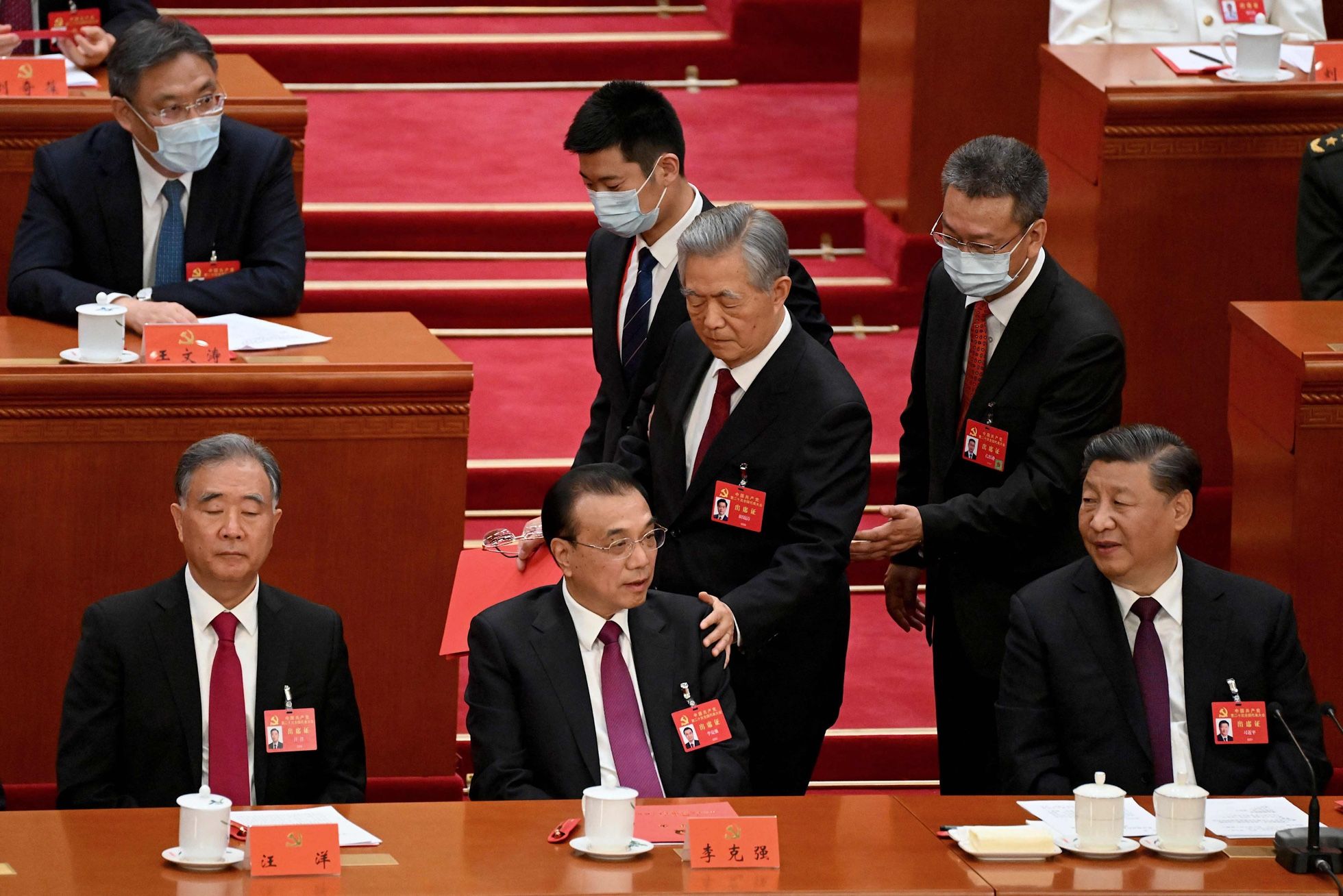
The third theory is that this [the conclusion of Hu Jintao from the hall] was invented in advance to demonstrate that Xi Jinping is really [located] at the head of China and its position is unshakable.
What the theory is true, we will find out for several months (or maybe we don’t know at all): if Hu Jintao disappears from all the news, this will be the first bell, and if in a couple of months they announce criminal cases against him or his son Huhafan, who also consists in the Communist Party, this will be another bell. But if none of this happens, maybe really a person became ill or an unforeseen skirmish between him and Si occurred when he saw new people in the list and was dissatisfied with this.
- What did they discuss at the last plenum during the XX Congress of the Communist Party of the PRC?
- Recently, two plenums have passed: the final plenum of the XIX Congress and the first plenum of the XX Congress of the Communist Party. At the final plenum, it is customary to discuss the successes that the Chinese Communist Party has reached over the past five years. It talked about economic reforms, about party construction, about improving people's lives, the fight against poverty, accelerating the pace of military defense and modernization. They also recalled important events that occurred during this time, for example, the Olympics in Beijing and the 25th anniversary of Hong Kong reunion with the People’s Republic of China.
In general, this is a repeat for those who missed one season of the series. At the same time, projects of changes are discussed for making to the charter of the Communist Party. The last such project was presented in 2017, when “the ideas of Xi Jinping about socialism with the Chinese specifics of the new era” were introduced there.
- Are the issues of ecology and pollution of fresh water reservoirs rise to such plenums?
- They also talked about the ecology, because it is included in the results of the “five -year plan”. Moreover, China still plans to achieve carbon neutrality by 2060, so the environmental agenda is part of the construction of the Chinese Dream and Beautiful China. But there was no separate focus on this, despite the fact that in recent months there have been big problems with fires in the province of Sichuan and a lack of fresh water.
Read more about China's ecology
The heat and lack of enough precipitation in China in 2022 led to the fact that the largest Yangtzi river frank: according to the official figures of the republic, during August, 60% less precipitation fell in the river drain zone than usual. In July, the Chinese government warned about drought several times. The southwestern province of Sichuan, where the Yangtzi River is located, in August of this year produced only 49% of its usual hydropower load. This led to large -scale production failures, including the temporary closure of Foxconn and Toyota plants.
- What happened at the first plenum of the XX Congress and what will follow it?
- The first plenum takes place the day after the congress, and the Politburo and its permanent committee are elected on it. This congress is important, since the main party roles are distributed on it. And since the party and state branches are fought in China, they need to be synchronized - the next plenum in March 2023 will be devoted to this. It will be followed by a session of the All -Chinese Assembly of People's Representatives (Chinese analogue of parliament), which will fix all their appointments.
- Who was in the new composition of the Politburo Communist Party?
- In the Politburo consists of 25 people, only seven are included in the standing committee. Li Kaqian , Lee Tsyan , who is now held by the post of head of the city committee of Shanghai, has come to the place of the head of government. In the list of [Communist Party] he is now under the second number, so he should become the right hand of Xi Jinping and the new head of the State Council-that is, the Prime Minister.
The third party -Zhao Lasji , who had previously been part of the permanent committee, headed the Central Commission for checking the discipline , now he will most likely head the All -Children's Assembly of People's Representatives .
The fourth man in the current hierarchy is Van Khunin, who is known for becoming the main ideologist of the present China. Number five is Tsai Qi, the head of the City Committee of Beijing, and the last two numbers - Lee Si and Dean Xuesyan. It is not yet clear what positions of these two people will occupy, there are only two of them - the post of head of the Commission of the Central Council on Policy and the Law, which oversees the security forces, and the head of the Committee on the Checking of the Discipline. They will take these two vacant places.
The age of each of the new members of the PKPB is also important. Din Xuesyan by Chinese standards is the youngest of them, he is 60 years old, who makes him a safety option in case he needs to replace Xi Jinping. There is no talk that he is really a successor, but besides him there is no one who would be born in the 1960s and would approach the role of the Secretary General after 10 years. And this is the most important, because it becomes obvious that Xi Jinping plans to stay [at his post] not only for the next five years, but also ten, if health allows.
- What are the main results of the previous two times of Xi Jinping?
- First of all, economic reforms are important: if earlier China moved towards openness [to the world], then under Xi Jinping it ceased. Now the main engine of the Chinese economy was not export, but the domestic market and the development of domestic consumption.
It is also important to strengthen the role of ideology in the PRC: before the arrival of SI there was no such bias in an ideological component. Now China is based on the concept of the Chinese dream of the great revival of the Chinese nation, this is a lot of talks about this during public speaking. In his speeches, including at the last congress of the Communist Party, he refers to the Imperial past and to what China was before the colonialists, speaks of centuries of humiliation. During the reign of Xi Jinping, insulation came to replace the openness, Koronavirus played a role in this.
- And how did the policy of “ zero tolerance ” affect the economy of China?
- It became less tied in international markets, especially after the wave of American sanctions against Chinese business, which began to slowly leave the markets. The state presence in Chinese private business also increases, which was not before - and in general the role of the state in the economy is increasing. Now each of the corporations needs to be chosen - either it remains in China and works for the future of the country, or is faced with problems, like Alibaba .
In addition, a public contract has always been in China: society does not intervene in politics, and the party provides economic growth. But over time, this fixation of China has disappeared on economic growth. For the past two years, officials at the reporting “two sessions” of the Communist Party, for example, no longer mention the figure of the planned GDP, that is, to society, they do not give any forecasts. According to the party, it is only important that the Chinese economy is conditionally stable, that there is no poverty in the country - but only by local standards. This suggests that now the Communist Party is not important economic growth, but the very revival of Chinese greatness. And for the sake of this, citizens should focus on other things, and not on mercantile economic growth and consumption, and so on.
- Why does the Communist Party continue to introduce coronavirus restrictions, despite the situation in the economy?
- The Chinese leadership felt comfortable during quarantine, when the country was closed, there were no problems with foreign media, which supposedly destabilizing the situation. They were also comfortable for them to be total control over society, over the movements of people along the streets. You can, for example, put opposition citizens in quarantine.
But, on the other hand, this leads to great scandals in different cities - the largest of them recently was in Shanghai, when a flash of incidence led to the city introduced Lokdown, but all delivery services were overloaded, couriers and people in a modern metropolis were simply closed in their apartments and starved. Nevertheless, there is no doubt that China is not going to move away from the "zero tolerance" policy. For the Communist Party, total control over society is more important than small town discontent.
- How, in such a situation, state media explained the need for Xi Jinping to go for a third term and how did the citizens react to this?
- The Chinese propaganda machine does not explain the actions of the authorities, its task is to serve everything for granted, as what just needs to be learned. Sometimes, among the reasons, the collective leadership slowed down Xi Jinping during very important reforms, which no one was dared to, so we need a person who will take everything into his own hands and will conduct painful, but very important changes. And despite the fact that the society will be displeased, the Communist Party is important to carry out these reforms, because without this it will be impossible to achieve the revival of the Chinese nation.
- Do citizens of the PRC express their discontent publicly?
- Protests on various issues, not necessarily political, periodically pass. Often they relate to environmental problems or civilian issues. If the protests are not political, then they end successfully, because the local authorities go to negotiations with the protesters.
But there are no big political protests: when they appear, people quickly disperse people. The only tool for protests on political issues is the Internet that is very much censored and actively monitoring. Any political post that quickly gains views and becomes viral is taken under control. If there is nothing critical to power in it, comments and reposts are simply turned off there. And if he is gaining heavy speeds, then the post is removed or deactivated by the user account that published it. The Chinese car of censorship has a large number of tools to track what society is protested against on the Internet, and a quick stopping of potential protest points.
- How will the new Tsinpin's new term for China and his domestic policy will turn out?
- I believe that there is no need to wait for big changes. This is still the same person and the environment is almost the same, even even more loyal than ever. Therefore, I think we will see the strengthening of the monitoring of the Chinese leadership over society and the increase in attention to those areas that the Communist Parties are important to achieve our own goals, including the technological development that is necessary for confrontation with the United States, and the development of the military and ideological spheres.
In addition, in domestic politics, in the coming years, a new principle of personnel policy should be formed, because Xi Jinping violated the principles of transferring power. Therefore, the transit process is again relevant, but it is not yet clear how this issue will be resolved and whether this will lead to the potential destabilization of the political regime.
- Will China’s relations with other countries change, including with Russia?
- Here we will also see the continuation of those trends in foreign policy that have been observed in recent years. Now China, probably, in the worst relations with the United States over the past decades, and so far there are no reasons for improving these relations.
I think that in the near future we will see the following steps of China to strengthen confrontation with the United States and the same from Washington. In relations with Russia, the trend that has been observed for the past few years will also be preserved - this is increasing the dependence of Russia on China. Naturally, with the outbreak of war, this dependence became much stronger, because China remained the last country, which, firstly, has a great weight in global policy, and, secondly, continues to communicate with Russia as a partner, and not as with a toxic country.
Katerina Orlova