
Translated material
Russia where its army stands
On January 25, 2024, Doxa was recognized as an “unwanted organization”.
If you are in Russia or plan to return to it, you can not replace our materials on social networks, refer to them and publish quotes.
Read more about what is possible and impossible, read in the cards .
Russia's invasion of Ukraine must be considered in the context of the colonial wars, which was waged by the Russian Empire and the Soviet Union, says decolonial researcher Anna Engelhardt. We publish the translation of the article written by Anna for the English -language journal The Funambulist, in which she raises fundamental questions about the structure of Russian colonial wars and explains how the colonial nature of conflicts affects the production of weapons and military tactics.
Authorized translator
Authorized translator
Sasha RatnikovEditor
Editor
Katya MorokoDesigner
Designer
SandyPublication
August 29, 2022
“ In Chechnya, only our place is where our detachment stands; The detachment moved-and this place immediately passes into the hands of the rebels , ”the Moscow Vedomosti journalist from the front of the Russian army in the Caucasus reported in the 1840s. This war, which lasted more than sixty years, has become one of the many colonial conquests, as a result of which a state was formed, known as the “Russian Federation”. Its “sovereignty and integrity” - one of the most strictly protected concepts in Russian criminal law - represent an extremely unstable unity of colonized territories. The fragility of state education, known as Russia, can be traced in its endless conquering wars. For centuries, every new war of Russia mechanically repeats the previous ones. Such a repetition of history may seem automatic, almost a foregone conclusion. What can we do now if Russia has already annexed the Crimean peninsula at least four times? How to stop the Crimean Tatars genocide on the Crimean Genocide, if already in 1783, Russian conquerors tried to erase this people from the Crimean land? Nevertheless, the frequency of conquests indicates that the colonial wars do not end in favor of the empire. Regardless of how successful each individual invasion was, their repeating structure indicates the inability of Russia to suppress decolonial resistance. The mythical integrity of the captured lands within the framework of the Unified State “Russia” is an unattainable ideal. Poprazing the quote with which I began: “Russia” where her army stands.
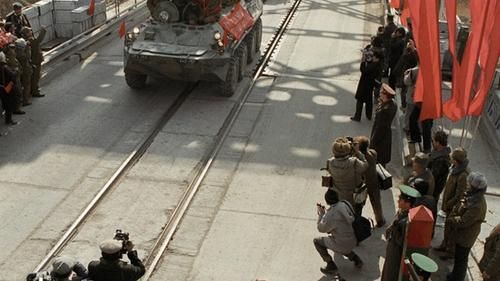
The withdrawal of Soviet troops from Afghanistan: the last column of equipment crosses the border of Afghanistan and the Uzbek SSR, 1989. The Uzbek-Afghan border basically took on its modern appearance during the Russian conquest of Central Asia in the 19th century. This conquest was part of the “big game” - rivalry between the Russian and British empires for dominance in the region. Source: A. Solomonov. Creative Commons: RIA Novosti.
Russia waged so many wars that their structure is visible as in the palm of your hand. One of the features of this structure lies in the general instability of the control that the war ensures. In the terrifying frequency of intrusions, their fragility is traced. No matter how cruel the actions of Russian invaders are, their power collapses under the fierce pressure of decolonial resistance. The Russian colonialism is fragile, like a thin sharp glass, but this does not make it less dangerous. It is precisely due to the fragility of its structure that it constantly crumbles with painful cuts. Its sharp fragments stick out of the Russian Academy of Sciences from numerous invasions, seizures of territories and genocides of peoples, which were never subduced by Russia. Therefore, the Russian conquest never ends. Even the economic shock caused by the collapse of the USSR did not prevent Russia from filling the newly formed gaps in its “integrity” by the bodies of those who dared to resist it. In 1991-1993, despite the disorganization of the central government, Russian troops dumped vacuum bombs into the Georgian residential areas during the civil war in Georgia. In 1994-1996, really without the structural conceptualization of the new capitalist state, Russia has already cleaned the population of Ichkeria, known today as Chechnya. Even despite the fact that in 1996, Russian troops were defeated by Chechen resistance, next year Russia found strength in order to drown the opposition movement in Tajikistan in the blood, fighting for democracy. The list can be continued.
Weapons "War" and "Special operations"
The structure of the colonial wars that Russia wages is clear in the historical perspective, but what is it? In 1988, the anti -colonial Chechen historian Abdurakhman Autokhanov noted that both the Russian and Soviet empires never waged “colonial wars”. They "performed international duty", "defended" or "ensured the security of the borders." The Chechen human rights activist Abubakar Yangulbaev in his recent article also indicates the reluctance of Russia to call war war. Comparing the Russian invasions of Chechnya and Ukraine, Yangulbaev draws attention to the similarities between them: the growth of hatred by Russians, the mass killing of civilians, the use of outdated methods of warfare, the lack of Russian military necessary skills, the task of establishing a puppet government and the use of peace negotiations to divert attention. Of these components, a Russian colonial project is formed - one, despite all its complexity. These features of the colonial war are parts of one structure, and therefore they are interconnected. In other words, the various features of the colonial wars, designated by Yangulbaev, directly affect each other.
Russia has many reasons not to call its colonial wars wars. As noted by Avtokhanov and Yangulbaev, the point is not only that such expressions as “fraternal help” allow you to endow bloodshed with positive connotations. In the course of “operations”, including “counter -terrorism” (Chechen war), and “events” (war in Afghanistan), the laws of war are optional for execution. But the use of such euphemisms has other reasons that are often not recognized by colonial states. According to Tarak Barkavi, a post -colonial historian of war, those who write or talk about the war rarely pay attention to the fact that the very concept of “war” is used exclusively to denote conflicts between empires. The empire does not necessarily be aware of this, but for it it is offensive to call the invasion of the “colonial war”, since in this case it will have to recognize the enemy equal to itself. The “war” is called conflicts only with those who are perceived in the colonial matrix as located at the same step with the empire. In favor of the Barkavi theory, including the fact that “war” is usually used in combination with words that downplay the meaning of what is happening (“small war”, “low intensity conflict”), or is completely replaced by words that convey that we are talking about something not very large-scale (“operation” or “ event ”).

We talk about Russia's military invasion of Ukraine, protests and repression. We believe that now, when dozens of media have closed or ceased to cover the war, access to independent information is more important than ever.
Not only serious terms, but also serious weapons are intended exclusively for conflicts between empires. At least since the Second World War, the Soviet and Russian army has been constantly preparing for war, meaning this war with the West. The whole military machine was tirelessly improved to struggle with another "nuclear superpower." Such an unconscious division of wars into “wars” and “special operations” predetermined the inefficiency of the weapons that was developed for use in colonial wars. The military who served in Afghanistan notes that those vehicles that were in service with the Soviet Army would be advanced technologies if they would have appeared in the post -apocalyptic world that survived the nuclear war. Burning, protected from radiation, and not from ambush and attacks of mobile units, they were useless during what was officially called the "events" of the Soviet Army in Afghanistan.
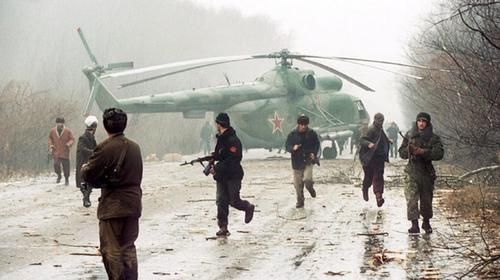
The Russian helicopter Mi-8, shot down by the Chechen forces near Grozny, December 1994. Source: Mikhail Evstafyev. Creative Commons.
Violence technologies in the colonial matrix
One of the formulas of the colonial war is as follows: "The only enemy for the war with whom it is worth preparing is another empire." Since, within the framework of the Russian colonial project, colonized peoples are considered as located at a lower stage of development, the Russian armed forces are constantly not ready for hostilities and are subjected to radical restructuring right during wars. The colossal losses of the Russian army give rise to cyclic “revolutions in military affairs”, designed to summarize the experience gained in new military technologies and avoid losses during subsequent intrusions. Nevertheless, truly radical military reforms are impossible due to the deep conviction of Russia in their own technological superiority. History shows that such ideas about the superiority of Russia in weapons are as torn from reality as the idea of racial superiority. Moreover, both of these concepts are closely interconnected. The idea of military superiority is laid down in colonial thinking as such. To understand how such a mechanism of colonial thinking works, we can simplify coloniality to a matrix consisting of different coordinates of “superiority” - racial, cultural, technological, economic and so on, which intersect and fuele each other, forming a single structure. We can trace the work of such a colonial matrix in how exactly the Russian army uses propaganda, ridicuating “ exotic ”, “ antique ”, “ artisanal ” and “ morally and technically outdated ” methods of warfare of Kurdish detachments of folk self -defense and Syrian opposition. The Russian Empire must constantly portray the peoples colonized by it as retarded, and this despite the fact that they successfully confront its army.

The Syrian Fracture exhibition, held in various cities of Russia. The photo was taken in the Patriot Park in the Moscow region. The weapons captured by Russian troops in Syria were exhibited in the orientalist atmosphere of the destroyed palmira to emphasize the “ancient” and “exotic” nature of weapons. This weapon, allegedly used by the "terrorists", mainly belonged to the opposition forces, including the free Syrian army, and was used during hostilities in modern cities, and not in ruins in the middle of the desert. Source: Official website of the Patriot Park
Within the framework of the colonial matrix, indicated above, the empire cannot admit that the forces of resistance managed to defeat its troops due to its technological superiority. Any military failures are explained through other coordinates of imaginary dominance over the enemy: for example, as the historian of the British colonial wars of Kim Ati Wagner demonstrates, through appeal to the race. According to the researcher, Britain believed that the defeat of the colonial troops was associated with the “fanatic” “Dikar warriors”, which compensates for their “backwardness” in the field of weapons. Thus, it is easy to notice that the “revolution in military affairs” is not able to solve the problem of the inefficiency of Russian military technologies. New military doctrines only allow you to find an excuse for a non -working military machine, emphasizing the exclusivity of Russians in other coordinate systems.
The fog of the colonial war
Contrary to colonial prejudices, the forces of anti -colonial resistance usually have high -tech weapons at the disposal. Moreover, such weapons are much more suitable for warfare in the conditions of a colonial war, something that Russia uses. High -tech weapons can not only be purchased in the countries of the Global North, but also act as donations from the sympathetic from the countries of the Global South. Finally, of course, high -tech weapons are actively produced by the resistance forces themselves, posing a serious threat to Soviet soldiers. So it was even during the war in Afghanistan. The most famous of the recent examples of using high -tech weapons of local production are drones that attacked the Russian military bases in Syria in 2018-2019. Miner drones launched from the territory controlled by the opposition of the Idlib province brought Russian mercenaries horror. Commenting on the losses of the Russian troops, the deputy head of the Russian Ministry of Defense accused the United States of attacks, saying that the equipment necessary for this is created " not on the knees and not in the Syrian desert ." Nevertheless, the drones were produced in Syria from materials available in almost any aircraft store, and were actively used for exploration and strike on Russian and Assad forces. Thinking about the involvement of the countries of the Global North, Russian President Vladimir Putin said that the drones were specially disguised as home -made devices, although in fact they are high -tech weapons. Thus, Russia, reacting to the attacks of drones, did not try to contrast them with deadly effectiveness. Instead of recognizing the technological equality of the enemy, Russia began to search for a double bottom. Such a searched for secret meanings is a reflection of a more general trend in the development of Russian weapons. In the course of those “revolutions in military affairs”, which was discussed above, the main emphasis is on reconnaissance technologies, despite the fact that in the public field they are given the least attention. Russia puts the priority of intelligence technology, since the image of the enemy as a mysterious other plays an angry joke with its army. In colonial wars, Russia is not able to comprehend the stereotype that it itself created, being in the ignorance of the enemy forces. The deputy head of the Russian Ministry of Defense Alexander Fomin cannot even allow the very possibility of the existence of the Syrian drones because of his ignorance, which is no exception, but, on the contrary, the key principle of colonial campaigns. Ignorance and ignorance are manifested in all aspects regarding knowledge of the enemy: the Russian army is not enough translators all the time, it uses outdated cards and has scattered intelligence about those whom it needs to be taken under control or eliminated. Based on the ideas of technological superiority, the military see the solution to these problems in the reconfiguration and improvement of information production machines.
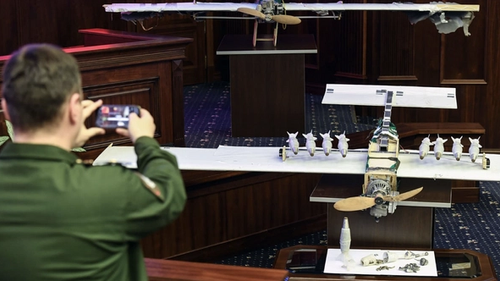
The Russian officer takes pictures of the drones who participated in the attack on the Russian military-air base in Syria. Drones in the picture were captured by the Russian military as trophies and were shown at the briefing of the Ministry of Defense on January 11, 2018. Source: Kirill Kudryavtsev/AFP.
Automation of the collection (des) of information
Such a dependence on intelligence equipment is usually no secret for participants in anti -colonial resistance, which often use it, strategically using “outdated” communication technologies (including wired communication and messengers) outside their usual radius of action. Partisans, as a rule, not only well know the technical range of such devices, but also understand that any system of technical surveillance or reconnaissance depends on people who collect and interpret the data obtained. Such Russian military specialists should have at least some idea of the language and culture of those against whom they are fighting. As it is easy to guess, the Russian military, which have the necessary knowledge, is always in deficiency, and the forces of anti -colonial resistance often come to this conclusion. The Chechens, when the Russians intercepted their radio converters, specially switched to Chechen, which allowed them to effectively encrypt information. Russian intelligence officers who participated in the invasion of Ichkeria confirm that they have not achieved any success in learning the Chechen language, since in principle they did not have such a task. At the same time, the Chechens, who throughout the history of the colonization of the Caucasus were actively imposed on knowledge of Russian culture, were so well aware of the enemy that they knew the weaknesses of Russian tanks and other military equipment. Another colonial practice, which was already used during the invasion of Afghanistan, is also strengthened by this trend - a call for the imperial war of soldiers of the colonized republics. Participation in the war in Afghanistan gave practical knowledge not only to many Chechen military, who skillfully used the weaknesses of Russian weapons, but also the leaders of the independence movement, including Johar Dudaev himself, who were aware of the gaps in Russian military tactics.
Anticolonial resistance, as a rule, still uses the asymmetry of information: on the one hand, colonial troops lack information that they actively reject or replace prejudices, on the other hand, the resistance forces, thanks to the knowledge of the culture and technology of the empire, have the fullness of the enemy information. The use of technical intelligence tools aimed at eliminating such asymmetry through a mechanized collection of information did not lead to the establishment of more effective control. Instead of increasing military potential, they only gave the Russian military self -confidence. Such arrogance of the Russian military is actively used against themselves. One of the Russian soldiers who fought in Chechnya reluctantly confirms this: “ The Chechens had one indisputable advantage: they knew the Russian language and could disinfect us on it, and we did not. Often, both during the battles and in the breaks between them, the natives got in touch with our troops. ” Speaking about “misinformation”, the military has in mind that the Chechens, whom he eloquently calls the “natives”, hacked their radio converters and informed them of the incorrect coordinates of goals. This and other evidence suggests that the Chechen hackers with an enviable frequency managed to cause the friendly fire of the Russian troops in their units, while remaining unnoticed. Indeed, how can Russian soldiers admit that those whom they despise as a lower race are able to hack their holy saints - “high -tech” communication networks? Today, Russian troops in Ukraine are also firing on their own positions, following the instructions of the hackers who hack their communication systems. The messages of the Russian military are constantly intercepted, change to the directly opposite, interrupted by the sounds of the Ukrainian anthem and the ghostly voices of children-robots. The auto -generated voices of children, stretching and crackling on radio waves, turn to them with a repeating question: "Russian soldiers ... step away ... [the sounds of cod] you really believe ... What does it make sense? .. This is not your war."
Ekaterina Moroko · Websdr Recording Start 2022 - 03 - 01t11 56 27z 9741.0KHZ