
Translated material
New personalist power after Putin? It is hardly
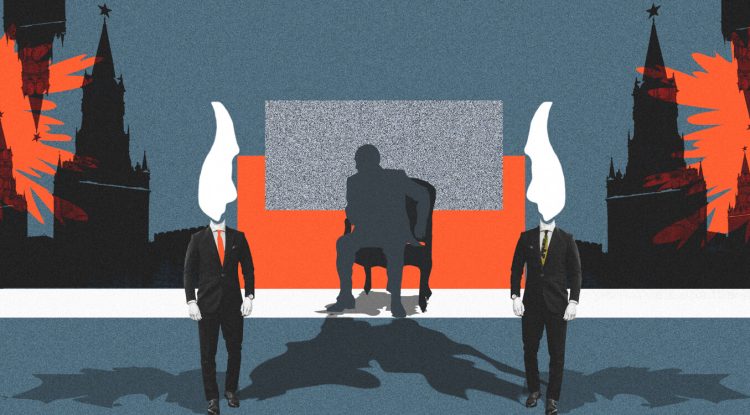
Political scientist Grigory Golosov about the possibilities of transforming the current regime
Once every two weeks in the “cold” an article by Doctor of Political Sciences, one of the leading political scientists of Russia Grigory Golosov, is published that the regime of Vladimir Putin is, under what circumstances he can fall and, most importantly, what will happen after him. This text of the votes moves to the third, key issue, offering options for the political future of Russia and evaluating their probability.
In order not to miss the main materials of the "cold", subscribe to our Instagram and telegram .
Russia after Putin. Options
The question of what will happen in Russia “after Putin” raised, at least since 2003 , and each time the correct answer was that Putin would remain. I must admit: it is such a scenario that seems the most believable now. The constitutional amendments of the 2020 created legal conditions for Putin to retain his post for another 12 years, and the political situation still does not have a different forecast. But something, of course, has changed, and if you reduce these changes to one brief formula, then we can say that for all residents of Russia-both for its ruling class and for the masses-Putin from the means of solving problems turns into the main problem.
This change is far from completed and definitely not realized. Many continue to hope that Putin - as it was almost always during his long rule - will be able to resolve the situation. Then Putin 2036 is possible, and maybe Putin 2036+ - the numeral will be determined exclusively by the health of the current president.
However, if the balance of power in the highest Russian political leadership will change, the regime will begin to transform. About the direction in which this will happen, I am going to talk in the following articles of my cycle for the Cold.
Let me remind you: I previously defined the current regime as a personalist dictatorship that exists in the electoral shell. I do not think that at the exit from it we will get democracy. In the near future this will not happen. Even in the case of democratization, she will be preceded by a transition period, which in itself will not become democratic. However, the long -term prospects of abandoning authoritarianism are far from guaranteed and not obvious. The world political development of past decades indicates that at the exit from one form of authoritarianism, we most often get another. There are options that can and should be discussed.
I will list them not in probability (in fact, I would generally refrain from determining this order), but in a logical sequence. Of course, it is always necessary to start with an option in which the changes will be minimal - the regime will remain personalistic dictatorship. Theoretically, this can happen both while Putin was preserved, and after a noticeable change - or even complete erosion - his political role.
Before discussing this option in more detail, I will denote an alternative. The range of authoritarian regimes is limited. The prospects of the absolute monarchy, if we understand it not in the metaphorical, but literally (as it exists, for example, in Saudi Arabia), strive for zero. This option has supporters (for example, Igor Girkin-Rachaletov), but I will not seriously discuss the situation in which Russia will not be the leading autocratic power, I will not become. This would take us too far into the foggy areas of the fantasy genre.
But other options are believable. The most probable is the seizure of power by power structures, that is, military or other militarized organizations. As a result, it is established that in political science it is customary to call the military regime , although in this case any power vehicles, as well as civil politicians involved in its side, can play an important role.
The third option is a party regime. Recently, in journalism, a lot of attention has been paid to the question of whether the current configuration of one of the varieties of this regime, namely the “fascist”, is now. I spoke out on this topic and now I can only confirm: no, not. The prospect of establishing another variety, communist, is extremely faded. However, party regimes, by definition of ideological, in the past demonstrated diversity that does not come down to these two categories, and the possibility of moving to the extreme right party regime of the fascist sense cannot be excluded.
The fourth option is a way beyond the scope of authoritarianism, the democratization of the Russian regime. I consider it possible no less than the preservation of authoritarianism, and I believe that in a wide perspective the future is precisely for this option. However, I will leave the rationale for this point of view on the following articles of the cycle.
Preservation of personalistic dictatorship
Now let's return to the first option - to preserve the current regime in a slightly modified form. When discussing the constitutional reform of 2020, the contours of the decision were planned, which, on the one hand, would allow Putin to maintain the main volume of power, and on the other hand, significantly changed some aspects of the functioning of the regime. I mean the creation of a state council, led by Putin, who, in this case, would give a presidential chair to the successor. The real power of the successor would be limited at the same time, so the last word, when making critical decisions, would remain with the chairman of the State Council. A similar option was immediately implemented in Kazakhstan.
It is difficult to judge how seriously Putin himself considered this scheme as a way to solve the “problem of 2024”, but this is not important, because in the end another method was chosen. The events of this year in Kazakhstan showed that Putin had every reason for fears about this option. In a stable situation, it works, but with any exacerbation of a formal head of state, it can be enough both institutional authorities and political resources to get rid of his predecessor, sacrificing him to popular discontent.
The transfer of power by inheritance
There is only one situation in which the separation of power between the formal leader and its informal boss is relatively safe for the latter. This is the transfer of power by inheritance or, in the broad sense, inside the family clan. Until such a situation, even party regimes can degrade, as evidenced by the experience of North Korea. Cases of this kind among electoral authoritarian regimes are quite numerous: from Djibuti to Singapore (although there is a lot of time there between the resignation of the patriarch of the regime Lee Kuan Yu and the coming to the power of his son Lee Lee). There is a very fresh example of Turkmenistan, where the presidential chair was transferred from father to son, but at the same time the father, Gurbanguly Berdimuhamedov, remained the actual ruler as the chairman of the upper house of the parliament.
The implementation of such an option in Russia is unlikely not because the constitutional reform of 2020 deprived it of institutional prerequisites: the experience showed that the Basic Law of Russia lends itself to changes with incredible ease and the recreation of these premises would not be a problem. The problem, rather, is the absence of a believable candidate of a relative heir. Putin, of course, has his mysterious, not very open to the general public of his daughter, but there are no signs that they can be considered as his successions. The lack of information makes this topic extremely complicated for reasonable judgment. However, it seems that Putin himself is not inclined to lay great hopes on his daughters in terms of their preparedness for great political careers, or even, possibly, as potential guarantors of preserving his actual power and security.
Putin's Russia without Putin
Let us now consider the prospects for the reconstruction of the personalist regime in a situation where Putin will lose power due to certain circumstances, but the configuration of the ruling group will not undergo significant changes. Discussing this option, in fact, is most difficult due to the non-obviousness of any stable configuration of this group. Even the attempts by Yevgeny Minkchenko to reconstruct the composition and distribution of powers within what he called the “Politburo 2.0”, now ceased, and even before were not particularly convincing. In fact, the configuration of the ruling group in the conditions of the personalist regime is not amenable to fixation by definition. Simply put, we do not know and cannot know who will stand closest to the decision center at the “moment x”.
Suppose, however, that the composition of this group will not be determined by the formal position of its members in the structures of power (this is part of another scenario on which I will not stop now), but the volume of their personal, which is not amenable to formalize power resources. The first thing that we can say, following this assumption that none of the possible applicants for supreme personal power will have a decisive advantage over others. The appearance of such a character in the conditions of a functioning personalist regime is extremely difficult, since he would pose a too clear threat to the current leader, and in Russia it is not even visible on the horizon.
You can, of course, resort to the argument that since the regime will retain its electoral character, the leader will determine the elections. Putin also did not immediately get his colossal political resources, but after a couple of electoral cycles, everything changed. However, it must be remembered that Putin won his first presidential elections in the conditions of electoral democracy, and the latter were still not entirely fictitious.
Now the situation is different. All members of the ruling group know that when preserving the main features of the Russian “electoral policy”, any candidate who will represent the existing power will win the election. The real fork will not appear at the moment when citizens are called to polling stations, and when members of the political leadership in a narrow circle will decide on the nomination of one of them to the presidency. I believe, however, that in this situation there will be only one decisive argument at the disposal of a potential winner - power, that is, the opportunity to attract an army or security forces to their side.
These circumstances take us beyond the scope of the model, in which the existing regime is preserved in a more or less unchanged form. Absolute monarchy or party regime can survive the active intervention of power structures in politics. The first is because the conditional Life Guards Preobrazhensky Regiment, which made a coup, may well limit its interference in politics by the change of one monarch to another. The second is because the military leadership is closely integrated with political in the framework of party bodies. The military leaders who participated in the struggle for power simply remain members of the party leadership. This does not lead to the establishment of military regime.
With personalist regime, this is impossible. There are no institutions - the court of the monarch or party that would ensure the integration of the security forces into a new order, while maintaining the secondaryness of their role. Everything goes to the one who ensured the power transfer of power, even if formally he does not immediately become the head of the regime. Thus, I do not find the prospect of preserving personalist power - with Putin with a significant change in his role or without Putin - realistic. The establishment of a military regime is more likely, and I'm afraid that from the above we can conclude that I think the probability of such an outcome is very high. No, I don't think. But about that - next time.