
Translated material
"Mom, I'm almost free"
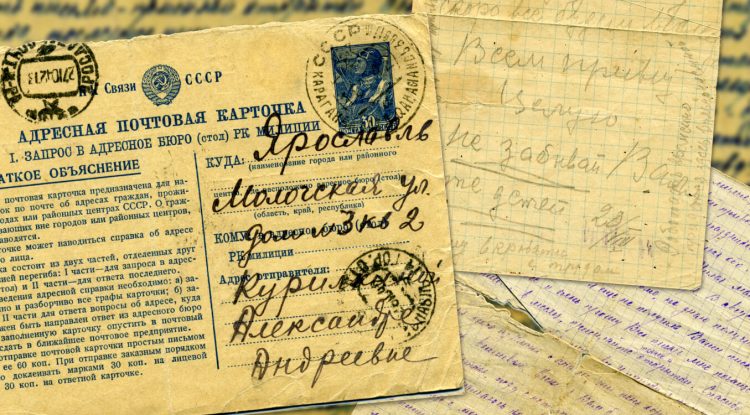
Arrested in 1937 for the "treason of the Motherland" the woman wrote a letter from the camp to the family. Read them
Valentina Kurilkina-Rudy is a housewife from southeastern Ukraine. In 1937, when she was 37, she was arrested as a member of the family of a traitor from the homeland. Kurilkin-Rudy was sentenced to five years in a forced labor camp: she was serving a term in the Akmola camp of wives of the traitors of the Motherland, where she died in 1942. With the permission of the “memorial”, “cold” publishes the story of Valentina and letters that she wrote from the camp to her mother and children.
In order not to miss the main materials of the "cold", subscribe to our Instagram and telegram .
All decryptions and letters are provided from the archive of the Memorial.
Valentina Kurilkina-Rudy was born in 1900 in Taganrog in the family of Vygochintsy. She had two sisters and brother - it was they who undertook to help her two sons after Valentina and her husband were arrested in 1937.
Valentina’s husband-Nikolai Rudy-studied in Berlin, and from the beginning of the First World War went to serve in the Austro-Hungarian army. In 1916-1917, Rudy was captured by the Russian army and switched to its side. In the 1920s, he graduated from the Industrial Academy, then he got a job as a party secretary at the plant.
Valentina married Nikolai in 1927: according to family history, the couple met at the resort. The couple lived alternately in Nikolaev, Zaporozhye and in Slavyansk. The following year, their first son was born-Spartak, and in 1931-Leonard. In 1937, Nikolai was arrested in Slavyansk, and a few months later - shot. Then, in front of the eyes of children and mother, Valentine was arrested as "a member of the family of a traitor from the Motherland."
Here is how the youngest son Leonard Rudy recalls the day of the arrest of the mother: “We woke up on the floor, it was August 1937, some people around us were, and there was a mother and grandmother, who fussed and began to collect us quickly, without explaining anything: they blinked, burst into tears. And at first we were sent somewhere in a huge room. There was a bunch of children on the floor, everything in bulk. Then they began to be transported to orphanages. I even remember that Spartak rode by train and fell from the shelf. ”
Valentina Kurilkina-Rudy was convicted in July 1938, and in October 1938 he was transferred to the Akmola camp of the wives of "traitors of the Motherland". Meanwhile, her sons fell into the orphanage. In prison cards, Valentina wrote only that “healthy” or “feels decent”. The main thing that bothered her was the fate of her sons.
Spartak in 1937 was already nine years old: he knew how to read and write, so he made himself felt about his grandmother, and Leonard was only six years old. According to his memoirs, in the orphanage he was renamed Gennady and gave another surname: “Something like Kukushkin, ore, or non-infirized. Everything was changed. Probably because I was six -year -old. And everything changed, and they did not immediately find me. Probably, some letters were sent to me, but I did not know how to read. "
The sisters of Valentina and her mother found boys and tried to adopt them, but to no avail. But they achieved their transfer to the same orphanage near Smolensk, where the children found the beginning of the war in June 1941.
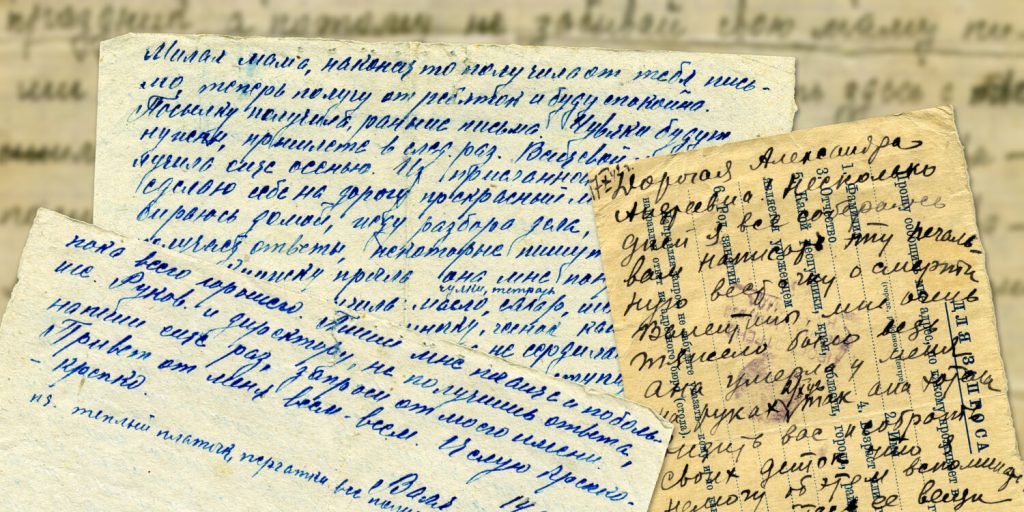
May 16, 1939. Valentina's letter to her eldest son
Hello, my dear, dear Spartik, sending you my greetings, kiss you tightly and congratulations on the end of the school year. You are now a fourth grade student, a very adult boy. I will come and do not recognize you, my dear.
Now that you have no lessons, write me more often - every 10-12 days. In letters, write in detail how you spend the time, what books you read, [what] saw the pictures, what you liked, who your comrades are. And describe, as you spent on May 1, how you went through the play in which you entered. You will go to the camps or to the grandmother, you write to her so that you and Lenarik are taken for the summer. Now write to me about this, inform the address and write to me in detail how you live.
Boy Spartik.
Tell everyone hello, write about everything. And if there are no letters from me for a long time, do not grieve, do not wait, but write to me. In the summer you will be with Lenarik, help him write me a letter and ask my grandmother to talk to the manager to be transferred to your orphanage. I wrote a statement.
Remember, Spartik, that your letters give me joy: on the day when I get a letter, I have a holiday, and therefore do not forget your mother, write me more often and more, I will be more fun to live here with your letters. Have you fulfilled my request? He wrote to my grandmother to be sent to me boots with galoshes [Work shoes], Vaselin, an old warm knitted blouse, colored threads [for skullcaps], fat and crackers? If not, then write now and do not forget anything. In the summer, be sure to deal with the letter: you write with errors, and in the fourth grade you can not make errors. Ask Aunt Zina to do with you.
Spartinka, I will save your letters, save you and you are mine. You will go to Prasolovo - take them with you [ask Uncle Pasha to photograph Lenarik and Hello Hello]. In the envelope, put the paper for me - I get it and write to you the answer. I received two letters from you, and I write to you the fifth. Ask your grandmother for brands.
Goodbye, my boy, kiss you tightly. Mom loving you.
March 12, 1941
Hello, dear dear mother, I am writing you another March letter, although I have not received an answer to February. And in general, despite all my requests, you write to me very rarely. Rather, mom, you write me alone, the rest have not sent me a line lately. From you I received an answer to the January and second [letter], where you wrote that the guys were sick with Seryozha: now how they were better? Honey mom, write to me more often. There is no time to write a letter - send postcards. Spartik’s silence is especially worried - the last letter was from December.
Today, mom, I have a holiday - I received a parcel from you, for which thank you heart. Now for a long time I will be provided with a delicious breakfast and tea with sugar, so tired of drinking it empty with one bread. Thank you for the threads - there will be more authentic days, I’ll start to embroider a skullcap - I almost finished the sport. In letters you ask how and with whom I live. We live here with those letters and news that we get from you, dream of a house that is not. I am surrounded by the same members [families of "traitors of the Motherland", Chsir], like me, we have no men. I still work as before-I embroider. We embroider exclusively with our hands - tablecloths, dresses, shirts with a cross and Poltava surface, personally, for seven months I have been sitting on a blouse, the drawing of which consists of triangles connected by me with a stem stem, the work is conveyor.
Send me in a letter of cigarette paper, I will translate the drawings and send them to you. I feel not particularly important, the weather is to blame for this, which changes two or three times for a day. I got the book, in vain you sent an expensive binding, because I do not make a library, but only read it. Find you also send - send cheap, and better read newspapers.
So there is life, from day to day we are waiting for a decision to revise our affairs.
Well, for now, all the good, my dear, dear, relatives. I hope to see you soon. I kiss you all tightly. Kiss your guys for me and do not forget mine.
March 14, 1942
Dear mother, finally received a letter from you, now I will receive from the guys and I will be calm. I received the parcel, before the letter. Chuvyaks (soft leather shoes without heels) will be needed - send next time. I received a duffel bag in the fall. I will make a beautiful bag out of the burden sent on the road: I’m going to go home, I'm waiting for the analysis of the case, some are already getting answers, some write from home.
I read the book, I liked it. In the package I received: oil, stockings, notebook, sugar, chocolate, threads, elastic bands, pillowcase, scarf, garlic - it seems, that's it. Ole write so that she does not be angry with my refusal, I think that it is impossible to act otherwise - the future scares me.
Mom, you will receive a letter from Sportik-they crossed it to me, I am very, very worried about him-why doesn’t he write-is it healthy? Well, dear mother, for now, all the best. Write to me more often and more. Greetings from me all, all. I kiss tightly.
PS heavy scarf, gloves - everything received, the parcels come carefully.
August 20, 1942 Hello, dear dear mommy, I know that you are waiting for news from me about liberation. And now, dear mother, I am almost free. They called me on September 5, while they were going, they came [from the campcank administration] and began to draw up - I was already ready. But, rightly, [arose] a cold, and I fell ill, diarrhea began. There is a passing yard, and they put me in the hospital. Mom, what a wonderful hospital - beds, painted floors, electricity, water supply, you go to the restroom with pleasure. Here they promise me to heal, the diet is good, there is an X -ray. And then I will go out of the wild and write everything in detail, and write to me at the old address, maybe I’ll get it again. Try to find children. How I want to see you, hug, so hard alone. One hope is that maybe we will be together soon.
Hi all. Kiss. Do not forget the children. Valya.
I write in bed with difficulty.
October 17, 1942. A letter from the Soalgerian Valentina of her mother is dear Alexandra Andreevna. For several days I was all going to write this sad news about the death of Valentina, it was very difficult for me, because she died in my arms on October 2, 1942. So she wanted to see you and collect her children that I could not remember it. Try to request her things, there are gifts for you and children. She cooked them for so many years. Native Alexandra Andreevna, I will write you in detail in a letter - I hug tightly. I kiss Valya.
In the 1990s, the sons of Valentina began to look for documents about the fate of the parents and turned to the archive of the memorial, where they handed over the camp letters of the mother.
Leonard became an engineer at the research institute, and Spartak served in the army and, according to his brother, participated in the suppression of the uprising in the GDR.
Now the memorial has two exhibitions dedicated to the prisoners of the Gulag. “Daddy letters” in Tbilisi and “Right of correspondence” in Syktyvkar. They have letters that people wrote from the camps to their families.