
Translated material
We left and are silent
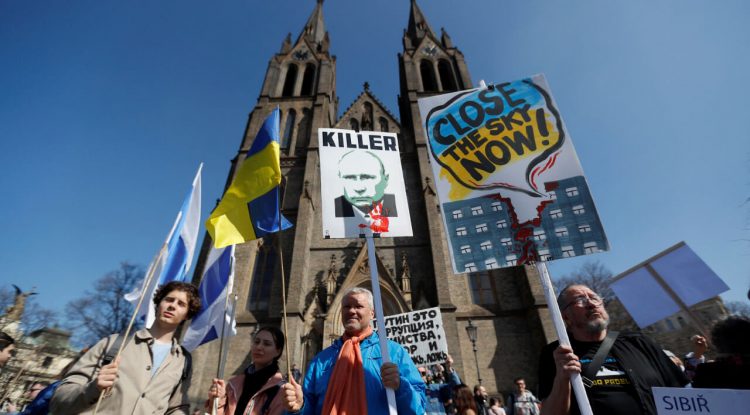
Social researcher Dmitry Dubrovsky explains why Russians abroad do not suit many thousands of anti -war rallies
In 2022, up to 800 thousand people left Russia, according to various estimates. One of the most common complaints about them: why, being abroad and safe, they do not go to street protests. At the request of the “cold”, a sociologist, a former associate professor of the tower, who has left the country, is responsible to him, and now the invited teacher of Karlov University Dmitry Dubrovsky.
In order not to miss the main materials of the "cold", subscribe to our Instagram and telegram .

I’ll start with a disclaimer: the phenomenon of the protest activity of Russians abroad needs a serious study; All reasoning in this text is based on episodic observations and unsystematically collected materials; All conclusions in the text are preliminary and entirely on the author’s conscience.
The question is why all hundreds of thousands of people who came from Russia do not suit anti -war rallies, proceeds from the belief that street protest is an undoubted moral duty. The protest must be numerous, because the Russian emigration itself is numerous. Finally, such a protest can convince the governments and the population of countries, primarily in Eastern Europe, that visitors do not support the aggressive political course of their state.
To answer the question, why - despite the obvious expectations and even requirements - such mass rallies does not happen, it makes sense to turn to the situation with street policies in Russia itself.
The last example of the truly mass protest of the Russians was the rallies of 2021 in support of Alexei Navalny. According to media estimates , about 100 thousand people in more than 100 cities took part in them. Since then, nothing of the kind has happened.
The beginning of the war was marked by the strengthening of repressions: the desperate attempts of people to protest were crushed by laws on “unauthorized rallies” and anti -icing restrictions (which were applied exclusively to critics of the authorities), now reinforced by the sanctions for “discrediting the army” and “fakes”.
In these conditions, we can take advantage of the formula of the economist Albert Hirschman, who proposed to evaluate the symbolic cost of actions dissatisfied through the opposition of the “voice” (protest) and “exit” (dismissal, departure). It follows from it that the cost of protest (“votes”) for the Russians was extremely high: criminal cases and serious prison terms for activists demonstrate the determination of the regime in the fight against disagreements. Emigration - or political escapism, withdrawal from any public protest - steel, if you apply the metaphor of “value”, a cheaper option, and therefore a rational solution.
From war and mobilization, Russians (I note: at all, political activists) leave for countries where the Russian -speaking community traditionally exists. But many of his representatives do not share outrage from the war, or even directly support Russian aggression. This kind of position can also affect the “cost” of the Russian protest abroad. The arrivals are at the center of a long and complex conflict, among citizens of foreign states, politically split in relation to the Russian regime. This happens in Estonia, Latvia, Germany. It is unambiguous and publicly expressing your views - it means that you immediately quarrel with a new environment for yourself.
In addition, for many Russians, the experience within Russia turned into a disappointment in rallies as an effective form of political action - "rallies do not make sense at all here or there." Only shares next to diplomatic departments can be considered an appeal to the state that unleashed the war, but there is no reaction from the diplomats sitting in these buildings.
However, I assume that, first of all, Russians' logic, which is common among local politicians and activists and often understood as “support of Ukraine”, affects the public political activity of Russians abroad. According to one Muscovite who participated in anti -war protest and leaving for Georgia, she simply fears a sharp reaction to Russian from citizens of the country, which actually lost 20% of its territory in conflict with Russia.
At the same time, Russian activists who left the country before February 24, as a rule, support anti -war movement. In Prague, Berlin, Warsaw and other European cities, rallies are regularly held, mainly near the embassies or consulates of Russia. Of course, they are not massive, although for Prague, for example, the anti -war rally at the end of March became a noticeable event and gathered about three thousand participants (with a total diaspora, about 30 thousand people).
The number of diaspora, of course, affects the scale of protest. For example, in the anti -war movement of Slovenia - several dozen people. The diaspora, as far as I know, is about nine thousand. Local Russians react differently to the public activity of this association. There are also such statements: "It is necessary to protest at home, on Red Square." When an announcement of the anti -war action appeared on Facebook, the organizers recalled everything: aggression in Ukraine and Georgia, Putin’s mass support and gas blackmail. The Slovenian activist of Russian descent Julia Yakshich admitted to me that, despite the words of support, including from Ukrainians, in general, the sensations are “very difficult”: it is the public protest of Russians abroad against the war that the goal for supporters of the common guilt of all the carriers of the Russian passport. This, it seems to me, is the largest increase in the "value" of public protest abroad for Russian citizens.
The author of this text participated in an anti -war rally organized by the Prague Russian Anti -Veenic Committee, and could not help but notice a small antimiting, consisting of about 10 Ukrainians and Chekhov under slogans like “there are no good Russians” and “you protest against mobilization, and not against war”. When discussing another action with the participation of public organizations, some Ukrainians stated that “they will not stand next to the Russians” even under the white-blue-white flag.
Martha Lempart - the leader of the Polish feminist movement “Women's strike” - at an anti -war rally in Warsaw asked the audience where the Russians are here, and, having received the answer: “We are here!” Offered “ to get out for a dick”. Participants in the demonstration supported this slogan.
Thus, we come to a paradoxical conclusion: the pressure of the local community affects the public protest activity of Russians, but it is precisely this community that requires the massive participation of Russians in anti -war shares. At the same time, Russian -speaking citizens of foreign states can react to a public protest aggressively, seeing in it a “betrayal of the homeland”.
The strategy of “invisibility” and non -participation in public protests is a natural response to these threats. Thus, people are reinsured by possible accusations and clashes from all sides.
I think that anti -war rallies abroad will continue, but they will not become massive for all the above reasons. I myself am a Russian citizen, and perhaps this affects my assessment of the situation. Nevertheless, I believe that a protest against the war can be embodied in various forms, not necessarily in the form of street shares. This can be financial support for Ukraine, cooperation in the assistance of refugees, the education of Russian citizens both abroad and in Russia, and much more.
Each Russian citizen brings a share of responsibility for the crimes of the Russian regime - this recognition is fundamentally different from the idea of collective guilt. In Russia - systemic degradation of political practices and institutions. But it is precisely through their development and support for any anti -war initiatives that we can achieve that public political statements, including street actions, will again gain meaning for Russian citizens and become massive.
The author’s opinion may not coincide with the opinion of the editorial office.