
Translated material
Riot against modernity
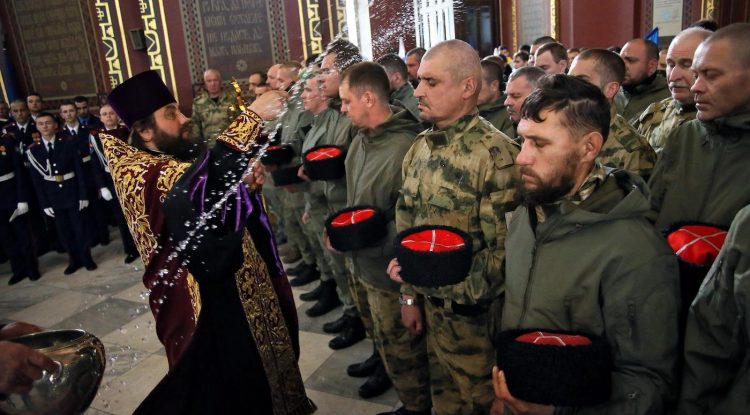
Russian Cossacks voluntarily go to the front to fight with Ukrainian. Why do they need it?
Two weeks before the start of the war in Ukraine, the General Staff of Russia announced that he would attract Cossacks in the “mobilization reserve”. Now, according to media reports, more than 10 thousand Cossacks participate in the hostilities; In memory of the dead at the front, they are already going to create a memorial in Krasnodar. At the same time, the history of the Cossacks is closely connected with Ukraine, and in modern Ukraine the Cossacks day celebrate on the same day with the Day of the Defender of the Fatherland. At the request of the Cold, Valery Kirsanova tells how the war became for the Russian Cossacks a way to determine its identity again.
In order not to miss the main materials of the "cold", subscribe to our Instagram and telegram .
“We have always been killers,” says Mikhail Myshkin. - I myself am a hereditary: I have great -grandfather, grandfather, grandmother, great -grandmother - Cossacks in the family. And the Cossacks are the warriors of Christ. ”
In 43-year-old Myshkin, two massive silver chains hang around his neck: on one-an icon, on the other-a cross. In recent years, Mikhail has been wiping a lot of work a lot around the country: he recalls that he was engaged in the flooring of the roofs in Novorossiysk, built a gas factory on Yamal, and recently worked as a roofer in Moscow.
Several times a month Myshkin came home to Novorossiysk, where he was in Konstantinovsky by the farm Cossack society. Myshkin conducted “Lessons of Courage”: he told fifth -graders about Cossack history and traditions, and also patrolled the streets as part of the squad. The Cossack Eugene describes this activity as follows: “They walked along the embankment, guarded. I would not say that he really liked it. "
In March 2022, Myshkin arrived home and found out that his chieftain Vladimir Gavrilenko went as a volunteer for war in Ukraine. Myshkin immediately called Moscow and quit. He was offered to take a half -year vacation: “Suddenly return,” but the Cossack refused.
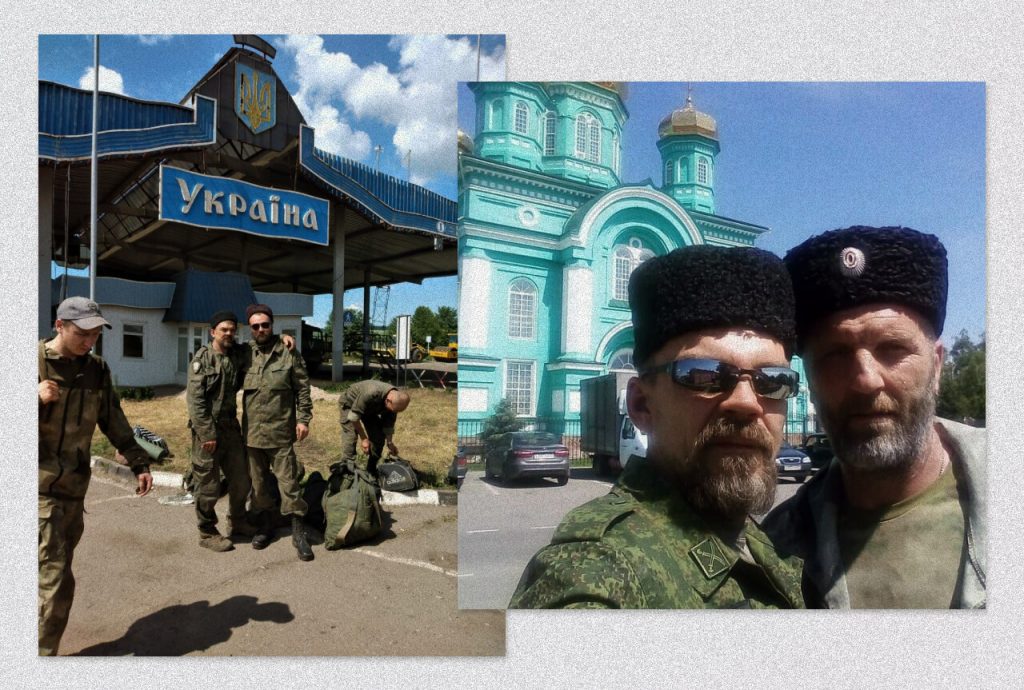
Working as a roofer in Moscow, Myshkin, according to him, received about the same as he was paid in the war. His motivation was different: according to Myshkin, the Cossacks always fought for the idea and for his land, and he considers Ukraine to be Russian land. “There was a scandal at home, of course:“ You do not need a family, you are more expensive, ”Mouseshkin recalls. - [But I said:] "Where is the chieftain, there and me."
Michael convinced his wife that he would just go to protect the “liberated territories”. He admitted that he was at the front when he was already in Ukraine. Together with the wives of other warring Cossacks and the Cossack confessor, Eugene organized joint prayers for the well -being of loved ones - they passed every day at 9 pm.
Until the end of June, while Mikhail was in Ukraine, Eugene, according to her, suffered two heart attacks: Myshkin was listed as dead, missing and prisoners.
We are ready to serve
Mousewitch born in the Urals is a descendant of local Yaitsky Cossacks. According to him, a paternal’s great -grandfather in the tsarist times was a marching chieftain in the Ural Cossack army.
In the civil war, the Bolsheviks exterminated hundreds of thousands of Cossacks for supporting the White Movement (the assessments of historians vary ; Cossack troops themselves, fighting the Reds, were also not distinguished by humanism), and then the Soviet government abolished Cossack troops. Many emigrated: during the Second World War, several tens of thousands of Cossacks fought on the Wehrmacht side, and General Krasnov headed the Main Directorate of the Cossack troops in Berlin (the monument was still standing in the Rostov region). In turn in the USSR, in the late 1930s, the Cossacks were allowed to serve in the Red Army-in the Kuban and in Stavropol, they even formed several Cossack divisions. Myshkin says that his great -grandfather during the war “beat the fascists”. “I followed in his footsteps,” he believes.
Attempts to revive the Cossacks in Russia began in perestroika when the Cossacks began to unite in military-historical clubs. Soon, representatives of the movement also recalled the Cossack autonomies that existed in tsarist times. In the fall of 1991, the ataman of the Union of Cossacks of the “Don Army” Sergey Meshcheryakov, along with supporters, wanted to create the Don Republic as a subject of the USSR in the Rostov region and the adjacent regions. The Rostov administration supported the appeal of the Cossacks, but the next day the prosecutor's office appealed this decision, and a few weeks later the USSR broke up, and no longer returned to the Cossack initiative.
It was in those years that Mikhail Myshkin really felt his identity for the first time: he spent his childhood in the village of Chernoleskoye at Stavropol and from 10 years old, when “he began to drive and ride horses,” he felt like a Cossack.
In the 1980s and 1990s, some activists interpreted the Soviet and 1980s policies as genoc. On rallies and in petitions, the birth Cossacks demanded that they recognize them with their culture, customs and national interests. In 2002, the State Commission even decided to include the Cossacks in the preliminary list of nationalities for the census. However, there were other opinions: the presidential adviser to the Cossacks of the Cossacks, Gennady Troshev said that Cossacks to consider nationality is “the same as calling the people of workers or collective farmers.” Historians also refuse the Cossacks in this right.
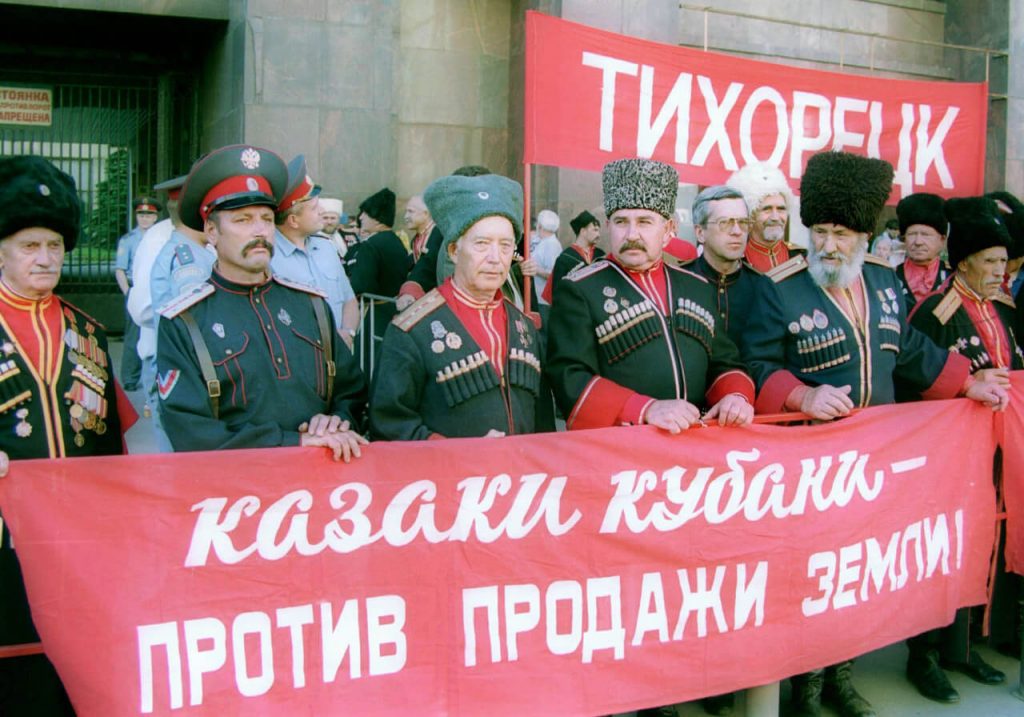
“[In those years] they began to actively say that the Cossacks are not only the defenders of the Russian state and warriors, but also the victims of the Soviet regime,” the researcher from the European University in St. Petersburg, Alexander Kamentsev, adds, who is engaged in the history of the Cossacks. “The Cossack activists themselves were small. But they took place to the authorities [with a message] "You need us, we are ready to serve." And the authorities thought: “Indeed, you can somehow use you.”
In 1991, Boris Yeltsin signed a decree on the rehabilitation of repressed peoples, which also mentioned the Cossacks. In response to this, the Union of Cossacks Kalmykia accepted the President into the ranks of honorary Cossacks. Already a couple of years later the Council on Cossacks under the President was created; Yeltsin also issued a separate decree in which it was a question of how the Cossacks undergo military service. However, by the mid-1990s they managed to organize only one volunteer Cossack battalion. He lasted three months in early 1996 and managed to participate in the Chechen war. At 800 soldiers 27 people were killed, another 130-deserted.
“Of these 130, maybe 30 there were scoundrels. The remaining 100 are normal Cossacks who simply could not endure all this, ” said Colonel Alexander Voloshin, the head of the military administration of the Terek Cossack army, complaining about the poor organization of military operations. “They still realized that we were just framed.”
In 1998, Myshkin went to serve in the army as an ordinary conscript - and three months before Dembel also hit Chechnya, where the second war was already going on. Myshkin does not like to recall this experience - even in conversations with relatives. “I was crucifying then,” he says briefly. “Because a person who does not appreciate his life, is a whip.”
Akhmat - strength, Cossacks - power
As the Russian government returned to the ideas of military patriotism, the Cossacks were increasingly becoming his suitable showcase. “[The state] is beneficial for all this movement with a Cossack education: the cadet corps, Cossack classes, because they teach patriotism and [that] how to be“ good resident of Russia, ”Kamensev explains. Cossacks caught hiding, actively participated in the annexation of Crimea and the dispersal of the rallies. The activities of the Cossacks in the Kuban were especially noticeable: they attacked the Kubani: they attacked the Kubani: they attacked Navalny was beaten by Nagikes by the members of the Pussy Riot group, and in the fall of 2022 they sought the cancellation of the concert of the singer Manizhi, who organized the Oleg Deripaska fund (the concert was eventually canceled ).
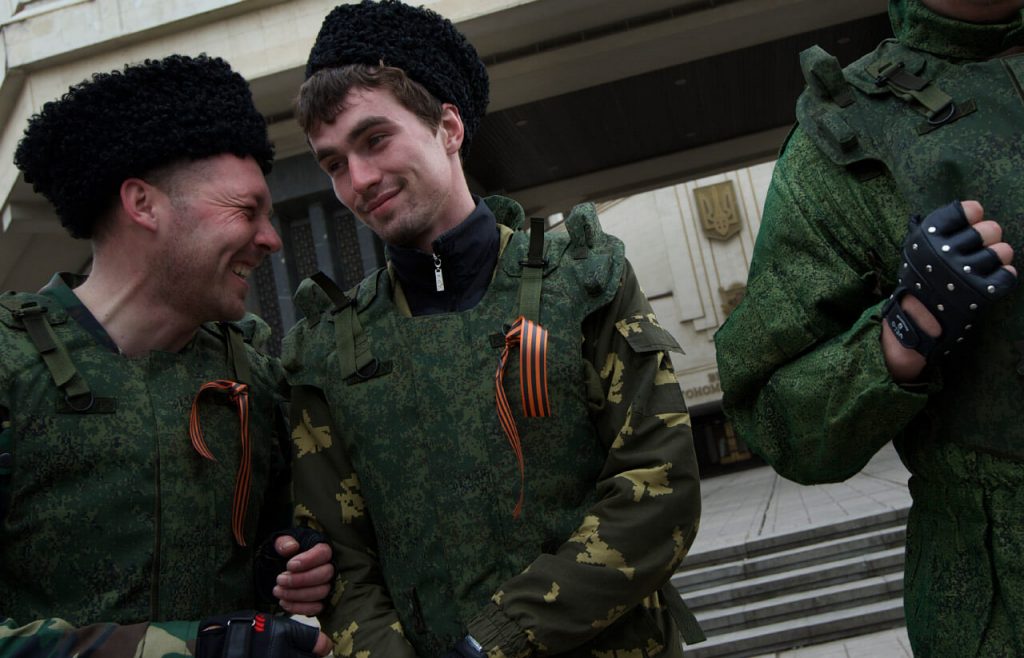
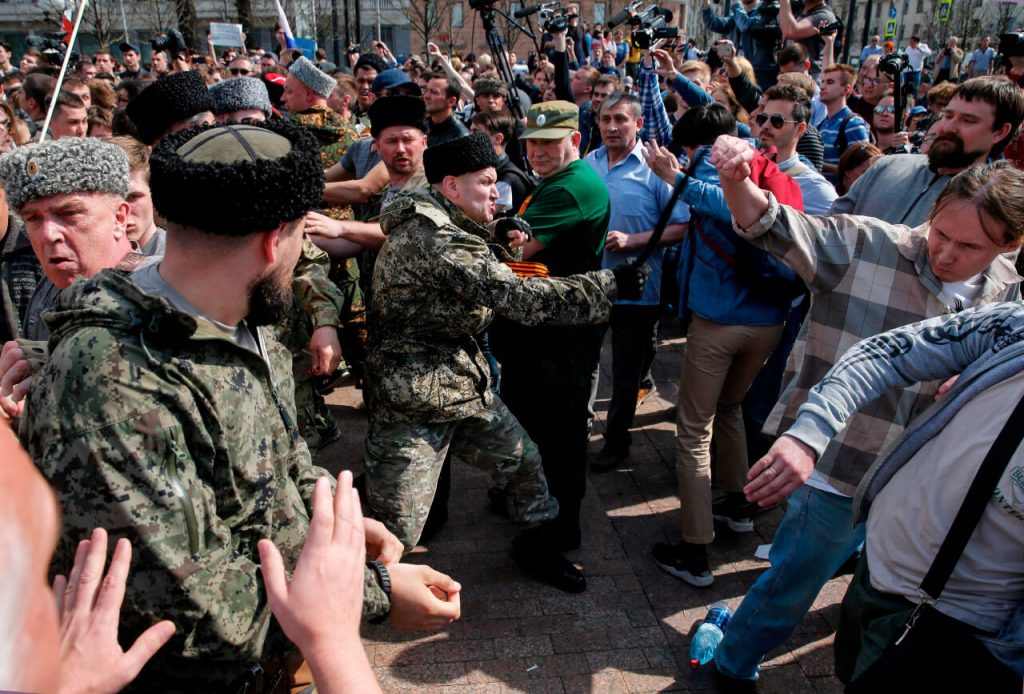
Now in the country the status of the Cossacks is determined, in particular, by the federal law , according to which the Cossacks are all participants in official Cossack societies. To become a member of the society, it is necessary to enlist the support of two Cossacks, withstand the trial period and take the oath in the presence of the priest. The Cossacks of the 2010 census, 67.5 thousand people in Russia considered themselves to be Cossacks by nationality.
Until recently, the Cossacks served in the army just like everyone else. Now, Kamensev suggests, this can change, and the Cossacks will be able to claim a special military status. “But it will be some kind of riot against modernity,” the researcher argues. - The creation of quasi -layers in the modern army is an archaic. This was abandoned 100 years ago. The very essence and meaning of the Cossack troops remained in the past, now it looks like a historical reconstruction carried out at the state level. ”
After the collapse of the USSR, the Cossacks re -determined themselves not only in Russia. According to Kamentsev, in Ukraine the Cossacks became one of the foundations of the new national construction. Leonid Kuchma issued decrees in support of the Cossack movement, Viktor Yushchenko was named the hetman of the Ukrainian Cossacks, and Petro Poroshenko postponed the day of the Fatherland's Day from February 23 to October 14, combining with the Cossack Day. “For modern Ukrainian identity, Kazakophilia and Ukrainophilia is almost the same thing,” said Denis Shatalov, a scientist of the research network of Eastern Europe, Prisma Ukraïna.
“In the anthem of [Ukraine, we are sung that we are a Cossack family,” Kamentsev points out. “And among very many Ukrainians who are fighting, this topic rises: that they are Cossacks and protect their homeland, their Cossack traditions. And the Kuban - they are the heirs of the Cossacks resettled. And they are fighting each other now. ”
Mikhail Myshkin confirms: Zaporizhzhya Cossacks tell their Russian colleagues that they are fighting for their land. “But this is all ideology, have washed their brains,” he said. But the Russian Cossacks are now on the same side with those with whom Myshkin once fought in Chechnya. “Akhmat is power, Cossacks are power,” he confirms. “That's the motto now.”
Fish rot from the head
On February 7, 2022, the General Staff of Russia and the All -Russian Cossack Society signed an agreement on attracting Cossacks to the “mobilization reserve”. In the beginning of March, after the Council of Atamans, they gave everyone the team to record the reserve, recall the interlocutors of the “cold”. But many decided to immediately go to the front volunteers.
By the end of April, about one and a half thousand Cossacks participated in the war with Ukraine. The ataman of the Union of Cossacks-military people of Russia and abroad Nikolai Dyakonov called on the “brothers” to mobilize-but only married and with his sons: “To be a continuation of the family, if the father of the family does not return from the special operation,” he explained . In August, there were already more than six thousand among the volunteers of the Cossacks, by autumn this amount increased to 10 thousand.
Myshkin did not have doubts that Russia was fighting for a just cause: “What is happening in Ukraine”, he saw on TV. “There they conducted experiments on young children and injured, eradicated the Russian people,” he says. - There was a rape, there was the eradication of children. They let the organs, they even showed us a video. This was the civil then said, who got out of the basement. "
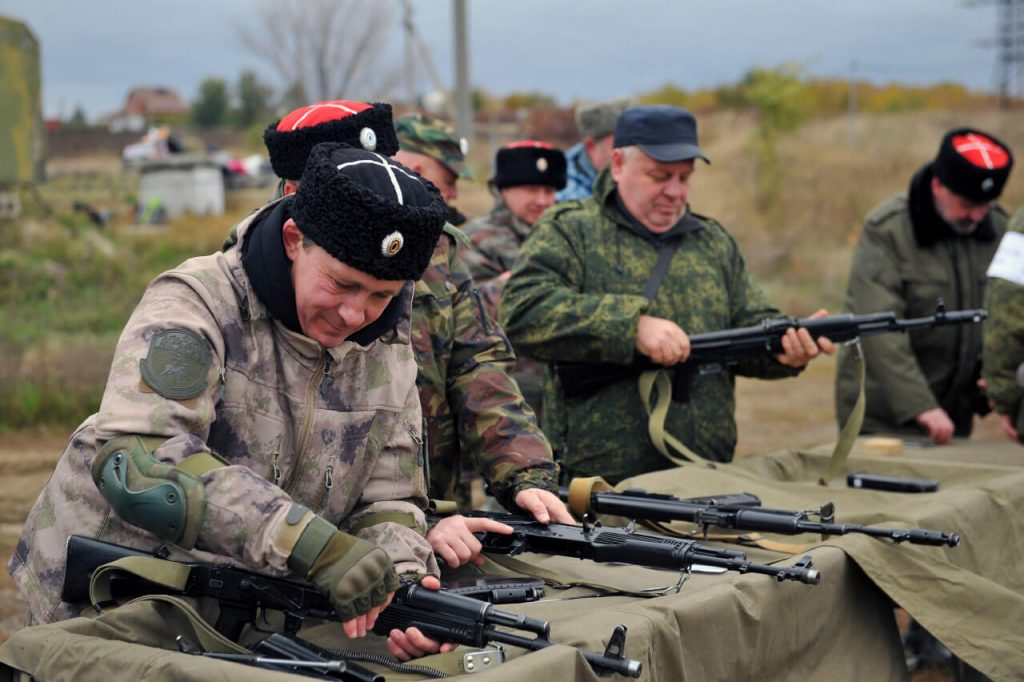
The Cossack detachment "Don" entered the territory of Ukraine at the end of April . Preparations for sending to the front took place at the training ground in Novoazovsk and took two weeks, and, as Ataman Gavrilenko says, they prepared everyone the same way - both people with combat experience and newcomers: “The attitude was:“ Ah, cannon meat, not to fight with them ”.
Cossacks were included in the 60th motorized rifle brigades were sent to the Kharkov region under the raisins. Vskor Gavrilenko and five of his colleagues, including Myshkin, were already in the village of Velikaya Kamyshevakha; From their weapons they had machine guns and one grenade launcher. “All day without food, water,” the Cossack recalls. - While they were lying under a sniper, they drank from a puddle: they threw disinfecting and drank there. We would just be thrown with caps if we knew how many of us and with what weapons. ”
Six Cossacks were supposed to spend in the village of three to four days, but in the end they remained for a month and a half: the detachment that was supposed to change them was defeated-according to Gavrilenko, out of 150 people left 15. “Who is without a hand, who is without a leg,” complements Myshkin. - And on TV this was not reported anywhere. Because if the whole truth will go, what losses in Russia will have a big panic. ” There, the Cossacks lost their colleague with the call sign "Grandfather".
According to the Cossacks, during the battles for raisins and the Great Kamyshevakha they did not have a normal connection: the radio was listened to the Ukrainians, and they had to get water, food and weapons on their own. When they blew up a Ukrainian pickup with a grenade launcher, the company commander for this awarded them with a pack of cigarettes and a pack of tea.
The problems of the supply of the Don brigade are also reported about the problems with the supply: there they collect money for equipment, radio and quadrocopters. On September 25, Russian military commander Alexander Scholkov on the air of the program of Vladimir Solovyov said that in the Donbass volunteers from the Kuban are fighting in old armored vehicles and without underwear.
Another sick topic Cossacks call relationships with army chiefs. The Don detachment was commanded by a certain Alexander with the call sign “Morpeh.” On the advanced interlocutors of the “cold” saw him once - after a shell from the mortar flew into his car, Morpeh did not come anymore.
Cossack Alexei Selivanov, a former officer of the Ministry of Internal Affairs of the self-proclaimed LPR, accused the Russian military of treating the Cossacks as an “auxiliary and secondive structure, with the losses of which one can not be considered.” “The Cossacks need their military correspondents who will tell about the Cossacks not only the Cossacks themselves in blogs and chats, but also to the whole society through the multimillion -dollar audiences of large media,” Selivanov added.
Myshkin agrees: the merits of the Cossacks in the war are underestimated. “On TV, they didn’t say a word for the Cossacks at all, only in Telegram and in YouTube,” he says. - Only now they started, and before that they hid that the Cossacks also act united, conquer. True, we need everywhere, we did not hide, we are no worse than military personnel. ”
“While we were there, the raisins were completely under the control of the Don detachment,” Myshkin continues. - Only the “Don” came out from there - you yourself see what was happening there ( in early September, Russian troops surrendered raisins. - Approx. “Cold” ). Because [fight] the youngsters, the unsettled boys. I now have a son -in -law in the Belgorod region, for four months it was left to serve. He was forced to sign the contract voluntarily-comprehensive. These are our commanders of the Russian army. The fish rots from the head. "
While Myshkin was in the war, his wife was informed about the death of her husband. “They call and say: they killed,” she recalls. “What heart can withstand?”
The second funeral was brought when Myshkin had already returned home. “The postman came to hand over my wife, I went out - I say: I am,” says the Cossack. “Well, this is how in Russia they relate to soldiers to everyone.” He calls the war in Ukraine the most cruel conflict of those in which he had to participate, and claims that "the Chechen [campaign] was more noble."
You are our defenders
The war in Ukraine for the Cossacks is something like a way to get social capital. The interlocutors of the "cold" claim: the attitude towards them has already become changing. The colleagues, who at the training camp called them "dumbbells", now they say: "If [the Cossacks leave the front] leave, we will leave." And civilians perceive them as intercessors. “In the Belgorod region you even come to the market, and there:“ Come on, you are our defenders, ”says a Cossack, who asked not to give his last name. - And they will make a discount. And periodically they will give you so. But to take it, of course, ashamed. ”
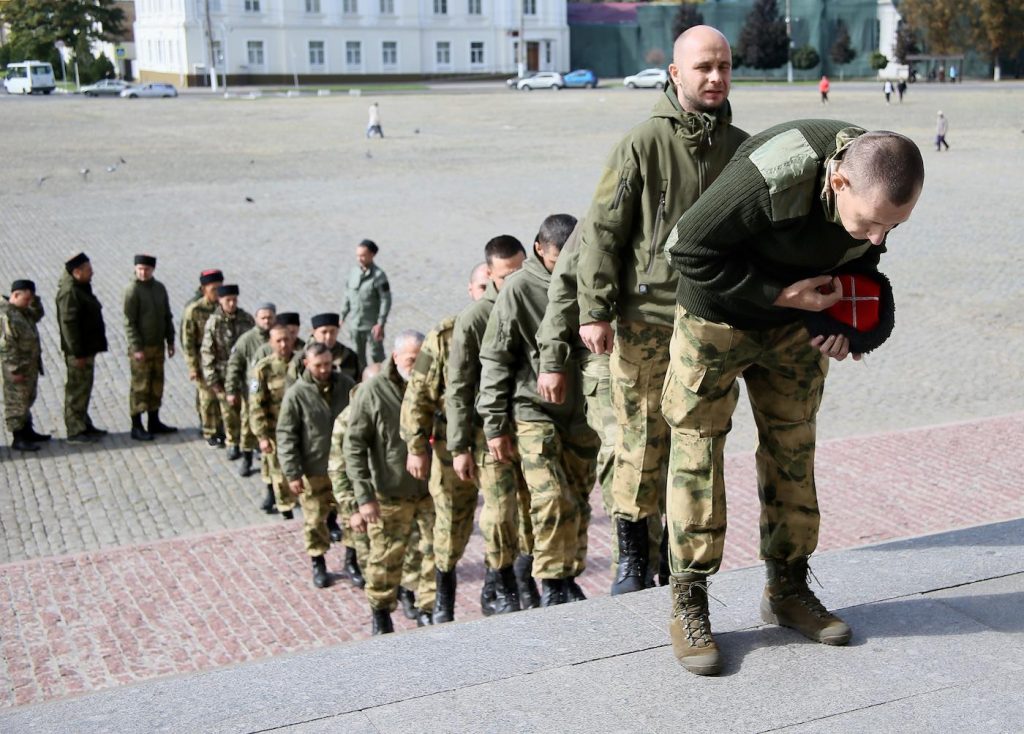
Ataman Gavrilenko claims that after the mobilization of the mobilization, the Cossacks "go to the military enlistment offices." Now 60 people are ready to go with him for war with him. But instead, Gavrilenko, who was injured back in April, was asked for "raising the mobilized fighting spirit." “I will tell, for example, how we hung our flag on the tower and the nationalists hung it,” he explains. “[Then] we went to blow the tower, because we could not disrupt the [flag of opponents].”
Mikhail Myshkin never returned to work by a roofer. In mid -October, along with other Cossacks, he went to the Tambov region, then to go to the front. “He was eager for a long time [back to Ukraine],” says his wife. - Well, what can I do, you won’t tie it to your leg. Cossacks - they are all patriots. "
Myshkin concluded the contract for six months. However, he hopes to return home by February - then they were promised to reward a combat mission for the past. The 27-year-old son of Myshkin, having learned that his father went to war after his chieftain, and signed a contract himself. For the past few months it has been at the front.