
Translated material
Will the junta come to power?
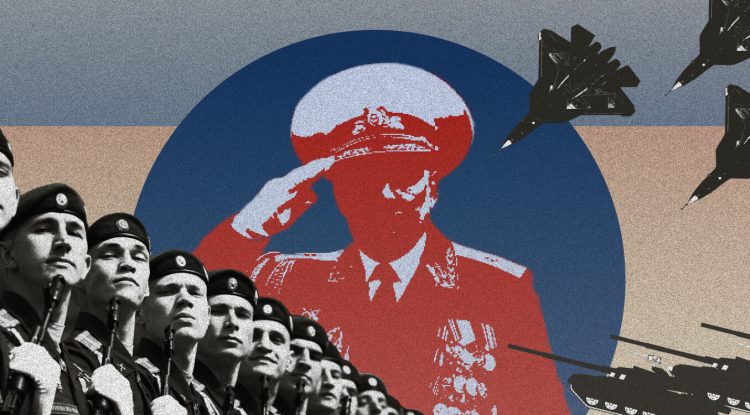
Political scientist Grigory Golosov assesses the likelihood of a military regime in Russia
What will happen to Russia after Putin? The cycle of articles by Doctor of Political Sciences Grigory Golosov, which he writes specifically for the Cold, is devoted to this issue. Since the spring of 2022, the political influence of Evgeny Prigozhin and Ramzan Kadyrov has noticeably increased. Because of this, many suggest that power in the country can completely move on to the security forces. Votes explains why a military coup is really possible, and tells what will happen next if this happens.
In order not to miss the main materials of the "cold", subscribe to our Instagram and telegram .
In the previous article in the "cold" I noted that military regimes often come to replace personalist dictatorships. I can not exclude the prospect of a military coup in Russia, another thing is the creation of a stable military regime here, whoever sets up such a goal. The connection between these two actions is far from as unambiguous as it might seem.
What is a junta?
The Soviet propaganda wave of the 1970s, caused by the overthrow of Socialist President Salvador Alle in Chile, after a couple of decades received an unexpected resonance in Russia in the form of the love of some “liberals” (I can’t refrain from quotes) to Augusto Pinochet, which really managed to build a sustainable military regime. In the Russian language, because of this, the word “junta” with an invariably negative connotation was entrenched, although in fact it is translated simply as “advice”. Indeed, the military regime in the case of its stability is the power of the Council, albeit quite specific in composition: a narrow college of military leaders.
Actually, in political science, a military regime understands a structure in which power either directly belongs to the leaders of the military corporation or is controlled by them behind the back of formal political institutions. The second situation is infrequent, but still observed in some Latin American countries, from Argentina to Guatemala, from the second half of the past before the beginning of the current century.
The "military corporation" is understood to mean the whole set of structures that have the right to use armed forces, that is, the structures of power - the army and organizations with a mandate to ensure state and public security. In some countries, in addition, there are various kinds of private military companies and security structures that operate legally, autonomously and have their own weight.
It is precisely because of the complexity of the composition of power structures that military dictatorship always arises as a regime of collegial rather than personal power. The army military leaders are always coordinated with the heads of security organs and other groups of security forces - otherwise the regime slides into the civil war.
The army itself is also a complex organization, which includes separate branches of troops and other large units. Prior to the establishment of military regime, they are usually under the supreme command of a civil policy-the president or prime minister. They do not even need to interact directly with each other. After the coup, however, it becomes necessary to decide what powerful powers each of the structures will have.
The collegial leadership was characteristic of all stable military regimes that are considered basic for this category: in Brazil, Argentina, Greece and many other countries. Pinochet’s regime was no exception. The general tirelessly emphasized that he was only the first among equals among the members of the junta, and was guided by this rule in practice.
Of course, like any authoritarian regime, military dictatorship can slide into personalism, become a regime of personal power and acquire some institutions (for example, electoral), which will provide the leader with a tremendous political advantage over other military leaders. This happened, for example, in Indonesia in the late 1960s-the “military general” regime Suharto ceased to be a military man and turned into a regular personalist dictatorship in most parameters.
The dictatorship of the security forces
Often we can hear the opinion that the "dictatorship of the security forces" has already been established in Russia. To justify this thesis, it is noted that in his professional past Vladimir Putin was an officer of the KGB.
However, Putin made a jump to the heights of the authorities not from the KGB, but from the administrative bodies, first of the regional and then the federal level: the work of the FSB head in 1998-1999 is only an episode in its political career.
Moreover, as the head of the security service, Putin was engaged in the prevention of a military coup: he allowed the politically weakened President Boris Yeltsin to maintain control over his own power structure and look after others. Putin coped with this task and, I believe that it was precisely for this that he received the main prize - the appointment of the successor.
Having become the president, Putin inherited the system of political control over the security forces. This system, debugged under Yeltsin and reconfigured under Putin, stands on two principles laid back in Soviet times.
The first is the deep integration of military leaders and heads of security agencies in the political leadership and, in a broader sense, to the top of the ruling class. In the USSR, such integration was provided from the highest level, the Politburo, and spread from top to bottom - to the entire power hierarchy. The security forces were simply public officials, albeit with some professional specificity. So it remains to this day, even though the Politburo was taken by the Security Council, and nomenclature feeders were replaced by much more bread privileges, for example, control over business and the development of budget funds.
The second is a fragmentation of power structures, the lack of a universally recognized leader outside the political leadership, their mutual distrust and competition. The signs of such competition in Soviet times were quite weak, but under Yeltsin they worsened, and already under Putin, in the early 2000s, this competition reached its peak. Then it manifested itself in the so -called wars of the security forces, one of the leading participants of which, Viktor Cherkessov, recently died in political unknown.
Can Russian security forces become a junta?
Since then, the sharpness of conflicts between the security forces has decreased, but now it seems to be a new round. Among the leaders of significant power structures are new autonomous players: Evgeny Prigozhin with his private army and Ramzan Kadyrov with his almost monopoly control over his own power organizations, whose activities have long spread far beyond Chechnya.
As a corporation, Russian security forces do not want (due to their complete integration into the structure of the authorities) and cannot (due to competition with each other) to carry out such a complex, coordinated action as a coup leading to the establishment of a sustainable military regime. There are no prerequisites for such a coup. There is no leader among the power corporation. All participants recognize Vladimir Putin as such.
Even if Putin’s discrediting as the head of state goes very far, an alternative figure is still not visible. Some look closely at Sergey Surovikin, but the hypothesis of the potential leadership of the military leader, the only achievement of which at the current theater of military operations is the organization of retreat, seems too bold. Which, however, for Surovikin only for the better. In the event of such a strong figure, Putin will not even have to make efforts to eliminate it: other security forces will eat.
Thus, there is no possibility for coming to power of military junta as a basis for a sustainable military regime in modern Russia. Does this mean that there are no conditions for a military coup? No, doesn’t mean. A military coup does not always lead to the establishment of a stable military regime.
It is often said that in Russia there is no tradition of army interference in politics. I do not agree. Even if you take out the uprising of the Decembrists by brackets, which, in my purely subjective opinion, could really lead to the establishment of a stable military regime of the Latin American model, there are still many such cases. These are endless coups of the 18th century, and the sad story of Emperor Paul, and the displacement of Lavrenty Beria in 1953.
In all these cases, the military, having played an important role in the change of power at a personal level, did not appropriate it, but remained on important, but secondary roles in the structures of the previous regime. The peculiarity of the current situation in Russia is such that it is impossible to preserve the personalist dictatorship in this way, because, as I wrote in the previous article from this cycle, the regime is too tied to the personality of the current dictator. It should obviously talk about the establishment of some other political regime.
If a stable military regime needs close coordination of power structures, then for a military coup leading to the establishment of another political regime, this level of coordination is not required. One of the power structures can simply suppress competitors' resistance and seize power. Sometimes this happens as a sequence of events, which is called a "double revolution." The events of 1965 in Indonesia initially looked like a conflict between the two groups of the military, each of which declared the desire to protect the President of Sukarno from the attempts of a coup on the part of another group. However, in the end, the victorious group of the military intensified so much that it itself seized power, and Sukarno lost it - at first, and then formally.
Military coup - what's next?
After a military coup, the situation can develop along two trajectories. The first of them is a series of more or less acute conflicts within the winning group, usually with the participation of the remnants of the losers of power structures, and, as a result, a series of military coups. In Syria, in the 1960s there was a joke about the queue of officers near the building of the General Staff of the country, in which the places were occupied by those who wanted to make another putsch. In this case, the coup opens a series of unstable, short -lived military dictatorships.
Usually this series, having the most destructive consequences for the country, ends only when the military either transfer power to civil politicians, or they themselves create some new (but not military) regime. Say, many African military dictators were cut off with other leaders and created new power structures, usually party, shortly after the coups. So it was, for example, after the fall of the monarchy in Ethiopia in 1974. Having usurped power, Mengista Khale Mariam did not stop there and proceeded to the design of the party regime of the communist type. As a result, an institutional shell was created for his personalist dictatorship, one of the most cruel in recent history. In Ethiopia, a series of mini-translates, each of which ended in the victory of the menhist, was short.
The second trajectory involves the rejection of this painful phase. The winning power fraction immediately begins the construction of a new regime. For example, in Burma (now Myanmar), the junta almost immediately after the seizure of power in 1962 announced that the new regime would be party in nature.
Theoretically, both trajectories are not excluded in Russia, and if the first can only be considered as a transition phase, then the second can bring with it a really new - and at the same time long -term - the quality of the Russian authorities.
Is it possible to establish a party regime in Russia - either by transforming the current or as a result of a coup? About this - in the next article of the cycle.
The author’s opinion may not coincide with the opinion of the editorial office.