
Translated material
"Cold is a strong engine of events." Why Russia really needs peace negotiations, but even large -scale blackout does not stop Ukraine. Military report from Nikolai Mitrokhin
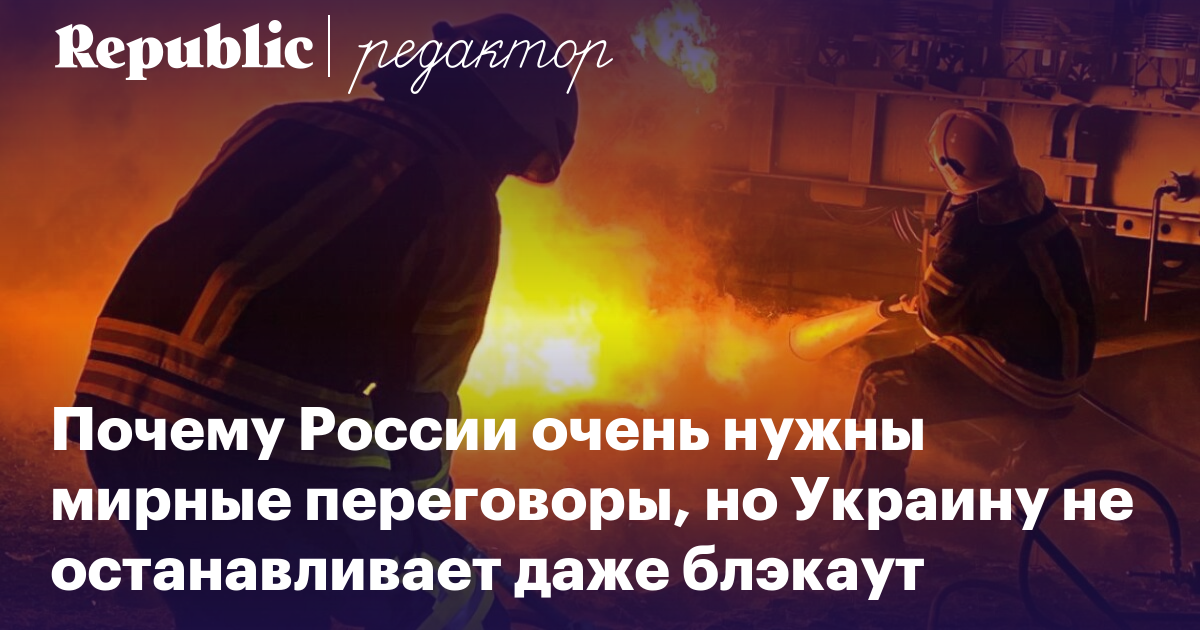
Political scientist and historian Nikolai Mitrokhin every week writes a review of key events that took place in the Russian-Ukrainian war for subscribers to Republic. In this issue: what are the scale of the Ukrainian Blackout, why Russia desperately needs peace negotiations, how Ukrainian drones reached Novorossiysk and why the West did not support the Ukrainian version of the fall of a rocket in Poland.
Attacks on energy infrastructure as an attempt to negotiate from Moscow
The main event of the week was the catastrophic deterioration of the situation with the energy system of Ukraine, which occurred as a result of the two next missile shelling from Russia. The shelling on November 15 was considered the most massive and long since the beginning of the war. For 3.5 hours, the Russian Federation released more than 100 missiles and drones, from which the APU intercepted at least 77. About 30 energy objects were damaged. On November 17, there was a second shelling, which primarily affected industrial enterprises, including gas processing.
The shelling was not catastrophic on their own, however, the systematic destruction of individual elements of the Ukrainian energy system (primarily generators, transformers and equipment, switching and distributing voltage) led to the fact that the national energy system began to support the general balance. As a result, in the same Kyiv, there are now three types of light disconnects - regular, urgent and super -war (non -anons), and in Odessa there is no light for about 20 hours a day. At the same time, some areas are happy to have electricity at least four times a day, while in others it does not exist for two days.
A similar situation in most of the country. Mobile communications and the Internet disappears. Happy owners of Tesl buy gasoline generators for refueling. There is not enough power of pre -purchased powerbans and time to charge them. Easier to a few owners of solar batteries, but their energy for all the needs of households, of course, is not enough.
Moreover, officials responsible for light and warmth in cities have no doubt that the situation will be worse further, since the Russian Federation is not going to stop shelling. The mayor of Ivano-Frankivsk advised the townspeople to look for a refuge in the village for the winter. The mayor of Lviv said that in winter without light and warmth, he would have to sit for two weeks. The head of the Kyivstar mobile operator announced that the network will provide a “point” coating. And the head of the largest energy operator DTEK generally advised Ukrainians to leave the country, as this would reduce energy consumption. True, a few hours later he stated that his words were incorrectly interpreted by journalists.
Simply put, the country is on the verge of Blackaut, after which light and heat may remain only in areas adjacent to some power plants (primarily low -power), as well as in those critical points where gasoline and diesel generators will operate, including those set from the EU. The authorities of large cities are already creating hundreds of heating points, communications and feeding points.
Kyiv without electricity
Oleksi Chumachenko / Keystone Press Agency / Global Look Press
What does Russia achieve, committing such an undoubted war crime as the deliberate destruction of civil infrastructure, affecting the lives of tens of millions of civilian people? As it became obvious this week, in such a peculiar form she is looking for negotiations on the world. The last shelling became an undoubted response to obstruction, arranged by the Russian Foreign Minister Sergei Lavrov at the G20 summit at Bali. There, the Ukrainian side rejected the idea of negotiations before the withdrawal of Russian troops. Although earlier individual leaders of the country assumed some possible contacts.
In this case, the bargain, undoubtedly, is about where the front line should go in case of negotiations. It is important for the Russian Federation to stop the fighting as soon as possible at existing positions in order to be able to subtit, arm, equip and bring to the positions of soldiers of the first wave of mobilization, pass the autumn draftees through the military training system and send to the troops (at least take barracks and be ready to protect the borders of the Russian Federation in the Belgorod and Kursk regions), as well as to calmly conduct a second mobilization wave in January. Constantly conducting military operations and the threat of breaking through the Armed Forces of the Armed Forces not only in the north and south of the front line, but also in the direction of the Russian regions devour all human and material resources and does not “give a break” to the Russian military. After the abandonment of Kherson and the right bank, there is a high risk of losing controlled parts of the Zaporizhzhya and Kherson regions, where, despite the creation of a combat -ready group under the fire of Haimers, and logistics problems are growing. If the negotiations suddenly ended in the world, it would be beneficial for the Russian Federation to fix the front line in the current form: it is not for nothing that it turns out, they fought - they grew up.
For Ukraine, such a “world” is unprofitable for the same reasons - the enemy, having received a break, will intensify, and in case of “stabilization” will be strengthened in the occupied territories. While the Armed Forces are successfully fighting, Ukrainian society will not come to terms with even a temporary “truce”.
The issue could resolve the consent of the Russian military to the allocation of troops to the line as of February 23, but this would be read by all as a defeat of the Russian Federation with an unpredictable (especially for the Russian Federation) result. But what if the Armed Forces of Ukraine continue to attack Crimea, “DPR” and “LPR”? Therefore, the Russian leadership considers it necessary to beat in Ukraine in violation of the conventions, so that Ukraine itself requested the "world". Or her sponsors frightened the waves of refugees and forced her to do this.
It can be assumed that Ukraine will not stop even Blackout. So far, in general, the APU’s affairs are going well - the offensive with the aim of liberation of their country will continue. NATO, apparently, will help with the supply of additional batches of systems of pro/air defense and shells to them. The EU promises to send additional electrical equipment to repair the power system, but the question is when it really comes.
Subscribe to read the whole
Make a subscription Redefine.media to read Republic
Subscribe [you can pay for a Russian or foreign card. The subscription is extended automatically. You can unsubscribe at any time.]
Where are the money subscribers going