
Translated material
"Sooner or later, they will get to everyone"
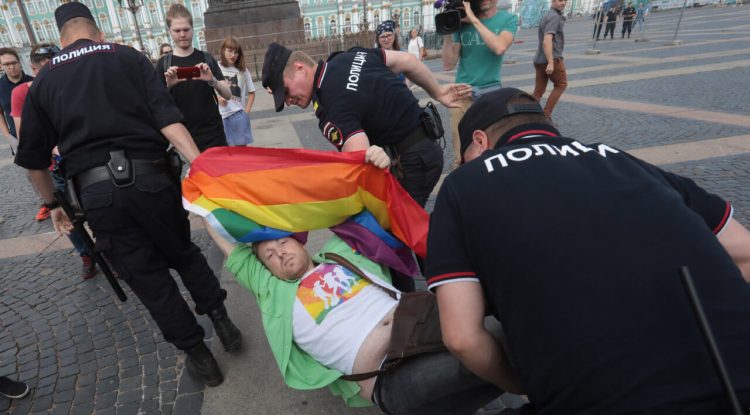
LGBT researcher explains who and why homophobia is needed
The State Duma has adopted a bill prohibiting the “propaganda of LGBT” to the audiences of all ages. "Cold" talked with the researcher of LGBT about why governments adopt homophobic laws and what consequences they may have.
In order not to miss the main materials of the "cold", subscribe to our Instagram and telegram .

Alexander Kondakov
Candidate of sociological sciences, teacher of the School of Sociology at the University College of Dublin. Researcher of LGBT and author of the book “Ominent Emotions: Quir-Sexuality, Technology of Power and Law in Russia”
Why do we need a law on "propaganda of LGBT"?
Almost all countries of the world were homophobic and used the struggle with the LGBT community as a political instrument. For example, in the UK in 1988, the Government of Margaret Thatcher adopted the so-called article 28 (in fact, this is also a law on “gay propaganda”) prohibiting state institutions and schools to talk about LGBT people and their rights. At this time, there was an epidemic of HIV and a political crisis, and with the help of such a law it was possible to attract voters of voters to their party. In Scotland, he was canceled in 2000, and in England and Wales-only in 2003.
Laws prohibiting same -sex sexual relations were also almost everywhere, including in modern democratic countries. They have been operating for many centuries, but they used them differently: they once killed them, and in more “herbivores” times they sent people to bars. One of the most famous examples is Oscar Wilde, who spent two years in the English prison.
In Europe, in those days, the law and religious institutions were very intertwined. Medieval laws were largely dictated by the church, but times have changed, the institution of law gradually emancipated from religion and began to focus on human rights.
In Britain, people ceased to judge homosexual relations in the 1960s after the so-called Wolfenden report. This document was drawn up by a group of psychiatrists, clergymen, doctors, lawyers and officials. After a gay survey, they came to the conclusion that homosexuality is not a disease and it makes no sense to judge people for it. Moreover, in some former colonies of Great Britain, these laws are in force to this day. For example, in Bangladesh, Kenya and Nigeria. The ban on homosexual relations was in the USA: in the codes of many states, this law remained until the 2000s. And in France, same -sex relations were decriminalized as a result of the Great French Revolution at the end of the 18th century.
Laws on the prohibition of "LGBT propaganda" are often an exclusively political tool for rallying people on the basis of hatred for a group assigned by a scapegoat. This is true for England of the 1980s, and for Hungary in 2021, and for modern Russia. Governments are looking for ways of emotional legitimation of their own power, because they do not want to do this with the help of democratic instruments - such as elections.
Homophilic laws are also a form of geopolitical struggle of democrats and autocrats. In order to demonstrate their position, some states adopt laws based on human rights, including LGBT, while others prohibit gay propaganda.
How does the propaganda of homophobia work?
In modern democracies, the recognition of the legality of power usually occurs through elections. Even if your party or candidate did not win, you believe that the process was honest. The Russian political crisis of 2011-2012 and large-scale protests showed the authorities that people no longer believe in this tool, they consider the elections-both in the Duma in 2011 and the presidential in 2012- fiction . How did the authorities react? She did not add up to powers, did not repent. Instead, she began to look for new methods of her legitimation. She remained undemocratic tools, primarily emotional informational stuffing.
There are a number of groups that people can treat with skepticism due to the fact that they perceive them as others that differ: these are not only LGBTs, but also migrants, for example. The same “gay propaganda” law happens the same thing: this historically established group is designated as different and strange. In this hierarchy, heterosexual people are better and more correct, and LGBTs are worse. Diversity can be turned into hierarchical relationships, where one group supposedly should have more rights, and the other has less. Therefore, when the LGBT community advocates its rights, it is interpreted as the fact that it requires privileges. If people respond to this rhetoric, the state declares that he can protect them from “others”.
It is clear that not all Russians agree with this, but there are groups of people who support homophobia. Thanks to her, they enter into an emotional connection with the government, the Kremlin, perhaps even personally with Putin.
It is difficult to name the exact percentage of homophobes, since in polls on acute political topics people often say what, as it seems, needs to answer (according to last year’s survey of the Levada Center , 38% of Russians are with disgust or fear of homosexuals, 13%, wary of 9%, and a total of 60% is likely to negatively relate to LGBT-parties. "Cold") .
What makes people more susceptible to homophobia?
Homophobic ideas resonate not with all, but with certain sections of the population. What are these layers? These people are the least informed about the diversity - ethnic, social, whatever.
These groups react to emotional political ideas better than more educated, urbanized, wealthy Russians. This is often due to poverty. If the country spends money not on education and science, but on bombs, potential homophobes will be more. In the 2019 Pew Research Center poll, a connection was found between the level of homosexuality in the country and its GDP per capita. People in richer and well -developed states are better about LGBT. According to another study , a decrease in the level of homophobia by 1% is associated with an increase in the gross domestic product per capita by 10%.
The more authoritarian the state, the more likely there will be homophobic laws?
Yes. If only because an authoritarian state usually needs uninformed people with poor education, focused on survival and therefore not interested in politics. It is such a population that is more subject to political manipulations, including homophobic.
In the mid-1930s in the Soviet Union, a law was adopted on the ban on homosexual relations-then the country in fact refused universal equality and became an authoritarian, conservative regime built around the Stalin personality cult. In Nazi Germany, gays were also sent to prison for their orientation. The USA was also homophobic under the extremely right Senator Joseph McCarthy in the 1940-50s.
How does this law concern those who do not belong to the LGBT community?
The fact is that if everyone is equal, then this really applies to everyone. And if one group of people suddenly turns out to be worse than the other, then tomorrow they can begin to discriminate against someone else. This is how fascist ideology works: the most marginalized groups will be the first to go, which the fascist government will be prescribed by such, then the following in the hierarchy, and sooner or later they will get to everyone. Safe life for fascism is not guaranteed to anyone.
If we want to live well, the principles of respect for each person and group are important. This is not about LGBT, but about equality for everyone. Hierarchy is a form of violence.
What are the consequences for society?
Homophilic laws provoke real violence . Someone is dying of attacks or suicides, someone has mental disorders, alcohol or drug addiction due to constant repression. And someone leaves and stops developing his country. All these are negative social consequences. And we are talking not only about LGBTs, but also about their loved ones. It turns out a fairly wide circle of people who suffer-someone is straight, and someone is indirectly.
Mass violence and destruction of part of the population cannot pass without a trace, they leave a deep wound. A higher level of homophobia is associated with an increase in mortality from AIDS and a reduction in the average life expectancy of men.
Society will begin to be treated when the government ceases to promote hatred and prescribe scapegoats. This process must be started. When in 1993 the so-called law on sodistiness was canceled in Russia, people did not even notify about it, and the prisoners did not know that they could leave prisons (in 1991 , 462 people were convicted under this article , in the first half of 1992-227.-approx. “Cold”) . And even more so they did not apologize to them, they did not pay compensation, there was no discussion about the rights of homosexuals and sexual diversity. If she were, perhaps, there would be enough decades to change the situation. But nothing was done, and the result - state violence resumed. At the same time, of course, it is impossible to get rid of discrimination forever, equality is what you need to focus on every day. Otherwise, you can easily slide where we are now.