
Translated material
Russians, back
Since February 24, the Russian army has made three “gestures of goodwill”—major retreats from the front line. As a result, it lost more than 60 thousand square kilometers of occupied lands. This is almost half the territory occupied since the start of the full-scale war. Using the data, we show how Ukraine returned the conquered territories, and together with an expert we analyze the causes and consequences of the three main retreats of the Russian army.
“Kyiv was not taken, and a series of mutually dependent failures began”
By the end of March, the Russian army occupied 125 thousand square kilometers of Ukrainian territories. This is the largest area that was captured during 9 months of a full-scale war. If we take into account the annexed Crimea and the territories of the self-proclaimed DPR and LPR, then about 168 thousand square kilometers of Ukrainian lands were under Russian control.
At the end of March, Russian troops retreated from Kyiv and Chernigov, losing more than 40 thousand square kilometers of territory. This retreat became inevitable after the plan to quickly capture Kyiv failed, says military expert Yuri Fedorov. “There was a plan to take Kyiv in a few days - a week. But within a week, Kyiv was not taken, and a series of mutually dependent failures began, which led to defeat in this sector,” explains the expert.
Problems with logistics, supplies and underestimation of enemy forces by the Russian command allowed the Ukrainian Armed Forces to defend Kyiv. “Due to winter and muddy roads, it was only possible to travel on paved roads. This constrained the actions of the army and allowed the Ukrainian armed forces to quite effectively shoot columns of Russian troops from those weapons that were supplied to Ukraine in significant quantities from Western countries. Supply could only be carried out through a limited number of transport communications. Because of this, traffic jams arose and logistical chaos began. Another important factor is the active resistance of the Armed Forces of Ukraine, which the authors of the plan did not count on,” Yuriy Fedorov examines the reasons for the retreat.
 March 31Source: ISW
 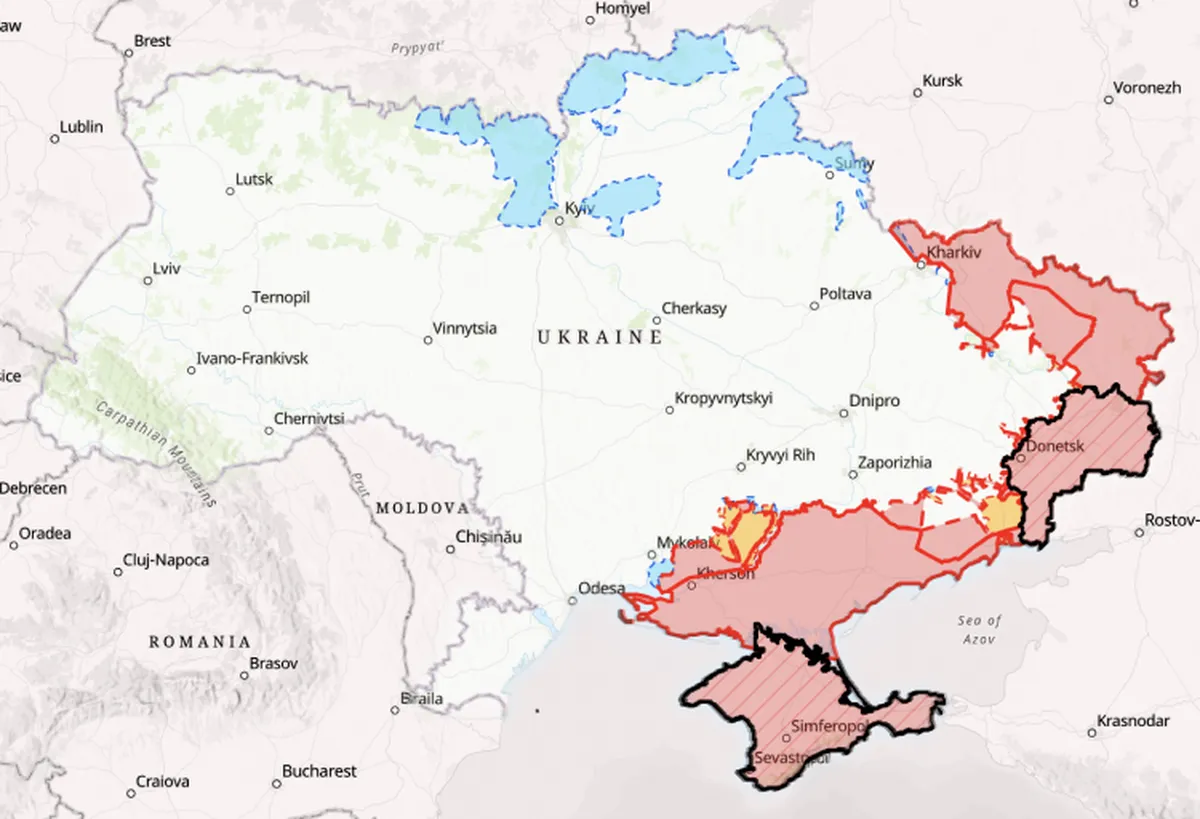 April 6Source: ISW
After this, about 80 thousand square kilometers of Ukrainian territory remained under Russian control. Over the next five months, after a large-scale retreat, the Russian army held these lands with virtually no loss of territory.
“They believed that there was no need to keep troops in the Kharkov region”
In early September, the Ukrainian Armed Forces broke through the defenses in the Kharkov direction near the city of Balakleya and launched a counter-offensive in the Kharkov region. Then Russia lost control over the region and lost almost 10 thousand square kilometers of occupied territory.
 September 6Source: ISW
  September 11Source: ISW
Ukraine’s competent tactics made it possible to achieve such results, explains Yuriy Fedorov. When the first line of defense was broken through, Ukrainian maneuver groups did not waste time on a frontal assault on cities and towns, but bypassed them and cut off communications.
“The Russian garrisons in these cities were few in number; they simply had to flee. First, Ukrainian forces surrounded the Izyum group in the south of the region, cut off its supply lines, and ultimately it retreated chaotically. The same thing happened with the Liman group. In total, 25–30 thousand Russian military personnel left there. These people were not physically destroyed, but they ceased to exist as an organized force and were forced to retreat with losses,” Yuri Fedorov describes the course of the counteroffensive.
The main combat units of Russia at this time were concentrated on the right bank of the Dnieper in the Kherson region and on the Donetsk front. “The command believed that there was no need to keep troops in the Kharkov region, because the Ukrainian Armed Forces did not have the strength to break through into the depths of the region. This is a big miscalculation in assessing Ukraine’s ability to overcome the defense line,” explains Fedorov.
“The surrender of Kherson is a very serious political defeat”
After another two months, the troops left Kherson, the only regional center that was conquered during this time. The area captured was reduced by another 4.8 thousand square kilometers. It was worth withdrawing troops from the right bank of the Dnieper at the end of August - this would have minimized losses, says military expert Yuri Fedorov.
Support “Important Stories” With your help we will be able to tell the truth about the war in Ukraine Support“Russian troops began to concentrate on the right bank in the spring in order to advance in two directions: to the west - to Nikolaev, and to the northeast - to Zaporozhye, Krivoy Rog. When HIMARS ( highly mobile artillery missile system - editor's note ) appeared in Ukraine in mid-summer and shelling of all logistics began, including bridges across the Dnieper that connected the left and right banks, it became clear that the planned offensive was not feasible. The military proceeded from the fact that it would be better to withdraw Russian troops to the left bank and transfer them to the directions where they are most needed, primarily near Donetsk. But the surrender of Kherson is a very serious political defeat, so Putin did not give consent. And yet, attacks on supply chains forced the decision to withdraw troops from the right bank. Only this happened with greater losses than could have happened at the end of August,” says Fedorov.
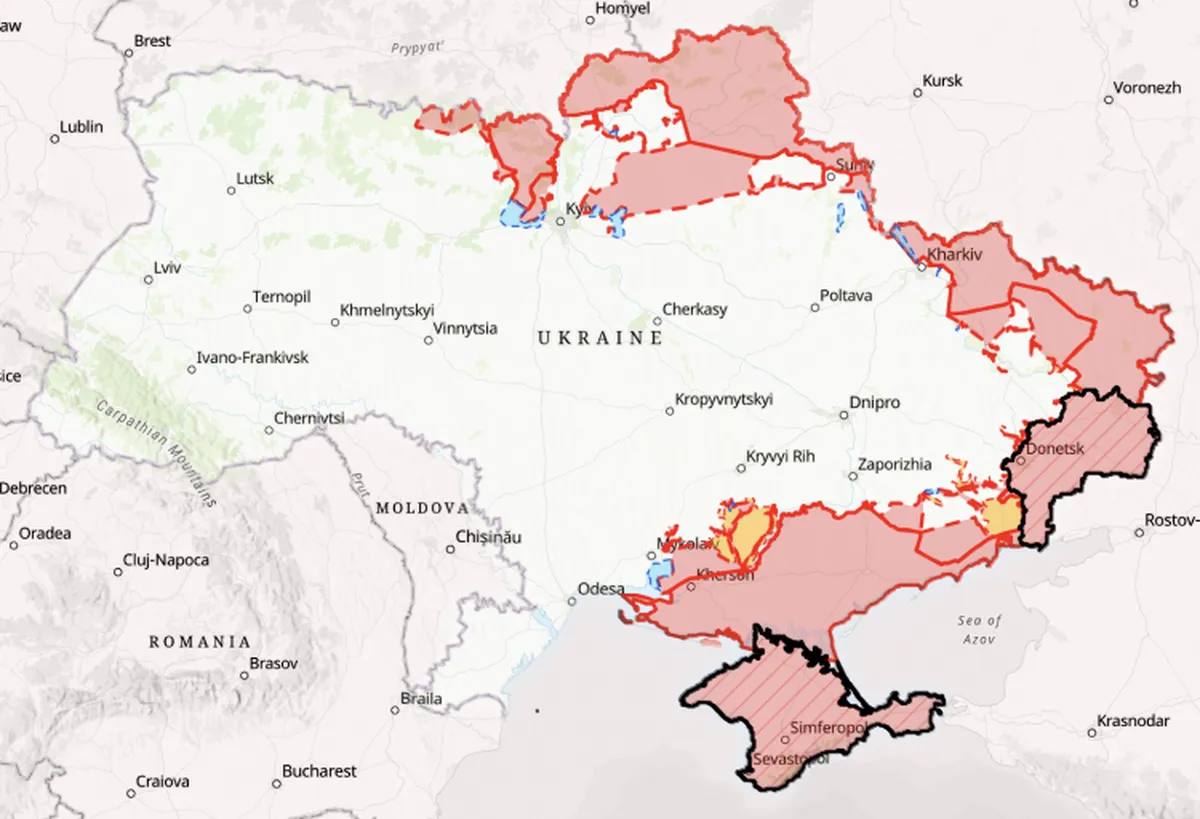
By the ninth month of the war, Russia retained control over only half of the territories it had conquered since the start of the full-scale invasion. As of November 24, Russia controls almost 65 thousand square kilometers in the Zaporozhye, Kherson, Donetsk and Lugansk regions of Ukraine. This is comparable to the area of the average Russian region - for example, the Stavropol Territory.
 March 31Source: ISW
  November 22Source: ISW
Russia paid a high price for these square kilometers. The irretrievable losses of the Russian army in Ukraine as early as mid-October could amount to more than 90 thousand people, sources associated with the Russian special services told Important Stories. Irreversible losses include those killed, missing in action, those who died from wounds in hospitals, as well as the wounded who cannot return to military service.
“The question is no longer about victory, but about minimizing damage”
Russia will no longer have any further major successes, says military expert Yuri Fedorov. He names the main factors that influence the balance of power between Russia and Ukraine:
Quantity and quality of manpower
Despite the fact that the active Russian army as a whole has more than 700 thousand military personnel, not all of them can be involved in battles. Russia is counting on the mobilized, but sending a poorly trained crowd to the front in the hope that, like in World War II, they will litter the enemy’s trenches with corpses is a bad strategy, explains Yuri Fedorov. Now there are special anti-personnel weapons designed to destroy manpower, there is long-range artillery that can hit logistics centers and deprive the front of the supply of ammunition; this did not exist during the Second World War.
Weapons and ammunition
Russia is running out of modern weapons, and obsolete models are being removed from storage. They are trying to modernize them, but this is turning out quite poorly, Fedorov believes.
By the end of September, after retreating from the Kharkov region, Russia had lost from 35 to 67% of all its combat-ready tanks and from 12 to 27% of armored vehicles, Important Stories calculated . Losses of unmanned aerial vehicles are also high. According to the minimum estimate, based on data from the Oryx project ( calculates the losses of Russian equipment using publicly available photographs - Ed. ), Russia lost 7% of drones in the war, and at the maximum, taking into account the version of the Ukrainian side, 49%. According to the calculations of "Important Stories", as of mid-October, at the minimum estimate, Russia had lost 7% of artillery pieces, and at the maximum - 28%.
Quality of command
The Ukrainian command has a more “creative” approach to solving problems and is outplaying the Russian command, which operates according to template schemes, says Yuriy Fedorov. The main tool of the Russian army is the so-called fire shaft. The Russian army created an advantage in the number of artillery barrels, did not spare shells and physically destroyed the defense of the Ukrainian army. After this, tanks and infantry came in. This is how the cities of the Lugansk region were captured, including Severodonetsk and Lisichansk. According to the expert, this is a template option; they used it to take Berlin. The Ukrainian headquarters has to come up with more interesting strategic solutions. For example, for a long time in the summer they said that the Ukrainian army would liberate the right-bank bridgehead, the exit to Kherson. All attention was focused on the south, and the blow was struck in the Kharkov region. This is a rather spectacular and non-standard move, according to Fedorov.
Army morale
In terms of motivation, the advantage is obviously on the side of the Ukrainians, who defend their territory.
“Until the end of August, many in the ruling circle in Russia believed that victory in the war was not only possible, but also practically guaranteed, the only question was timing. Now the situation is reversed. The majority already believes that victory is impossible, but defeat becomes real. The question is no longer about victory, but about minimizing damage,” military expert Yuri Fedorov is confident.
Editor: Alesya Marohovskaya (if you want to suggest a story, write to Alesya here: alesya.marohovskaya@istories.media).