
Translated material
Putin as an avatar of all rulers
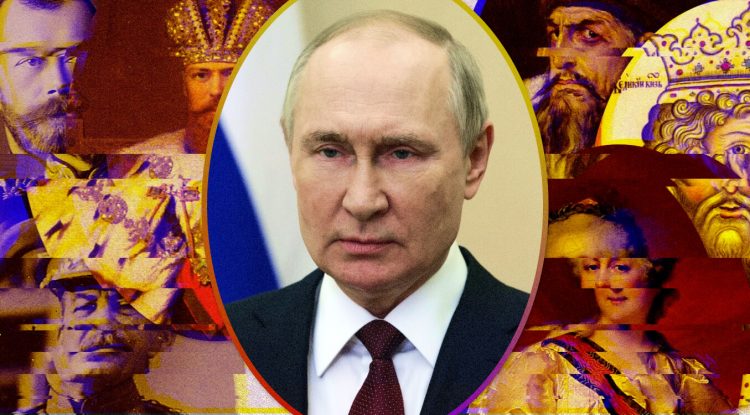
Historian Ilya Budraitskis explains how the regime subjugated the whole history of Russia
Each speech of Vladimir Putin is “historical”. Propagandists use this word, emphasizing the meaning of presidential theses for the future of the world. The rest call Putin’s performances so, simply pointing to his constant references to the past. The history of Russia is the main topic of state orders in the field of culture and education, an official explanation of foreign and domestic policy, even the justification of repression. At the request of the “cold”, the historian, political theoretician Ilya Budraitskis explains how the mechanism of subordination of historical science works to the state works.
In order not to miss the main materials of the "cold", subscribe to our Instagram and telegram .

On November 5, just a few days before the exit of the Russian troops from Kherson, Red Square was turned into a kind of huge theater scene. Hundreds of people dressed by soldiers, generals and employees of the Stalinist NKVD were desperately trying to “recreate the historical atmosphere” of the 1941 parade. The role of Stalin, the appearance on the rostrum of which then demonstrated the determination of the Soviet leadership to defend Moscow to the last, was implicitly reserved for Vladimir Putin, who visited the exhibition. Muscovites who passively observed this reconstruction, according to its directors, obviously, had to re -survive the atmosphere of the patriotic unity of the people and the government. The two parts of this equation are the leader and its people, in which the first continues to create history, while the second is designed to identify in the present his own past.
Obviously, history in the last decade of Putin's rule has turned into the main justification of state policy. Back in February 2012, Putin read to the participants of the pro -government rally in Luzhniki Lermontovsky “Borodin”, clearly identifying the upcoming presidential elections with a decisive battle against Napoleon, where voters, as soldiers in 1812, have to restrain the “oath of allegiance”. In 2014, in his speech about the “return of Crimea,” Putin had already sent his listeners to the history of the baptism of Prince Vladimir, after which the peninsula acquired sacred significance. In 2016, opening a monstrous monument to Vladimir on Borovitskaya Square in Moscow, the president stated that this prince "laid moral value foundations that determine our life to this day."
One of the amendments to the Constitution adopted in July 2020 reported that Russia was “united by a thousand -year history” is now a law. Representing the new monument to Alexander III in the Gatchina Palace, Putin noted that the reign of this emperor was determined by the "harmonious combination of large -scale technological, industrial, state transformations and fidelity to national traditions and culture, its original sources." In his recent September speech about the “entering new regions into Russia”, Putin recalled Suvorov and Catherine II.
In each of his political decision, Putin sought to delegate the responsibility for him of the Russian history itself and imagine himself as an avatar of one or another ruler. Its actions are determined not by the conditions of the present, but the same unchanging state principle is reproduced.
Paradoxically, the cult of the great rulers in this understanding is combined with an impersonal idea of history, which has been repeated as an unconscious archetype for centuries: a constant West is always opposed to Russia. The names of this enemy are constantly changing - from the crusaders and Napoleon to Hitler and Biden - while its essence remains unchanged. The content of the ideas that this archetypal enemy carries - whether it is Roman Catholicism, racial theory or liberal democracy - do not matter, since only its goal, which is the destruction of Russia, is important. The direction of history is determined not by the desires of people and not an ideological struggle, but by a clash of eternal forms, frozen civilizations.
This battle continues both in the present and in the past, which the enemy is also constantly striving to attack and reassess. “Falsification of history” is officially recognized as one of the key threats of national security, and, as the Russian president does not tire of repeating, with “distortion of history” “the buildup of states and peoples begins.” The sovereignty of the present, therefore, stands on the foundation of the sovereignty of the past, any attempt to challenge the consistent nature of which is equal to state crime. By and large, this was the fault of the historian Yuri Dmitriev or Memorial, at the process of which the prosecutor directly accused the organization of “distorting historical memory”.
The memory of repressions - like the memory of popular uprisings or suppressing national minorities - breaks the story about the eternal harmonious unity of the people and power in the confrontation of external threats. The danger of this memory that gives a challenge to the state is that it constantly imposes material evidence: forgotten mass burials, personal evidence and interrogation protocols.
Since the beginning of the 2010s, a powerful infrastructure of the state “historical policy”, which included hundreds of monuments and exhibitions, has been created in Russia. One of the main contractors of these state orders, the Russian Military Historical Society, led by Vladimir Medinsky, was established jointly by the ministries of culture and defense-which clearly illustrates this connection of history with the issues of “national security”.
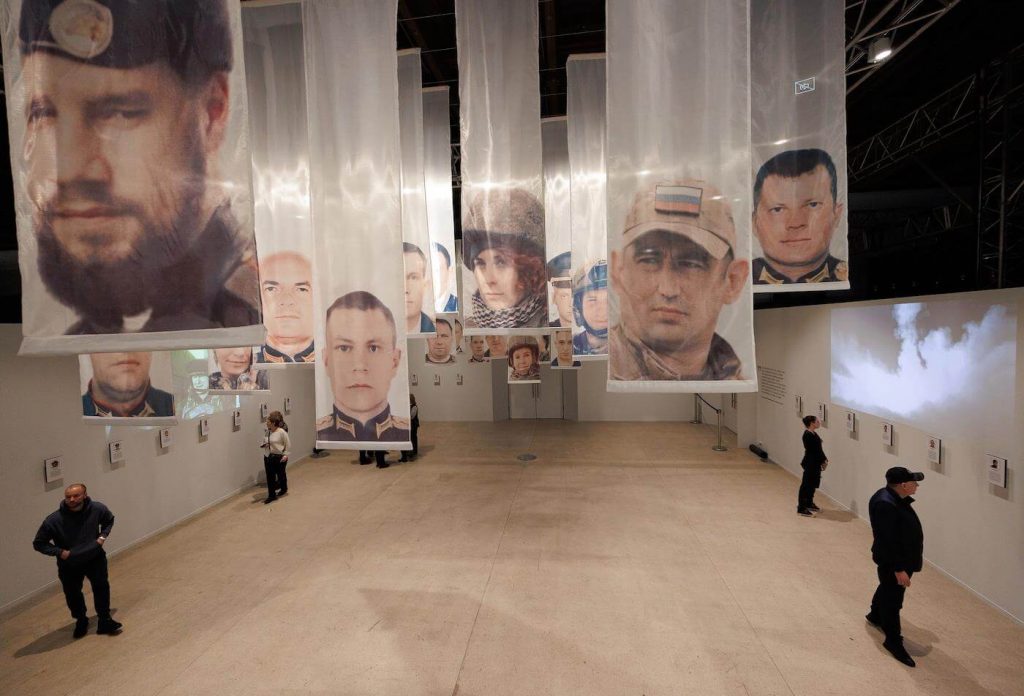
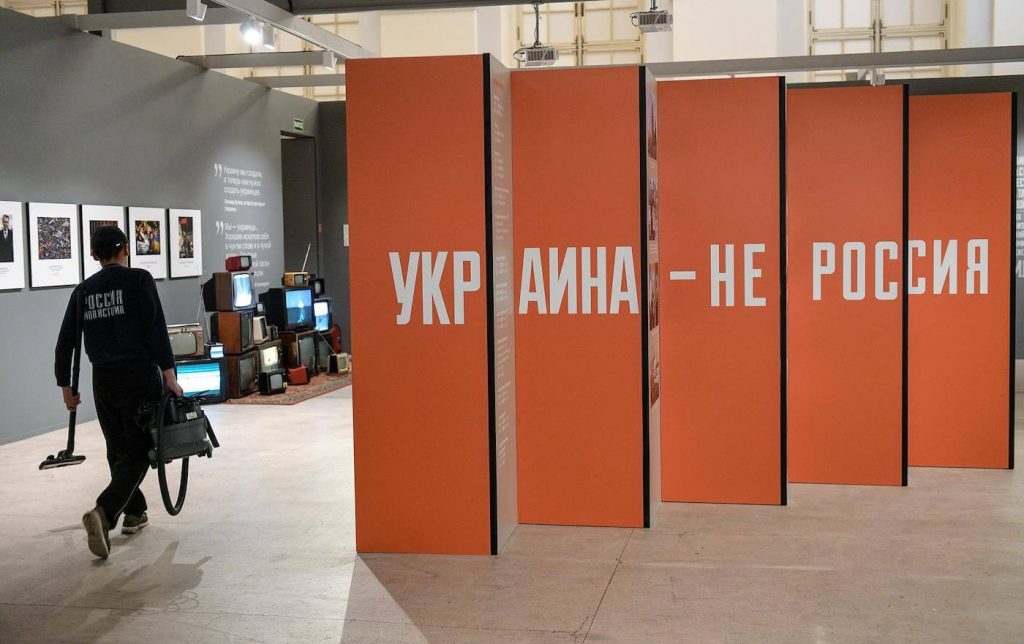
Another important player in this area is the Patriarchate of the Foundation "My History". He created a huge network of the so -called historical parks, representing in an accessible form the official concept of continuity of all Russian state forms - from ancient Rus' to the Stalinist USSR. A distinctive feature of these expositions is the complete dematerialization of the historical process: this is not a museum where the story of eras is built around genuine objects and documents, but an endless series of banners and staged videos. Visitors to the exhibition, who are invited to “find out their history”, find here only a thousand -year history of glorious victories achieved thanks to the wise rulers.
Just as today, the population of this “historical Russia” plays the role of a wordless material from which the building of the state is being built. Now “My History” represents a new exhibition - “Ukraine. At the fractures of the eras, ”the plot of which also reveals the dualistic struggle of the two principles that passes through the centuries: the true one, within which Ukraine has always remained part of a single state and“ spiritual ”space with Russia, and false, which tried to tear it from Moscow.
The theoretician of the history of Jan Assman identified two types of historical memory: “cold” and “hot”. The “cold” memory is created exclusively from above, the state and elites. Expressed in institutes, monuments and temples, she teaches subjects how and what they should remember. This type of collective memory is not based on a real experienced experience belonging to social or national groups, families or individuals. On the contrary, he suppresses such an experience so that he cannot violate the consistent version of history corresponding to the interests of the state. The “hot” memory, on the contrary, is trying to rethink the past and give it another content through activity in the present. In other words, the “hot” memory constantly seeks to revive the story and again open questions that the institutions of “cold memory” want to close once and for all.
After the start of the war and the destruction of the remnants of any public policy in Russia, it is obvious that any forms of “hot” memory are outlawed. “Historical Policy” - as an excuse for the present by the past - in Russia finally turned into politics, and the “continuous history” of the Russian state is declared the foundation of non -alternative official ideology. However, this means that the past displaced by the state, associated with the history of disagreement, uprisings, anti -war resistance and imperial suppression of small peoples, poses a relevant danger to the dominant order. After all, as the philosopher Herbert Marcuse once wrote rightly, "the memory returns with the memory of the past, the departed fear and the departed hope."
The author’s opinion may not coincide with the opinion of the editorial office.