
Translated material
Party regime after Putin. What can it be
A new article from the cycle of political scientist Grigory Golosov about the future of Russia
"Cold" continues the cycle of the leading Russian political scientist Grigory Golosov about what will happen to Russia after Putin. Previously, votes assessed the probability of coming to the power of the junta and another personalist dictatorship . The new article is devoted to the potential party regime. It is likely to end with anything good for the country - and that's why.
In order not to miss the main materials of the "cold", subscribe to our Instagram and telegram .
Party regimes of the twentieth century
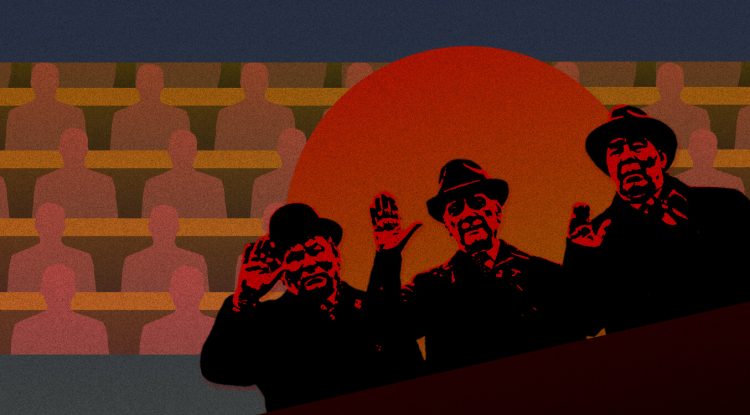
Personnel dictatorships have only recently become a dominant form of authoritarianism. Until the end of the 1980s, the championship held party regimes. Our country is well familiar with the communist. The form, which is most often called the "fascist regime", is also heard. There were others, but they rarely remember them today.
In the second half of the last century, in many developing countries there were regimes that belonged to the category of party ones either because they imitated the Soviet system, or because it really became like it. The fashion to simulate fascist regimes was in developing countries (especially in Latin America) in the 1930s, but then it came to naught.
Party regimes are much more than any other form of authoritarianism need ideology. And indeed: how to justify the party’s claim to power, if not through elections? The easiest and most obvious way is to attribute to this party the most true, undeniable true vision of the prospects of social development, embodied in an ideological doctrine.
Examples: Marxism-Leninism and its local varieties in communist regimes, racial theory of the Nazis in Germany and a slightly softer form of aggressive nationalism in the Nazis in Italy. The party regimes of developing countries were usually nationalist. They highlighted various kinds of concepts of national integration, although at the same time many of them adhered to socialist positions.
"United Russia" is a non -ruling party
Discussions about whether the transformation of the current Russian regime in the direction of the party is also possible, also begin with the discussion of its ideology. On this, as a rule, they end. However, the starting point of this conversation should be different. It is necessary not to start with ideological, but with the structural features of the political structure. This is very simple: if there is no ruling party, then there is no party regime.
Obviously, the Russian regime is not party. United Russia cannot be called the ruling party. And the point here is not that in Russia there is no one -party. This is not a prerequisite. Yes, most party regimes did not even draw even formally alternative elections, reducing the periodic appearance of citizens to polling stations to an absolutely empty ritual - as it was in the USSR. But we also know exceptions. One of the most durable party regimes lasted in Mexico from 1929 to 2000. For most of this period, elections were held in the country, to which a legal opposition was allowed. And not as fictitious as in modern Russia.
The Mexican regime was party, because the institution and revolutionary party really rules. Moreover, it served as a mechanism for the change of power. The presidents of Mexico enjoyed great powers, but none of them was delayed in power for more than six years laid under the Constitution. The opinion of the current president about who became his successor was usually taken into account, but the decision was not for him, but for the governing authorities of the party.
Dictators and their parties
So it should be under party regime. In many cases, it was. Authoritarianism, in fact, contains a natural tendency to slide into a personal dictatorship. However, to the extent that the regime remains party, this trend has a limit. The power of Nikita Khrushchev in the USSR seemed endless, but in 1964 he was shifted by the Plenum of the Central Committee of the CPSU. In modern China, for a long time there was a “generation change” system, which ensured the replacement of the country's top leadership. We can recall that Benito Mussolini in Italy was removed from power by the party-state body-a large fascist council.
Cases of turning party regimes into personal regimes are numerous. However, every time this happens, the result becomes erosion of the regime, the loss of a party nature. Say, in the last years of the reign of Nikolai Chausko in Romania, members of the Politburo of the Romanian Communist Party were actually under house arrest. Chausko completely usurped power and lost it as a result of a power coup, and not at all by decision of the party.
The personalist dictatorships of Joseph Stalin in the USSR and Mao Zedong in China became possible after the terrible blows inflicted on these leaders in their own parties: the Stalin’s “Great Terror” and the Maoist “Cultural Revolution”, during which the Communist Party of China has actually lost power for a while. And in modern China, the strengthening compliance of Xi Jinping goes hand in hand with the weakening of the significance of other members of the party leadership.
All these examples illustrate a simple thought: personal dictatorship is almost incompatible with the party regime. The dictator needs a party only to the extent that it serves as an obedient tool in his hands, and does not allow the transformation of its other leaders into independent political players. The limits of the tolerance of the sole ruler to his own party are determined only by how useful the party is as a tool for retaining power and current management.
Why Putin United Russia?
What are the benefits of United Russia for Putin? Exclusively in the fact that according to the results of the elections, she wins the majority of places in representative meetings, and then obediently realizes the legislative agenda dictated by the executive power. It is quite obvious that the successes of Putin himself in the presidential election “United Russia” contributed to the minimum, and sometimes, perhaps, interfered: the popularity of the party always inferior to the popularity of the president. The role of "United Russia" in the management of the country is negligible. It does not affect the composition of the central government, and at the regional and local levels it serves as an appendage of administrative bodies.
Putin has no need for United Russia as a ruling party. It is useless beyond the framework of the narrow tasks that she already performs. At the same time, if United Russia really claimed a share of power, then there would have no one to take this share except Putin himself. I do not see a single reason why he would agree to this. The evolution of the party regime in a personal dictatorship is quite possible, but the return trip - from personal dictatorship to the party regime - is unrealistic from the point of view of elementary political logic.
Russia without Putin - party capabilities
Now we consider the options in which the further evolution of Russian authoritarianism will take place without Putin. As I showed in the previous article , the probability of coming to the power of a military junta, which is being built on a consensus of a wide circle of security forces, is small. However, since this option still remains, as they say, on the table, it should be noted that some consolidated military regimes tried to take shape as party. However, without much success.
The military junta usually includes people who have united in order to shift the current regime, but at the same time not adhering to any common views on the development strategy. These are not politicians and certainly not ideologists, but simply military. Once in power, they usually talk about the fight against corruption, about the need to establish more effective management, about overcoming external or internal threats of national security. They treat civil politicians with distrust, but do not have their own political experience necessary for party construction.
Only in a few cases, the military who came to power adhere to common views, which serve as the basis for party projects. The junta, which overthrew the civil government of Burma in 1962, put forward a plan for the revolutionary transformation of society, which was supposed to implement the party of the Burmese socialist program created from zero. However, the one -party regime, established in Burma, was only a screen that covered the sovereignty of the junta, and the construction of socialism as the main ideological guideline of the regime gradually faded into the background, replacing pure nationalism.
This is not surprising, given that the implementation of the “Burmese socialist program” put the country on the line of economic disaster. In the end, faced with mass protests, the military actually dismantled their party, but remained in power. In Africa, similar processes were observed in Somalia and Sudan. These unfortunate countries are still the consequences of the transformation of society launched by the military. In general, however, this is quite rare, unusual for military regimes of development trajectory.
Party projects in military regimes, which are a product of the struggle between different groups of military and other law enforcement agencies are significantly more in demand. The leaders of such regimes are inclined to justify their success in the struggle for power by the fact that, unlike competitors, they fulfill an ideologically justified mission and enjoy the support of organized social forces. But when successes are achieved and competitors are eliminated, the leaders of such regimes simply usurp power and become ordinary autocrats, for whom the ruling party, as we have seen, is not particularly useful, and in some ways even harmful.
The former leader of Ethiopia, Mengist Hayle Mariam, took a little more than two years to remove other leaders of the coup from the power (and eliminate physically), after the anti -monarchical coup of 1974. All this time, Mengista imagined himself as a solid Marxist-Leninz, and where Leninism, there, of course, and the party. But there were problems, because even in the conditions of the monarchy, several underground parties of communist orientation acted in Ethiopia. All of them welcomed the coup and, of course, expected that the mengiste would share power with like -minded people.
However, the menhist did not clear his way to power to share it, and such claims caused him quite natural irritation. He directed all his energy to deal with other Ethiopian communists-the Ethiopian People’s Road Avolutionary Party and the Popular Front of the Liberation of Tygrai-the struggle with which became the main content of the “red terror” unleashed in the country. As a result, by 1979, when Mengista directly began party construction, the Ethiopian communists were either exterminated or went into an even deeper underground than it was under the monarchical regime. The party created by the military completely depended on these military, and did not play any independent role in the country's policy.
Military regimes, regardless of their character and origin, are alien to party policy. This should be remembered by those Russian nationalists who now have the hope that Putin in power will replace a more ideologically close leadership. An example of Ethiopia shows that ideological proximity to military dictatorship does not guarantee either power or even political survival after the coup. Rather, on the contrary. The best that Russian nationalists can count on with such a turn of events is the role of a media servant of the regime, which, however, they regularly play under Putin.
This, of course, does not exclude the fact that the members of the military-political leadership themselves will adhere to some uniform, ideologically colored views. It is possible that these views will not have that communist-the time of communism as ideology, apparently, has passed-but some left or left-poolist hue. In the end, a mix of nationalism and leftist was characteristic of many military regimes of the past. Therefore, the question of an ideological shell that Russian authoritarianism can acquires is noteworthy. But about that - next time.
The author’s opinion may not coincide with the opinion of the editorial office.