
Translated material
Does Putin have ideology?
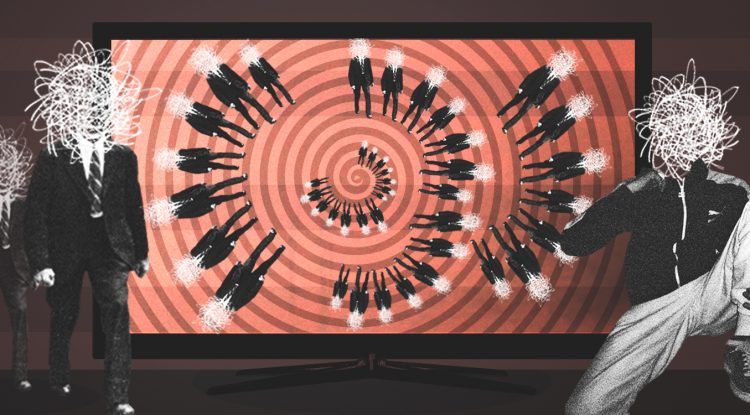
Political scientist Grigory Golosov explains what ideas the regime is
“Putin’s ideology is the development, stability and prosperity of Russia and every Russian”-this is how his spokeswoman Dmitry Peskov explained the system of Putin's ideas. But what does this phrase mean and does it mean at least something? Is it possible to describe and explain the modern Russian ideology? What are "traditional values" or "conservative path"? Doctor of Political Sciences Grigory Golosov answers these questions specifically for the “cold”.
In order not to miss the main materials of the "cold", subscribe to our Instagram and telegram .
The theory of ideology
The ideology of the Russian regime is being discussed a lot and willingly. The impetus for the new discussion on this topic was given by the May article by historian Timothy Snider about “fascist Russia”. I would not want to enter into a discussion with Snyder: enough is said on this topic, but we should still talk about the ideology itself. So, is the Russian regime ideological? If so, what is his ideology?
To begin with, the concept of ideology is determined fuzzy and is used in different meanings. There is no single idea of the role that ideology plays in political life. These disagreements have a long history.
To clarify my own positions, I must pay some attention to the nature of ideology. I will try not to plunge too deeply in history, the jungle of public thought and abstract theorizing.
The nature of ideology
For a long time, the word "ideology" was rather abusive. At first, it owed this unenviable reputation to Napoleon Bonaparte, who unflatterly responded about the work of the inventor of the term, philosopher Antoine de Tracy, and then mainly to Karl Marx. In a series of early works, Marx wrote that with the help of ideology, the dominant class controls the thoughts and moods of the oppressed in such a way that they accept the operation system as natural and not having alternatives. Any, not only religious, the form of ideology is, according to Marx, the “opium of the people”.
Paradoxically, it is precisely in the Marxist tradition that is much later - closer to the end of the 19th century - an alternative idea of ideology as a system of views capable of serving as a weapon oppressed in the struggle against the existing order began to form. Naturally, Marxism itself claimed the role of such a science.
After the emergence of communist regimes, which widely used the ideological processing of the population for the purpose of political mobilization, such an understanding of communist ideology became predominant for its supporters, and the thesis about the “control of thoughts” was reserved for all other ideologies. In the circles of left intellectuals, there is still an ironic statement "they have ideology, you have opinions, I have science."
In modern political science, the concept of “ideology” occupies an important but not central place - it is mainly used in the study of voters' behavior. Ideologies for political scientists are a system of values, knowledge and beliefs by which people are guided in the world of politicians and direct (as well as explain) their own actions, first of all, the choice of voting. Often, no one expects wider political participation from ordinary citizens, but if other forms of political mobilization are important for the existing political regime, then ideological motivation is also used for them.
Ideology and mobilization
The truth or falsity of ideological representations for political scientists is not the subject of priority interest, and this radically distinguishes modern approaches to the problem from Marxist. However, in many other respects, continuity is obvious, and above all, that ideologies can be ranked according to their ability to provide individual forms of political mobilization. For some ideologies aimed mainly at justifying the existing social order, mobilization of citizens is permissible only in limited volume. Such ideologies are called conservative. Other ideologies strive for a wide mobilization of citizens to achieve goals set by political leaders. Such ideologies will call mobilization.
To which of these two varieties will we relate the ideology of the current Russian regime? Before moving on to this issue, you need to figure out if he has at least some kind of ideology. For a long time, political scientists shrugged this problem based on the fact that for any personalist dictatorship, including Russian, ideology is not the subject of priority necessity.
This is due to the fact that dictators do not like to assume obligations to achieve ideologically motivated goals, preferring to emphasize their “pragmatism”. In the classic form, this was expressed by the odious Central African dictator Jean Bedel Bokass when he said that he would accept the ideology of the country that would help him build a railway. In fact, however, such “pragmatism” in itself is ideological in nature, serves as the basis for the fundamental conservative ideologies inherent in personalist dictators.
Perhaps, in their content, such ideologies are closest to the original Marxist thesis about the “opium of the people”.
Russian ideology
Russian ideology has existed in this mode for a long time. Since the beginning of the 2000s, official Russian media, which have always served as the main channel of ideological processing of the population, focused on several theses that can be formulated something like this:
- Under the leadership of Putin, Russia came out of a strip of instability and the popular suffering caused by it.
- Putin has a unique ability to lead Russia further along the road of stability and prosperity, the growth of the living standards of the masses.
- In order for Putin to continue to successfully cope with this historical mission, there is little from citizens - to support him in the elections and refrain from expressing protests. Putin himself will solve all problems.
This ideological complex, if you can call it that, resonated well with the life experience of a significant part of Russian citizens both during the period of painful economic reforms and at the beginning of the current century, when oil prices were especially high. It is easy to notice that the ideology of the Putin regime was then not just conservative (which, in fact, was recognized by some propagandists), but also directly aimed at the political demobilization of the population, at the passive adoption by citizens of the social and political order, which had developed following the results of the transformations of the 1990s.
Therefore, it is not surprising that the ideology of Putinism carefully avoided any specific provisions that would explain to the population the actions of the leader. As is usually the case in the conditions of personalistic dictatorship, Putin was invited to believe in the word. And in order to weaken the ability of citizens to critical evaluation of individual actions taken by the authorities, the official media instilated cynicism and distrust of any judgments that would specify discussions on political issues. Political activity outside the direct support of the regime was explained by the selfish motives of its initiators. Accordingly, any public statement that goes beyond the official line was considered as a manipulation aimed at satisfying private interests.
Hence - such a feature of Russian propaganda as uncertainty in assessments of almost any facts or ideas noticeable in the modern world. Perhaps the only thesis on which all the propagandists converge is that one -sex sex is undesirable, and marriage is allowed only between diverse faces, “mom” and “dad” are definitely needed. Such a fixation on sex matters seems even somewhat strange. But the positions of propagandists on other issues are best expressed by one of the favorite phrases of the participants of the talk show on Russian television: “Everything is not so unambiguous.”
Ideology from talk shows
Freedom? Better than lack of freedom. In Russia, real freedom, and in the West, chaos is arbitrary. But at the same time, Russian civilization is such that we always put the interests of the state above the interests of the individual. Democracy? Better than the dictatorship. In Russia, as well as in countries like Syria and Venezuela, real democracy, but in the West - no. But in Russia there is a tradition of autocratic power in which there is also a lot of positive. European values? Russia is their last defender, and Europe itself has long betrayed them. But Russia is also an Asian country, therefore, our values are more likely Asian. Justice? Russia for justice, and in the West - operation and inequality. But the ultra -high incomes of officials and large entrepreneurs protect Russia from giving these valuable experts to be omitted by foreign corporations.
Mandatory references to international experience are, of course, a distinctive feature of modern Russian ideology. Partly, these references are purely rhetorical in nature and are given within the framework of the design among propagandists of the structure "We are not all perfect with us, but in America they are lying blacks." But nationalism is really characteristic of ideologies, and Russian is no exception.
The ideology of nationalism
Ideologies in the vast majority have always been and everywhere remain more or less nationalist. Only socialism and some versions of liberalism allow exceptions. Internationalism occupies some place in the world of democratic ideologies, but for authoritarian regimes, nationalism is a natural way of ideological expression. Even the Soviet regime, having begun to readily sacrifice Russia for the sake of the goals of the world revolution, after a couple of decades began to acquire a pronounced nationalist hue. Eviously nationalist are both the remaining communist regimes, from China to Cuba and dictatorships in developing countries.
However, nationalism of the Russian regime is very peculiar. This is, so to speak, negative nationalism, which emphasizes that any country is worse than Russia in some parameters, but does not explain why Russia is best in principle. One of the reasons for this situation, of course, is that many residents of the country have foreign experience, and he indicates that life in Russia is not so good compared to other countries.
The deeper reason is that Russian ideology is devoid of natural component for any nationalist ideology, namely references to ethnicity. The Russian state is multinational, and it wants to be preserved in this capacity. Russian nationalism is unacceptable for the authorities. But Russian nationalism does not exist. The concept of "Russian world" works for export, absolutely empty and does not even answer elementary questions. Where is the "Russian world" is located? Who inhabit it? If Russian “advisers” are found in Central Africa, does this mean that Central Africa is part of the “Russian world”? Do we want her to be part of him?
Ideology of "Imperiality"
It is sometimes said that the Surrogate of Nationalism in Russia could be the imperialist ideology of territorial expansion, the so -called imperial. I must note that those imperialist ideologies that really dominated the world before the Second World War usually included an ethnic component. For example, British imperialism would not have been impossible without the thesis that (1) the moral and material superiority of the British nation, its ability to carry the “burden of the White Man”, justifies the territorial expansion and (2) for the British empire itself is a useful, economically profitable enterprise leading to the enrichment of the people.
Is it possible to convincingly formulate such theses in relation to the foreign policy of modern Russia? I doubt it. The central place in the excuses of the “Imperiality” is occupied by primitive resentification, the endless and monotonous listing of resentments inflicted by Russia by its foreign “partners” in a more or less distant past, as well as memories of past victories. In addition, nationalist feelings are trying to warm up the thesis that “strong” (that is, threatening neighbors) Russia will “be afraid, and therefore respect”. I’m afraid that common sense makes this thesis doubtful even for people who are far from politics who are not deprived of at least some kind of life experience. Many are afraid of the courtyard bully, but no one respects him.
Summing up, I state that the ideology of the Russian regime is deeply conservative, devoid of any specific content and internal connectedness, simply unconvincing. This regime cannot have other ideology.
Another authoritarian regime, having replaced the current one, could, of course, try to form an ideology suitable for party construction and mass political mobilization. It is possible that such a mobilization ideology could be nationalist. However, it is necessary to start not just from scratch, but with a negative value, because it will be necessary to overcome the legacy of the current regime - the deep political passivity of the population, its disorientation and cynicism regarding any ideological constructs and values.
The author’s opinion may not coincide with the opinion of the editorial office.