
Translated material
"Before the war, they were eco -activists"
On January 25, 2024, Doxa was recognized as an “unwanted organization”.
If you are in Russia or plan to return to it, you can not replace our materials on social networks, refer to them and publish quotes.
Read more about what is possible and impossible, read in the cards .
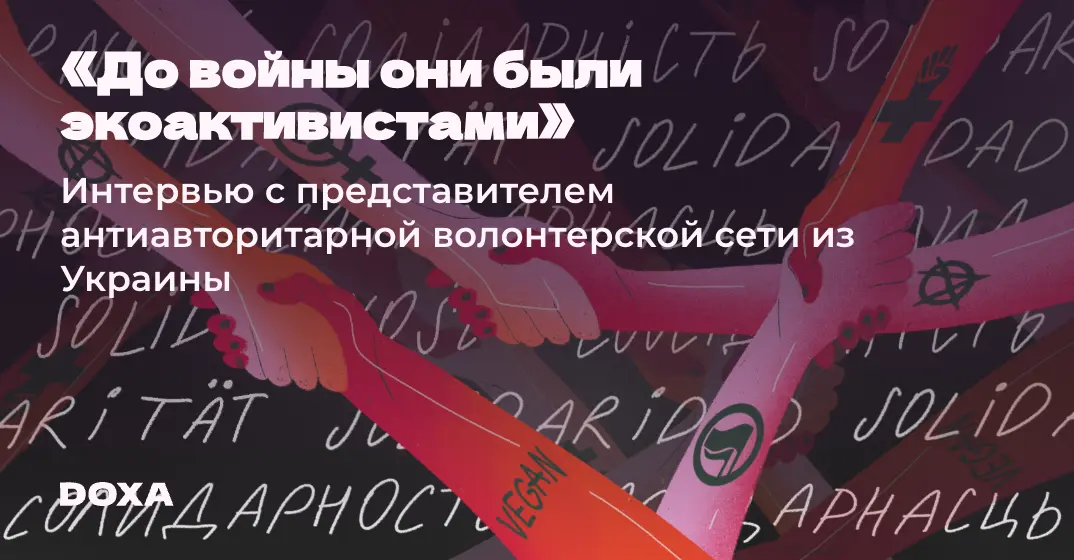
How to preserve anti -authoritarian principles during the war that Ukrainian anti -fascist_s think about nationalism and what help from Russia they are counting on - Sergey Movchan from the Kolekiv Solidarosti shared their views with DOXA.
Editor
Editor
Peter tIllustrator
Illustrator
SandyPublication
September 13, 2022
" Kolekitivato Solіdarnosti " (previously "surgical Soligadarniya") is an anti -autorite volunteer network that began to operate in Ukraine from the first day of full -scale Russian invasion. Now they support up to 150 anti -authoritarian fighters in Terborne and the Armed Forces and distribute humanitarian aid in the regions injured from the war. In addition to direct action, the “Kolektiv” conduct active media work: they say in social networks, the media and conferences, why it is so important to support Ukraine today and why they, being anti -authoritaries, are built into the state military structure for this.
- Thank you for agreeing to an interview. It is now difficult for many Ukrainians to speak with someone from Russia, even if they would like.
- For me, this is definitely not a problem. I know that the mood is different now. We have comrades from Russia who went to Troy. We do not share stereotypes and try to think with the categories of solidarity.
- Tell me for starters, what are you doing now, what areas of work do you have?
Some time before the full -scale Russian invasion, anarchists, anti -fascists of varying degrees of radicality took place, and two strategies were accepted on it in case the invasion of the still occurred. Firstly, some people who are ready to directly protect Ukraine will join the territorial defense. All together will go to one specific territorial defense and create a horizontal detachment that promotes anti -authoritarian values. Secondly, you need a volunteer movement that will provide this detachment and present it in the world, to tell why we are forced to join the armed resistance. So it happened. Already in the early days [after the invasion] both entities arose: some of the people went to the anti -authoritarian battalion, part then created the "Operation Solidarity" In early July, the horizontal volunteer initiative "Operation Solidarnost" announced a division. Part of the team under the old name received 16% of the total funds and saved accounts (~ 7000 subscribers on Instagram), where since then it has not published news. “Kolekivtiv Solіdarnosti” received 84% of common means, continued to work in their previous areas and report about it in newly created accounts (now on their Instagram ~ 700 subscribers_z). .
I joined the volunteer group somewhere on the fifth or sixth day of a full-scale war, and since then the network has grown significantly. If initially the emphasis was on our anti -authoritarian detachment, then we began to support other activists - in the broad sense of anti -aboars that join armed resistance. We began to support them all, in whatever area, in whatever city they were.
- How did you make this decision and how did your movement grow? Comrades are contacting you, you just personally know someone or at meetings discuss who else to support?
-Firstly, we find whom to support through joint information channels. Secondly, our initiative itself consists of people who are also members of other communities. These can be anti -fascists, refugees from Belarus, zoo defenders, participants in feminist organizations or people involved in the left media. Everyone and everyone has comrades and comrades in their field of activity that went to the front. Some contacted us directly. We ask others ourselves: is something necessary?
View this post on InstagramA post Shared by Kolektivativ Solidarnosti • Solidarity Collectives (@SOLIDARITYCOLLECTives
Over time, we began to support the “twin” - comrades of our comrades in military units. Now we are cooperating with trade union figures, when we know that these are not yellow trade unions Trade Unions created by the employer or actively cooperating with capital contrary to the interests of the employee. , and active, combat. Previously, for example, we participated together in protests against changes in labor legislation. Today, many of the protesters then fight, and we help them.
At some point, they took up humanitarian aid. In the warehouses, there were many things that we were brought from abroad, and the fighters do not need them. When the Russian troops moved away from Kyiv, we went to the liberated regions, looked at the horrors that were being created there, talked with people and realized: damn it, [providing humanitarian aid] is a very important mission.
Now we have three main directions: militarian, that is, assistance to our comrades in military units, humanitarian and media, that is, communication with people in the world is an explanation of why it is so important to support Ukraine today.
-And you communicate with one of the Russians, except for those who are fighting now on the side of Ukraine, with some organizations in Russia?
- There are informal connections. At some events, we intersect with people and organizations from Russia - I don’t know if it is safe to call them. We do not refuse ties with them. There are many contacts with Belarusians, which were massively emigrated after protests [2020].
But with the Russians there is no daily permanent cooperation, such as, for example, with organizations in Germany, Poland, France, Italy. We are “teams of solidarity”, in fact, because a rather large number of people and organizations contribute.
View this post on Instagram
- How much does organizations and activist from Russia verify the usefulness and ethics of what they do, with comrades from Ukraine?
- Almost no one checks anything with us. As far as I understand, the initiatives act at their own discretion, and there are different opinions about their activities. Just the other day, a comrade from Russia, who went to Troy, said that he had quarreled with all [comrades from Russia], because they refused to let the trains downhill. And there are those who believe that any anti -war resistance is already good.
If in Ukraine the slogan “No War” is often perceived as Russian propaganda and amazing, in Russian realities it is a slogan of at least protest and anti -government. There is no single opinion [about the activities of Russian activist_k], although there are enough radical views among the Ukrainian activist.
And I really sometimes feel ... We have this feeling that not enough. Not enough is done in Russia. We really expected a powerful anti -war movement in the early days, that it would be more effective. Why didn't it work out? Well, yes, the repressions that are incomparable with what exists in Ukraine, the regime is much stronger, much more authoritarian. This can be understood, it can be rationalized. On the other hand, the feeling that has not been done enough leads to total disappointment in Russia, in local activists - and among the people, in people.
In the end, you expect people in Russia who talk about the “fraternal people” will not perceive this war with the fraternal people, something will begin. Protest, massive, not only in Moscow and St. Petersburg. And as a result, protests are drying out in a week or two, and after that the support of the war, that is, the support of the regime, is growing. It really makes many thoughts: "Yes, Lord, burn, nothing can be changed there."
- Thanks for the very clear presentation. Such moods, of course, are completely understandable. If you return to your story, can you tell about the division that happened?
- From the point of view of most people, we initially engaged in volunteer activities as a team based on horizontal principles. But then it turned out that all financial and media resources are in the hands of one person. He stated that he did not see more prospects in volunteer activities, and one of the most important goals [of our organization] is to strengthen the financial situation of the anti -authoritarian movement. It was announced that he and two more people were being separated and taking half of the money. Half of the money remains for us for volunteering, half goes to these three people for some of their ideas.
We tried to agree, although for us it was negotiations with a person who speaks out of the perspective of strength. We already agreed to give part of the money, but let them at least show us some calculations that these funds will go.
This left, to be honest, an indelible imprint [in the team]. A bunch of people burned out, someone came out [from the team]. It seems that the beginning of the war was less stress than this internal disassembly. At some point, we realized that there was no point in pulling further. And we decided that we would tear with the old name: Okay, we do not have access to old social media, this is not the main thing. The main thing is people. Almost the entire team remained in the "teams of solidarity", and we retained our contacts.
Naturally, we had to make a public statement, to explain why people are the same, and the name is new. I really hope that the day will come when this question will stop someone to worry. We have much more important problems: material, we do not have enough hands, logistics, media work.
View this post on InstagramA post Shared by Kolektivativ Solidarnosti • Solidarity Collectives (@SOLIDARITYCOLLECTives
-You were originally an anti-authoritarian organization, most team members have some established moral principles. There were probably procedures that were supposed to prevent such a situation? Have they changed now? Maybe you have tips for horizontal organizations?
- Why, in principle, this conflict happened? Precisely because everyone proceeded from the fact that we have common ethics and such a situation seems to be impossible. But one authoritarian person with ambitions is enough for everything to sprinkle. Therefore, now everything is originally decentralized: different cash desks are assigned to different people, the directions have their own coordinators, much more transparent reporting. Now we are trying not only to write: "We bought a helmet." No, we say: “Here, these are such guys - how much we can give information, of course - before the war they were eco -activists, today they are in the Lviv Tro - or in Odessa, in Kharkov - and now this helmet went to them.” We are trying to be much more transparent both in front of themselves - everyone can see reporting and ask a question at any time - and publicly.
It seems to me that any horizontal initiative should immediately take care of, firstly, about the decentralization of resources, and secondly, about the inclusion of each person and recognizing the value of the contribution of everyone. No one should engage in micro -management, each is their own area of responsibility.
View this post on InstagramA post Shared by Kolektivativ Solidarnosti • Solidarity Collectives (@SOLIDARITYCOLLECTives
And the third is, of course, comradely communication. We must immediately, immediately agree: we have a friendly team here, a friendly manner of communication, no other communication is acceptable. Otherwise, frustration, anti -conflict sessions that end with new conflicts and so on.
- How much is possible in the conditions of war to adhere to anti -authoritarian principles when you need to make decisions very quickly? After all, even in a calm time in the group, communication is not immediately established. And you, it turns out, had to do a lot on the fly.
- Yes, there is no universal recipe. What we do: distinguish, where we need a collective discussion, and where the decision can be made on the fly. For example, there is an amount from which purchases must be discussed by the entire team. And if the amount is less, then the people responsible for contacts with the detachments make decisions themselves. Of course, there is no point in discussing twenty people, buying or not buying a walkie -talkie. At the same time, it will be wrong if one person decides to allocate 5,000 euros for the purchase of a drone and does not ask anyone about it.
- You mentioned that you cooperate with different European organizations. I know that with the Dresden Black Cross. Who else? Who was right away, who came along the way?
- Indeed, one of our key partners is the ACK network. They supported us immediately, and we are grateful to them for the quick establishment of contacts in Europe. Largely, thanks to this, the money went quite quickly, for which we were able to buy important things. We were supported by ACHK-Drezden, Galicia and Kyiv, which are now in exile, let’s say so. Polish No Borders and Inicjatywa Praacowicza. Not only the anarchists helped - the Spanish Trotskyists contacted us. Quite a lot of local European initiatives simply wrote: "Hello guys, we raised money for you." Or: "Hello, we organize a discussion, could you join?"
View this post on InstagramA post Shared by Kolektivativ Solidarnosti • Solidarity Collectives (@SOLIDARITYCOLLECTives
I participated in conferences in many countries where I described our situation. I saw people with very different views. This is striking, because in the same Germany people can collect money on, I don’t know, body kit for weapons, but they can ask: “Why don't you deploy a weapon against your own government and not at the same time?” Some of the people, it seems to me, expected that anti -authoritarian detachments were almost Makhnovshchina The rebel anarcho-peasant movement under the leadership of Nestor Makhno. It arose in the summer of 1918 during the Austro-German occupation. It took place under the slogans of the “invalid labor federation”, “complete freedom”, etc. The rebel detachments acted against the Austro-German troops and the army of the hetman Skoropadsky (1918), the UNR Directory, the army of General Denikin (1919) and Wrangel (1920). Now they will arrange and will fight simultaneously both against Russia and against the state. People who are far from Ukraine sometimes had idealistic representations. But these ideas allowed them to help as a result. And vice versa, people from idealistic ideas wrote: “Yes, Ukraine, support, solidarity! Therefore, we ... will go and block all NATO bases in our country. ” As a sign of solidarity with Ukraine. That is, a very different understanding of what is happening here. Therefore, it is so important for us to communicate.
Our girlfriend, who traveled from Achk-Kyiv with performances, threatened the Stalinists in one city with almost physical reprisal, because they thought that she had come here American imperialism and Ukrainian Nazism to promote. Views - even in the left, even among anarchists - can be very separated.
- Why is the anti -authoritariats to support Ukraine? How do you formulate this?
- Repeatedly heard a position that equalizes the two sides of the conflict: they say, both states are bourgeois, repressive, but there can be no part here. This opinion, by the way, is quite popular among Russian left. Anarchists sometimes criticize us for participating in government agencies, first of all - for the readiness to serve in the army. But here it must be understood that neither a blind, brought to absurdity pacifism, or imaginary Makhnovshchina are not able to stop the invasion. The invasion is incomparably more authoritarian state, under the occupation of which not only Bandera, but any political movements will be brutally repressed. Ukraine is poor, rather weak (in institutional terms), but due to this a rather democratic state. We, like no one, are aware of all his problems, but no one wants to live in the empire here. Therefore, today's war for the inhabitants of this country really has become folk. People are fighting not because the insidious US and NATO sent them to die. We - we all have subjectivity. And those anti -autorals are bad that cannot recognize her behind their own ideological dogmas. And the abstract slogans “For the world” will not stop a single tank and will not bring a single rocket.
- And how did your needs change over time? As I understand it, at the very beginning it was difficult not so much to collect money as to make the necessary purchases.
- Indeed, in the early days of the war in Ukraine there was practically nothing left. Absolutely all military units, hunting stores were cleaned to zero. In pharmacies-not even in Kyiv, but in Ivano-Frankivsk-there were no simplest bandages. Tourist stores are the same: sleeping bags, karemians, fliskes, terms - everything was sold out. And it really was necessary at the very first stage, because people went to the front naked, beast. Something was, of course, but the majority simply did not have normal tactical military equipment.
I had to look for all this abroad, but there everything ended very quickly. All raked in Poland, the Czech Republic, Slovakia. Especially with body armor were big problems. We managed to buy 100 body armor - a great success of the first days. The same, by the way, is in the humanitarian direction: there were many basic products where there were no bread in Kyiv, bread was one of the most valuable goods.
Since then, of course, a lot has changed: Voentorgs, tourist shops were opened again. Many - from ordinary men to entire enterprises - switched to the production of plates for body armor. Of course, not everyone is closed with needs, but now they are already different. The war is becoming more technological, more and more means mobility. We are increasingly asking to buy cars, drones. Moreover, there are not only quadrocopters, but aircraft that can cost fantastic money - more than 60,000 euros. We are not able to cover [such amounts] on our own, but we can help the air intelligence detachment where our guys serve. More often requested night vision devices, thermal imagers. Not just any boots, but comfortable, wear-resistant; Not just some form, but such that it does not burn, which is very important in the artillery war.
View this post on InstagramA post Shared by Kolektivativ Solidarnosti • Solidarity Collectives (@SOLIDARITYCOLLECTives
Now there are fewer needs, but we need much better things. Especially considering that more and more of our comrades are transferred from TRO to ZSU and find themselves at the front line. They decide the little things there: can you drop this body armor for a second, can your turnstile break or still save from blood loss.
- And the ZSU themselves do not have time to equip everyone? Or is it too much a budget load?
- In general, this is interesting, because Russian propaganda spoke about the need to demilitarize Ukraine, and we, volunteers, are forced to wool in all the military organizations of the world in search of a qualitative form. Now, perhaps, it has become better, but a lot of things in the war are consumable. Once something flew into your location-everything burned out. This is not to say that ZSU does not equip, but a lot of things are missing, or there, but not the quality that fighters are required. Here we join the business and thousands of volunteers who support their guys and girls.
- I want to unscrew a little bit to Russia. You said that you do not have enough volunteer hands. Can you technically, it is ethical to support Russians_ki? Or do you think that their main task is to engage in their own anti -war resistance?
- Well, let's say so, there are many options. Own anti -war resistance in Russia is great. On the other hand, many active people left. How can they help? Information work. At least among his audience. If you are left -wing, anarchists, then please convince your comrades that in Ukraine there is not a fascist junta in power. And the left ones, who joined the resistance, are also not accomplices of fascism and not puppets in the hands of Western puppeteers.

We talk about Russia's military invasion of Ukraine, protests and repression. We believe that now, when dozens of media have closed or ceased to cover the war, access to independent information is more important than ever.
Donaters. This, of course, decides. All our activities are built on donations, and we are grateful to everyone who thus makes contribution.
There is an opportunity-it is not easy, probably, but there is an opportunity to come here and join some TR. Although many have already encountered the fact that, in fact, even if you really want, it is not so simple to get to war. Even a paradox: there are volunteers who have been trying to transfer to the front for months, and there are citizens who are trying to hide, they find them at night clubs or on the beach of Odessa and hand the summons there.
Although, of course, we have a shortage of workers. Especially qualified hands-people who could help with media work, with purchases, with contacts. If someone really wants, it is real to come and help. Or help remotely: information, financially.
-I thought, for example, about those Russians who are somewhere in Europe-should they recommend it?
- Indeed, they have something to do. After all, they come to us not only for money. Now there is nothing that in Ukraine would not be needed.
When you go to settlements affected by the war, communicate with people, you understand that they need literally everything. Food, basic clothes, tools, building materials. Diapers, female hygiene, basic medicine. It doesn’t matter how many beads, how many trucks we will bring this - it will still be few. Just because people were because of this war on poverty. They were poor before, but the war pushed them over this line.
The essence of the humanitarian disaster in Ukraine is not that there are no food in stores, not that there is no drinking water. No, the bottom line is that people lost housing due to hostilities; People lost their jobs due to the fact that their enterprises were bombed or they simply closed-there is nowhere to draw material resources. Perhaps people have a hundred hryvnias to buy a bag of buckwheat and rice in the store, but a bag of humanitarian assistance in which they lie will be tangible and useful.
Everything is needed. And if people who emigrated from Russia want to take part in helping the Ukrainian people, no matter how pathetic it sounds - help in this war, help survive this war, then this is a huge field for work.
View this post on InstagramA post Shared by Operations Solidarnost (@Operation.SOLIDARITY)
- Thank you. Is there something that I would like to illuminate, what we have not touched?
- Perhaps I would also like to raise a topic that we are constantly asked about: nationalism, ultra -right. Here I also have a small call. The fact is that before that I was engaged in the monitoring of ultra -right movements, and I believe that the best strategy is to tell the truth.
We see two diametrically opposite lies. The lies of Russian propaganda unreasonably exaggerates the influence of the ultra -right, calling Ukraine a fascist state. In the Ukrainian parliament is one deputy from the Nationalist Party "Freedom". All. And then the chosen not according to party lists. In the latest elections, the coalition of the right forces received 2.17%, and it takes 5%to get into parliament.
The Ukrainian government, parliament - businessmen, they will say what is now a request for. There is a request for nationalism. But it is normalized not because there are some fascists in power. Two main surges [nationalist] moods are the annexation of Crimea, the war in the Donbass in 2014 and now. You can compare the reasons and understand that no one did so much to strengthen nationalist sentiments in Ukraine as Vladimir Putin. Nobody.
I am far from the idea that in Ukraine there is no fascism as such - this is a stupid attempt by our liberals to divide into black and white. Stupid, because there are a bunch of photographs, and to deny the existence of the ultra -right in Ukraine, including in military units, simply does not make sense. But we need to talk about reality. Over the past year, our monitoring recorded 177 cases of ultra -right violence and confrontation, of which violence against people - 58 cases. This is not comparable even with one day of the war. And this is not comparable to what is happening in many European countries.
This is a difficult problem, it requires a separate big conversation. That is why I urge everyone who wants to write about the ultra -right in Ukraine to contact us, people who know about the situation in Ukraine in the field. And do not construct images from your ideological attitudes instead of reality.