
Translated material
"You know how to read, you can do - what else do you need?" In the Evenki village, they do not see the need for education
“I don’t want to study, I want to hunt,” says nine -year -old Dima Nupreik, looking up from notebooks with textbooks. He sits at the kitchen table and listens to his father. “Once the bear burst into my wintering, I let it closer and shot it,” says Andrei Nupreichik. “I had a single -barrel. And if the cartridge had overthrew, and if I missed? But no, put it to death.” Dima looks at his father without looking up. Andrei, catching his gaze, laughs: "You know how to read, you know - what else do you need from school? Yes, do not go."
Source: "Baikal people"
There are not enough teachers and doctors in Siberian villages and cities. People leave closer to big cities. The first -aid posts are empty, there is no one to work in them. In schools, there is no one to study and teach. The buildings are dilapidated, new ones are almost not built. So it was before the "special operation". Now there is even less money for medicine and education. Instead of schools and hospitals on their territory, authorities restore destroyed houses in Ukraine. We show what is happening with schools and hospitals in the Siberian outback.
"Time here seemed to be frozen"
In the Evenki village of Vershin-Tutura of the Irkutsk region, all residents have been involved in hunting and fishing since childhood. “We were wrapped in diapers, we already had cartridges in our hands,” says Uncle Dima Nupreichik Andrey Kornakov. “We are all our lives with weapons.” In a local school, children periodically eat from lessons, because they go with their parents to a lake or to the forest - "for prey." Teachers treat this with understanding.
“We are in the heart of the taiga and far from any civilization,” says the school principal Tatyana Stanilovskaya . - Time here seemed to froze.
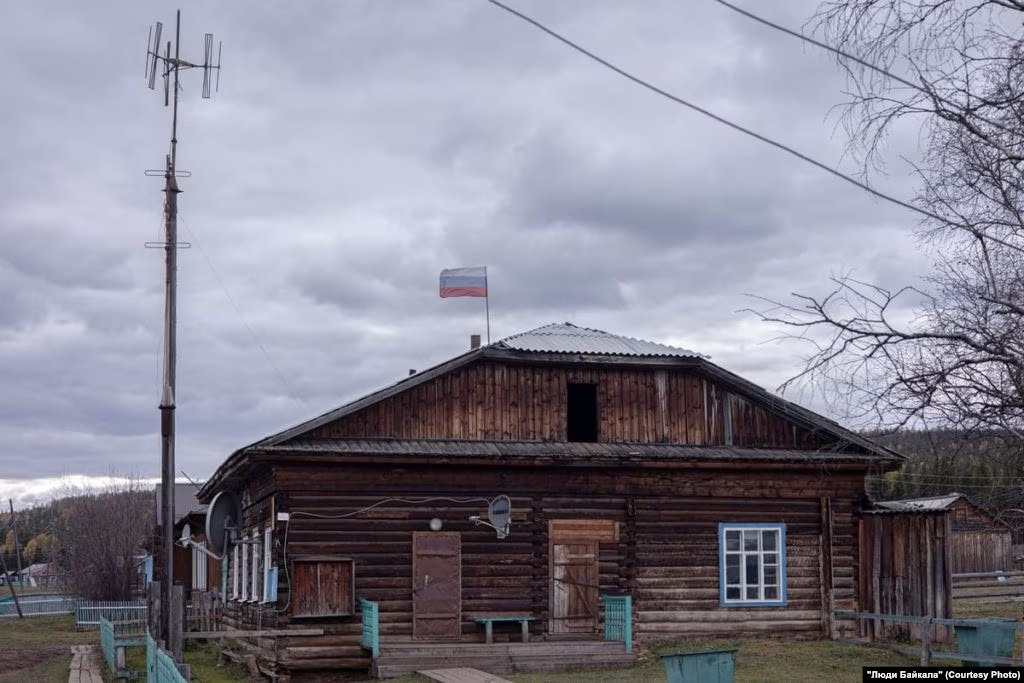
A school at the top of the tuture was built in the late 20s of the last century. Then the village itself appeared. The Soviet government forced Evenks to throw a nomadic lifestyle and settle in one place. Other buildings appeared in the village: residential buildings, hospital, mail, club. Everything is wooden, one -story. Everyone is still worth it. There are no new buildings at the top-tuture.
Locals say that "time froze" due to the inaccessibility of the village. From the district center, the village of Kachug, it is located only 60 kilometers. But 37 of them - on the road called "Sloby." She goes through passes and swamps, one pit immediately replaces the other. The road has not been the tractor for many years. In the summer, spring and autumn, you can drive through it either on all -terrain vehicles or on horses. In extreme cases, go on foot. In winter, it is easier: the path freezes and covers with snow. In frosts, they get on the road in 3-4 hours. The rest of the year - from 6 to 9 hours. Around - taiga, there are many bears and wolves. Hunters drive or walk along the road only with weapons.
Now about 180 people live at the top-tuture. 39 students go to the local school-nine. In the 1990s, there were 10-15 schoolchildren in the village, and 1-2 people were sitting in the classes. Tatyana Stanilovskaya says that it is impossible to enjoy improving the demographic situation and after a few years "students at school will be few again."
Chum for bosses
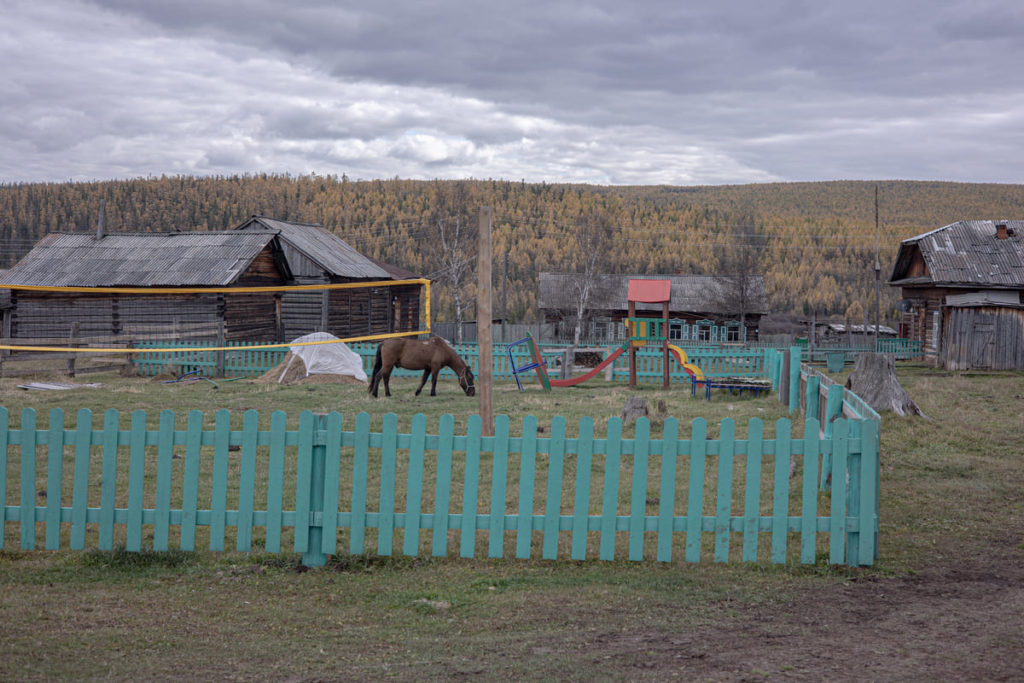
School - a long log house on Lesnaya Street. On the one hand, the rural club, on the other hand, is the administration. At the entrance to the building there are several posters: "Chronic disorders when using marijuana"; "Do not break your life into doses"; "In drinking women, hormonal background is disturbed."
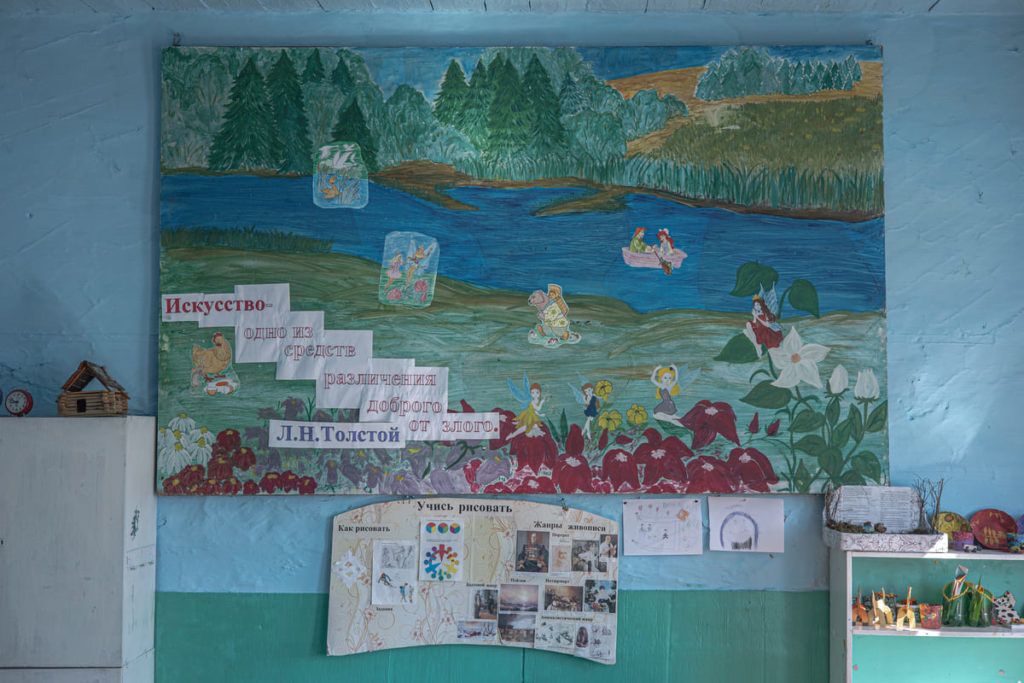
Wooden floors at the school are painted in a dark brick color. The walls in the classes are blue-green. The classes themselves are small, in some there are only five to six desks. There are stoves in the classes, drown here with wood. No one has electric heating at the top-tuture. Toilets at school - on the street.
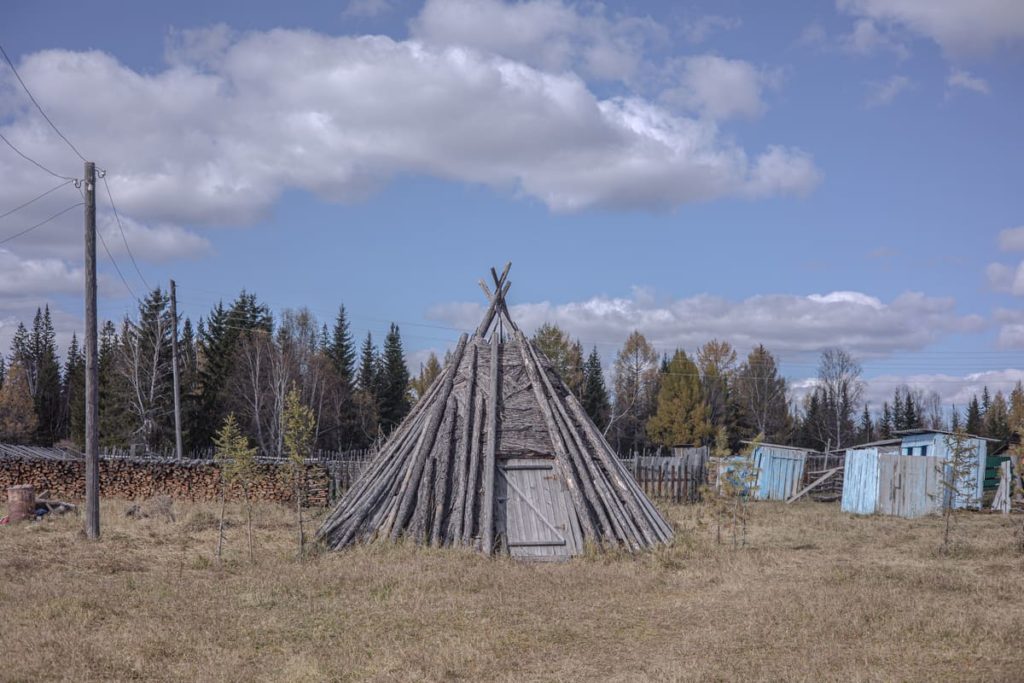
One of the main local attractions is the Evenki plague, which stands in the school court. He is the only one in the entire top-tuture. Locals live in log houses and do not put the plague.
The school plague was built by the former rural head Vladimir Shchapov, he is also the father of the current director of the school Tatyana Stanilovskaya. The structure made from poles and birch bark. Inside there is a table and bunks, a place for a fire. Stanilovskaya calls this place "atmospheric." Usually on the door in the plague there is a lock.
The doors open when local officials meet important guests: district and regional administration, journalists. Irkutsk bloggers are impressive techniques at the top of the tours: at first the guests are fumigated with smoke of juniper, then they put amulets on the neck and invite to dinner. The moose is treated with their hearts, roe deer liver, with blessed cutlets, fried caviar perch and lingonberry wine. Guests are delighted. “Well, you won’t lead the bosses to the school canteen,” teachers shrug.
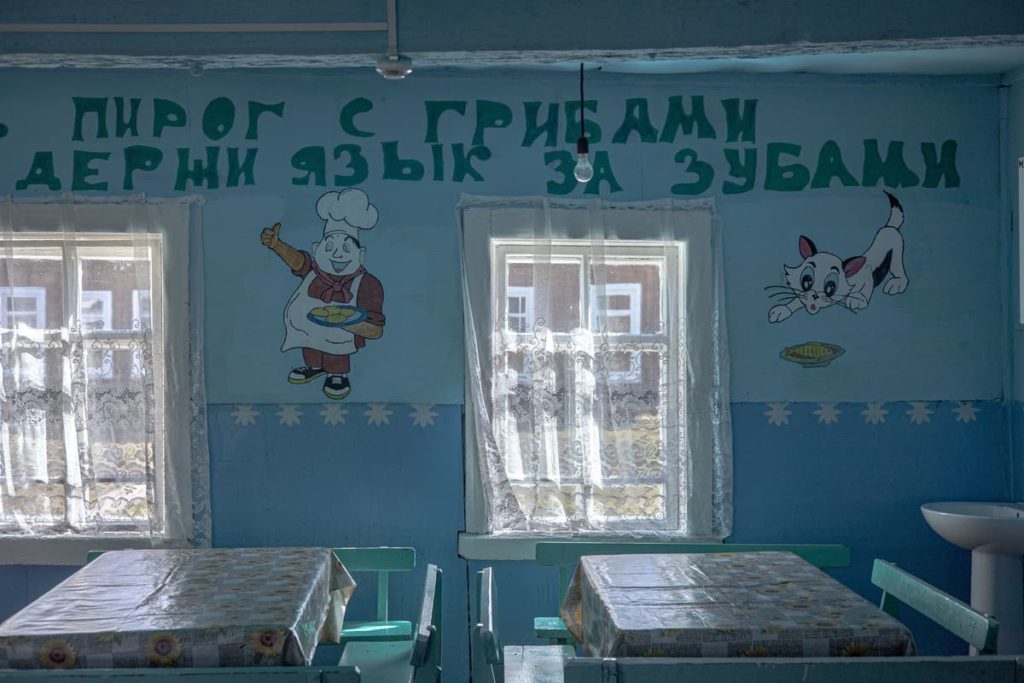
Schoolchildren are fed in the dining room according to standards. For example, on November 30, borsch was given borsch on meat broth, meatballs, pasta and cucumbers salad. Of the 39 students, 36 people eat for free: 18 like primary school students, the same amount as beneficiaries, from low -income and large families.
"We have no shamans, no deer"
The school has ten teachers. Most of them teach several subjects at once. Nadezhda Markova is engaged in younger schoolchildren, and also leads lessons in chemistry and fine art. Natalya Dorofeeva teaches history and geography. Director Tatyana Stanilovskaya teaches physical education, technology and Evenki.
“I have a dad Evenk, and my mother is Russian,” Stanilovskaya said in an interview. - [Evenki] I first studied at school, and then I began to learn by dictionaries. A relative comes to us who owns colloquial Evenki and helps me. I write words in a notebook behind him. Now I can speak almost freely.
Now Evenki at school is taught once a week in a special course format. Stanilovskaya says that this is not enough. “We can’t say at all,” she shrugs. “And there are parents who are against learning the language - they say why it is.”
In Evenki, units speak at the top of the tuture-mainly older people. Residents themselves emphasize that "there are almost no clean Evenks." Olga’s husband Andrei Nupreichik calls himself a “half -blood”. “My mother is an Evenk (that is the name in the village of Women of Evenki nationality - LB) , and dad is Belarusian,” says Nupreik. “And so almost everyone.” His son-in-law Andrei Kornakov adds: "Yes, according to the documents we are Evenki. But we have no shamans, there are no deer, only the old people say in an elegant. Here we are Evenki."
Locals want their children to study not Evenki, but English: it is believed that he can come in handy in life. But with English teaching is a problem. “Previously, the girl led, and last year she left for Irkutsk - she got married,” says Olga Kornakova ’s mother’s mother. “Teachers from Buryatia promised, but she did not reach. I see, looked on the Internet how she lives here and got sick.” “It’s hard to find a new teacher,” the school principal Tatyana Stanilovskaya confirms. “Not everyone will risk coming here.”
In Soviet times, the Evenks were given quotas: after graduation, one could enter the institute for a medic or teacher. The benefits have not been acting for many years. And young inhabitants of the top-tuture who graduated from universities can be counted on the fingers. The head of the local outpatient clinic, Marina Zueva, says that he cannot choose a replacement. She worked in an outpatient clinic for 25 years and wants to leave in a few years. “But we all fail biology and chemistry. And most importantly, the children do not want to be doctors,” Zueva shrugs his hands.
“I do not want to study,” one of the top-tuture high school students argues. He asks not to call his name. - From the first grade, they taught me to shoot at the banks. I already went to Sobol with my father. Well, what a biology with chemistry to me! I want a gun - and in the forest. Pulls.
- Do you want to learn English?
- Who should I say to him with? With dogs?
"In Russia, I respect the President of Russia"
Tatyana Stanilovskaya, showing the school, first leads to the history office, he is a museum. Behind and on the side sides of the cabinet hang and stand exhibits: deer heads with horns, amulets from beads, scrapers for dressing skins, hooks for hanging packs. At the school board - a portrait of Vladimir Putin, to the right of him are hunting skis, upholstered in fur. Under the portrait of Putin - an application in the form of a birch. On the birch - paper leaflets. On one of them, it is written by children's handwriting: “In Russia, I respect the President of Russia,” on the other: “I am proud that Russia is proud, and bold and fair.”
Since September, the school began to raise the Russian flag and conduct "conversations about the important." On raising the flag, children line up in the corridor: there is no more space for this. Near the technology office there is a small flagpole, nearby - a portrait of Putin and printed words of the anthem of the Russian Federation. Teachers bring a column and include a hymn from a mobile phone. “At first, the children smiled, did not understand [why it is necessary],” says Tatyana Stanilovskaya. “But everyone is watching the TV! Now everyone perceives, everyone is singing, the text learned.”
"Talking about the important" also go, but, as Stanilovskaya notes, "we have not talked about Ukraine yet." She says that she fulfills all methodological recommendations. True, it is not always possible to show schoolchildren about the day of folk unity or symbols of Russia: the school has a very low Internet speed - 256 kbps. This is enough to check the mail. But showing a video from the site is impossible. “We have to download it in advance, but it doesn’t always work out,” says Stanilovskaya. “But nothing, we get out. Children perceive normally. Patriotism is needed.”
Tatyana Stanilovskaya’s sister - the director of the rural club Vera Khorishchenko - also stands for patriotic education. In March, she held a car racing in support of the "special operation". Ten "Buranov" - snowmobiles on skiing drove along Lesnaya Street. At the wheel sat adults who brought schoolchildren, in whose hands were Russian flags. The "Buran" made a circle, and then stopped in the center of the village. The children put down the flags and took out the posters: “For the President”, “We don’t throw our own”, “For Russia”. Then they were built in the letter V. "The children really liked it, all of all the brushes were blundered!" - exclaims the director of the rural club Vera Khorishchenko.
Vera is glad that money was allocated from the budget of the Irkutsk region to support the city of Kirovsk in the LPR. They restore the damaged at home, repair schools and kindergartens, build new sports grounds. The Government of the Angara region refuses to call the amounts of costs. “The same Russians live there [in Kirovsk],” Khorishchenko is sure. “And who will help them, if not we? I am ready to wait.”
Parents of students call the school at the top of the tuture "rotten and orally." Residents were promised that in 2022 they would begin to build a new school building. “But they never started,” said Director Tatyana Stanilovskaya. She does not know what is the reason that the construction has not begun.
Last year, the roof was completely replaced at the Vershino-Tutur school. But neither the teacher nor the parents are happy with this. “If we have been made a new roof, they will no longer build a new school,” Tatyana Stanilovskaya shares the general opinion. “Maybe even never.”
The Russian authorities blocked our site. To continue to read the publications of Siberia. Realities, subscribe to our telegram channel .