
Translated material
"I'm in chats at 17 hours a day"
In 2022, Petersburgers joined refugees from Ukraine. Since spring, tens of thousands of residents of Mariupol and other occupied territories drove through the city. Many fled from the basements and burning apartments without things and documents.
Most refugees went to Petersburg to further cross the land border with Europe. The city authorities did not provide for any help for them. The entire load of work - the organization of overnight and nutrition, the purchase of tickets, restoration of documents, the search for things - lay down on volunteers. They created a group of assistance that is still valid.
“Paper” spoke with Petersburger Christina Enotova, who helps refugees eight months about how this experience influenced her life.
About motivation
-Is your main work somehow connected with the help of people?
- Absolutely not. I am an engineer in a private company. Still an engineer, although it is strange that I have not yet been fired - a look at what is happening is completely different.
I always thought that the environment of techies is more logical, such people seem to be better in analysis. But the analytical abilities of those who surround me at work are upset, they try not to notice many things. Their position, their nothing, their perception of reality disappoints me. Therefore, of course, they do not know what I do. But they notice that I am constantly on the phone.
- Have you been engaged in volunteering until February 24?
-A little with animals, with the organization of events, with children or master classes. Sometimes I prepared food for someone deported. A little bit, but often. So it was six years old - now I am 30.
I realize that I always seemed to be the most: in school and university years, I was an elder, the captain of some teams. So now I can’t even call volunteerism an active life position - it sounds stupid when you are this since childhood.
- When you understand what you want and can help refugees from Ukraine?
- The beginning of the “special military operation” greatly affected my emotional state. I learned about her when I was driving to work - I leafed through Instagram, I constantly opened it, and the other day I could not remember the password. And she climbed to the appeal of the Ukrainian president.
At first I just didn't understand. I thought: “Yes, there was a conflict in the Donbass. It is so developing, apparently? Some new stage? " But during the day it became clear: this is something completely different.
Then I immediately realized what would happen next - and could not realize why the rest did not understand. That nothing will never become. There will never be relations between countries and people as before. And they will never relate to me as a citizen of Russia as before. And all the sanctions that then happened - the departure of companies, the closure of borders - no longer surprised me.
So the 24th I was in total horror. During the day, I realized that this feeling does not pass, and the rest in transport, at work - it does not appear. And I began to think: “Maybe this is something wrong with me? Maybe I'm overdoing? " In the evening we met with friends a rather large company. And I realized that I am not the only one. That not for me alone is horror and trouble. What else can someone look at tomorrow and see that everything is very bad.
- Does your family have the same position?
- I do not have a very big family. I had several conversations with older relatives about what was happening. Their theses in the spirit “if we had not started, they would start” unacceptable for me. Actually, we quarreled several times and no longer raised this topic. They also do not know that I help refugees.
In February and March, until I came to volunteering, I keenly felt that I had nowhere to use myself. It was a difficult period, because ordinary things became completely unnecessary. I could not change the overall situation, but I really wanted to stop being an object. I wanted to become those who are changing something.
My friend called me to help the refugees - almost everyone comes so, through friends. And from May 1, for eight months, every day I will coordinate volunteers and refugees.
In chats, I am an average of 17 hours a day. At the end of August, in September and right now I feel that I can’t cope. I find out some new facets of my burnout: at times I feel that I am tired of eating, tired of looking at the phone.
- Can we say that all this is based on guilt?
- No. I survived this feeling, as soon as I began to do something. There was simply no time left for him. This is a cool sensation: all the lyrics and reflection are fading into the background, because you have business, business and business.
Feeling guilt is justified when you could do something. It seems to me now that I could more, but not in the circumstances that we had until February 24. It was necessary to be a seer to understand that we must somehow act.
About St. Petersburg volunteers
- Who, as a rule, comes to help refugees?
-It is difficult to describe some kind of social portrait. Unless there are more women. And of course, there are a lot of those who used to be familiar with each other - it all acts at the expense of sundress radio.
We are a horizontal community - people of completely different specialties, views, ages: from 18 years to 60. There are those who have many friends in Ukraine who are half Ukrainian or married to a Ukrainian. There are those who have no one there - like me. We are very, very different people who have united a very unusual reason. This is such a web that converged at one point.
A common feature is perhaps sympathy. Reflection, empathy. What is called emotional intelligence.
We, volunteers, do not know everything about each other. It’s like work colleagues - not everyone is delighted with each other, and therefore not close, this is normal.
- All these people are in Russia?
-Most lived in Russia, but now someone has left-they started long before mobilization. The rest are scattered in different cities. Someone plans to leave, someone is not. I'm not. It is difficult to say from what reasons. Dementia and courage.
- You mentioned different views. This also applies to political views?
- There is no political subtext in our activities. We are people who help people. Out of politics, leaving, outside the policy. This is a cornerstone. The political conversations of the wards with the people in whom they spend the night with us and even among themselves are not welcome.
There are admins and moderation in chats - everything is like in any decent chat. If a policy pops up there, which is not happening so often now, it is ruthlessly modified by the admins. Even the streamlined hints in the style of "here are", "here they are."
Sometimes there are attacks of bots that reposts something from other channels. Often these are Arab bots - I do not quite understand, however, why. Sometimes people are in stress-after all, everyone is getting tired-some kind of statements that contradict the rules begin to do. Then just ask you to change the subject.
Volunteers can discuss politics, but exclusively in private conversations. This is very strict, because we really want to continue to help and do everything in accordance with the laws of the country in which we are.
-Are you scared for your safety due to volunteer activity?
- It is not forbidden to help people. When I begin to fear some things, I remind myself all the time. What can I do so that it is still possible? To call things as they order me to call. Do not discuss things that they order me not to discuss. Well, there are trifles.
- Do you have conflicts in the community?
- There are many of us. To be effective, we have to discard all the conflicts that lie outside the goal. There were no conflicts with the transition to my memory - basically these are ordinary volunteer disputes on how to cause good. We are too different people, so it’s hard for us to argue. Like everyone, we pass through different stages that are characteristic of horizontal community - I like to call us such a word.
- Does such a difference in the background at the climate inside the Commonwealth affects?
- As a rule, this is a supporting atmosphere - you can pierce if you get tired. If you did something good and you understand that you are well done, you are unlikely to want to conflict with anyone. Therefore, everyone is usually praised - we understand that we are cool.
About tasks
- What exactly are you doing?
- Basically, my work is "tie the threads." As a rule, people who need help do not know at all where to get it. Imagine: arriving refugees need tickets. They do not know what the Russian Railways website is - instead of this one can be called any abbreviation, the effect will be the same. And I understand where you can see the tickets cheaper and how to get to the desired station. So the range of tasks is very basic: to help come, leave, find things or a suitcase, if necessary, and a place for an overnight stay. For those who are not going to stay in St. Petersburg, this is quite enough.
For those who live in the PVR [in Tikhvin], for example, the needs are slightly different: food, medicine, more stationary things are corny to find and convey a vegetable grater. Naturally, we do not provide All-Inclusive, we just help until people have issued documents.
This is generally a rather complicated process, and in St. Petersburg everything works even worse than in the regions, which is strange. The bodies specializing in refugee support are very little explained, and payments (in addition to benefits for certain categories of refugees who received the necessary documents, the state promises a one -time payment of 10 thousand rubles for each - approx. “Paper” ) do not come as quickly as in the provinces.
There are very special cases: for example, people may not be able to use the phone or express emotions with text.
Requests are very different-some think that we are sponsored by the Red Cross or United Russia, so you can ask for something more briefly. But we have no sponsors, so it remains to be calmly explaining that we cannot offer another option.
- Do you remember your first experience with refugees?
- Certainly. I was worried if they would want to interact with me at all. But everything went very well - I was worried, they worried. It was a family of three: mom, dad and son. Their suitcase was torn - we found a new one. We had some sedative conversations: I tried to convey that everything was fine, that no one would leave them or offend. Just a human conversation. They successfully left St. Petersburg - either to Germany, or to Estonia through Narva.
And in parallel, I had a young couple with two cats. They also left - now in Ireland. Trying to get a job, they have issued benefits. They live in an apartment and already work - it was difficult to get a job, but now everything is going well. I correspond with them sometimes.
- What is the situation on you the most difficult emotional imprint?
- Specifically, I was lucky, probably. I have a short memory in this regard - I try not to remember the bad. But it is unpleasant when they are deceiving. When people have money, and they ask you something. Not because it is my money, but because it is the money for which I am responsible. And because I could help someone else on them. This is unpleasant. It’s not a pity for finance, they are just limited: in the first months there were people who went without anything that were.
If not about my personal experience, I know a lot of bad stories. Many people cannot cope - mainly remaining in Russia - with PTSD. We still have no ability to live injuries: to go to a psychologist, to engage in introspection.
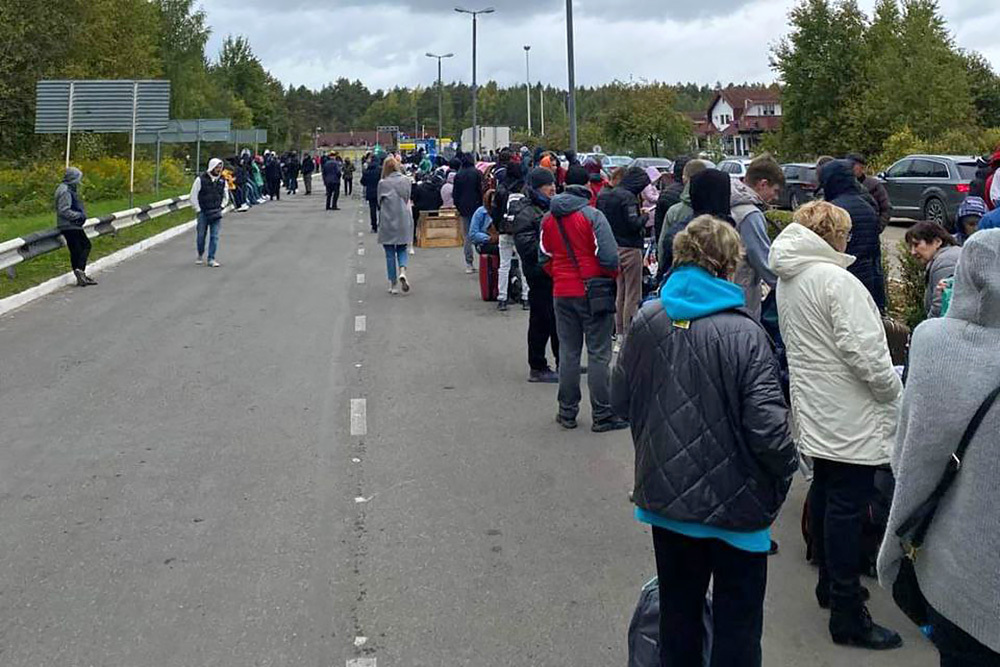
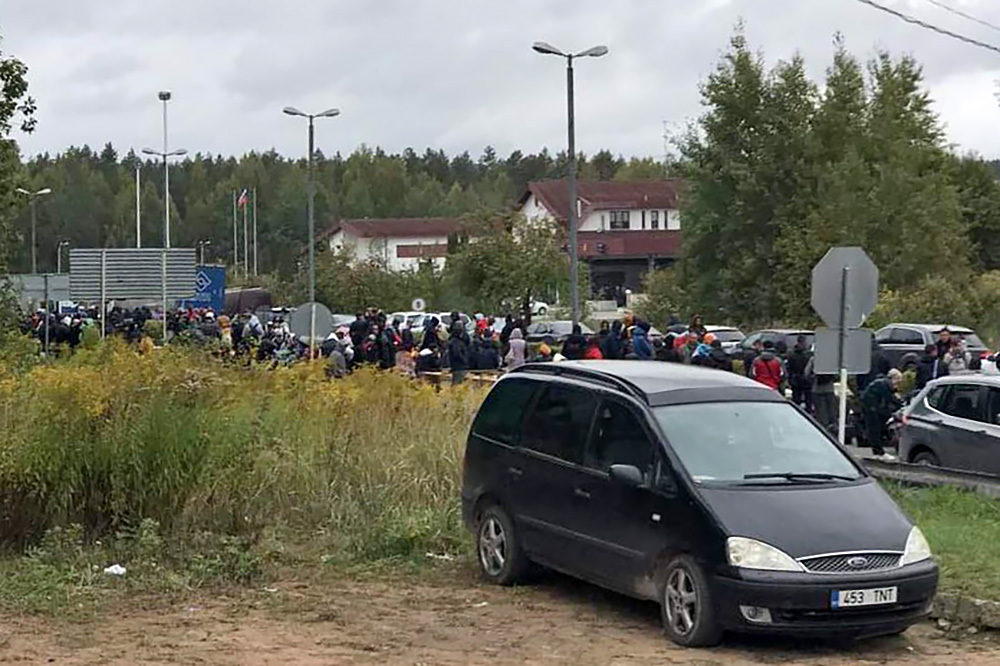
September on the border in the Pskov region was also very traumatic. They stopped missing people there. As far as I know, two people died there (on October 1, volunteers wrote with reference to refugees that two women died in lines - approx. “Papers” ). This was not officially confirmed, but I have no reason not to trust the people who live there. For me, it was a very great shock, as well as the fact that they were silent about it. The inability to recognize your mistakes is very typical for the official organs.
- And which case is the most valuable to you?
- I have two. When we took out a family with a child, a cat and an unsuccessful grandmother. We were able to drag her through all the borders - on the hands of the family, but we organized the entire transfer. And they managed to shove the stroller onto the plane, although it did not go through the dimensions. Successful medical cases are always complex, but pleasant.
Well, the second ... Refugees with many volunteers cease to communicate, because we give little information about ourselves. We are nobody to them - "thanks, goodbye." Yes, and they are simply not up to us, we are used to sitting on phones. Therefore, the most valuable stories for me-when some kind of communication continues.
I helped one Kiev woman: she is within 30 years old, she got to Europe with her wonderful cat. She initially did not know that I was from Russia and I was also in Russia. I was terribly surprised - I even thought that she would refuse help, in fact, had the right. But she asked: "Why?" I explained to her: “Because it is important to me. Because people need to help. ” I so remembered her surprise. We are not only what they say on the TV - at least one, even from the other side. Not everything, as they say, is so unambiguous.
She did not refuse help then. Moreover, she asked if she could communicate with me after the help is over. I realize that not all Ukrainians are ready to communicate with me as a citizen of Russia, who is not going to leave here. Therefore, such situations are especially valuable to me. By the way, she did not stay in Europe. She left back to Kyiv.
About the results of the year
- How many people have you helped in a year?
- There is an approximate figure. The total number of applications is a dozen thousand families. The application has an average of three people: we have a gypsy camp, there are 30 people, but there are people who leave one at a time.
It is difficult to calculate how much it is for applications from the remaining, because their requests for help do not end. Now we have introduced clear rules on the volume of assistance. If people decided to stay here, they must equip their lives themselves, draw up documents, look for work - our resources are not endless.
- What volunteer care is still missing in St. Petersburg?
“Some fresh blood, because we have been the same people with us for many months.” Money is always cool. Probably, now, on New Year's Eve, I can say for the first time that we need them - winter in St. Petersburg does not contribute to the completion of good.
In general, help always needs help. We need people who can take to their house, take refugees from a point to a point, order products - a time resource is much more valuable. I am very grateful that for eight months of my work I have not had to look for help for longer than one day.
- What is the most valuable lesson that did you endure from the experience of volunteering this year?
- You have to live together. And agree. You can agree on everything if you want. I haven't endured a lesson yet. I will endure it when it all ends.
“Do you see some future with your Commonwealth, when will it end?”
- No. Everything is very different. Maybe some small groups will continue to communicate. But the reason for the unification is too specific with us. Nothing will hold, probably.
I don’t know what the help transforms into. She will clearly need some further. But what exactly and how to rebuild is still incomprehensible.
What else to read:
- "What have you done so long in Russia?" How Estonia refused to enter refugees from Mariupol. Interview with a human rights activist .
- The real results of 2022 for St. Petersburg and Russia. War, protest and crisis - in numbers .