
Translated material
In 2022, the authorities blocked more than 247 thousand Internet resources
During the year, the authorities blocked social networks, Russian and foreign media, VPN services, as well as already-familiar-links to anime, texts of prohibited songs, proposals for the purchase of sanctions products and articles with compromise for officials.
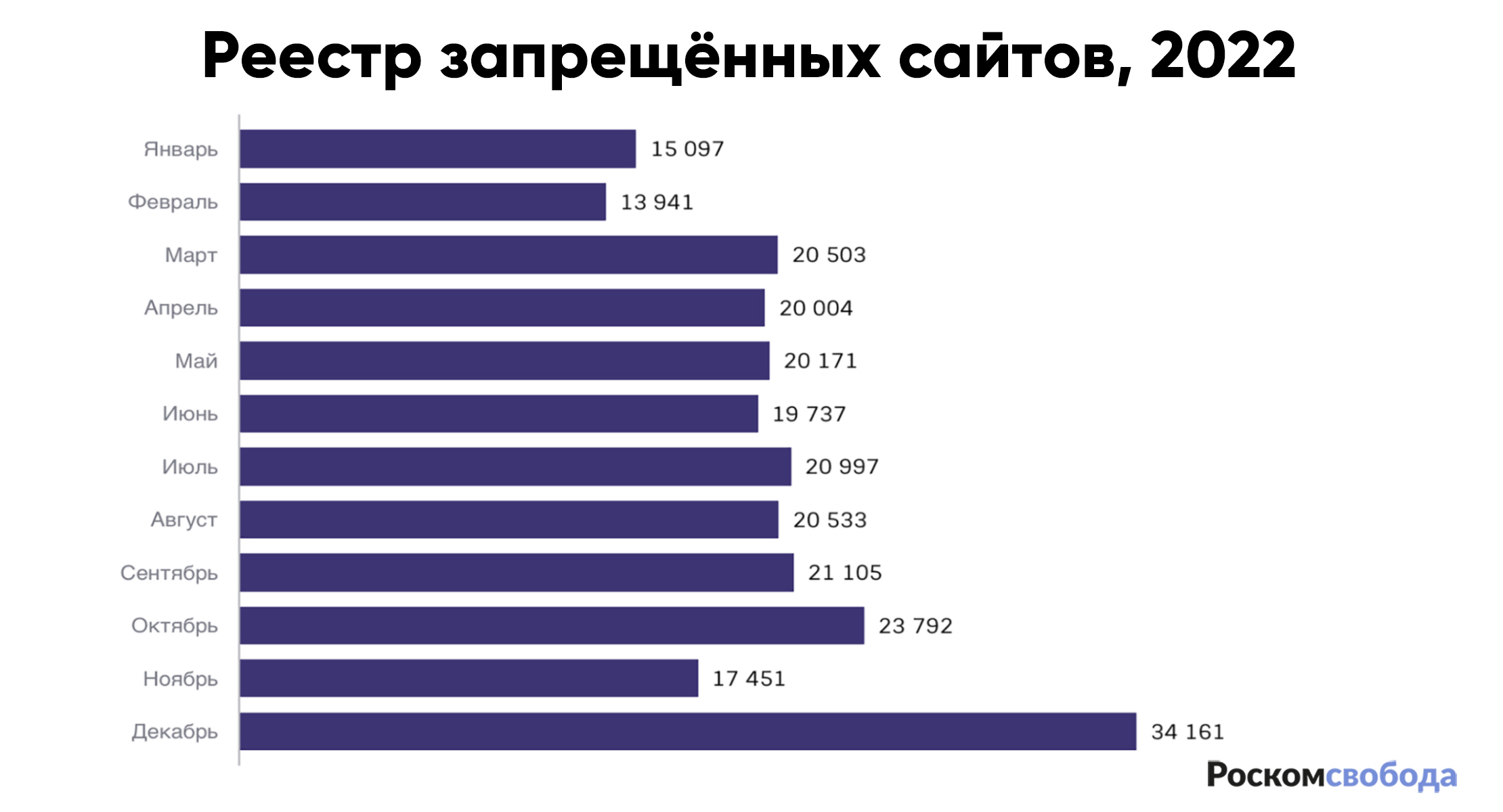
As of December 27, 2022, 247,492 links to sites or specific pages on the Internet were included in the register of prohibited sites in 2022. The most dangerous for the dissemination of information in 2022 were sites of independent media, human rights organizations and projects telling about events in Ukraine . For reasons of military censorship, at the request of the Prosecutor General’s Office , more than 9 thousand sites were introduced into the register (separately on this here ). In November 2022, we noticed that records began to appear in the register without indicating the body that demanded to make one or another site for blocking. At the same time, the motives for restricting access to such sites remain the same that the Prosecutor General’s Office has - the authorities found information on them, which can supposedly discredit or contain fakes about the actions of the Russian army. After February 24, such popular media as Medusa, Mediazon, Radio Liberty, Republic, DW, BBC, 7x7 fell under the ban on Russia. Horizontal Russia ”,“ Taiga.info ”, The Village, Doxa, etc.
In addition to blocking links and entire sites covering events in Ukraine, at the end of last year, a law was adopted that expands the powers of the Prosecutor General in terms of extrajudicial locks . The agency was authorized without a court decision to limit access to materials that contain “justification and (or) justification for the implementation of extremist activity, including terrorist activities”.
After the entry into force of the law on the ban on LGBT propaganda in December, the government introduced information that promotes non-traditional sexual relations, pedophilia and floor change in the list of content to make information banned in the Russian Federation on the Internet by decision of Roskomnadzor. This means that from next year even more locks associated with this kind of content are expected. Previously, individual sites and pages with LGBT Tematics were blocked at the request of Rosmolodezh.
In August, the Minzifra published documents, which proposed to endowing Roskomnadzor with the authority to block mirrors of previously blocked sites . The resolution will enter into force on March 1, 2023 and will be valid for 6 years.
Also in 2022 , the Ministry of Internal Affairsdetermined the mechanism for blocking sites containing personal data of persons under state protection . The Roskomnadzor was recognized as responsible for entering such sites in the register of prohibited, which will be obliged within a day from the moment the decision to declare the information is obtained and the decision to restrict the access to it to bring the corresponding entry in the register.
The deputies also proposed amendments to certain legislative acts of the Russian Federation ”, thereby endowing the Prosecutor General’s Prosecutor General to forever block the media for the dissemination of inaccurate information about the“ military special operation ”of Russia .
Journalists drew attention to the fact that since April, the media blocked in Russia stopped showing Russian search engines in the search results - these are Yandex, Mail.ru and Rambler. In Yandex, they explained this by the fact that the company removes all the links from the search results that Roskomnadzor brings to the register of prohibited.
Throughout the year, Roskomnadzor, courts and other departments that have the authority to limit access to sites on the Internet, continued their usual work.
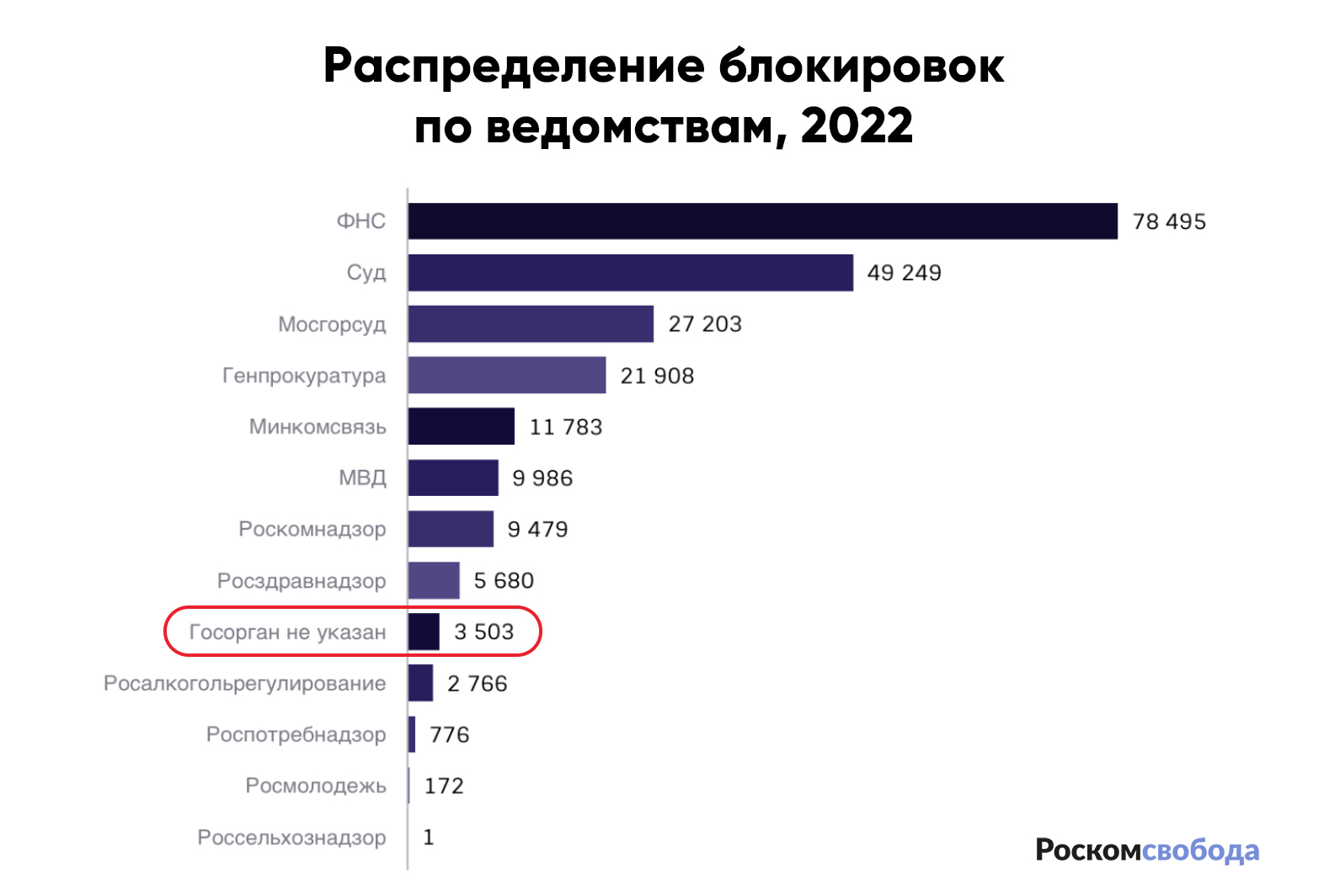
Forbidden topics, services and sites on the Internet in 2022:
- Sites with duck -in personal data of Russians
We are talking about Saverudata and Itarmy sites, on which the merged database from Yandex.Dera was posted, and then other services - Delivery Club, Wildberries, SDEK, Beeline, etc. The decision on the blocking was made on March 10, but they were entered in the register only on March 23, and then access to them began to be limited.
- VPN services
One of the first high -profile locks was the restriction of access to the Tunnelbear service. The link to it in the registry has been located since 2018, however, until January 2022, the Ghostbear option helped to access (Make My Encrypted Data Look Like Regular Internet Data) in the client’s settings. At the same time, the decision to block Tunnelbear was made back in 2017 by the Dyurtyulinsky District Court of the Republic of Bashkortostan. In June, residents of different regions of Russia began to report failures in the work of ProtonVPN and NordVPN, later a list of another 7 VPN services to be blocked was published .
- Sites of Ukrainian and other foreign media (military censorship)
Similar locks began since February this year, and the first to hit military censorship were the sites of Ukrainian news sites and portals, as well as the website of the Ministry of Health of Ukraine. The attention of the Prosecutor General’s Office attracted two links to materials from the site of the popular Ukrainian Internet telekanal “Gromadske” (“Public”). The department considered the materials posted on them as extremist, but it decided to send the site to the ban. Later, three large Ukrainian news sites touched in Russia: “Correspondent.net”, “Ukrainian Pravda” and the website of journalist Dmitry Gordon. Together with them, the same decision in the register made links to the site “Real Tephs”, the Ukrainian “Interfax”, as well as the portal with information about the losses of the Russian army. Later, the Ukrainian portals and media were made in the register of prohibited sites in whole packs, now the “Left Bank”, “Censor.no”, “New Time” (NV.UA), “Depot”, “Foccation.ua”, “Zahіdnet”, the Unified Information Agency of the country of Ukrinform, Uainfo and others are banned.
- Compromant articles for officials and articles about bribes
For example, materials about Alisher Usmanov, while on some blocked sites, the court decisions were made back in 2018 and 2020. The link was prohibited by the article about the bribes “you won’t be allotted - you won’t go: how to give it to the“ paw ”.” At the same time, the material itself was a reprint of the article from “Inosmi”, which, in turn, is the translation of the analytical material “How to Grease a Palm” The Economist British weekly. A comic article about bribes blocked by court decision was also included in the register of prohibited. At the same time, the prosecutor’s office of the Arkhangelsk region applied to the court with a request for blocking, and the same material has already been blocked earlier on other resources
- Cryptmnings and sites about cryptocurrencies
One of the most popular FORKLOG sites and cryptocurrencies in Russia was included in the register, later its additional domain. The decision to block was made by the Prosecutor General, which means - due to military censorship. In August, crypto exchangers and sites also were banned in Russia, which talked about how to exchange Bitcoin for rubles blocked by the Saratov court in the lawsuit of the district prosecutor's office.
- Services of secure email
So, for example, the German cloud and postal service Eclipso was blocked. He was introduced to the register at the request of the Prosecutor General’s Office, which means that the department discovered extremism, calls for riots or “discrediting the Russian army”.
Swiss security postal service SWISSCOS.Email was also prohibited. As in the case of other locks of postal services, the Prosecutor General’s Office initiated, apparently, due to messages about false mining.
- Sanctions cheeses, hamon and other products
On the complaint of the Khabarovsk transport prosecutor’s office, 9 links were made to the register of prohibited sites, by which Russians could acquire various types of Hamon. Another 7 references to proposals for the sale of cheeses, Hamon and Spanish sausage were blocked at the request of the raildog of the district court of Orel.
- Anime and cartoons
According to the “rubber” decision of the court, 15 links to the “Titans attack”, “Hell Dante” and “Inuyashiki” fell into the register. In addition, Kaliningrad joined the regions in which the courts are considered their duty to protect Runet from the dangerous influence of references. There, by decision of the court, 13 more links were blocked on the anime “Cosmos: Death Territory”, “Hell Dante” and “Cats Paradise”. The courts continued to make decisions on the blocking of references to the previously banned anime and cartoons: “Happy Forest Friends”, “Prince of Darkness from the back desk” and “Magician Magician. New start ". Another 170 links on the anime “Sayuki: reloading: Zeroin” was blocked at the suit “OKKO”.
- Songs, lyrics and clips
At the beginning of the year, links were included in the register to phonograms and texts of previously banned song Morgenstern. In January, the Ministry of Internal Affairs entered the register at first 4 links to the song, then twice added a few more links to resources to this list. In some cases, since the blocking was carried out according to HTTP, entire sites turned out to be blocked. We are talking about the song “Pink wine 2”, for which earlier the musician was fined 100 thousand rubles under an article on drug promotion.
Later, the Bandcamp music platform site was blocked for placing the songs “Armate!” Anarchist punk group "Brigadier", previously entered in the register of extremist materials. The song “Columbine” of the rappers “Zamay” and “Glory of the CPSU” at the request of Rosmolodzhi also fell under the ban. In addition, the lyrics of the song of the punk-group “The Orgasm of Nostradamus” were prohibited. The court and the prosecutor’s office in Krasnoyarsk formally approached the case, having accepted the absurd text for a real call for the reprisal of the young generation.
- Links to materials of organizations recognized in Russia as undesirable or extremist
Since the beginning of the year, the authorities have continued to fight the publications of investigations of Navalny and the FBK. Roskomnadzor sent the publications a letter demanding to delete publications in which it was about the film “He is not Dimon”, materials about the Palace of Vladimir Putin, the apartment of the head of “Rostec” Sergei Chemezov on Manezhnaya Square, the dacha of Roskosmos Dmitry Rogozin and other officials. The receipt of such a letter was confirmed by “Medusa”, “Rain”, “Echo of Moscow”, “Free News” (Saratov), “Very” (Magadan), The Village, “Paper”, Znak.com, Tjournal and Republic. Also, a FBK donation page, pages with Navalny’s investigations about the Simonyan-Koosayan, deputy of Slutsky and Vladimir Solovyov fell under the ban. Everything is one decision of the Prosecutor General. Later, 7 more links were included in the register with a reprint of materials that concern Vladimir Putin, Dmitry Medvedev and his wife, Vladimir Yakunin, Vladimir Solovyov, as well as information about how they had a public outcry.
- Sites of games and various services where there were appeals to readers regarding events in Ukraine
So, for example, the site of the popular computer game Stalker 2: Heart of Chornobyl was blocked . On it, the Prosecutor General’s Office discovered the appeal of the creators of the game to fans and subscribers, which said the condemnation of the so -called “military special operation”. Also, since April 2022, one of the most popular Chess sites Chess.com has been in the register. The attention of the Prosecutor General’s Office attracted two articles: one of them spoke of the site’s policy in connection with the “special operation” conducted by the Russian army, in the second - about Ukrainian chess players and the events that occurred with them.
- Links to podcasts
The podcast of the Russian BBC service “What was” was blocked at “Yandex.Musik” was blocked. The podcast itself was removed at the request of Roskomnadzor, which in turn relies on the decision of the Prosecutor General. The sites of the BBC themselves and the “Russian BBC service” were previously blocked in Russia for the coverage of “special operations”. Also, at the request of Roskomnadzor, Yandex.Musik blocked the podcasts “What happened”, “Text of the week” and “Signal” from Medusa and the Podkast “Quote of Freedom” from Radio Liberty.
- Links associated with LGBT Tematics
For example, the Nuntiare et Recreare site dedicated to believers of LGBT representatives of various religious and confessional affiliations, as well as the website of the LGBT Museum in Russia. They were included in the register of prohibited at the request of Rosmolodezh. After the adoption of the Law on the ban on LGBT propaganda and entering this information in the list of prohibited to disseminate such links in the register will be more, and there will be to limit access to them, including Roskomnadzor.