
Translated material
"The music of propaganda says:" You are part of the team. You are good ""
The clip for the song “I am Russian” by the performer of Shaman on Utube was watched by more than 22 million people. For Russian musical propaganda, this is a rarity, notes the musicologist Anna Vilenskaya. She studied the music of Nazi Germany, the USSR and North Korea, as well as modern Russian patriotic songs.
The researcher told the “paper” how musical propaganda affects a person and what the music of totalitarian states have in common.
Anna Vilenskaya
musicologist, composer, creator of the "Open Musical Lecture"
- What to consider musical propaganda?
- When I am talking about propaganda music, I primarily mean the music in which a certain view is broadcast, which is supported by the authorities. I will give an example. Noize MC wrote a song about the rain of the rain and describes in it his feelings from the loss of the homeland. He sings on his own behalf, as he feels. At the same time, people choose whether to “buy” this music or not, to support it or not.
The music of the popular artist Shaman is also presented as an author's look. At the same time, he first finds himself on the program with Andrei Malakhov, then suddenly on Red Square next to Putin sings the anthem of Russia . In fact, his work is "promoted." It turns out that musical propaganda is not a specific genre, but a situation in which author's music is actively advanced and served as universal, popular, state, sacred.

At the same time, the authorities do not order music directly. There is no such thing that they take the author and give him a task: "Write this and that, using such words." At least I don't know about this.
- Why can we compare the musical propaganda of different eras?
- Unlike political scientists who often do not want to draw historical parallels, such parallels can be carried out in music. Firstly, it is safe. Music does not affect society as much as any political factors. Secondly, the time over art is less powerful. For example, a century ago there was no Internet, smartphones, but music influenced a person about the same as now.
- When does the state need to use musical propaganda?
- I studied the music of Nazi Germany, North Korea, the Soviet Union and modern Russia. In Germany in the 30s, the state was engaged in music specifically, in detail and professionally.
If you read Soviet musicology textbooks, they will say that in the 18th - 19th centuries, German music was great, but in the first half of the 20th century Nazi Germany killed the whole culture. This is not true: the opposite took place.
Goebbels led the musical imperial chamber, the purpose of which was to make music more diverse and professional. In fact, it was such a trade union where the composers allocated money to write great German operas. He arranged musical events.
In the film Romm “Ordinary Fascism” shows one of such events where the Germans together eat soup, drink beer and sing songs, and this unites them.
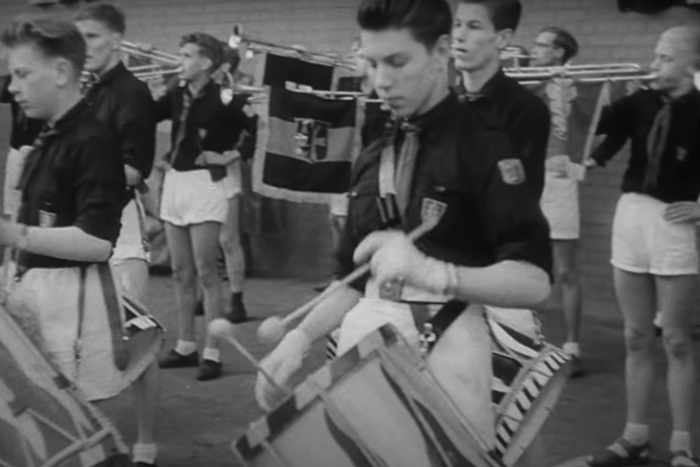
All the music, which the state used then, was divided into two types: German author’s music, for example Wagner, and folk music based on German folklore - folk dancing, which later became military marches. Both types are associated with the idea of community, association. If this is a dance, then we dance it together, if the song - we sing it together, if the opera - we are affected together.
In the Soviet Union, the situation was different. The main task was to replace folklore with something new. In the 30s, when the Russian village was destroyed, folklore, in fact, ceased to exist. Around the same time, a certain updated folklore appeared, which was based simultaneously on Orthodox chant and hard labor. But this was supplied, of course, in a different form, and the form changed from lyrical to more march, choral. The task was to encourage action.
- And in North Korea, the musical propaganda has a task?
- It is interesting here. Ekaterina Shulman, telling how the authoritarian state differs from the totalitarian, says that the authoritarian encourages everyone to inaction, and totalitarian to action. In this sense, the music of Nazi Germany and the Soviet Union is totalitarian, prompting action. But the DPRK songs are different.
Musically in them is very few people. It is very difficult for them to sing along, and they encourage more inaction. That is, they act on an authoritarian principle. There is a feeling that a certain leader says, and you must listen to him and not interrupt. No choral inserts, no dance, and judging by numerous videos, people are mostly sitting at concerts in North Korea.
- What is musical propaganda in modern Russia similar to?
- In modern Russia, the authorities, apparently, do not understand what they want. There is no general party line. It feels like this is a circle of amateur performances, in which they tried it, tried it: rap , “ blades ”, lyrics , imitation of folk songs . All this is extremely motley and calls for different signals, but in the end it does not call for nothing. And thank God.
There is an exception: Shaman songs are good music. In the sense of well done. It sounds very European, there is nothing folklore or thieves in it. The chords in it sound with a certain drama. This is not the music of the Soviet -type march, it is a European spiritual story.
- If a totalitarian state does not order music, then where do the templates come from?
- Creating a technical task for the composer is insanely difficult. Of course, in the Soviet Union, composers raised the question of whether this or that music was enough, but each time they faced the fact that it is not clear in which categories to reason.
Usually the state acts smarter. The authors themselves look at what happened, what they liked, what they approved - this is how the templates are formed and the narrowness appears. I imagine this in the form of sand, which is poured with paths, trying the directions: "Yeah, here not very, here is not very, but I liked it so much." Meanwhile, the intermediate stages disappear in which there was a place for experiments. “Mandatory elements” appear, as in Soviet music from cinema, Soviet marches or Soviet children's songs.
- Why don't people resist monotony?
- There are three links: society, composer and a certain customer. Society forms a request, but cannot formulate it. In this case, an emphasic composer is required, who can feel this request and respond to him with music. In turn, the customer-business or state-must feel that the composer is doing something right, and help him get monetization and popularity.
Society cannot give an unambiguous answer whether the music turned out or not, but overall tended to be grateful to any music that he receives. When diversity arises, it can say: "Oh, how cool." And when it disappears: "It used to be different." This is a maximum of possible assessment.
- WHAT ABOUT WHICH MUSIC IN THE RUSSIA THE RUSSIA?
- Russian modern music consists of several layers. The first layer is the musicians who left for exile. For example, a coin or noize MC. There [in their music] there is no censorship, self -censorship, and basically it is thematically connected with what is happening. It is written for people who, perhaps, also went into emigration or who feel lonely now in Russia, and it exactly corresponds to their request.
The second request comes from people who are difficult to contact with this reality. They need to understand that everything is the same as it was. For these people, music is written, which pretends that nothing is happening. For example, if you collect the best hits-2022 in Utube, you will see quite a lot of new songs there, which are written in a very different way.
And the third layer is the music that Russian propaganda creates. It is for those people who cannot pretend that nothing happens, but they need some supports to understand what values they have and that there are people with the same values.
- What is in common with the music of totalitarian states?
- Music should solve the existential problem of a person that psychologists formulate as “I and the world”. Simply put, this is a fear of finding answers to the questions “Who is I?”, “Why do I think?”, “How can I live in peace if I do not understand anything? They spit it out into him, and then I will also die from him. ”
The answers to these questions are always individual. They depend, for example, on mental health, neurotypic, experience, age. And the music of propaganda is trying to give universal answers: “You are part of the team. You are good: Arian, Soviet man, “blood from the father”. And the world around is bad and you need to fight with it. ” In form, it is mainly marches or music, which is easy to sing along, which gives a feeling of community.
At the same time, cultural codes are used, elevating the nation, whether it be frets, chords or something else. This is exactly what is bad in modern Russian propaganda music - it is not clear which codes in it are trying to use. What do they want: the Soviet Union, Tsarist time, the nineties?
- When does the music of propaganda manage to survive the regime?
- If you divide the music roughly into two types: the music of simple genres and the music of complex genres, which belongs, for example, Strauss, then we will succeed that the music of simple genres dumps, and it remains complicated.
In the Soviet Union, for example, there were a lot of different music, but, in fact, the Leningrad Symphony of Shostakovich remained as the subject of culture. Because the music of simple genres is an emotional cast of the request of society at a particular moment, as if we had flooded and show it with gypsum, and the music of complex genres is already reflection.
-Will there be anything from modern Russian music?
- No, now this does not appear. There are people in Russia who make culture and make it cool, but they leave the country. I will not name the surnames, because not all left, but among the music that propaganda uses, there is nothing of the kind.
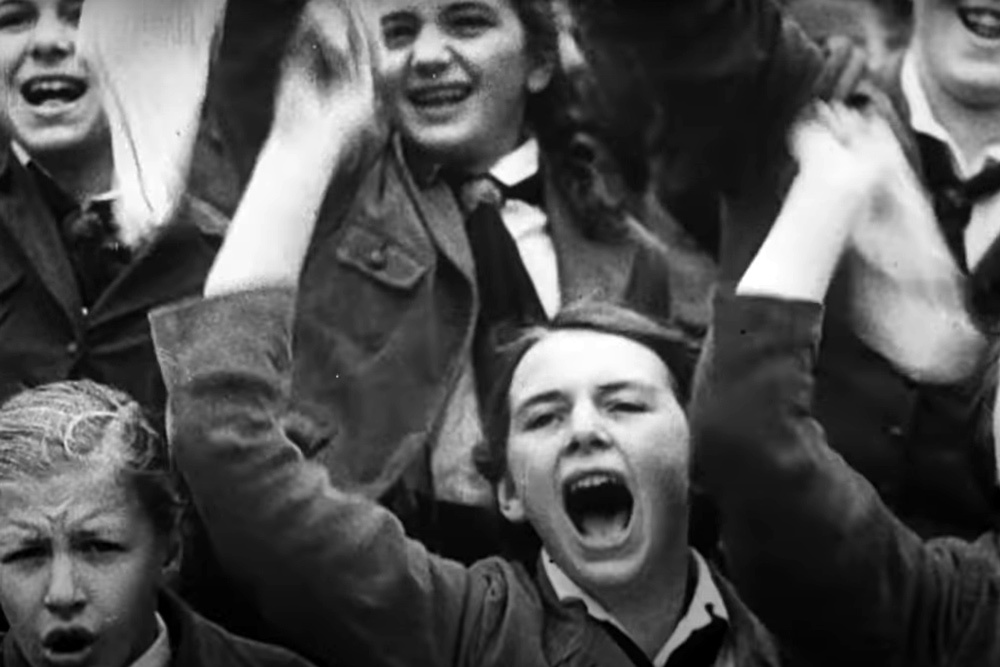
Photo on the cover: frame from the film "Ordinary Fascism", 1965
What else to read:
- Damned old house: 7 entities of Basevich’s house - the main abandonment in the center of St. Petersburg.
- Under the guise of "Orthodox PMC". As a billionaire, a priest and ex-policeman created express courses in St. Petersburg for those who wanted to fight.