
Translated material
"We have trapped with the whole class"
On January 25, 2024, Doxa was recognized as an “unwanted organization”.
If you are in Russia or plan to return to it, you can not replace our materials on social networks, refer to them and publish quotes.
Read more about what is possible and impossible, read in the cards .
“On October 3, the“ conversation ”was dedicated to the teacher's Day. This was the first lesson after “referenda” in the occupied territories of Ukraine. We needed to read a two -page text about “Russian World”, “eight years of the war” and the reunification of Russian cities, ”says a teacher of one of the Russian schools. Since the beginning of the school year, she, like other teachers, should conduct “talk about important” - mandatory lessons on patriotic topics that the Ministry of Education invented after the start of the Russian invasion of Ukraine.
We talked with three teacher_nitsi from different cities of Russia about how the school administration controls the program “Talking about the important”, why children in the lessons listen to the Russian anthem, and also how teachers play “conversations” on the guitar and still feel that these classes are “torture”.

Illustrator
Illustrator
Stasya BububuEditor
Editor
Author in tearsPublication
October 29, 2022
Maria*
Leads "talk about important" among high school students
I do not need these “conversations” at all and children from my class, too. I am very sorry for them. Having served six lessons, instead of rest and personal affairs, they should sit for another 45 minutes and listen to the lecture, the theme of which is “lowered from above”. I see nothing wrong with a conditional class hour, but only if he really can benefit students. I was lucky that my students at least remain in these lessons and we can talk about something. In one of the 11th grades, children simply do not go. The teacher remains with six students, and these poor seven people eventually sit and discuss some strange things. It seems to me that this turns into some torture, a very undesirable event for children.
We, teachers, find ourselves between the hammer and the anvil. On the one hand, there is a school administration that forces us to adhere to specific topics. On the other hand, schoolchildren who do not want to talk about these topics. And there are you, who does not want to do it at all
These classes spoil the schedule for us. There are quite a lot of university teachers in our school: they come, conduct couples and return to their universities. We have to look for where to squeeze the “conversations”. The school administration said that she understands our unwillingness to conduct these lessons, but there is nowhere to get away from this. What if the check will come? We were told that we are not obliged to use the materials that are presented on the site, but we must try to adhere to the topic. Teachers are trying to carefully approach "conversations." We say to the children that we have no right to occupy a certain position that they themselves form their attitude to different phenomena. Some teachers perceive these lessons as a circus, a farce. There are those who are ashamed in front of the children, and those who are trying to move away from manuals as much as possible to interest schoolchildren.
At the very first “conversation” dedicated to the Day of Knowledge, I read the stories “I want to be a janitor” about the desire to be a janitor and unwillingness to receive a higher education. After that, we talked with the guys our strengths and weaknesses, goals and desires. It turned out a rather therapeutic conversation. When the theme was a day of music, our teachers organized a concert for several classes. Teachers and children brought guitars and sang songs for 45 minutes. Everyone was just having fun.
On October 3, the “conversation” was dedicated to the teacher's Day. This was the first lesson after the "referenda" in the occupied territories of Ukraine. We needed to read a two -page text about the “Russian world”, “eight years of the war” and the reunification of Russian cities. First, we say that a referendum is the will of the people, free will, and so on. Then - that this is originally Russian territory, which was opened by Catherine II and which only 30 years existed independently. And in the final of the “Russian World” lesson, it is opposed to the Western. I did not read it. I doubt that one of my colleagues has become.

We talk about Russia's military invasion of Ukraine, protests and repression. We believe that now, when dozens of media have closed or ceased to cover the war, access to independent information is more important than ever.
When I spend “conversations about the important”, I have the feeling that we were trapped with the whole class. Sometimes I just turn on some film and watch children: they are engaged in their business, make homemade, sit in phones and, obviously, chatting in a class conversation, because they begin to laugh at one point. I have a feeling of involvement in something bad, I feel like an overseer who makes children sit in the classroom and does not let go home. At the same time, I am in the same trap: I sit and cannot leave, because this is my job. I can’t help but conduct this lesson. It happens that in anticipation of the call, I look at the time every five minutes. I feel that I returned to school as a student and sitting in the last lesson, waiting for a “saving” call. As soon as he rings, I feel relief. Finally you can go home.
“Talking about the important” is a kind of return to the Soviet Union. They want to scold everyone under one comb, having approved a single social thought. I did not live in the USSR, thank God, but my senior colleagues describe these lessons that way. This is all sad and sad. We are trying to develop the culture of individualism at school. Each child has his own schedule and curriculum. And the state tries to make them a society in which everyone thinks the same and knows the same thing.
I do not want children's education to be associated with a political agenda, because in this case both children and their parents will take the walk to school as a view of the propaganda channel.
Sophia*, Perm
Teaches the lyceum tenth grades
For me, “talk about important” is a way of the state to generalize, give schoolchildren a single idea of moral categories. Apparently, the Ministry of Education wants to strengthen control of children and take their education under their wing.
At first, many teachers have questions. Even before the start of the school year, on the website “Talk about the important”, lessons were posted until the New Year, they were far from humanitarian (better to say humane) pedagogy. Among them were frankly propaganda classes, which contradicts the law on education. At first there was a huge piece about the war with Ukraine and love for the homeland. I was shocked when I saw him. To the lesson “Our Country - Russia” was a video at the end of which were given the examples of “heroes moving the Fatherland forward” - military: for example, there was Magomed Baachilov, who participated in the Chechen wars on the side of the federal troops, as well as Andrei Dyachenko, who fought in Syria. Then all these topics were removed. Partly due to such plans, the Lyceum administration gave teachers freedom in conducting lessons.
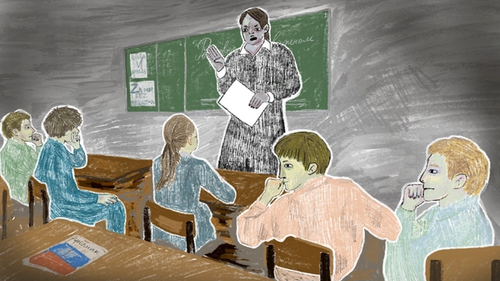
I believe that the very idea of “talking about the important” is quite cool. It is good when there is an extra time to talk with the children about what they consider important. It is necessary to go from what worries them, and not wait for the materials “from above”. I build my “conversations” from this point of view. Previously, we had a classroom clock, on which we talked about things of interest to children. And I, as a class teacher, watched the communication of children and in response shared my thoughts. Now it has become convenient that I no longer need to look for a window in the schedule for such conversations.
Before each lesson, I see the manuals from the site for “general development”. I am curious what we are offered to spend. Moreover, the content of the lessons is unpredictable. Materials are laid out for lessons on Tuesdays, six days before the lesson. In the telegram channel of the project, notes on the psychological climate in the class are posted. Recently laid out a podcast about conflicts and how to work with them. Also in the materials there are always videos on the topic. I never turn them on. I have adult children, and if I seriously try to put something like that, I will lose the trust that I have achieved for years.
Sometimes I take topics that they offer on the site, for example, I held a lesson in honor of the 165th anniversary of Tsiolkovsky. Why not talk with the children about the founder of astronautics? It turned out well with the "Day of the elderly. We discussed the phenomenon of old age in Russia. On October 10, the theme of the "conversation" was the day of the father. I did not conduct such a lesson, and even more so to speak according to the manual, because I realized that for many students this is a sore story. More than half of the class are children from incomplete families. Such a conversation would simply make children out of his temper, and then, imagine, they still have to study all day.
In conducting "conversations" we are free. The administration of my lyceum is quite liberal. We were asked to be kept within the framework of the topic, and choose the content on their own and adjust it to the class request
Perhaps in other schools differently: in terms of control, everything depends on the administration. She sets the tone of classes, the level of control, the regulatory design of the lessons. In addition, they pay us for these lessons, but in some schools not. But some teachers still refused to lead them.
There are good attendance in these classes. There is no sabotage yet, but children clearly have tension about these lessons. I am trying to gradually reduce stress and conduct them with maximum benefit for students. It is important for me to convey that “conversations” can be “not cardboard” and you can really arrange a conversation about the important.
If a lesson about Crimea appears in the program again, then I will approach it from a historical point of view. We will be able to talk about the history of the peninsula, about to whom he belonged and who lived on it, discuss Soviet documents, and what was still “confused” under Khrushchev. And then discuss what we came to today. Why do some say that Crimea is Russian, while others are Ukrainian.
Vladimir, St. Petersburg
Leads "conversations" in high school
It seems to me that the goal of “talking about important” is propaganda and patriotic education. At first, I thought that these lessons were needed in order to normalize the war in Ukraine in the eyes of children, but so far there was not a word about the war. Instead, rather interesting topics are raised: Tsiolkovsky, music - this resembles a general cultural class hour.
The school day begins at eight in the morning. Monday: Children come to school, we turn on the Russian anthem and listen to it . After that, we are informed of the topic of "conversation". Recently there was a day of father - so we are watching a video and presentation dedicated to the holiday. If there is time, we listen to children. They say what this day means for them. There are many interactive games in the manuals stylized under television programs “Field of Miracles”, “What? Where? When? ”,“ Who wants to become a millionaire? ” Children like this format. Methodological recommendations allow you to conduct a lesson interestingly and transfer the focus to culture, lowering the narratives of propaganda and war.
In general, so far there was no seditious propaganda at the “conversations about the important”. At least not the same scale as on the March lessons of hatred On March 1, classrooms were held in Russian schools, postponed by the war in Ukraine, the declaration of independence “LPR” and “DPR”, and also offered to read the article by Vladimir Putin “On the historical unity of Russians and Ukrainians”. .
It seems to me that the “conversations” were conceived as a horn of propaganda, but, faced with the hostility of the teachers, the Ministry of Education changed the format to the toothless, with addition to the anthem
It is difficult to understand how the teachers reacted to "conversations." Many perceived them as an additional load. Teachers are already overloaded. The children calmly reacted to the "conversations." It just appeared another hour at which the teacher says something. The only thing they are unhappy with the schedule: children do not like this lesson on Monday morning. Parents of schoolchildren are also not very alarmed by "conversations." They are much more afraid of due to mobilization: some fathers have already gone to fight to the front.