
Translated material
35 years ago, Soviet rock musicians performed the song "Closing Circle" on the "Blue Light"
This is how it looks from 2022: someone from that choir was declared an enemy of the people, and someone now supports war
One of the most famous Russian songs about friendship and unity - the composition "Closing Circle" Chris Kelmi - turned 35 years old. Today it is difficult to believe that all Soviet rock stars that participated in the records of those years could gather on the same stage: some Russian propaganda now represents the enemies of the people, others appear on patriotic Z-concerts. At the request of Medusa, the music critic Lev Gankin studied the history of the recording - and found out that Michael Jackson and Lyonel Richie, Garik Sukachev and Alexander Sklyar for the song “I Stay,” and the patriotic choir in the song “Standing” the SHAMAN singer, in common.
The New Year's “blue light” of 1987 was not similar to the previous ones: the program was reverse for as a kind of potpourri from musical and acting numbers, which were removed not one after another in one space, but literally where it was necessary - up to India, according to which Alla Pugacheva toured on those holidays. The finale came out unusual.
“Our airtime is running out,” her performer Sergei Minaev said mysteriously at the end of the song “Karina”, “that's why ... the last New Year's surprise!”
The picture changed sharply: instead of dancing under the perestroika Hi-NRG, a mysterious Chris Kelmi , sitting behind the piano, appeared on the screen. “Here is one of those stories ...” he started. “About whom people argue ...” - Alexander Gradsky picked up. The next five minutes, representatives of the Soviet rock scene, one after another, the line behind the line performed the composition “Closing Circle” of the Rock-Atelier group, Vede Kelmi. It was in this pathetic polyphonic version that it became a popular superchite (in addition to it, there were two more options- more chamber , performed by the main composition of the Rock-Atelier from the group of the same name, as well as instrumental , for the television program “rhythmic gymnastics”).
If, despite the patchwork structure of a particular issue, to perceive the “blue light” as a certain single conceptual action, then the solemn choir in the finale is a natural, even begging solution. The expressive power of the reception is obvious at least since the time of the “ode to joy” in the final of the Beethoven ninth symphony. Kelmi and Rock-Atelier also had a fresh opportunity to make sure how it works: the Lenkom Theater was the official place of employment of the ensemble, where the musicians, among other things, performed the Rock operator of Juno and Avos with its famous final “allluly” . Probably, one of the sources of inspiration for the New Year's television project was just Hallelujah, and the other two years earlier than the multi -platinum hit “We Are the World” of the authorship of Michael Jackson and Lionel Richie, produced by Kuinsi Jones.
Formally, between “We Are the World” and “Closing Circle” is really much in common. Both here and here in the camera lens-assembled specifically for the solemn occasion of the All-Star Band, most participants of which are content with the performance of a single line, and then weave their voices into the choir. Both songs clearly demonstrate that Margarita Pushkin, the poet, composed the text “closing the circle”, defined as “the secret of simple melodies”: there and there - a wide, widespread melodic line, a logical chord square, an indispensable resolution of a tonic and an increase in harmony by a half -ton or a tone for an exit to the next budget.
Even between the specific characters of the two filming can be drawn in parallels: to compare at least the eccentric Jeanne Aguzarov and the no less bright Sinda Lopee, as well as the Gradsky and Ray Charles with their impromptu vocal “Edlib” in the second half of each of the compositions.
Both songs, among other things, are obviously made in the genre of manifest. True, they are not quite the same. “We Are the World” is a charity project in favor of starving Africa. The lyrics are practically agitation: the time comes when the whole world must unite, people die, we must extend their hand to their help and so on. The Western show business willingly played these games at least since the “Concert for Bangladesh” George Harrison, and by 1980, having finally turned into a large industry, he began to do this even more often: in the same 1985, the single Jackson-Richie was performed by the hundred-headed choir of the Live Aid, organized by the musician and actor Bob Geldof and marked the peak of rock-blessing.
You can relate to the pathos “We Are the World” (Prince, for example, considered the song terrible and refused to participate in its records, although he then presented a separate track for the final album under the sign of USA for Africa), but its message is primarily empathic: the rich and famous are trying to help the poor and patients. The charitable initiative gathered artists of various profiles from the microphone: white and dark-skinned, young and old, rock and pop stars, immigrants from the world of country and R&B. One of the most striking finds of Kuinsi Jones is a long-lasting duet-re-reducing Stevie Wyander and Bruce Springstin in the second part of the song: Grav's genius and a hoarse stadium rocker, Avers and reverse, Yin and Yan of American Popular Music.
If overseas artists were preoccupied with raising funds to help the victims of hunger in Africa, then for the Soviet song “Closing Circle” it has become the assembly point of their own community. Many years later, Pushkin will call the song "Anthem with our mythical rock britality."
Before the “blue light” appeared on the air of the fate of the performers, the songs were different: someone, as Gradsky, was an official artist, albeit with a specific career trajectory, and the same Aguzarova had to survive both imprisonment and forced labor on logging. Not everyone was in a cloudless relationship with each other-so, Kelmi was only a year earlier, Hevi-Metal baked on the pages of the magazine "The same age" , and now, as if nothing had happened, the side with representatives of the heavy workshop: Vitaliy Dubinin , Arthur Berkut and others.
One way or another, the song “Closing Circle” became evidence that the perestroika rock movement realized itself as such-not the constellation of bright loners, but a full-fledged scene with a common purpose and general aesthetic ideals. The text “We Are the World” was turned outside - the lines of Margarita Pushkina, on the contrary, documented the internal struggle and the victory won in it: “The stones of the roads managed to break through the sprout”, “We were able to hear the music.”
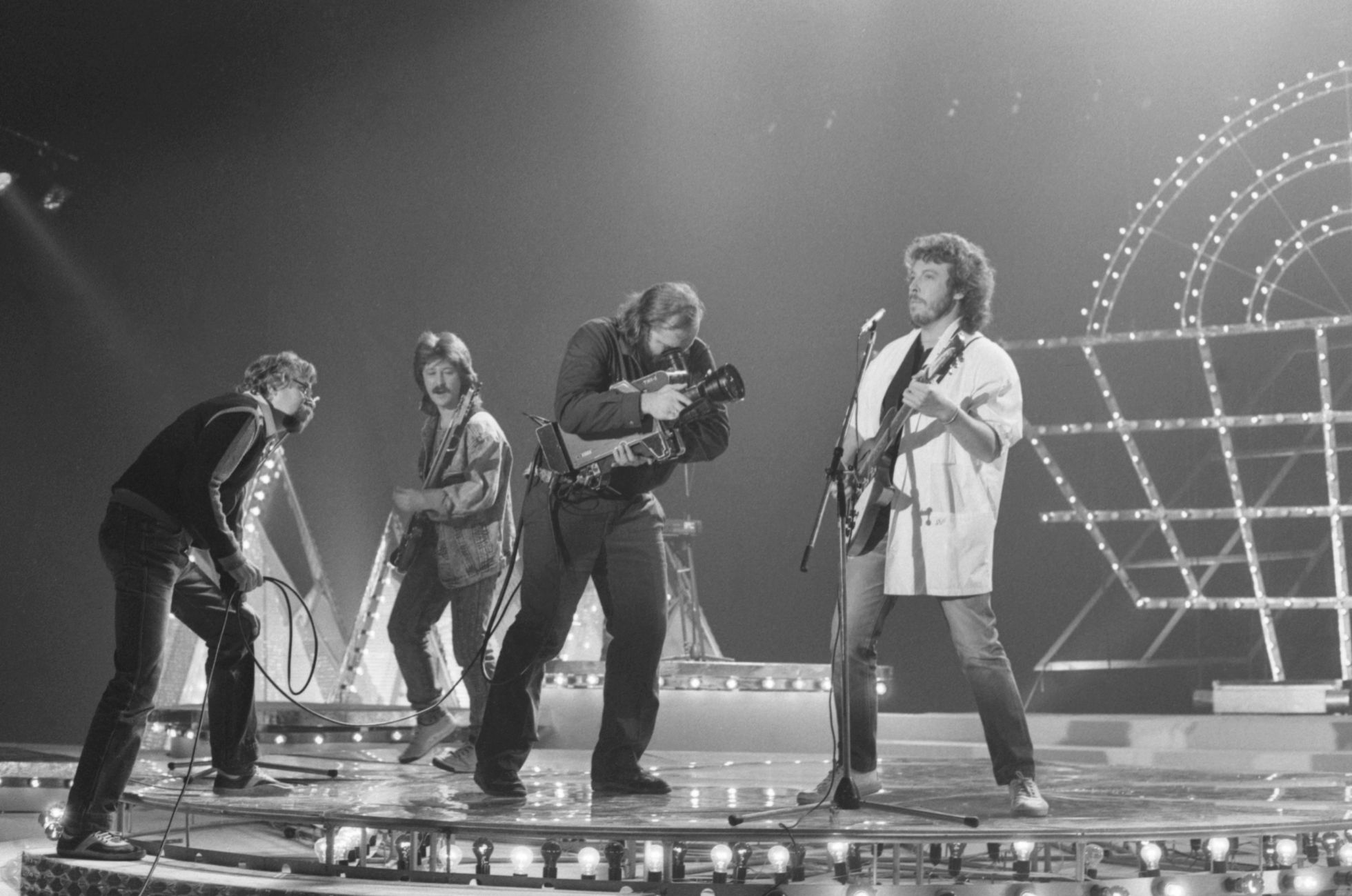
However, after 35 years, there is a feeling that the Soviet rock of the 1980s in the mass consciousness is not associated with the artists that we see in the video from the Blue Light. It can be stated that, collecting like -minded people and closing their circle, the musicians who appeared on the screen of Soviet television did not call him the heroes of the underground, representatives of the "generation of janitors and watchmen." Thus, the composition of Kelmi and Pushkin is a showcase of a specific cut of late Soviet rock music: clamped, metropolitan, highly professional, legal or striving for legalization in the system of state cultural institutions.
Kelmi himself, as was said, worked in Lenkom. The musicians Pavel Laughter and Andrei Davidyan also were directly related to the Rock-Atelier, which also participated in the record “Closing Circle”. Davidyan, in addition, previously played with the author of the song “Closing Circle” in the art rok “leap summer”-like another person involved in the clip from the “blue light”, the guitarist and composer Alexander Sitkovetsky. Sitkovetsky and Gradsky were members of the Union of Composers of the USSR, Yuri Gorkov, Anatoly Aleshin and Yuri Davydov - immigrants from the world of VIA: “Flowers”, “Funny guys”, “Araks”, “Architects”; The future frontman of “Bravo” Valery Syutkin sang in the “architects” then.
Ovanes Melik-Pashayev, asking in the song the question "Why is the river in a hurry to the seas?" - Strictly speaking, not a musician at all, but a manager with branched Philharmonic connections: among his clients who also participated in the record “Closing Circle”, Andrei Makarevich , Alexander Kutikov, Evgeny Margulis, Konstantin Nikolsky, Dmitry Warsaw. The latter, attributed to the Mari Philharmonic in those years, in 1987 released one of the first Hevi-Metallic records in the USSR-“crossing the threshold” of the Black Coffee group. In addition to him, the already mentioned Dubinin and Golden Eagle (Aria, Autograph), as well as Alexander Monin and Grigory Bezugly (both of the cruise group), were responsible for the hard-blast-metal flank on the Blue Light.
In a word, the company is quite representative - but not exhaustive. In one year, the famous festival in Podolsk was held with the record “Closing Circle”, the films “Rock” by Alexei Teacher and “Assa” by Sergey Solovyov were shot. All this is milestones in the history of Soviet rock, but with a performance on a “blue light” they form almost non -intersecting sets.
It is interesting that after a few years, yesterday’s rock anddegown gives rise to his collective manifesto-the song “All this Rock-n Roll” , performed again by the whole team of artists, including Konstantin Kinchev, Garik Sukachev, Alexander Sklyar, Vyacheslav Butusov and Yuri Shevchuk. The difference between this track and the song “Closing Circle” is noteworthy both at the sound and poetic level: there is a measured piano ballad, here is a hard guitar blues rock, there are philosophical abstractions, “pederasts, drug addicts, Nazis, and a punks are like one socially dangerous and prison is crying for each”. The rock brow of the named after Chris Kelmi was definitely not the only one in those years: other circles diverged on the water surface of perestroika rock music.
Today they all opened. Kelmi and Alexander Gradsky, who owned the first two lines of the song “Closing Circle”, are not alive. Andrei Makarevich, in whose apartment, according to the recollections of the participants in the recording, the composition was composed, opposed the war with Ukraine and was declared a “foreign agent”. And Alexander Ivanov, a former soloist of the Rondo group, singing a key line about a sprout breaking through stones, participated in several concerts under the sign “Za Russia” and said that “all artists should now deal with the most important thing: like our predecessors in the 1940s, go to the forefront, sing for children in trenches and hospitals.”
However, the very form of a collective musical statement is still in demand-only the pathos of these statements and the performing staff are changing. After February 24, 2022, at least two similar compositions were recorded and published in Russia: “I remain” Garik Sukachev (the surpond of the ancient song Anatoly Krupnov) and “we will stand up” by the singer Shaman. Stylistically between them a little in common: the first is the bully SKA-Punk with puffs, the second is a pathetic ballad, knocked out on the production capacities of the center of Igor Matvienko. But there are intersections: a similar structure (dozens of artists take turns in a microphone) and a patriotic charge, however, of different strengths.
The formal reason for the record “I stay” is the 30th anniversary of the song itself: Anatoly Krupnov composed it in the early 1990s, and the context of that era here, of course, cannot be ignored. With the collapse of the USSR and the discovery of borders, the musicians massively stretched out of the country - by the way, they also included many performers of the “Closing Circle” composition: Sitkovetsky, Aguzarov, Aleshin, Warsaw, Berkut. Against this background, Krupnov made a different choice, and what is important is non -conformist or at least felt by such: in “I remain” the reckless determination of a person who consciously goes to the risk (“And let me be a little afraid, but I, I stay”).
The fresh cover is made with the unconditional love of the original-a video sequence shot in 2022 in the television studio of the program “Aparty by Margulis” is interspersed with archival black and white filming of the author’s performance of the song. But the main thing - the very feeling of a risky, unobvious life choice - is nowhere to come from. After all, “era of their era” is not overwhelming rock patriots in Russia, but completely different artists-those who protest against Russian aggression and the accompanying patriotic fucker or at least reflect it in their manner, from the face with an incorrect expression .
Unlike “I stay”, “we will stand up” - not recognition of love to the native aspen, but an uncomplicated, distilled apology of war: faces of the singers and singers who swallowed arshins and singers are replaced by tanks and aircraft performing combat missions in Ukraine.
It is interesting that between the compositions that recorded two compositions, one direct intersection is found: the frontman of the Va-Bank group, Alexander F. Sklyar, participated in both sessions. The political position of Sklyar has long been known, but if in “I stay” it is among his own kind, rock musicians of the “butterfly” format, then in the song “Get up” a prominent representative of the company who once spent “All this Rock-R-Roll” discovers the willingness to play on someone else's field, closing the circle with Nikolai Baskov, Stas Mikhailov and Nadezhda Babkina. The condition for participating in such co -products for him, thus, today is ideological, not creative intimacy.
True, about the same - adjusted for a reason for the performance - one could say about the song “We Are the World”. El Jerro, a jazz singer, performing one of the lines in that project with his unique velvet voice, recalled how he dared to approach Bob Dylan during the record and express his respect - Dylan did not honest him in response. Margarita Pushkin knew what she was talking about: it is naive to expect that musical teams of honeycombs like a “closing circle” can actually become the foundation of any spiritual fraternity. Mostly these are utilitarian, functional projects that pursue one or another situational goal.
The goal of the We Are the World project was achieved: in June 1985, a plane with food, clothing and medicines flew to Ethiopia and Sudan. The effect of the performance of Soviet rock musicians on the Blue Light is more difficult to measure in dollars or kilograms, but it was obviously: popular music was firmly entrenched on television-the “Musical Ring” was followed by the “A”, “Muzoboz”, the relay of clips with MTV and other formats. The song “Closing Circle” did not commit a revolution, but at least it became a point on the timeline of the Soviet and Russian rock historia, a sign of legitimization in the cultural space of the country of previously non-millet sounds and images.
The composition “stand up”, in turn, legitimizes the current state narrative in the same space, likening the Russian-Ukrainian war of the Great Patriotic War, to turn it from marginal into the mainstream, and from February 24 the whole propaganda machine has been working diligently. However, judging by the comments on Yetube (very dubious sociology, but it is difficult in Russia today), the process is not very smooth.
It is not difficult to give an ethical assessment of the performance of Shaman, Sklyar and other artists now. How successfully it fulfills the set ideological task, remains to be established.
Lev Gankin