
Translated material
The universe in the laboratory
German scientists experimentally simulated an analogue of the behavior of the early universe
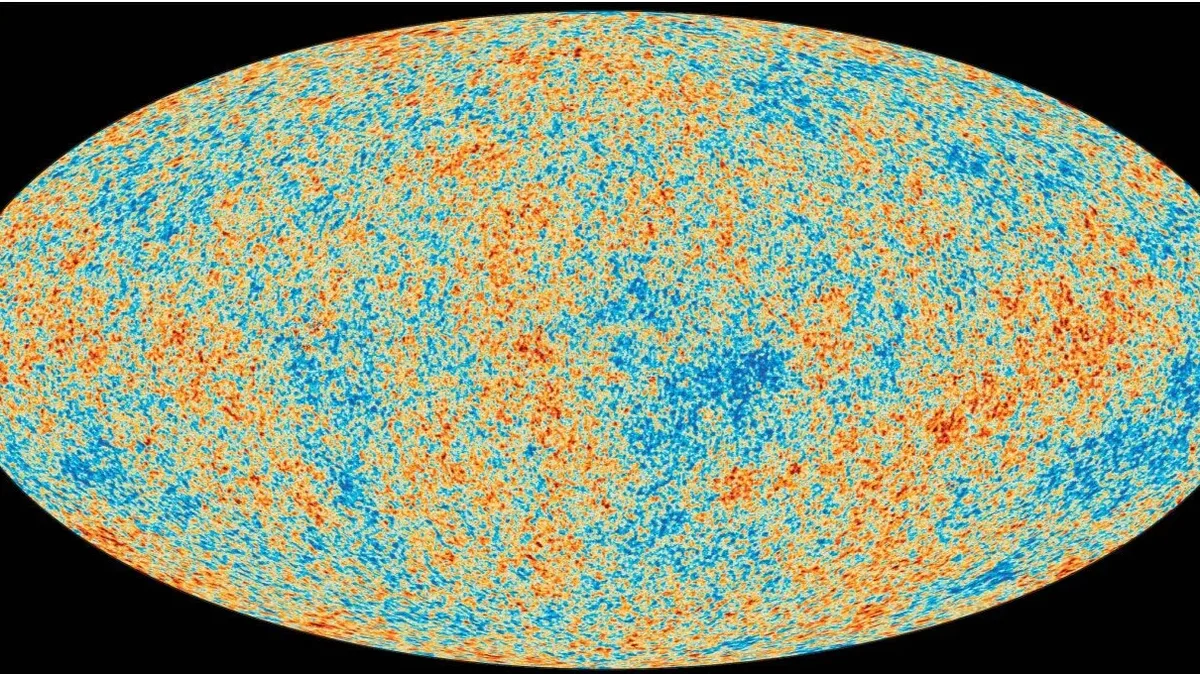
Having placed Bose-Einstein condensate of potassium atoms in the magnetic field, physicists demonstrated the appearance of acoustic fluctuations that reproduce the structure of cosmic microwave radiation.
The Physics Today magazine has published an article on laboratory simulation of the most important cosmological processes - the appearance of acoustic waves in the early Universe.
How was the universe arranged in the earliest stages of its development? Just looking at heaven in the telescope, it is impossible to say about this: the oldest objects that we could observe theoretically were born no earlier than 380,000 years after the Big Bang. This is due to the fact that before this moment the universe was opaque for the light, which means that not to see anything in it in any telescope in it.
However, the universe is filled with the so -called relict radiation. It formed just at the moment when the Universe became transparent. It shines in all directions strictly the same: from anywhere in the sky, this weak radio emission comes to Earth with a temperature of about -270 degrees Celsius. And this temperature practically does not depend on the direction in the sky that we look at. This means that the Universe at the first time of its existence was extremely homogeneous and isotropic.
Why is this so? One of the most accepted hypotheses is the hypothesis of cosmological inflation. The initially observed universe at the time of the large explosion was less than the proton, so in it all matter was in a homogeneous state. Then followed an extension of about 2 to 100 times for 10 V -30 degrees. This quickly “trample” the initially causal fragments of the universe over huge distances, so they ceased to interact. Therefore, distant, causally-sophisticated pieces of the universe were suspiciously the same.
The same, but not quite. It turned out that the temperature of relict radiation changes slightly from point to point. It changes to hundredths of a percentage, and this cannot be attributed to the measurement errors. The most characteristic scale in the sky on which these fluctuations are noticeable is 1 degree. That is, if the fluctuations of relict radiation are visualized, then the sky will be motley - it will be covered with red (warm) and blue (cold) spots in dimensions of about two moon each.
It turns out that these fluctuations are not without reason. They correspond to the waves of sound that spread in the early hot universe after the end of the inflationary stage. Figuratively speaking, after inflationary expansion, the Universe "Singing". Physicists calculated what the characteristic scale of the heterogeneity of the background of relict radiation should be. For minor heterogeneities, they just correspond to what can be seen in observations.
But observations are not an experiment. We do not have a spare universe on which we could put experience and see how everything was in the beginning. Therefore, physicists from the University of Heidelberg - Marcus Oberlter and his team - decided to use an analogue to “see” space phenomena in the laboratory.
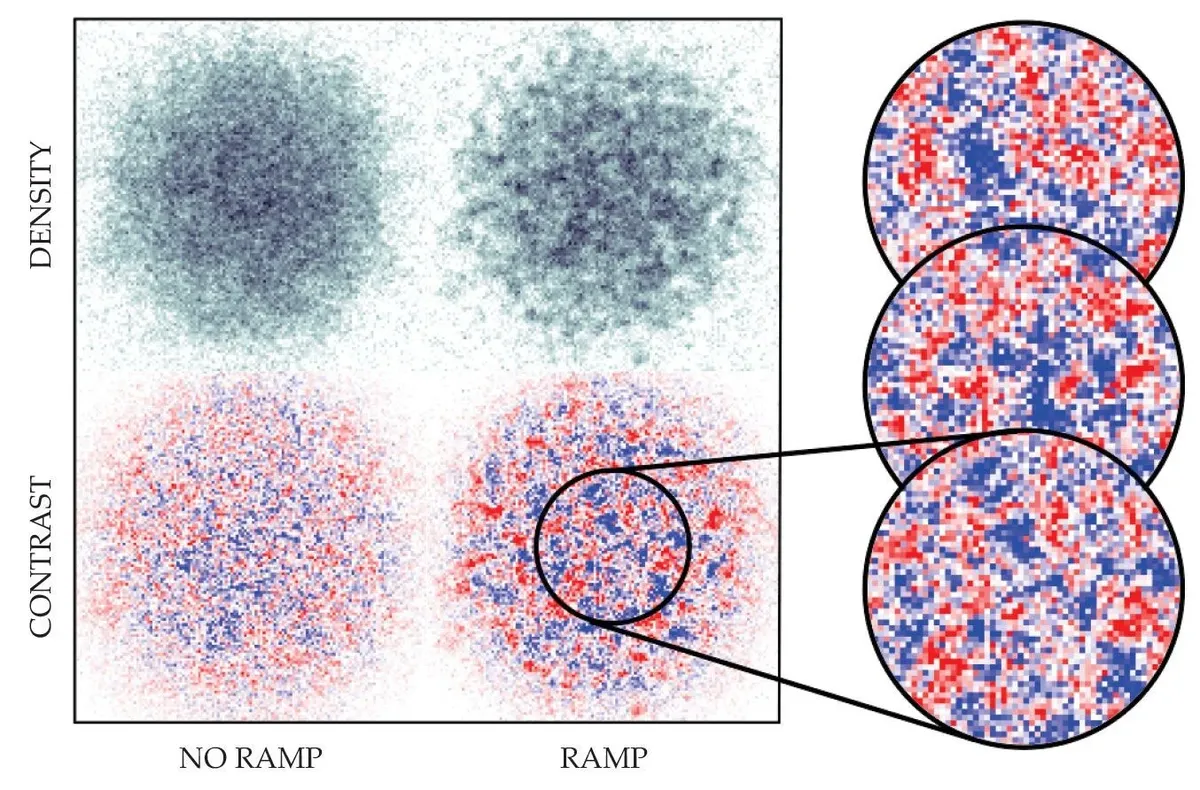
As a model of the early Universe, they used Bose-Einstein condensate of potassium atoms. Bose-Einstein condensate is, roughly speaking, a very sparse gas made of very cold atoms. At the same time, in the case studied, the continuous Bose-Einstein condensation, they can be represented by a single continuous quantum field. This brings them closer to the early universe, which was filled with the field of the so -called inflaton that provides inflation.
How to simulate the expansion of space? The overthal proposed to use the phenomenon of the so -called Fashbakh resonance for this. It consists in the fact that an effective radius of the interaction of atoms changes in a magnetic field. With certain values of the magnetic field, atoms seem to come into contact with each other. If the field is then reduced, then the radii of interaction is also “reduced”. From the point of view of atoms, this is all the same if the space between them expanded and due to this expansion of space would be carried over long distances.
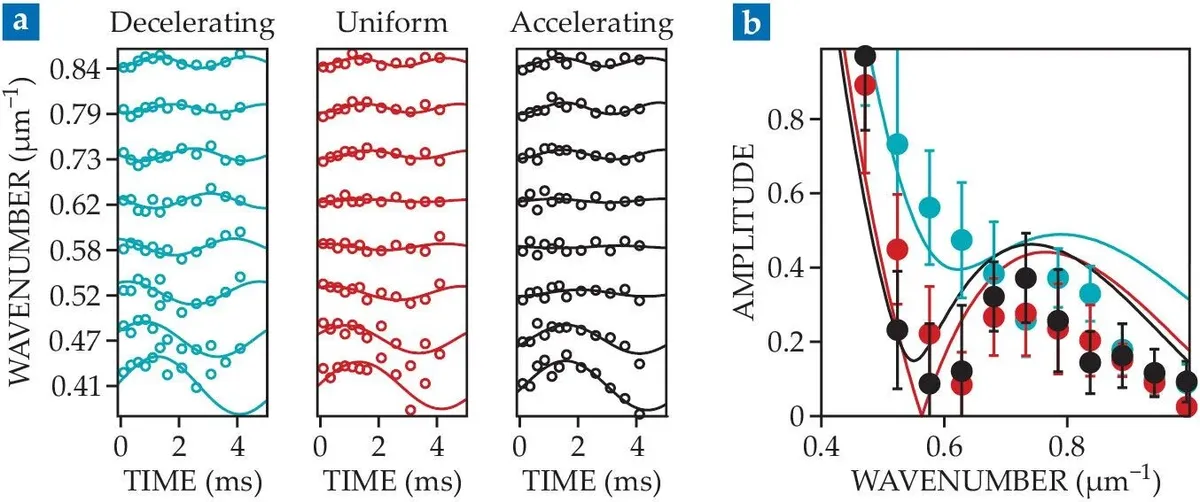
In the experience, the overthal and colleagues studied - thanks to manipulations with a magnetic field - an accelerated expanding "universe", evenly expanding and expanding with deceleration. The experiments showed that in the case of the expansion of Bose-Einstein condensate, it is filled with acoustic vibrations that correspond to the fluctuations of space microwave radiation. At the same time, the experience of scientists could be repeated (unlike a large explosion), which would allow them to trace the corresponding acoustic waves in time and build the distribution of their wave vectors. Thus, we can look at the analogy of how the "melody" with which the universe "sounded" changed.
The experience of the overseer is also important because it allows you to directly approach the modeling of the era preceding inflation. If inflation has left the observed mark in the universe, then the previous era, too, theoretically could do this. So far, its modeling is a matter of the future.
Prepared based on the articles by Johanna L. Miller “The Early University in a Quantum Gas”.