
Translated material
Planets near the red dwarf
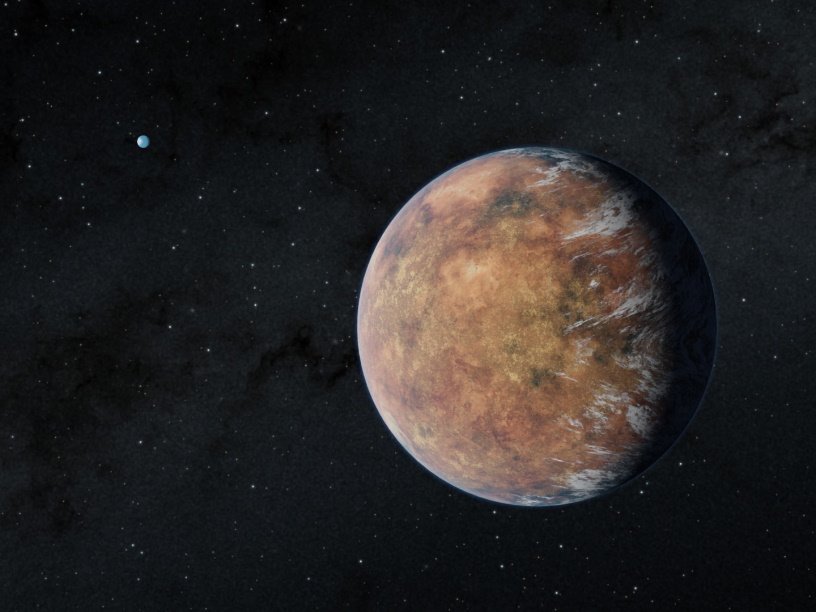
The TESS space telescope has already discovered the second land-like planet in the potentially inhabited zone of the TOI-700 star, a red dwarf in the constellation Golden Pisces.
The TOI-700 star is in about 102 light years from us. Its mass and size are about 40 % of the mass and size of the sun, and the surface temperature is half the sunny. In 2020, astronomers announced the opening of three exoplanets rotating around the TOI-700. The planet closest to the star, TOI-700B, has the size of almost the same as the ground. She is probably rocky and turns around the star in 10 days. The planet TOI-700C is a gas giant, about 2.6 times more than the Earth, it spends about 16 days on the path around the parent star. The most remote planet, TOI-700D, slightly larger than the Earth (mass-1.6 earthly, radius-1.14 earthly) and has a period of circulation of 37.43 days. The TOI-700D is in the potentially inhabited area of its star, it receives 86 % of the energy from the star that the sun gives the Earth. The surface temperature of the TOI-700D, according to scientists, is –3 ° C. It should be remembered that all three planets are close enough to the star, so under the influence of its gravity they are always facing the star in one side, which causes a large temperature difference between illuminated and unlit hemispheres.
The size of the new planet, which received the TOI-700E designation, is 95 % of the size of the Earth. The period of its appeal is 28 days. “If the star were a little closer or a little more planet, we could find the TOI-700E in the first year of Tess,” says Ben Hord from the University and the NASA Goddard Space Flights Center. “But the signal was so weak that we needed an additional year of transit observations to identify it.”
The opening of the TOI-700E is reported by the publication in Astrophysical Journal Letters.