
Translated material
Always - a favorite character
Inna Churikova died. Anton Dolin recalls her roles, in each of which it is impossible to imagine another actress
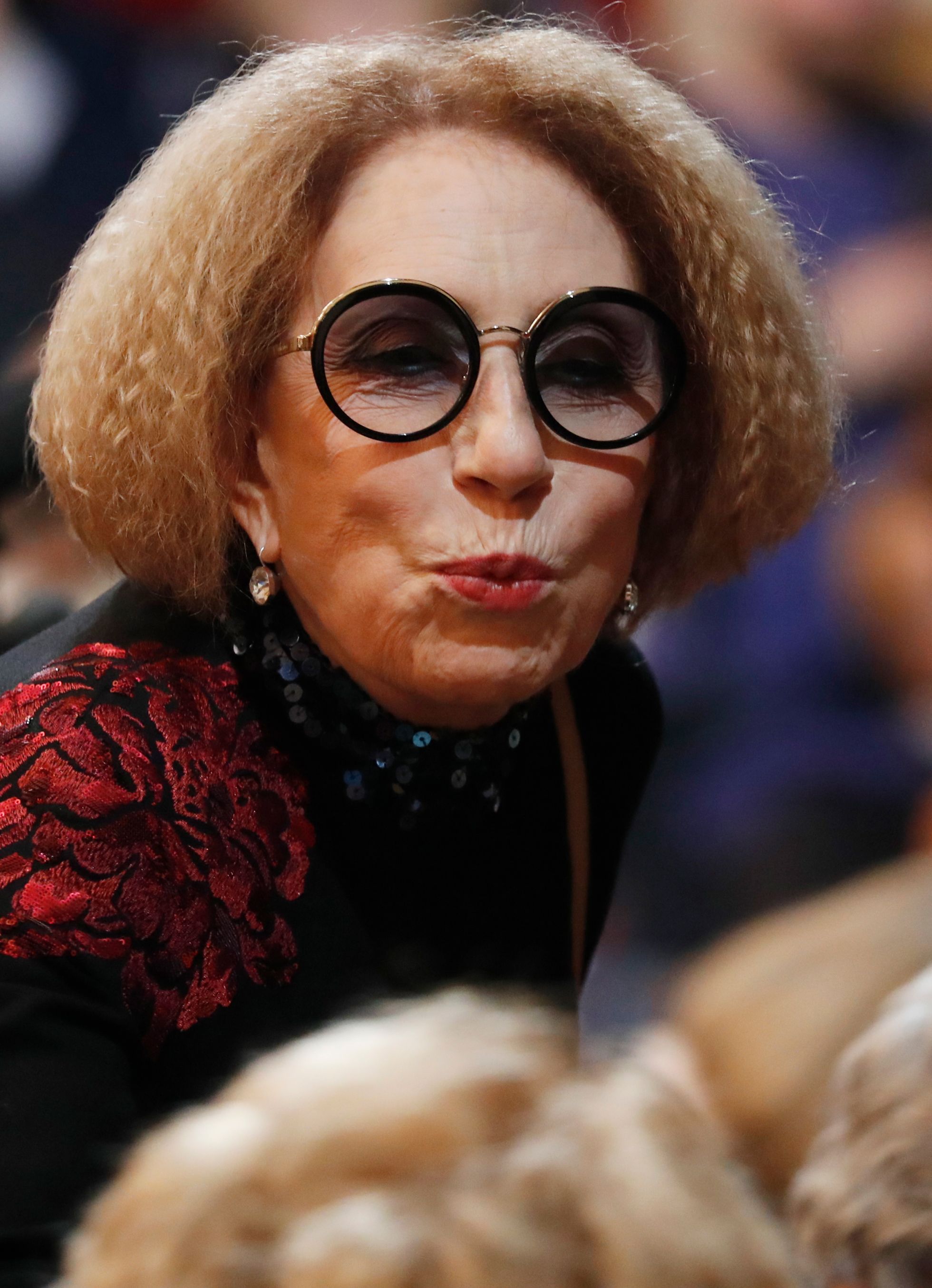
Inna Churikova died at the age of 79. Since 1975, she was an actress of the Moscow Lenkom Theater, and also starred in many films that the whole country knows. Some of the most memorable roles Churikova played in the films “The same Munchausen”, “Military Field Roman”, “Vassa”, “Courier”, “Shirley-Millley”, “Ribbish Adam”. The film critic of Medusa Anton Dolin talks about an incredible portrait gallery created by an actress.
Inna Churikova - from rare people, in relation to which the definition of “brilliant” does not seem to be hyperbole or a manifestation of inappropriate emotions. This is not an exaggeration, not a compliment - a statement.
But the nature of its talent from the definitions eludes, combining the opposites in itself. It is customary to divide the actresses into “characteristic” and “beauties”, but who dares to attribute to one of the two categories of Churikov? In her images there were fragility, vulnerability, tenderness, from which the spirit was breathtaking. But there was an amazing ability to grotesque, almost a caricature. And most importantly, for more than half a century, for more than half a century, she had a unique ability to combine these two hypostasis and paradoxically combine.
It is enough to recall the beginning of her career in the cinema. An unforgettable contestant from “I walk around Moscow” by Danelia-the gold standard of the Soviet lyrical comedy, followed by the frighteningly warped Marfushenka-Dushenka from Morozko, then a worthy partner of the no less brilliant Evgeny Leonov in the surrealist “thirty-three”. The very different directors saw in her the source of inspiration, as if trying to fix her unforgettable appearance in some kind of stable role, but could not. Thus, her first truly great role was born: heroic and tragic, albeit at the same time and funny, Tanya Tetkin from the directorial debut of her husband and comrade-in-arms Gleb Panfilov “There is no Broda in the fire”. The romantic-paradoxic ballad about the civil war won the festival in Locarno, and this Golden Leopard was common for them. They were generally equal - Panfilov and Churikova did not turn out to the complex duet of the “author and his muses”.
In her unforgettable person, his recognizable features was inevitability, the finality of the medieval portrait - Churikova could become an ideal model for Van Eyke . It is no coincidence that many of her key roles in the seventies were associated with eras, extremely far from the landed congestive USSR. The adamant and vulnerable Soviet jeanna d'Aark in the “beginning” of the same Panfilova is the best that Churikova played in the cinema, the theater debut in the Lenkom “tile” of Mark Zakharov based on the play by Grigory Gorin in the role of Niel (often talk about the archetypalness of two jesters, skinny Ulenspiegel and dense lamas, but why they forget about the soul of their union, trepidable, trepidable. NELEL?) Finally, Ophelia in the revisionist Hamlet in the production of Tarkovsky. A decade later, she will return to Elsinor , but already in the version of Panfilov and in the role of Queen Gertrude.
Panfilov created an incredible portrait gallery, and in the center of each picture was Churikov, although the films themselves were so different - it ensured both the variability of the genre and the author’s loyalty to himself. The State Council of Uvarova in “I ask for words”, a literary critic Sasha in the shelf “Topic”, a buffet in the Vampilov “Valentina”, two almost mythical figures - Vassa Zheleznova and Nilovna - in “Vassa” and “Mother”, two surprisingly non -banal interpretations of the canonical texts of Gorky. At the same time, Churikova continued to attract directors of extremely different styles, views and approaches. The repulsive hypocrite of Jacobin in the phantasmagoric “Munhgauzen’s very Munhgauzen”-Zakharova, his wife-pedagog in the lyrical “military-field novel” Peter Todorovsky, the mother of the protagonist in the perestroika “courier” Karen Shakhnazarov-in any, even a secondary role, became the favorite character of the viewer.
Churikova had no disastrous or empty periods, for her the work was always located, even when both rental and film production were freezing. That, if you think, amazingly, its data was very “specific” - but all stereotypes were destroyed by the fire of her unforgettable talent. In the nineties there were such bizarre experiments as the “Ribbet of Adam” by Vyacheslav Krishtofovich, “Casanov’s cloak” Alexander Galina, “The Year of the Dog” Semyon Aranovich. Undoubtedly, underestimated films, each of which is not presented with another actress. And then the key to the career of Andrei Konchalovsky “Ryaba Kurochka” with the role in the literal sense of the archetypal and rare spectator triumph for that decade, the burlesheques “shirli-Mill” Vladimir Menshov.
In the zero, she, becoming a living classic, played more and more often in the adaptations of the classics. General Epanchin was especially remembered in the “Idiot” by Vladimir Bortko, but there were still “guilty” Panfilov, as well as the series for modern writers-the Aksenovskaya “Moscow Saga”, Solzhenitsynsky “The First”. In the new millennium, Churikova cemented literary images of both XIX and XX centuries.
In the 2010s, Churikova herself became a living myth, not stopping creating amazing new roles. Sometimes episodic and iconic, like Mikhalkov’s in “Bathered by the Sun - 2” or Panfilov in the recent “Ivan Denisovich”, sometimes in the comediographers of a new generation, for which she became a real treasure. Are the “Best Day” of Zhora Kryzhovnikov or “Oz Country” Vasily Sigarev - Hooligan non -conformist paintings, in which its presence was so organic?
It seemed that she would act and always live. That Russian and world culture without Churikova will never be the same. However, it did not seem.
Anton Dolin