
Translated material
Muscovites fourth day carry flowers in memory of those who died in the Dnieper to the memorial in the city center
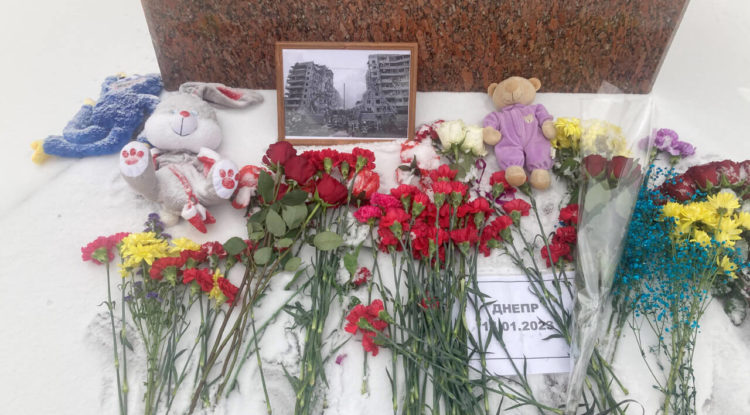
They are hindered by public utilities, police and pro -government activists of SERB. This is what is happening there
Lesya Ukrainian is a Ukrainian writer and poetess, known for poetry collections and translations into Ukrainian. The monument appeared to her in Moscow in 2006 on Ukrainian Boulevard, ten minutes from the Kyiv station. For more than fifteen years, the bronze sculpture stood unnoticed, but after a missile strike at the residential building in the Dnieper became a place of a spontaneous memorial. "Cold" tells how the action of solidarity has become one of the few ways to express its attitude to the war for dozens of Muscovites. And even they are trying to ban it to them.
In order not to miss the main materials of the "cold", subscribe to our Instagram and telegram .
On the evening of January 18, the boulevard was empty and quiet on Ukrainian Boulevard. Only a flashing special signal on the roof of a police car 10 meters from the monument to the poetess Lesa Ukrainian is striking in the eye. Holds rare passers -by in tension - apparently, just in case.
"They will not touch?" - Suddenly, a man in a brown jacket asks quietly, nodding towards the car. Behind the windshield, the indifferent faces of employees are barely distinguishable, illuminated by smartphone screens.
“I would like to lay flowers,” the man creases, “but I don’t know.” They are removed, and it is incomprehensible whether they are delayed or not. ” A day earlier, four were really detained by the Ukrainian monument to Lesa. They were taken to the Dorogomilovo police department-one of them, as reported by the ATS-Info, drew up a protocol on petty hooliganism. Among the detainees there was a woman with a dog: the police put the mistress in the car, and the dog was left on the street. Later she was taken by the neighbors.
“They put Bobik - they are sitting and looking,” the man continued in a brown jacket. - Personally, such anger takes me ... there will be what will happen! Even if they take it away, let it. The devastation is complete. ” He exhales and looks at the monument: "Do not tell me where to buy flowers here?"
"Is this normal?"
On January 14, Russia inflicted a missile blow to several regions of Ukraine. In the Dnieper, the shell flew to the nine -story house, almost completely destroying the two entrances. The rescue operation lasted three days: 46 people were killed, among them six children.
On the same day, spontaneous memorials in memory of the dead began to appear in different cities of Russia. In Krasnodar, St. Petersburg and Omsk, flowers brought to the monument to the poet Taras Shevchenko, in Yekaterinburg - to the monument of victims of political repression. And in Moscow - to the monument to the poetess Les Ukrainian.
It is not known who was the first to bring a photograph of the house destroyed by the Russian rocket and laid a bouquet. But there were hardly so many colors here. On January 17, they occupied almost the entire pedestal.
Before the war, they were brought only on the birthday of Lesya Ukrainka, February 25. “I live here, I saw,” the man said in a neighboring cafe. “Every year, the delegation came from the embassy [of Ukraine], but now the Dnieper.”
In the evening of January 17, when dozens of people, having heard about the memorial, carried toys and bouquets to it, activists of the pro -government movement of SERB appeared in the crowd.
“Why was the Ukrainian air defense a rocket over the house? - shouted one of the activists of SERB, provoking the gathered at the monument. “Why don't you go to Ukraine now?” In response, a woman snapped: “Yes, because because of Putin this I cannot go to my relatives! Because it was he who untied the war. "
- Seriously? Or did your friends [Ukrainians] burned Odessa?
- Steam!
What happened in Odessa
On May 2, 2014, during street clashes between supporters and opponents of Euromaidan in Odessa, the house of trade unions on Kulikovo Field Square caught fire in Odessa. In a fire, 42 Anti -Maidan activists were killed, who barricaded inside. It was not possible to establish on whose fault the fire began (both groups were armed with Molotov cocktails). Russian propaganda gives this episode of the intra -Ukrainian conflict as genocide and a reason to invade Ukraine.
Activists shot what was happening at the monument on an action camera and did not fall silent for a minute. The most noisy-in a dark blue down jacket, a cap, with a newspaper armpit and a black barce-threatened with fines: “Everything is recorded with us!” “Look,” he said to another, pointing to the pedestal. “They brought their LGBT.” The man reached for a multi -colored children's pyramid, grabbed the toy and demonstratively dismantled it into pieces.
- Tell me, is that normal? - He turned to another passerby. - Immediately propaganda LGBT!
- And what? - the passerby answered calmly. - For example, I am a representative of LGBT.
- And who burned about the [de] osu? - the activist did not let up.
- Not about the [de] birch, but o [d'E] osu.
Arriving policeman, a man with a barce personally pointed out whom to detain "for discrediting his own." He also did not forget about the pyramid, “promoting non -traditional values”, he also insisted that she be indicated in the protocol as propaganda.
The next morning, there was not a single bouquet at the Ukrainian monument to Lesa: they all, together with children's toys, removed utilities.

"I consider this a form of protest, I hope not the only one"
On January 18, after the news of the detentions at the monument, no one crowded there. Muscovites came one at a time. Someone, trying to go unnoticed, approached the monument and carefully left cloves. Others approached faster, took the flowers from the backpack and were also rapidly hidden. And some even stood at the monument detached, baptized and fell to their knees. But the police in the car did not care about them.
“I sympathize with people, I want to express my grief,” says Daria, a 25-year-old girl, losing a bouquet. - What is happening is terrible, and I am very sad from this. I understand that I can only lay flowers-and I wanted to somehow support the people who are there. I sympathize with them. "
“I don’t know, probably, [I do it] just for myself,” another woman says, putting the cloves. -I do not think that our sympathy will somehow help the victims and their loved ones. Most likely, they do not need it. ”
For many, the action is a way to express not only sorrow, but also a protest. Lowering flowers, the townspeople admit that they express their attitude to the war. “Now there is no other way out of this disagreement and is not expected,” Daria continues. “Therefore, so far. And this is also important. "
“I think this is a form of protest, but I hope that not the only one,” says 19-year-old Boris, a theological student who “lived under the current regime” all his life. -In the future-I hope, in the nearby-we will have some other ways to express our opinion safely. I had the impression since the beginning of February that I, like me, humanists, unfortunately, have a minority in Russia. But when I came here, I still have some kind of an spark of hope. ”
By the evening of January 18, there were no less children's toys and flowers of Lesya Ukrainian than the day earlier. Among them was a white sheet with a printed large font “ Dnipro ”.
Two women about 60 years old were walking past the monument. - Let the flowers carry - there are no problems! - alone said loudly. -Only without the petitions of my and these El-Ba-Ba-Ba ... I will not say.
-El-he ...-another prompted her
- LGBT! - the first agreed.
Women slowed down at the police car and nodded approvingly to employees.
- Already denied everything! - It was heard near the monument. - Already all of their Balabol, Prratovich had denied ( former adviser to the President of Ukraine, Alexei Armnutovich, on the first day after the attack, said that the Russian missile could be shot down by Ukrainian air defense. He later stated that he had made a mistake, and after a wide discussion, his words were resigned . - approx. "Cold" ).
***
On January 19, almost a week after shelling, people continue to carry flowers, toys and candles to the monument to the Ukrainian. Public utilities seem to no longer touch them. In the nearest floral cloves, they quickly end. “Naturally, they began to buy more,” says the saleswoman of this store. - Like everyone in the area. Take everything that is.
- You know why?
- I guess.