
Translated material
How to invest with a horizon at 10 years old
This material (information) has been produced and widespread by a foreign agent The Bell or applies to the activities of a foreign agent The Bell. 18+
The strategies of investment banks, which we talked about in past issues of mailing, are designed for active investors who want to get profitability above the market in the next year. But the accuracy of such forecasts is traditionally low, because the situation largely depends on macroeconomics, which is difficult to predict. The past year is a vivid example.
Some investment companies offer to look at the markets in terms of a long -term investor with a horizon of 5-10 years. In this case, market estimates and long -term historical trends play a more significant role, and therefore it is easier to predict the dynamics of assets. In this material we will talk about several such strategies.
Vanguard strategy
Despite a significant decrease in shares of shares due to changes in rates on rates last year, American papers are still overvalued from the point of view expected in the next 10 years of profitability. This is stated in the strategy of the world's largest provider and founder of the Vanguard index funds, released at the end of 2022. World shares are now, on the contrary, are on the lower border of a fair assessment.
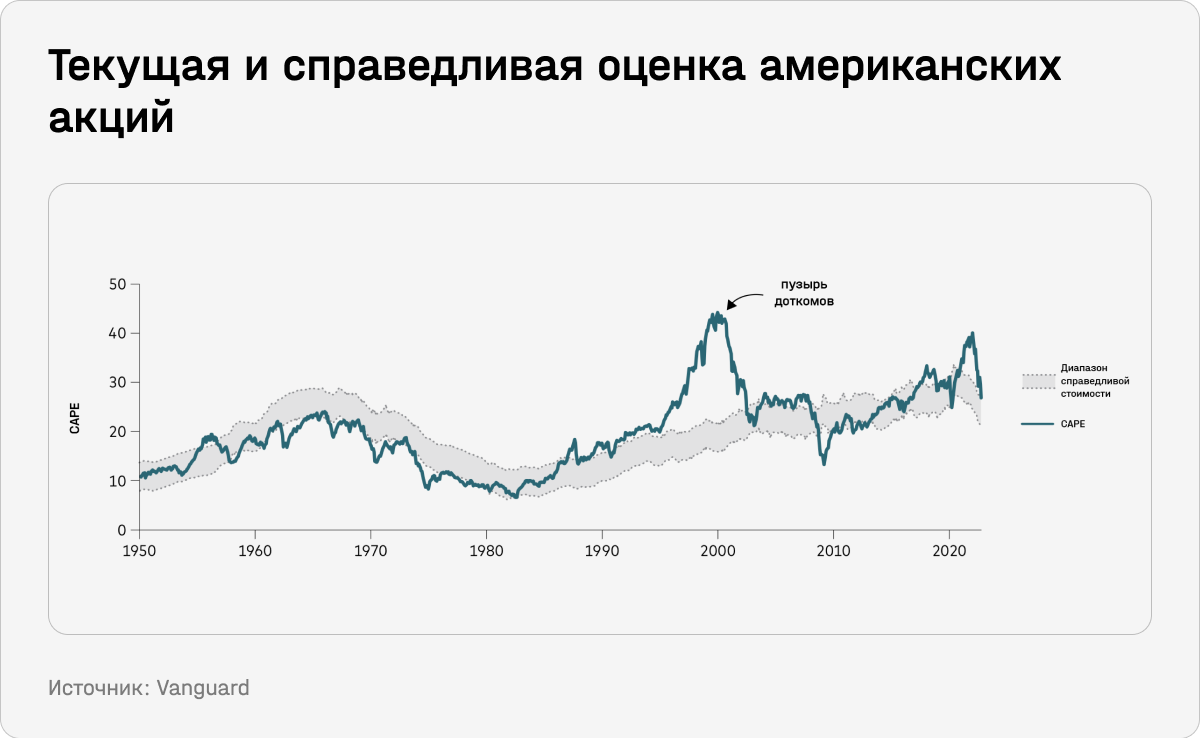
Vanguard analysts defined the validity of the current assessment of US shares as the ratio of the current value of the cyclically adjusted Schiller index (Cyclical Adjusted Shiller Price/Earnings Ratio, Cape) to the “fair” values of the Cape for the American market of shares in 1940–2022.
- CAPE is the ratio of the price of a sliding average profit in 10 years. Such normalization allows you to smooth out profit fluctuations due to business cycles.
- Fair Cape is the level of CAPE to which the market should strive, taking into account the level of bets and inflation. Reducing fair Cape means increasing the risk of investments in the action.
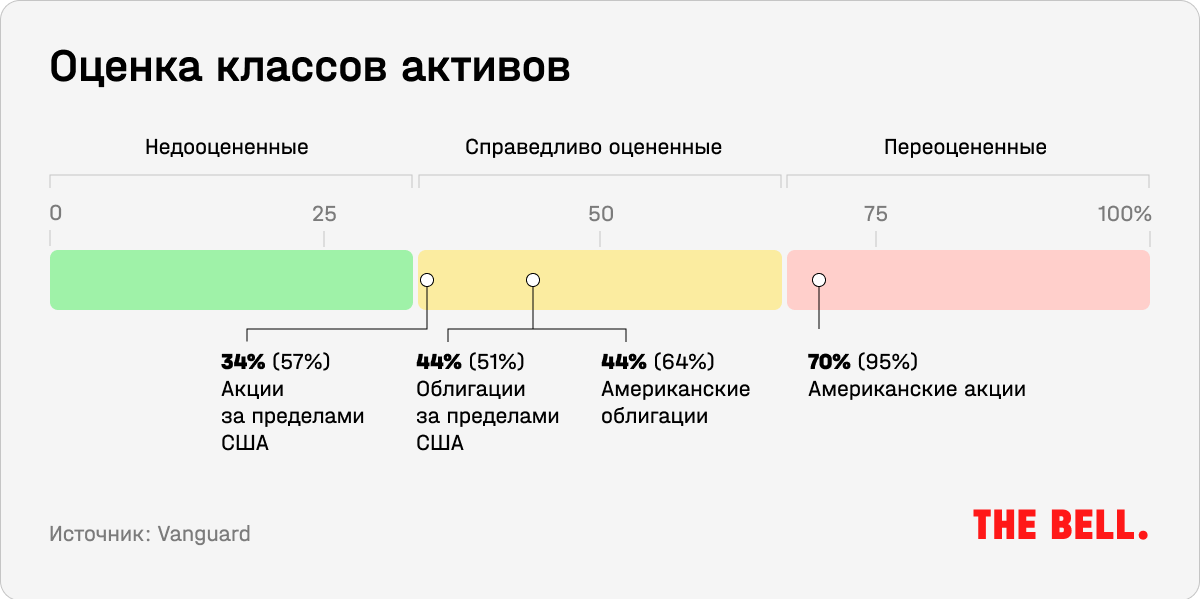
So, on September 30, 2022, American shares are located in the 70th percentile relatively long-term historical average values. A year before, on September 30, 2021, they were in the 95th percentile. Cape, despite the decline, is still above the range of fair values.
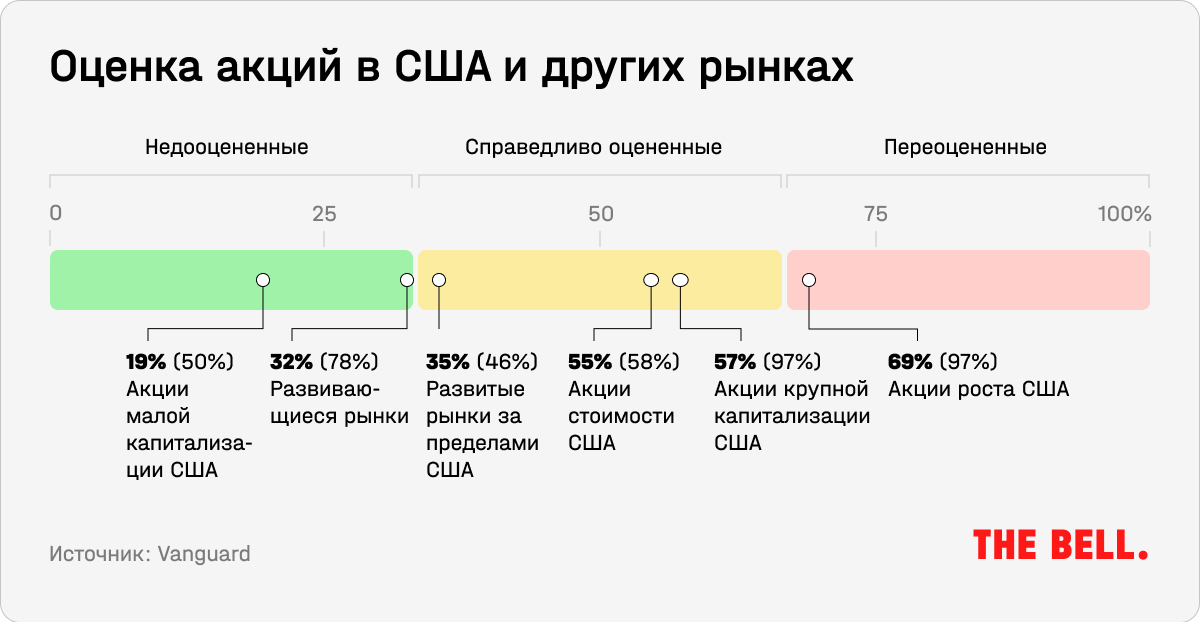
To calculate the level of assessment of the global market, developed and developing markets with weights of 70% and 30% are taken, respectively, for which CAPE is used for the appropriate country indices of MSCI. The most underestimated of the international are shares of developing markets, the assessment of which relatively historical average has decreased significantly. Promotions of developed countries are a little more expensive, but close to the lower border of a fair assessment.
But at the same time, there is an underestimated segment in the American market - these are shares of small capitalization companies (the lower ⅔ ⅔ index of the Russell 3000 at the cost of the company). The values of the value (lower ⅓ ⅓ ⅓ index of the Russell 1000 P/BV) at the cost look justly estimated, and the growth shares (the upper ⅓ ⅓ index of the Russell 1000 P/BV) still look overvalued.
This is confirmed by the consensus opinion of analysts from investment companies AQR and GMO, specializing in investing in underestimated assets, and some investment banks - we talked about this in the last issue of the newsletter . They believe that the bubble in growth shares has not yet burst, but the profitability in the US should be sought already in the cheapest (Deep Value) papers.