
Translated material
“Israel is torn to pieces of two ideological vectors”: an interview with Andrei Kharasov and Emile Shleimovich
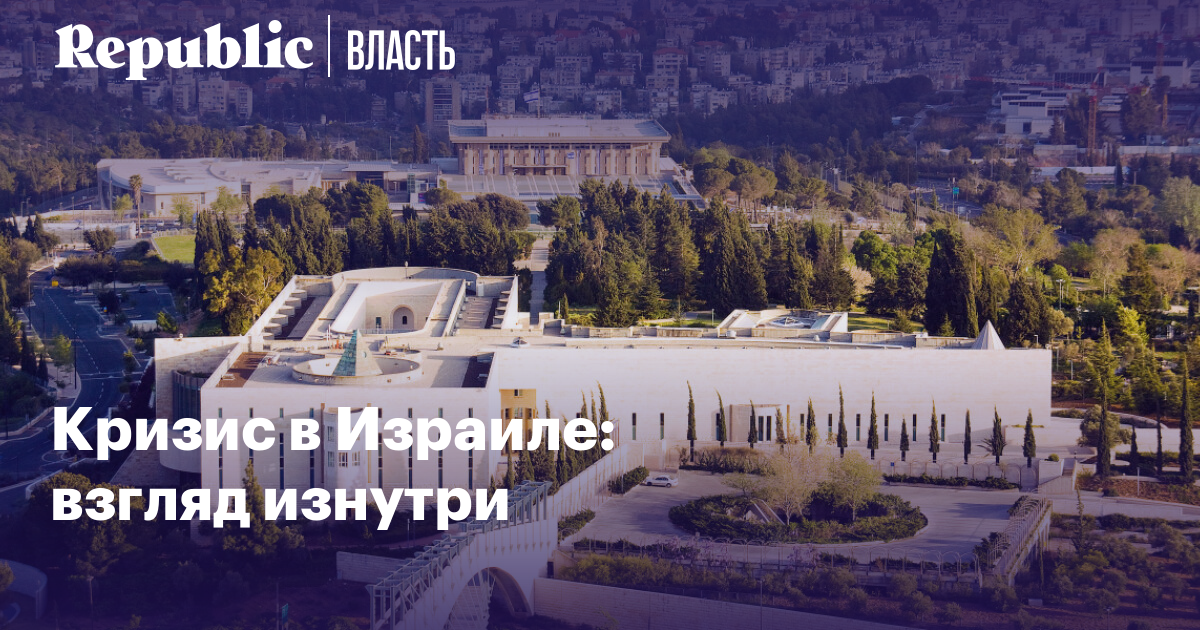
In the previous article, we told you about the premises and causes of a serious crisis, in which there were a political and judicial system of Israel. Now we offer you an interview with real experts in Israeli policy-the editor-in-chief of the site “9 Channel” by Andrei Kharasov and the editor-in-chief of the information and analytical site “Details” Emile Shleimovich.
Rimma Pole: How did it happen that Netanyahu and the Likud party, whose leader he is, concluded an alliance with ultra -organization? After all, Likud is a liberal party, its roots in the Zionist movement - completely non -religious?
Andrei Kharazov : Those when the Zionist movement was completely non -religious, have long passed. The descendants of secular Zionists at the beginning of the 19th century, for the most part, live in the elite quarters of the Center for Israel, which is popularly called the "state of Tel Aviv", and believe that this is Zionism. Real Zionists who now populate the expanses of Judea-Samaria and live in constant danger-for the most part religious people, the so-called "knitted piles". This is a fair part of the Israeli society, and it is she from the time of “agreements in Oslo” who has been in the front edge of Zionism. Many of them vote for Likud, many - for their own representatives, which are now called - the “Religious Zionism” block. With ultra-Orthodox, they are united, firstly, religiosity, and secondly, Jewish national identity. Thirdly, and this, perhaps, is the main thing-the general confrontation between the left circles, for the most part, the descendants of those very Ashkenazi pioneers-syonists who are now ideological opponents of Israel as a Jewish state and as an independent force in the international arena. Therefore, for Lida, which is the main right-national party in the country, where it is more natural with religious Zionists and even with ultraordods than with left-wing socialists. Even if they call themselves liberals, in reality, all their liberalism boils down to feminism and promotion of homosexual marriages, but instantly ends as soon as it comes to economic freedoms of the population and state non -interference in private life. In this regard, the "liquid", conservative in terms of the way of life and family values and liberal in the economic sphere, left -wing secular circles, with all their non -religiosity, are absolutely alien.
Emil Shleimovich: Not really. Likud is not liberals, but National Liberals. Recently, the first part of the phrase outweighs. National - it means, based, primarily on the Jewish tradition, the basis of which is the Torah, and the priority of the Jewish nation, and not the liberal "freedoms for all." This can be seen in all manifestations of recent years - up to the law on the national character of the state of Israel, developed by the commission under the leadership of the Likudnik Amir Okhana, now he is the speaker of the Israeli parliament.
Indeed, the Likud party arose as a block when the unification of Gahal Menacham Begin merged with several small parties on the initiative of General Sharon before the 1973 elections. The demand for preserving Jewish values has always been one of its postulates, so the merger with the orthodes is quite natural: the more liberalism was eroded in this party, the more space was allocated to the “scrapers”, and this process has been going on for at least ten years. The same corresponds to the vision of the electoral bone of the party: social periphery, city poor, immigrants from the countries of the East.
RP: I could never understand why in Israel created by European -educated people far from religious fanaticism, religious fanatics have such a great influence on life in the country? What is the reason for this shift? And what is the future, in your opinion, Israeli, secular, progressive, or religious-day?
Andrei Kharazov : Israel is now literally torn to pieces of two ideological vectors, while it is the fanatical-religious among them. Religious fanatics are an absolute minority even among ultra -organization. The vast majority of the ultra -organizational population are just people who observe a strict religious way of life. Suppose, in Egypt on the street you will see a lot of men with salary beards and in robes who pray five times a day, and a lot of women in Nikabah. However, this does not mean that Egypt is directly inhabited by religious fanatics. Fanatics are those who are ready for the sake of faith to fight, smash, kill. There is practically no such phenomenon in Israel. But there are religious circles, and, above all, ultra -organization, which live whole communities, quarters, cities and try, as far as they can, imposing their lifestyle to others, considering it the only true one. There is a left minority, which is also ideologically very actively, it fights conservative values and tries to impose its views and its norms of behavior - in many ways even more aggressive than ultra -organization. And there are many passive people who are generally closer to a particular worldview, but who do not share the assertiveness with which the ideologists of these worldviews are beating for their values. In Israel, there are a lot of people who consider themselves Jews in the entire complex of this national-religious phenomenon, even if they are not strictly religious, and yes, the Jewish self-awareness of the population here largely has a great influence on life, including everyday. But I would not say that "religious fanatics" play a decisive role here. Just a rather large part of the country is used to living a traditional Jewish way. And there is also a rather large part of the country, which fundamentally opposes the manifestations of such a way and believes that life in public space should fully comply with the "best European patterns", without any religious-Jewish coming. These two vectors constantly fight among themselves. The ideological minorities preaching both the same approach are very active and believe that the unconditional is true on their side, so this struggle of worldviews often resembles a “cold civil war”. But in general, life goes on its own way, and one who does not want to delve into all these feuds too much may well not do this. Although there are different practical inconveniences. The complete absence of the opportunity to conclude normal secular marriage. In Israel, such a procedure does not exist in principle, marriages are concluded only through religious institutions - a rabbi, priest, cadi. Lack of public transport on Saturdays. And, on the other hand, different “left” pieces such as canceling the column “mother” and “dad” in state forms that frankly infringing on the rights of men legislation, etc.
Subscribe to read the whole
Make a subscription Redefine.media to read Republic
Subscribe [you can pay for a Russian or foreign card. The subscription is extended automatically. You can unsubscribe at any time.]
Where are the money subscribers going