
Translated material
New fight for Stalingrad
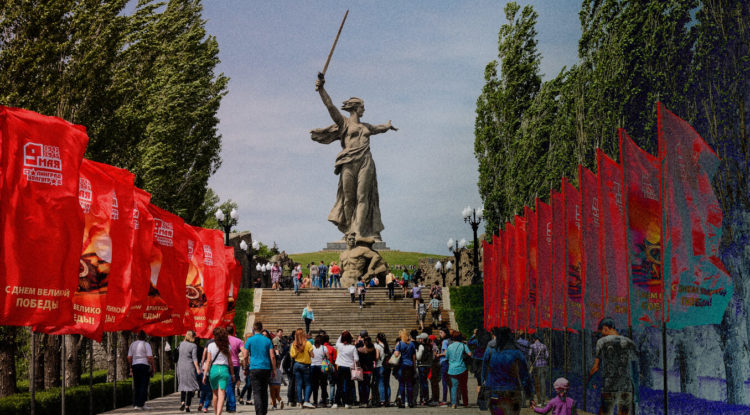
Publicist Ivan Davydov - about whether Volgograd will be renamed to Stalingrad and, if so, that this will mean
On February 2, 2023, 80 years of the victory of Soviet troops in the Battle of Stalingrad. To the anniversary, Volgograd was renamed one day to Stalingrad: they replaced signs on houses and road signs. Such symbolic actions take place in the city nine times a year, to commemorative dates, and they are always accompanied by a discussion whether it is worth renaming the city officially. On the eve of the VTsIOM, he published data from a survey about the attitude of residents of the city to potential renaming. 67%do not support this initiative, 26%support. Nevertheless, before the visit to Volgograd, Vladimir Putin, there were rumors that he was going to personally announce the return of the Soviet name. The poet and publicist Ivan Davydov, at the request of the “cold”, explains that Stalin’s return to official toponymy will mean, and offers his own version of a new name for Volgograd.
In order not to miss the main materials of the "cold", subscribe to our Instagram and telegram .

When the Cold War was just beginning, John Steinbek came to the Soviet Union from America - at that time a rather famous writer - and Robert Kapa - probably the most famous military photographer in the world. They wanted to understand how it turned out that in yesterday's allies the states now see dangerous enemies, whether Soviet people differ from ordinary and, most importantly, whether Russian wars want.
They were in Moscow, in Kyiv, in Georgia, in the country of writer Simonov, and were also in Stalingrad. Not a city - mountains of broken crushed stone, potholes, funnels, skeletons of destroyed houses. Stalingrad was just starting to revive. People lived in some incomprehensible cracks, in the surviving basements and climbed out of the ground every morning to disassemble blockages, build housing and factories, and teach children.
Describing the Stalingrad life, Steinbek noted one detail - it seems to be insignificant, but in fact capable of revealing us a lot. Well, he is a great writer. Getting out of the underground holes to a destroyed life, women did not forget to preenate:
“So, from the windows of our room we watched as a girl suddenly appeared due to a large pile of fragments, which last spent a comb for the last time a comb. Neatly and purely dressed, she made his way through weeds, heading for work. As women succeeded, we did not understand, but they, living underground, managed to look neat and preserve pride and femininity. The housewives came out of their shelters in white handkerchiefs and with baskets in their hands went to the market. ”
The stroke is the brightest: try to imagine this place that has recently been a city. The place made by the legend. The place where the fate of the most terrible war was resolved. A place where there is almost nothing but terrible traces of this very war. But even there, a person remains a man, people want to continue to live. Normal human life. Not forgetting about the war (how do you forget it when it is around?), But still looking at the heroic past, but in the usual future.
Then Steinbek received the Nobel Prize, and Kapa was blown up by a mine and died, photographing another war. But today we are not about them.
***
There are two topics in which key contradictions between the Union with all its nightmares (but also with the legend of the most delicious seal) and non-Soviet Russia concentrated. Some now consider her non-Soviet, but non-Soviet she nevertheless remains. These topics are the removal of the body of Lenin from the Mausoleum and the “Return of the Historical Name to the Hero Gorus Stalingrad”.
In the 1990s, when these nodes were tied, everyone determined political factors: the fear of the new elites in front of the “red revenge” and at the same time-the unwillingness to enjoy the communist electorate. To return to Volgograd the name of Stalin after shock information therapy of the era of publicity means bending to red-brown, to give slack. Finally burying humanly Lenin means to finally quarrel with the Communist Party of the Communist Party. Both are risky.
Now, of course, the times are different. Looking at the comic croaking of the top of the Communist Party, led by Zyuganov, it is almost impossible to believe that once the Kremlin was afraid of these people. The largest of the systemic pseudo -polation parties does not pose any threat to the authorities. But with Lenin, the situation became completely crazy. On the one hand, from the article of the main historian of Putin V.V. “On the historical unity of Russians and Ukrainians”, we know that it is Lenin-the founding father of modern Ukraine, and such sins are not forgiven. On the other hand, in cities in the “new territories”, monuments to Lenin are restored and return “historical names” to the streets, renaming them in honor of the same Lenin and his accomplices. The topic, by the way, is curious and deserving of a separate conversation.
And trying to speculate about Volgograd (aka Stalingrad), and completely fall into the abyss. Firstly, the quasi-religious cult of the Great Patriotic War has finally took shape, around which state ideology that was not fully spoken aloud is built.
Secondly, Putin, a person approximately equal to the state, experiences special feelings for the Volga city. Historian Ivan Kurill (originally from Volgograd) once noted : “Putin, of course, goes there. Until recently, he had such a tradition (or superstition): every year he always visited Volgograd before the elections. He said something, he always appeared on the Mamaev Kurgan. He in Volgograd, remember, announced the creation of the All -Russian Popular Front. For him, this is some place of power, he believes that he is fueled there. He first arrived there in February 2000, three weeks after he was appointed. ” And now, by the way, he goes - not before the elections, but perhaps before the fateful message to the Federal Assembly.
Thirdly, Comrade Stalin’s business is getting better: he regularly falls into the top three most popular historical figures in Russia; Here and here, monuments to the great leader crawl out of the ground, and indeed-there is a desire of part of the elites to revise the assessment of the leader and his era, formed back in perestroika.
That is, switching to the language of official propaganda, during the greatest geopolitical catastrophe of the twentieth century, when the West imposed on us alien values, forced us to forget about the greatness of the ancestors and shoved sodomia into the swamp.
Feel? Anyway, the Supreme Commander -in -Chief cannot, who led the country to a great victory, is considered a serial killer. Especially when you consider that now a great victory for the country is the main event of not only the past, but also the present and the future. The country is still fighting the heirs of the Nazis, continues to win the long -defeated Hitler. Is it for nothing that, in the State Duma, they took care of the expulsion from the school program of the literary Vlaser Solzhenitsyn, who slandered the great leader?
And, accordingly, the chances of Volgograd are growing into Stalingrad. Again, the old arguments that have been lifting Stalinism were not gone anywhere: the main battle of the Second World War did not occur in Volgograd, even in Paris there is an area of the Battle of Stalingrad and the Stalingrad metro station, but what are we worse than the French?
***
Stalinists feel the trend. The Communist Party goes to the attack: for the party, which has long become a meaningless element of the decorative political system, the fight for Stalingrad is at least some chance to remind of itself. Gennady Zyuganov is returned to the topic regularly, members of the regional branches are not far behind. The other day, the Lipetsk Communists proposed renaming the city, referring to the requests of the participants of Svo, "whose grandfathers and great -grandfathers fought near Stalingrad." Who risks going against the heroes of the special operation?
However, not the Communists, of course, solve such issues. In the current world, the heir to Soviet glory is not Zyuganov, but Putin. Not a funny opposition, but real power. And back in December, the deputies of the Volgograd Regional Duma proposed to rename the city, feeling approximately where the wind of a great story blows.
But the inhabitants of the city seem to feel something else. Then a petition appeared on the network against renaming, the authors of which claimed that the return of Stalin to the city is an act of justification of repression. People still want to live, want to, "go out in the handkerchiefs." Perhaps now it is even more seditious desire than in the late 40s of the last century.
But, of course, little depends on the will of citizens too. So far, the local authorities were limited to a compromise decision-the city changes the name, but only during the time dedicated to the 80th anniversary of the Battle of Stalingrad. The signs at the entrances have already been replaced , and Putin, going on a visit to Volgograd, still comes to Stalingrad.
***
At the same time, Dmitry Peskov directly states : “No, no discussions are on this subject.”
There is complexity. The farther, the more, the more willing to compare with Stalin, and not only critics of the presidential course and not only to offend. But he himself is in no hurry to try on the jacket of Generalissimus. Until recently, he even made the laid down speeches on the day of memory of the victims of political repressions, and it acts, on our happiness, while still not old: the long time in the stages does not rave long, and the unfortunate people do not shoot in dungeons. It happens that they mock, yes, but they don’t shoot.
Sometimes I even think: what if there is a kind of jealousy for the successes of an outstanding predecessor? Putin, used to be used, replayed everyone, so Stalin also needs to be replayed. To carry out your industrialization (not the fact that a solved but necessary task in the context of isolation of the economy), to arrange your Great Patriotic War. He.
But these are all jokes (possibly inappropriate), and the bottom line is that the current Russia is with a hybrid ideology, inside which they try to marry the “course on anti -colonialism” with the “struggle for historical territories”, with the cult of the GDP, with the desire to be a successor to both the Union and the Romanov Empire, with a sudden awakened love of traditional The values that are thought of as a mixture of “home building” with a system of thieves' concepts are simply not able to deal with the Soviet heritage.
In the early 1990s, the new masters of the country did not dare to be lustration and the trial of the CPSU, and it turned out from Russia as a result of what happened. Then they could not condemn, today they do not dare to finally rehabilitate. Point terror against disagreements likes and seems effective, but to start a large one is not dared to start for a variety of reasons. I think, oddly enough, that ethical reasons are no less important than logistics: no matter what our bosses do inside and outside the country, they do not want to see cannibals in themselves. And they are even afraid of final certainty - because the situation of uncertainty itself leaves more space for maneuver.
The Putin state is very sensitive to the events in the field of symbolic - I even think that now the words and meanings have become more important for him than any deeds. The renaming of Volgograd to Stalingrad would be a powerful symbolic gesture, unambiguously showing that the road has been chosen. French Generalissimus - on the right shoulders. So far this has not happened, and after a few days the signs at the entrance to Volgograd will be changed once again.
But, I repeat, the probability - both the final choice and the final renaming - is there, and every day it is higher. Locked to the past mode in the past is looking for answers to today's questions. Comrade Stalin has a simple answer.
***
And if you seriously take care of the issue of renaming, I would suggest returning to Volgograd his genuine historical name - Tsaritsyn. Surely there is a woman in the country who will like this idea. Or even a few women.
The author’s opinion may not coincide with the opinion of the editorial office.