Translated material
Heracles's robe
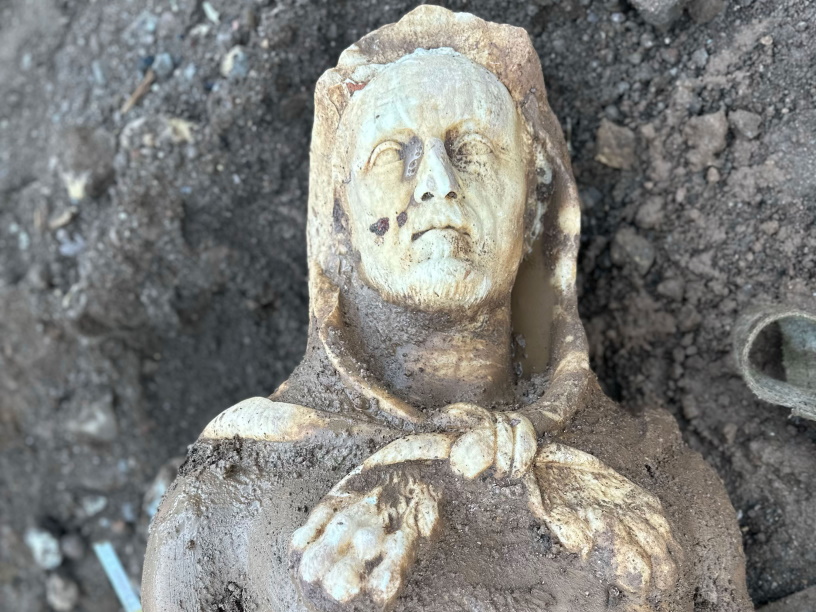
A marble statue in full growth was discovered on the ancient Appievo Road lead from Rome to the south. She depicts a person who is worn by the lion’s skin, so the mouth of the animal covers the head like a hat, the front paws are tied to the collarbones, like a scarf, and the hind legs are thrown over the left hand - all this corresponds to the ancient tradition of the images of Heracles, dressed in the skin of a Nemey Leo. However, the facial features of the statue do not correspond to the traditional iconography of Hercules. Therefore, it is assumed that this is a portrait of a person dressed in a costume of Hercules.
The statue was found not during archaeological excavations, but during the laying of the new sewage line. A breakthrough of the pipe of the 19th century led to the appearance of funnels in the archaeological park of Appia Antik. For repairs, decisive actions were required in an extensive territory. Archaeologists have worked with utilities throughout the complex project. For a long time there were no finds, but then this statue was discovered 20 meters below the level of the street.
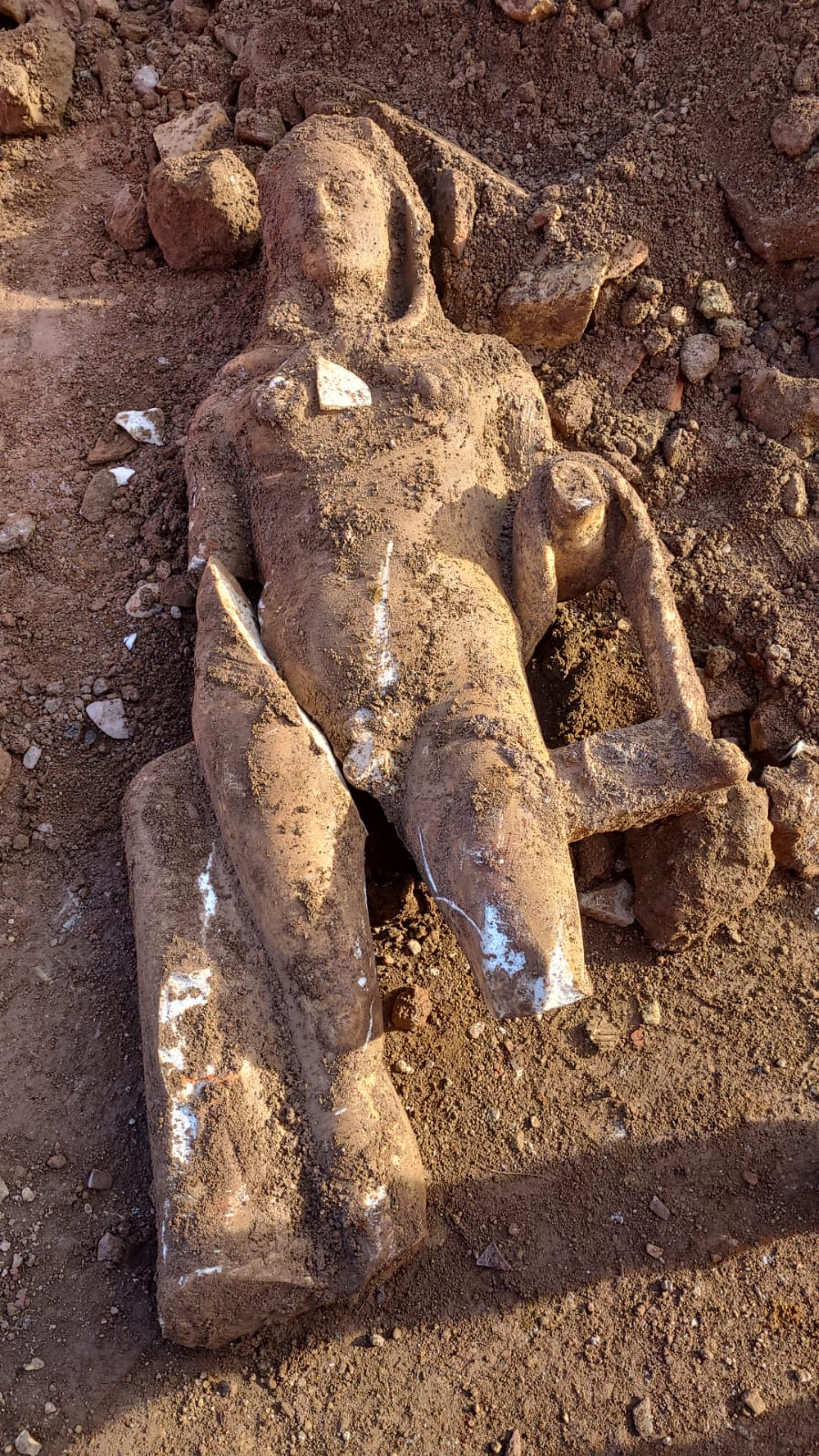 Photo: Parco Regionale Dell 'Appia Antica
The find was made on the second mile of the Appaeva road next to the tomb of Procullah (the second half of the 1st century, E.). The statue was found under the collapsed pipe of the 19th century. Most likely, this was not its original location. Probably, it was discovered during the construction of the old sewer line and simply thrown into the ground under it. At that time, there was no archaeological supervision in Rome, and the workers could simply just bury the statue. Without stratigraphic information, it is difficult to determine the age of the statue. The only thing that remains with archaeologists is its comparison with other artifacts, and they began to explore comparable work. Scientists have already had a hypothesis about a person’s personality in a lion's skin. Perhaps this is Emperor Trajan, who ruled in 249–251.
Researchers have discovered a significant similarity in the facial features of the statue and well -known portrait images of Trajan Depion, in particular, with a bust from the Capitol Museums in Rome. The statue has the “wrinkles of anxiety” characteristic of official portraits, resembling portraits of the time of the Roman Republic and designed to portray the care of the ruler for the fate of the state. Other characteristic features are the processing of a razor beard and morphology of the eyes, nose and lips.
_-_Glyptothek_-_Munich_-_Germany_2017.jpg)
Senator Guy Messi Quint Depsius was proclaimed the emperor soldiers in the province of Pannonia and occupied the throne, defeating the previous emperor Philip Arab. The detection accepted the name Trajan in honor of the famous emperor of the II century , who was considered an ideal ruler and the best emperor in the history of Rome (Optimus Princeps). During his short reign, he made a priority the revival of traditional Roman virtues and religion. He annually appointed himself as a consul, tried to restore the position of censor in the Senate and published the first official law on the persecution of Christians, demanding from all Roman citizens to make sacrifices to the traditional gods of Rome, praying them about the health of the emperor and the well -being of the state.
In Rome, a luxurious Term Complex was built with the detection on Aventin and the Colosseum, which suffered earlier in a fire, was restored. Large -scale public construction sites were part of the detection policy to strengthen Roman values and were supposed to remind the Romans of the glory of previous times. Also, the detection streamlined the tax policy, which helped to stop the uprising in the east of the empire.
The detection died in 251, defeating in the battle with the Goths under Abritt (in the territory of modern Bulgaria). He became the first Roman emperor to fall in battle with an external enemy. After death, the Senate deified the detection. The image of himself with the attributes of Hercules, of course, corresponds to the desire of the detection to imagine himself as a defender of traditional Roman virtues.
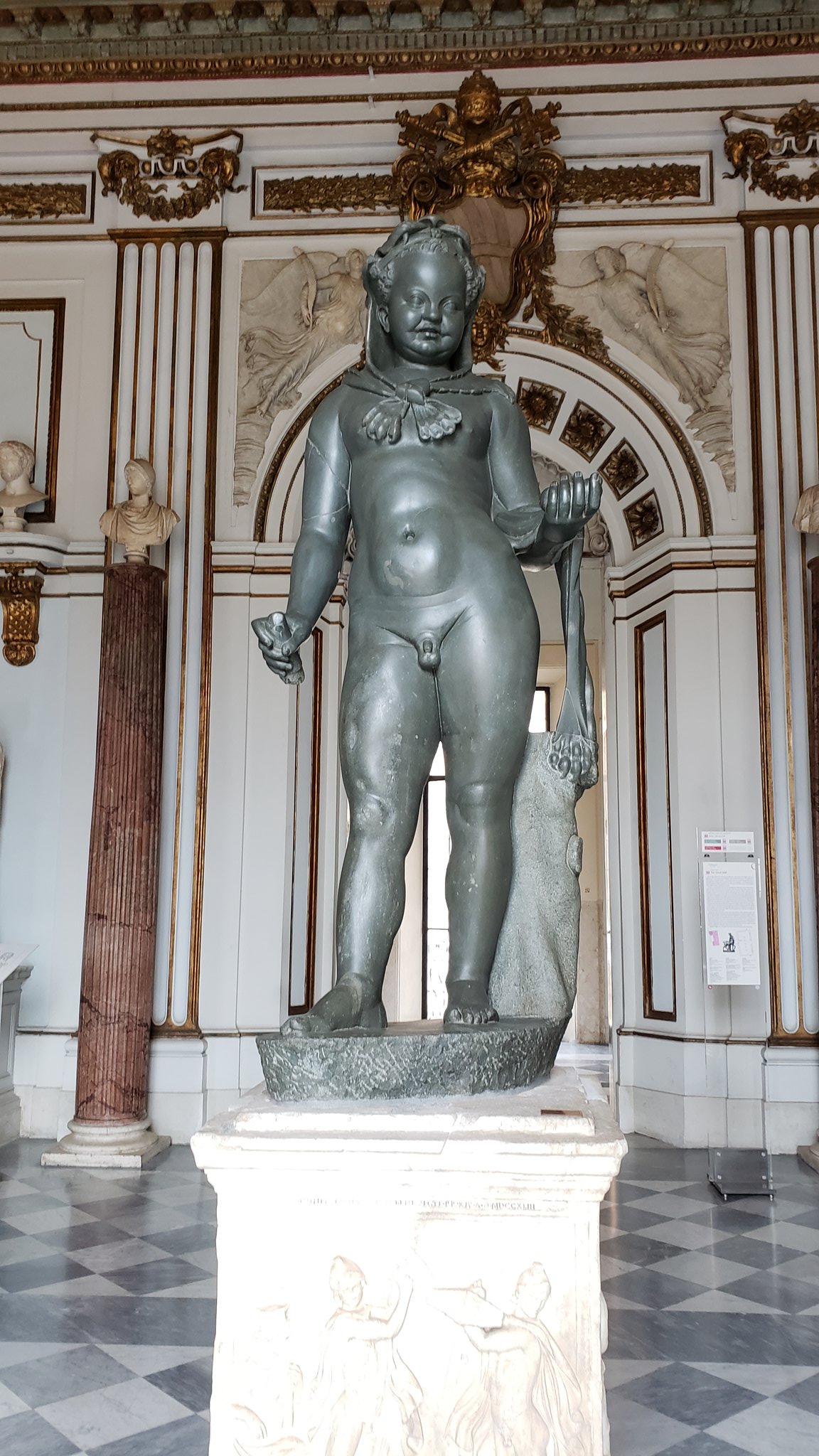
In the terms built by Decim on Avenin, an unusual basalt statue of Hercules was previously found in childhood. Although he is still a child, he is still dressed in the skin of a Nemean lion, thrown over his head, with paws tied on his chest. There was a club in his right hand (now only a fragment remained from it), and in his left he holds Hesperid apples.