
Translated material
Rev. Martyr Ignatius Dalanov
The persecution of Soviet power to the Russian Church was such that it was not to say about their faith, but even silently follow it as a feat. The new martyrs and confessors, glorified in the face of the saints did not come: believed, prayed and meekly went to their Calvarys.
“Polit.ru” recalls those who gave their lives for faith and by whose prayers the Russian Church is alive - even if almost nothing came to us besides the name.
Publications were prepared by Kirill Kharatyan (included by the Russian authorities in the register of foreign agents).
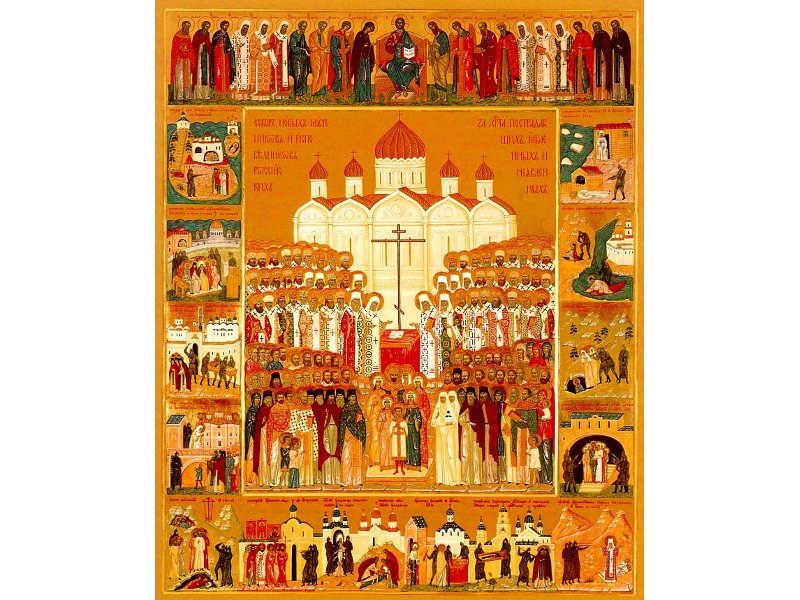
 Icon Cathedral of the Holy New Martyrs and Confessors of Russian
Ivan Dalanov is a peasant son from the village of Kozhemyakino of the Zhistovsky district of the Justinsky volost of the Vitebsk province in the family of a peasant. He received his education in a rural parish school. He served in the army.
On June 6, 1911, 26-year-old Ivan Dalanov entered Optina Deserts. On September 11 of that year, he was blessed on a cash. Carrying on obedience at the monastery dacha, then was an assistant to the cook. Since 1914, he passed obedience in the John-Baptist monastery of Optina Desert.
In July 1914, part of the brethren-osophone monks and novices-were called up to the front in connection with the war with Germany, and among them the novice John, who was sent to serve in the 5th Infantry Siberian Regiment, served in the convoy.
On the Grand Friday of the fourteenth of 1917, he was tonsured in a ryasofor. According to other sources, he returned to Optina on February 1, 1918.
After the closure of the Optina desert, he began to serve as a watchman in the Tikhvinsky church in the village of Strelna Kozelsky district of the Kaluga province (now the Sukhinichi district of the Kaluga region). He was tonsured into monasticism with the name of him the name Ignatius and ordained a deacon.
In 1929, he was ordained a hieromonk. He served in Kaluga. At the end of 1920 - early 1930, he provided material assistance to the monastic community in the city of Meshchovsk, led by IGUM. Joannikiy (Dmitriev), whom he met in the Optina Desert.
Since 1934 he served in the Spasskaya Church in the village of Kurynichi of the Peremyshlsky district of the Moscow (now Kaluga) region.
In November 1937, employees of the NKVD asked the duty witnesses - the secretary of the village council, the collective farm foreman and one of the collective farmers who gave the investigator the testimonies that the Hieromonk said that the description of the Odongists conducted only to find out how many people had died under the Soviet regime, but how many believers remained to determine whether to close or open the churches, which The Communists, preparing for the elections, begin people to put in prison for anything; They argue that the Soviet country is the most democratic in the world - the people can choose whom they want, but in fact, the opposite is true, they plan the candidates who are needed, and if you object, they will put him in prison and record a counter -revolutionary.
On November 23, 1937, the NKVD employees arrested the father of Ignatius, and on November 27 he was questioned.
- You are arrested and held accountable for counter -revolutionary activities. The investigation invites you to give testimony on this!
- There was no counter -revolutionary activity on my part.
- You give the wrong testimony. The investigation has sufficient material about your counter -revolutionary activity.
- I give the investigation sincere testimonies that no counter -revolutionary activity was conducted on my part.
- In November 1937, you conducted counter -revolutionary agitation in connection with the elections to the Supreme Council. Give testimony on this issue.
- I did not conduct counter -revolutionary agitation in connection with the elections in November or other time.
- In April 1937, you conducted counter -revolutionary agitation and slandered Soviet power. Give testimony on this issue.
- I once again declare that both counter -revolutionary agitation against the existing system was not carried out in April and at another time, I consider these testimonies of witnesses wrong.
- Where did the monk of the Saratov monastery come to you and why does it live with you?
- For counter -revolutionary activities, he served his sentence in Siberia and Orel, after which he arrived in Kaluga, and the bishop sent him to us. He did not serve in the church, but worked in the garden ...
- And who else lives in the gatehouse?
- A nun, watchman, the wife of the church elder and her sister still live in the guard.
- Have you organized a monastery there?
- Two monks, a nun and three churchmen lived in the watchdress, we did not organize the monasteries there, but gathered because there was nowhere to live.
- Denying the charges, you took the path of deception of the investigation, which has sufficient material convicting you in counter -revolutionary activity, so you are invited not to deceive the investigation.
- I do not find myself guilty of accusations, and once again declare that no counter -revolutionary activity was carried out on my part.
On November 27, the investigation was completed, the next day the investigator made an indictment, sending him to the Troika, and on December 2, 1937, the Troika of the NKVD sentenced Hieromonk Ignatius to ten years in a forced labor camp.
July 25, 1940, after being in various prisons, he ended up in the Temnikov camp in Mordovia. On August 24, 1942, Father Ignatius became seriously ill and was placed with pneumonia in the lasaret-star of the camp No. 11.
He died on September 3, 1942 and was buried in an unknown grave in a camp cemetery.