
Translated material
Empathy is like a protest
Anthropologist Alexander Arkhipov - about why you should not underestimate the spontaneous memorials after the tragedy in the Dnieper
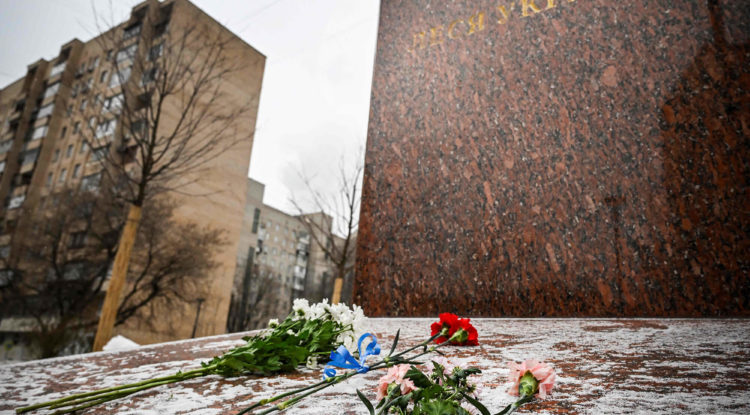
On January 14, 2023, the Russian missile fell into an apartment building in the Ukrainian Dnieper, at least 46 people died. This is not the first murder of Ukrainian residents in their homes, but it was it (unlike previous shelling) that caused a wide resonance in Russia: people in different cities created dozens of spontaneous memorials, brought flowers, candles, toys to them. According to the social anthropologist, the author of the telegram channel “Entertaining Anthropology” Alexandra Arkhipova, 85 such memorials appeared in 62 cities. Especially for the "cold", Arkhipov explains that this speaks of the protest moods of Russians.
In order not to miss the main materials of the "cold", subscribe to our Instagram and telegram .

Causes of "flower protest"
The collapsed house in the Dnieper was disassembled gradually, for several days, people were taken out of the stones-living and the dead. Journalists interviewed the miraculous survivors, social media published terrible pictures, for example, a photograph of ordinary kitchen, half collapsed. Around - ruins, and on the table are apples . Such shots provoked a media shock-this is not “something that can be quickly forgotten”, as one of my interlocutors put it. The multi -storey building in the Dnieper is part of the usual Soviet development, and the commentators on social networks wrote that “the inhabitants of the Dnieper high -rise building were the same as we”, “as it looks like my kitchen”, “I have the same baby stroller”, “the same vase for fruit”.
Anger and horror are pushing to somehow express their feelings, but their expression is hindered by censorship and a system of political repression, built in Russia in recent years. After the start of the war, laws were adopted that forbidden the Russians to express their opinion on the war under the threat of criminal or administrative punishment. Rallies and political meetings are prohibited. A large number of politically active people left Russia.
Human rights activists report almost 20 thousand detainees for an anti -war position since February 24, 2022: people tried to speak out against the war through single pickets, graffiti, leaflets, posts, comments, likes and a change of avatar. In addition, we should not forget about extrajudicial political impact: dismissal from work, threats to loved ones, public insults by government representatives.
All this led to the fact that it became impossible to speak publicly.
Where did this tradition come from and what does it mean?
In 1992, in Northern Ireland, the American social anthropologist and folklorist Jack Santino carefully watched places where, after death, “places of worship” arose due to clashes with the police. Here is a 14-year-old girl herself decided to put a note and a rose at the place of the murder of her father with an armed militant in Belfast. These memorials were not created by anyone on purpose, no one ordered this girl to do this, people did not have a leader or coordination, and even the church did not urge them to create. Those who left the flowers wanted to make their grief visible, to share their violence.
This tradition is new, existing in large cities. Over the past 30 years, folk memorials as a way to make a statement, memorial and political at the same time, have spread around the world (here you can listen to a short story about this).
Not any disaster causes a wave of folk places of memory. The conditions necessary for this: mass dissatisfaction with the way the state and government representatives react to the tragedy - disrespectful attitude to the victims, insufficient attention to what happened, the concealment of facts - this is a trigger that leads to a wave of spontaneous folk memorials.
On February 27, 2015, Boris Nemtsov was shot on a large Moskvoretsky bridge. At the site of his death, a spontaneous memorial immediately arose, which was supported by volunteers for five years: people carried flowers and notes. So they, right under the walls of the Kremlin, announced the problem: real customers of the murder of Nemtsov were still not convicted (anthropologist Dmitry Gromov conducted the study of this memorial).
But this is the Moscow tradition. She became All -Russian in 2018, after a fire in a shopping center in Kemerovo, where 60 people were killed. During the construction and operation of the building, elementary safety requirements were violated, firefighters could not get inside for a long time, and after the tragedy, the government pulled with the announcement of national mourning. The horror of this story and dissatisfaction with the actions of the authorities led to the emergence of a large number of spontaneous memorials. According to the data that we collected, spontaneous places of memory appeared in at least 246 cities.
"Flower protest" as a statement
A simple action is to bring one flower and put it to the monument - this is primarily a message. Firstly, this is a statement, memorial and individual. Through the action - when a person lights a candle or puts a toy - he says: "I get grief." Secondly, it is aimed at the public and therefore is performed near public places in the city center-this is the invitation “Goryye with me”. Finally, thirdly, this is a demonstration to the passive public, passing by that something around is so wrong that such a spontaneous memorial is becoming necessary.
One of my interlocutors in the process of research, Ksenia, brought flowers to the wall of crying in Moscow. According to her, for her it was at the same time and a way to cope with emotions (“I can do not do anything, but I can’t do anything”), and with a protest (“I am against you and your actions, I grieve with them, and I do not rejoice with you”).
Such a public expression of grief quietly but effectively turns over the ideological opposition “Our Soldiers - Heroes” against “Our Soldiers - Enemies”. The sorrow of the people participating in the creation of folk memorials indicates those who have become genuine victims of the war, and so opposes official heroics with its cult of the participants of the "Switch".
Who are these people and why are they doing this?
As in the case of Northern Ireland, described by Jack Santino, people of different ages and education participate in the Russian Flower Protest. Many of them are not political activists in the usual sense of the word: they did not go to big rallies, when it was possible, did not oppose the authorities openly. Nevertheless, this is a real grassroots protest. There is no organizer and coordination (unless opposition telegram channels exchange photographs of memorials).
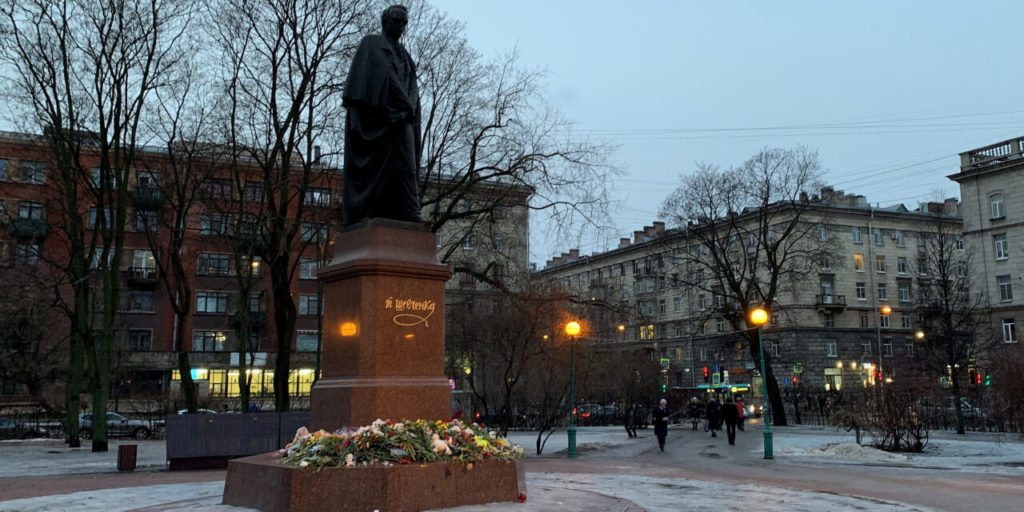
My colleague, a folklorist, watched how people came to the monument to Taras Shevchenko in St. Petersburg: young and elderly, they left flowers and toys, painted hearts, brought yellow-blue objects, baptized, prayed. In Moscow, people even kneel.
Modern propaganda does everything so that a person who does not share the aggressive ideas of the Russian authorities feel lonely, and one, as you know, is not a warrior in the field. Therefore, those who participate in the creation of memorials in memory of the Dnieper strive to see people who experience the same feelings, even if they are silently near the monument. When my colleague, Irina K., walked along the street and carried flowers, she was naked and asked if she was going to Shevchenko. And Ksenia, which I quoted above, told me: “I wanted everyone who brought flowers, or just thought about bringing, or simply experiencing similar feelings, I saw that he was not the only one, that he does, thinks, experiences not only with him.”
Aesopov Language Public memory
I know about 85 folk places of memory of the Dnieper tragedy in 62 cities (in some cities, people created several memorials: for example, in St. Petersburg - seven).
| Reference to Ukrainian culture and Ukrainian cities | 23 | 27% |
| Victims of politics | 36 | 42% |
| Victims of wars and disasters | 11 | 13% |
| Universal values | 12 | 14% |
| Religious objects | 2 | 2% |
| Dnepr signs in the park | 1 | 1% |
At first glance, it seems that all monuments are selected on the principle of “Ukrainian”. In fact, this is not so. The choice of a monument is also a message, and the most important of those that we discussed today.
Only 16 memorials were created in places related to Ukrainian culture or history (monuments and busts of Taras Shevchenko, Lesa Ukrainian, Nikolai Gogol and Bogdan Khmelnitsky). Five more memorials were created by signs and signs related to Ukrainian cities: Dnepropetrovskaya street, Kyiv street, Ukrainian boulevard. It turns out that 27% of memorials contain a public message - a sign of solidarity with Ukraine.
But even more memorials include another message. 36 memorials were created in very specific significant places - among monuments to victims of political terror of the Stalin time, another 10 memorials - among the monuments to a variety of victims: Chernobyls (there is also a reference to Ukraine), victims of war, children of war; At the place of self -immolation of journalist Irina Slavina in Nizhny Novgorod, near the stone in memory of the death of people in a fire in the Kemerovo “Winter Cherry”.
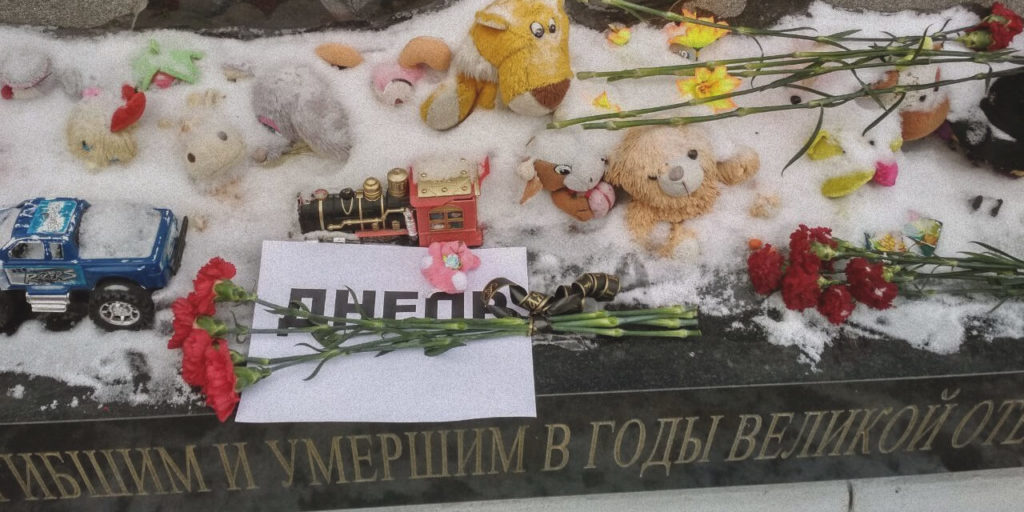
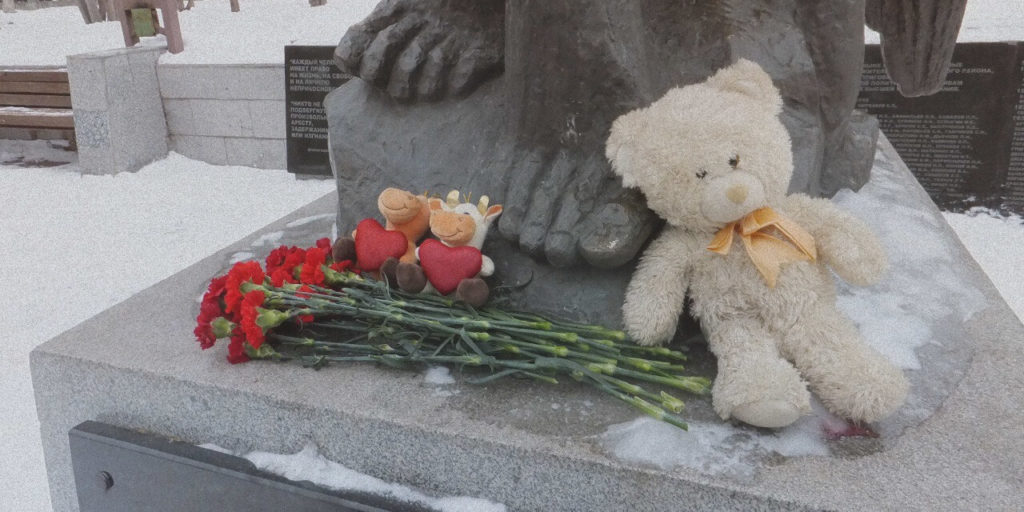
The creation of a memorial at the monuments to the victims (only 56% of cases) is a message, and it is read definitely: the state killed people earlier, kills now and will kill more. According to this logic, apparently people put small “Dnieper” signs and left flowers at the monument to the poet Osip Mandelstam in Moscow and writer Viktor Savin in Syktyvkar: they both died in the Stalinist camps, one in 1938, the other in 1943. The same message stands behind the flowers and words of love for the Dnieper in Nizhny Novgorod at the place of self-immolation of journalist Irina Slavina, who committed suicide in 2020 due to the persecution of the Investigative Committee. Memorials are created at monuments to children of war (Arkhangelsk, Voronezh, Vladimir), victims of fascism (Saratov and Mine). Here you can see an additional message: "Those who killed people in the Dnieper are also fascists."
The fact that people cannot say a poster, they speak with flowers and choosing a place of memory.
The confusion of the authorities
Promotions similar to “flower protest” are terribly inconvenient for the authorities. It is difficult to punish them, because the laying of colors is difficult to classify as discrediting the Russian army. Activists who are trying to come to the monument with posters are delayed immediately, but most just put flowers. There were also detentions for laying flowers, for example, in Tver and Moscow (and in Moscow there were already several such cases) . One of my interlocutors said that she and her friend were seriously preparing to detain, heading to lay flowers: “My friend and I went like a business. We bought flowers for cash, took water, books, passports and charging for the phone. ”
Spontaneous shares of solidarity do not have a leader who can be planted. Of course, you can destroy the memorial - and the flowers, indeed, regularly remove utilities (for example, in Perm, Moscow, St. Petersburg). However, instead of one destroyed memorial, another arises - and in another place.
Therefore, in some cities, instead of arrests, it seeks to destroy the public measurement of the memorial: for example, in Moscow, the security forces asked the Ukrainian to take photos suitable for the monument and forced them to delete.
You can also weaken the very content of the message: for example, in Togliatti and Vologda, a leaflet with the inscription "Dnieper" disappeared from the national memorial, as those who laid flowers report. It becomes incomprehensible to the random passerby why and why people carry flowers.
They acted even more creatively in Voronezh: they conducted the “interception of the agenda”. After January 14, a folk memorial appeared at the monument to “children of war”, where local residents began to bring flowers and toys, including a toy tiger woman (we know this from photographs on the network). January 25 - the day of the liberation of Voronezh from the Nazis. And on January 25 on urban television, a plot was shown with the same folk memorial (on the video - the same toy tigerok), saying that the townspeople carry flowers in honor of the anniversary of the liberation from German invaders. About the Dnieper, of course, not a word.
***
More than two weeks have passed since the impact of the missile around the residential building. And folk memorials all appear. They began to appear in memory and about other cities where people die, for example, a sign about Kharkov in a small Russian city of Balakhna.
Many, having read this column, will shuffle their shoulders and say that this is not enough. Some flowers, toys, candles. You can’t stop this war. And that is true. But so about war and grief you can at least tell , and this is in the current circumstances, when they are sent to prison for sympathy, already an act.
I thank the readers of my channel “ Entertaining Anthropology ” , which helped to collect photos of memorials from different cities.