
Translated material
Whether Chatgpt Google will kill, exposure audio fakes and Bigteh reports
The topic of release-whether the chat bots will kill search engines
This material (information) has been produced and widespread by a foreign agent The Bell or applies to the activities of a foreign agent The Bell. 18+
Hype like around Chatgpt has not seen the technological market for a long time. The OpenAi chat boot has already proclaimed the Google killer, Google himself announced the Red Code inside the company and returned to Sergey Brin’s work, and it seems that all self-respecting IT companies have declared their own competing chat bots. We understand how really the threat of search engines is really great, why the ChatGPT developers themselves did not expect special success from their brainchild and what the Russian Yandex is being prepared for the main challenge of time.
100 million in two months
On November 30, the California Laboratory of Artificial Intelligence Openai (among the founders and investors of which was Ilon Musk) launched the ChatGPT chat bout, based on the neural network language model GPT-3.5. This is an artificial intelligence of the generative type - that is, capable of creating new information on the basis of the studied data (what it is and how it works, you can read, for example, here ).
Immediately after the release, the Openai chatbot caused a real splash: in a week the service collected the first million users. By the beginning of February, the monthly audience of ChatGPT reached 100 million users. This is a growth rate for consumer Internet services in history, writers writes . For comparison: Tiktok to collect your first 100 million MAU, it took about nine months, and Instagram - 2.5 years.
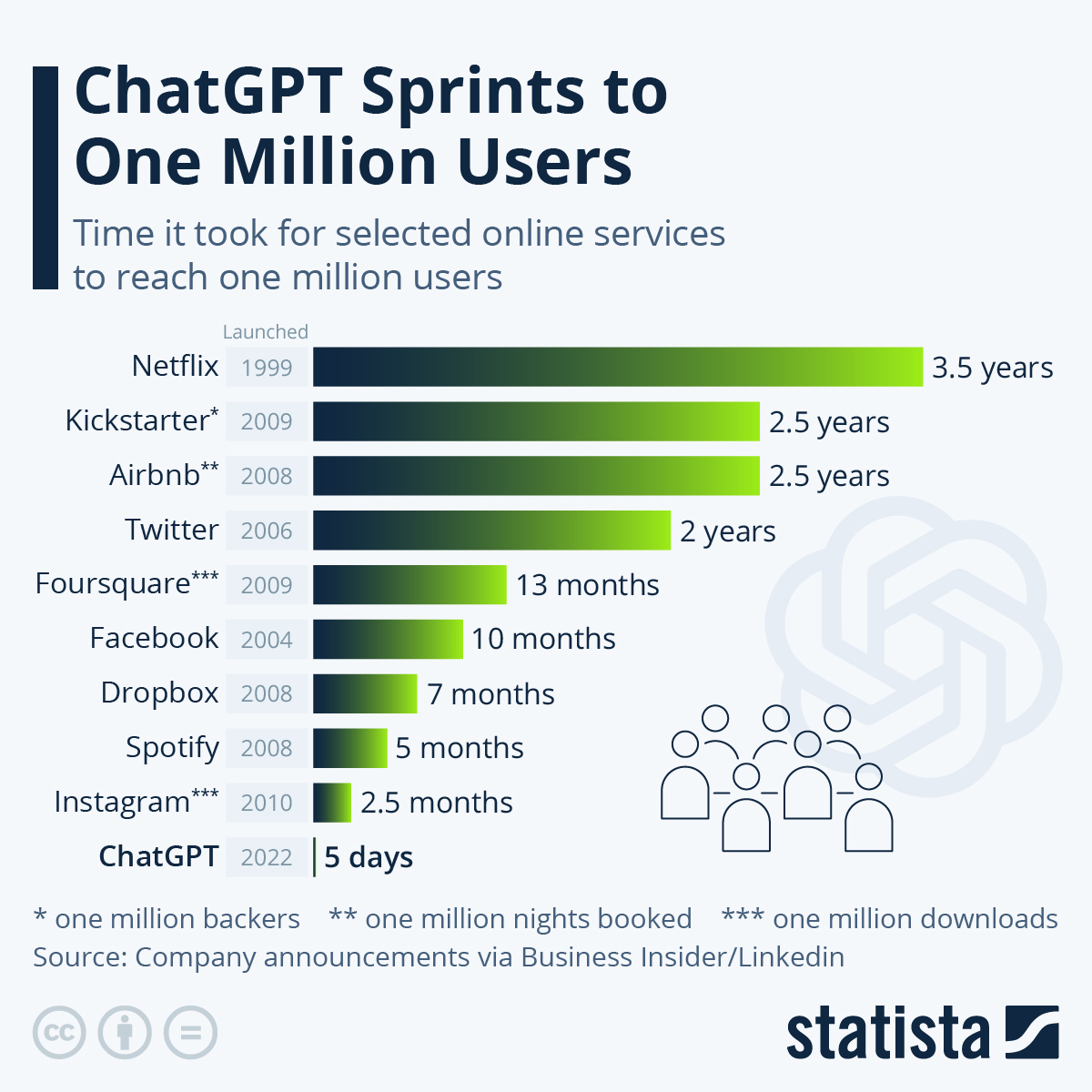
The main reason for this popularity is ease of use. Openai made a chatbot free, and in order to use it, no special knowledge or skills need. Thanks to this, users around the world immediately found many different applications for Chatgpt. We have already talked about how a few days after the release with the help of a chatbot, people without skills in programming began to write simple games and services, student abstracts that were able to successfully surrender, books , articles and even create artificial languages.
Two months later, the set of applications found for ChatGPT continues to grow. So, at the University of Minnesota, the neural network managed to pass the exams rightfully. The Chat Bot answered 95 test questions and wrote 12 essays, then his answers were “combed” and mixed with impersonal work of students. As a result, ChatGPT passed the exams, although not “excellent”. In addition, the chatbota, even without special training, practically managed to get a medical license. And in Russia, with the help of the service, they already managed to write and protect the whole diploma: it took 23 hours to finish the work, the student of the Russian State Humanitarian University, of which 8 took the editing of texts written by AI.
For 10 weeks that passed with the release, the judge in Colombia managed to consult with the Openai chat boot: he added the answers of the AI to the conclusion in the case (the insurance company against the parents of the child with autism was sued). In addition, the ability of Chatgpt to write a code was tested by hackers. With the help of a chatbot, they already make up training programs, create personal assistants for correspondence and write children's books.
From all this, it became clear that generative AIs are potentially capable of greatly influencing many different spheres and markets. But one of the hottest topics for discussions in this regard was a multi -billion dollar business search.
Battle for the search
Already in December, almost immediately after the release, ChatGPT was proclaimed a potential “Google killer”. With the help of such chat boots, the search paradigm itself may well change in the near future, experts counted. Instead of a list of resources where you can find the answer, the answer itself will appear even to the most difficult question. In one or two years, the “death of Google” was predicted by the creator of Gmail Pol Bukhait: “AI replaces the usual page of search results, on which they (Google) make the most money. Even if they catch up with AI, it will still destroy the most profitable part of their business. ”
Google himself seriously thought about such a prospect. According to The New York Times , after the Bot of competitors began to quickly gain popularity, the company declared “red code” , which means that the company has encountered a serious problem and everyone should be prepared to solve it. The leadership of the technohigant held a series of meetings, where a new development strategy was discussed. Finally, the head of Google Sundar Pichai asked to join in the discussion of the founders of Google, Sergei Brin and Larry Page. This week, Brin sent the first in a few years a request to access the Google code, writes Forbes. The co -founder of the company is studying Lamda - a colloquial neural language model that is developing with ChatGPT, which is being developed by the Techno -Gigant.
There is not so much information about Google development in the public domain. Lamda - “Revolutionary Communication Technology” - was presented in the company in the spring of 2021, but they have not yet made a public service from it. Nevertheless, Google has already opened a preliminary record for those who want to test a chatbot. The company also asked its employees to test the Apprentice Bard chat boot on the LAMDA, as well as began to test several options for the design of the search page with the ability to conduct a dialogue with AI.
Under the onslaught of a competitor, Google decided to significantly accelerate with all the releases and presentations of the results of the work of the AI unit. At a call with investors on Thursday, Pichai assured that the technohigant would show his own chatbot in the coming weeks. In addition, on February 8, the company will conduct a sudden event dedicated to how Google uses AI capabilities to make the search more “natural and intuitively understandable than ever before” (you can watch the presentation here at 16:30 Moscow time).
Another important news that signals Google's attention to the topic of AI is $ 300 million investments in the startup of immigrants from Openai Anthropic, experts say . The company is developing its own Claude chat boot, which has not yet been represented by the general public (earlier the main investor Anthropic was the FTX founder FTX Founder Sam Bankman-Frida). In this round, Anthropic will receive an estimate of $ 5 billion.
Open AI herself chose another strategic partner for the development of ChatGPT: in January, Microsoft confirmed “multi -billion dollar investments” in the project. For the first time, the technohigant invested in the AI developer back in 2019, having invested $ 1 billion at once. In January 2023, journalists found out that Microsoft was preparing to invest $ 10 billion in Openai and integrate a new, not yet released version of the GPT-4 neural network into their office programs. And soon it became known that using the GPT-4 Microsoft is going to make a new version of the Bing search engine, which will use the chatboard to respond to requests. This can happen in March.
The bulk of the passions in this race is quite clearly evidenced by the fact that Chatgpt itself appeared almost by accident. Openai was very “afraid to lose to competitors,” Nytfound out . Her own employees learned about the plans for launching the chatbot only two weeks before the release-and were confused, because the whole year the team did not work on it, but on the new generation of the GPT-4 language model, which should surpass the previous one in all indicators. This model could appear at the beginning of 2023, but the top management of Openai decided not to take risks and not wait until the competitors launch their chat bots.
ChatGPT success was a complete surprise for the team. The developers of Openai to the last feared that the bot on the language model of two years ago could seem “boring” to users. In addition, computing power was overloaded due to the influx of users and failures began. And the company's management began to be afraid that excessive attention and various abuse (like all the same generated essays and diplomas) will attract unnecessary attention of regulators.
Arms race
Be that as it may, the beginning of the "arms race" in AI is laid. Following the largest players, the plans for launching similar products began to be built by other IT companies. For example, the Chinese Baidu prepares its analogue of the chatbot for release, which can also be built into the search engine. The British “daughter” of Alphabet, DeepMind, plan to present their developments in 2023. Her chatbot will have to give answers, backed up by specific sources (which ChatGPT does not have) to minimize the number of “unsafe and inappropriate” answers.
Yandex announced its own plans to launch a similar product this week. It's about the chatbot on the Yalm 2.0 model, which is developed in the company. The first such services may appear until the end of 2023, wrote Izvestia.
The point is not just a successful competitor release. Such neural networks are developed by many companies, says Konstantin Lahman, head of the computer vision and ML Yandex ML applications. Now the world has already accumulated a large base of research on research in this direction, on which all major players rely - both Openai, and Google, and Yandex. “Both we and all other companies find interesting ideas there, which we then use at ourselves and on their basis are trying to improve the quality of our own algorithms,” he says. To say that Openai did not have and no competitors would be absurd.
“There is nothing revolutionary in this [ChatGPT], although this is how it is perceived by the public,” said the Vice-President of META (prohibited in Russia) and the leading and specialist of the company Yan Lekun this week. Other companies have such systems, they just did not gain the popularity of Chatgpt, he added.
Moreover, neural networks and machine learning technologies are used in the search for a long time. “Almost all the information that we consume on different platforms is recommended to us with algorithms,” Lahman explains. Generative text neural networks are used to form short answers, collages and cards. Therefore, all the loud headlines about the “Google killer” and the death of the search engines seem far -fetched: the neural networks will not kill the search, but make it better, the expert believes. And the search engines will not kill either, because search engines are just a tool that is already constantly changing.
The very mechanism for finding documents on the Internet is critical - generative neural networks can use the sources found as the basis for the formation of their answer. “One specific neural network will not be able to incorporate all the knowledge of the world. It is much easier to teach her to use the information found, ”Lahman explains.
ChatGPT is the evolution of earlier models, while new models have new technological and food properties, the expert says. And in this sense, the GPT-3 release of two years ago was no less surprising than the appearance of Chatgpt, Lahman says: “Just for a person before the model exceeds a certain threshold, it will seem stupid. And after - it will become smart. But in fact, the process of evolution, which the neural networks pass, is continuous, although it may seem to us that there was nothing before this breakthrough. ”
Russian companies really have achievements in this area, says the co -founder of Intento and AI specialist and data analysis Grigory Sapunov. Yandex has a rather serious Yalm, Sberbrus - Rugpt. Companies also have their supercomputers. “But due to the lack of supplies of a new modern iron to the country, the gap with leaders will increase,” the expert said. “There are never enough resources, because there will always be more ideas. We are in a situation where we need to creatively approach what iron we use. Yes, we cannot just take iron that everyone uses, and do everything on it. But we come up with something, ”says Lahman.
Not such a "killer"
It really is not worth anticipating the defeat of Google and other search engines after the ChatGPT release, according to Morgan Stanley. Although new services are threatening for Google, the company has a great advantage in the form of billions of users, writes Bank Analyst Brian Novak. According to Similarweb, at the end of 2022, the Google search share in the world was more than 90%, while the share of Bing, the potential partner of Openai, did not reach 3%. Moreover, Google itself has invested billions of dollars in artificial intelligence - only over the past three years, the company spent more than $ 100 billion on research and development, and its expenses for this direction will only grow in the coming years.
Talking about the victory of chatbots over search engines early and for another reason-so far, generative models make too many serious mistakes. Experts, who interviewed Insider, agreed that Chatgpt often does not distinguish facts from fakes, and in some cases may even come up with answers (the researchers of AI are called “hallucinations”).
Nature has already warned that the use of generative AI for research could lead to inaccuracies and plagiarism. For example, when the authors of the text asked ChatGPT the question: “How many patients with depression are experiencing relapse after treatment?”, They received too a general answer that claims that the effect of treatment is usually long -term. “Nevertheless, numerous high -quality studies show that the effect of treatment is weakening, and the risk of relapse ranges from 29% to 51% during the first year after the completion of treatment,” the researchers write. Even the head of Openai himself Sam Altman wrote that "it would be a mistake to rely on [Chatgpt] in something important right now."
Another important problem of chat bots like ChatGPT is to use them very expensive. In order to answer one question, the chatbot needs much more computing power than Google to issue an answer in the search engine. In December, Altman wrote that one chat with a bot costs several cents (Morgan Stanley rated it at 2 cents - this is about seven times more than a request in Google). At first glance, it may not seem expensive, but if you imagine that the chat boot will be used in the same volume as the search for Google, then communication with it will cost at least $ 100 million a day.
Finally, it is also very expensive to collect huge volumes of data and finish the models - expenses are calculated by hundreds of millions of dollars, even without taking into account the costs of specialized engineers, experts say (the same ChatGPT is still trained on data until mid -2021). Moreover, the more complicated the model and the more parameters in it, the more it will be more expensive.
For example, ChatGPT has 175 billion parameters now - this makes the model so universal, but at the same time extremely energy -intensive. Even taking into account the fact that the partnership with Microsoft opens up access to the Azure infrastructure for Openai, to completely replace the chat-boot search so far with an unattainable utopia.
Most likely, the future of the search is in the hybrid of the current model and chatbot, the Sapunes reason. At least in requests that do not imply one correct answer, a good chat boot would be much more useful than a simple search for pages from the Internet. So you can expect something to use chat bots in the search will be limited to some specific class classes, or the chatbot will be available by separate subscription. In addition, it is important to remember that the search is far from the only area where chat bots will have a huge impact, the expert recalls. It is also important that a large breakthrough simultaneously occurs in the generation of images (and in the future it should be waiting in the video) and in writing code. “At the junction of all this, many interesting things will happen,” he summarizes.
The good news is that the interest in Chatgpt will attract more money in AI, writes Novak from Morgan Stanley. Artificial intelligence seems to become a “new big idea” on Wall Street: the volume of trading shares of C3.Ai, Soundhound Ai, Bigbear.ai and other companies using AI and machine learning has grown sharply. For example, the manufacturer’s shares on the basis of AI and ML Bigbear.ai this week went up by 65%, and the volume of bidding exceeded the average over the past three months by 22 times, the author of our investraillers Vyacheslav Dvilov wrote (you can subscribe to it here ).
Transactions
Yandex reduces the share of uber to the joint venture
Yandex nevertheless decided to buy a 29% of the share in the joint venture of MLU BV, which is managed by Yandex.Taxi, Yango and Uber in Russia. This joint venture appeared in 2018, and at first the companies had big plans for a joint future.
But by 2021 the situation had changed, and Yandex began to increase its share, and then completely received the right to redeem Uber shares. The price was then determined in the range of $ 1.8-2 billion, the term is two years. But the 2022th made adjustments: the value of assets after the start of the war sagged greatly. The deadlines have also changed: Uber in March began to look for the opportunity to quickly get rid of the remaining Russian assets.
As a result, Uber Yandex offered $ 925 million. Exactly as much as at the end of December, the American company, according to the Agency, was proposed by the founder of Kismet Capital Group and the ex-head of MegaFon Ivan Tavrin. This price turned out to be much higher than that which was originally going to pay Yandex, the interlocutors of The Bell, familiar with the situation, said. And the Forbes source noted that Tavrin’s intervention played into Uber, who wanted to sell the asset more expensive, and Yandex eventually had to offer the price even with a “small bonus” to the Tavrin proposal. True, in order for the transaction to take place, it should still be approved by the government commission on foreign investment control. And she usually does not allow Russian companies to buy foreigners who decided to leave Russia after the outbreak of war, without a significant discount.
Online investigation
What can you learn from the audio recordings and how to save telephone conversations
Verification of audio is one of the most poorly developed areas of working with open data. Зачастую звук наложен на видео, и для его проверки используют инструменты верификации видеофайлов. Но, чтобы убедиться в том, что попавшая к вам аудиозапись — не фейк, лучше пользоваться специальными программами для анализа аудио. О них мы и расскажем в новом материале нашей регулярной рубрики «Онлайн-расследование».
🔎 Most of journalistic investigations are based on open data. По воскресеньям в рубрике «Онлайн-расследование» специальный корреспондент The Bell Ирина Панкратова рассказывает о методах расследования в сети, доступных каждому. With their help, you can check any dubious information - this is not only interesting, but also useful.
Bigtehi
Взлеты и провалы бигтехов
На прошлой неделе отчитывался Microsoft, на этой — остальные бигтехи, на которые все еще приходится значительная доля рыночной капитализации. Их акции показывают уверенный рост с начала года благодаря снижению опасений по поводу роста ставок, но отчет за прошлый квартал и — что более важно — прогнозы на будущее должны были стать серьезным испытанием. На ключевые бизнесы компаний ожидаемо негативно повлияло замедление спроса. В свежем выпуске нашей инвестрассылки рассказываем , как они отчитались и на что обратили внимание рынки в прогнозах на будущее (подписаться на рассылку можно здесь ).